
MELU-302 · Lesson 12 of 12 · 26 min
Practice exam review and test-day strategy
▶ Video coming soon A video version of this lesson is on the way.
Ten days before her exam, Jenna took her third and last full practice test on a Saturday morning at the Platte Valley office, with the door shut, her tabbed 2023 NEC, her calculator and a timer set to the bulletin's limit. She scored 84. Her first practice test, five weeks earlier, had been a 68. Roger asked what had changed. Jenna said it was not that she knew much more code. It was that she had stopped losing points she should have had: lookups that took too long, misread questions and Nebraska rules she had never studied. This lesson is about how she did that, and how she planned the day itself.
The lesson pulls together the rest of the course. It sets out a study plan, shows how to review a practice exam with a miss log, reviews the Nebraska facts most likely to be tested, and gives a routine for the week before and the day of the exam. It ends with what to do after the result, pass or fail.
A study plan
A workable plan for a working electrician runs about ten weeks at eight to ten hours a week. The first two weeks build a map of the code book: chapter layout, the index, the articles used most and the tabs. Weeks three to six cover content in the order of the exam's weight, with calculation practice every week: dwelling and commercial load calculations, conductor sizing and ampacity adjustment, voltage drop, motor circuits, transformer sizing, grounding and bonding, and box and raceway fill. Week seven covers the Nebraska material: the State Electrical Act, the retained 2017 provisions, inspection requests, apprentice rules, renewal and the business topics in this course. Weeks eight and nine are timed practice exams with full review. The last week is light review and rest.
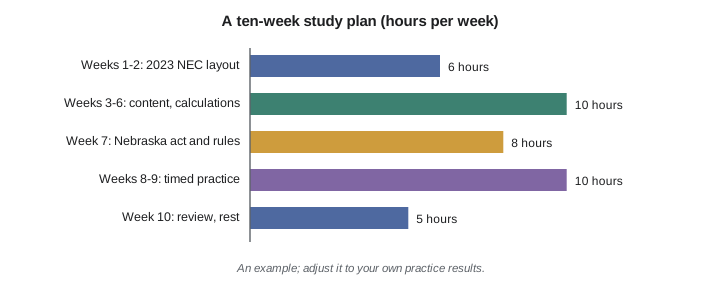
Fit the hours around work. Most working electricians study best in short sessions on weekday evenings and one longer session on the weekend for timed practice. Put the sessions on the calendar like jobs, and tell the people at home and at work what the next ten weeks look like. Jenna traded two Saturday on-call shifts to keep her practice exam mornings free.
Adjust the plan to your own results. A candidate whose first practice exam shows strong calculations and weak navigation should shift hours to lookup drills. A candidate who already knows the book well may need more time on the act. The plan exists to be changed by evidence.
Reviewing a practice exam
The score on a practice exam matters less than the review afterward. Go through every question, right and wrong, and for each miss record the content area and the cause. Lesson 4 gave four causes: you did not know the rule, you could not find it in time, you misread the question, or you made an arithmetic or unit slip. Also mark correct answers that were guesses; they are misses waiting to happen.
Then sort the log. If most misses in one area share one cause, the fix is obvious. Jenna's first log showed eleven navigation misses spread across many articles, which told her to drill the index, and six misses on the act, which told her to study it. Her second log showed only three navigation misses but four load-calculation slips, all from skipping the step of writing units. Her third log was short.
from collections import Counter

# Jenna's miss log from practice exam 1 (example)
misses = [
    ("navigation", "services"), ("navigation", "motors"), ("act", "apprentices"),
    ("content", "hazardous locations"), ("navigation", "grounding"), ("act", "renewal"),
    ("misread", "branch circuits"), ("navigation", "raceway fill"), ("act", "inspections"),
    ("arithmetic", "load calculation"), ("navigation", "feeders"), ("act", "retained 2017 sections"),
    ("navigation", "transformers"), ("act", "liens"), ("navigation", "emergency systems"),
    ("navigation", "conductors"), ("act", "insurance"), ("navigation", "boxes"),
    ("misread", "GFCI"), ("navigation", "fire alarm"), ("navigation", "overcurrent"),
]
by_cause = Counter(cause for cause, _ in misses)
for cause, n in by_cause.most_common():
    print(f"{cause:11} {n:2}  {'#' * n}")
print("Top fix:", by_cause.most_common(1)[0][0])navigation 11 ########### act 6 ###### misread 2 ## content 1 # arithmetic 1 # Top fix: navigation
The Nebraska facts most likely to be tested
The act and the business topics cannot be looked up in the NEC, so they are worth memorizing. The table collects the numbers and rules from this course that make natural exam questions. Confirm each against the current act and rules before your exam, since the legislature and the board can change them.
| Topic | Rule (summary) | Lesson |
|---|---|---|
| Contractor eligibility | One year as a licensed journeyman, or a four-year electrical engineering degree with acceptable experience | 2 |
| Journeyman experience | Four years; three for residential journeyman | 2 |
| Passing score | 75 | 4 |
| Code edition | 2023 NEC from August 1, 2024; 2017 edition for five dwelling sections | 5 |
| Inspection request | At or before start of work; 50-cent supervisory fee; 250-dollar late fee | 6 |
| Correction order | Final inspection 10 to 17 calendar days later; appeal within 10 days | 6 |
| Apprentices | Same project location; no more than three per licensee | 7 |
| Liability insurance | 100,000 / 300,000 dollars bodily injury; 100,000 dollars property damage | 8 |
| Liens | Record within 120 days of final furnishing; copy to owner within 10 days; two years | 9 |
| OSHA reports | Fatality 8 hours; hospitalization, amputation or eye loss 24 hours | 10 |
| Renewal | Expires December 31 of even years; renew October 1 to November 30 | 11 |
| Continuing education | 12 contact hours, at least 6 on the NEC | 11 |
The week before
In the last week, stop learning new material and sharpen what you have. Do short timed sets of twenty questions, not full exams. Review the miss logs and the Nebraska facts table. Check the book against the bulletin's marking rules one more time and remove anything that breaks them. Confirm the test center address, the appointment time and the ID. Get the calculator's batteries replaced. Sleep normally; a tired candidate reads questions badly.
Jenna also did one thing she called the dress rehearsal. Three days before the exam she drove to the test center at the same time of day as her appointment, found parking, timed the trip and went home. On the day itself nothing about the trip was new.
Test day
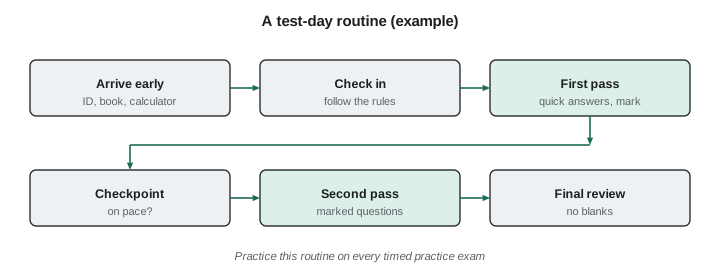
Eat a normal meal, arrive early and bring only what is allowed. At check-in, follow the staff's instructions exactly; they handle many candidates and the rules exist to keep the exam fair. Once seated, take a minute to read the on-screen instructions and check that the calculator works.
Then work the plan. On the first pass, answer what you can quickly and mark the rest. Check the clock at each checkpoint. On the second pass, take the marked questions, the longest lookups and calculations last. In the final block, make sure no question is blank. If you feel stuck or anxious, close your eyes for ten seconds, breathe, and move to the next question. One hard question is worth exactly as much as one easy one.
Practice questions with reasoning
The examples below are written in the style of exam questions on the Nebraska material. Work each one before reading the steps.
Worked problem
Apprentices on a farm job
A contractor sends one journeyman and four registered apprentices to wire a new machine shed on a farm. The farmer, who owns the property, is not doing any of the work. Is the crew legal?
Show solution
- The farm exemption covers work by the owner, not by a contractor's crew.
- The apprentices must be supervised by a licensee at the same location.
- One licensee may supervise no more than three apprentices.
- Four apprentices with one journeyman exceeds the ratio.
Answer: No; add a second licensee or reduce the apprentices to three.
Worked problem
The basement on a state job
A question asks which edition governs ground-fault protection for an unfinished basement in a new house under state inspection.
Show solution
- State inspection means the state standard applies.
- Basement GFCI in dwellings is section 210.8(A)(5).
- The act applies the 2017 edition to that section.
Answer: The 2017 NEC governs that requirement.
Worked problem
The lien deadline
An electrical subcontractor last worked on a commercial building on March 3, 2027. By what date must it record a lien?
Show solution
- The deadline is 120 days after final furnishing.
- March has 28 days left after March 3, April 30, May 31 and June 30, which is 119 days through June 30.
- The 120th day is July 1, 2027.
Answer: July 1, 2027.
Worked problem
The school in the city
A question describes a new public high school inside Omaha and asks who inspects the electrical work.
Show solution
- Omaha runs its own inspection program for most work in the city.
- Public educational facilities remain under state jurisdiction wherever they are.
- So the state, not the city, inspects the school.
Answer: The State Electrical Division's inspectors.
Worked problem
The lapsed policy
A question says a contractor's liability policy lapsed for three weeks with no claims, and asks whether the board may act.
Show solution
- Section 81-2104 lists failing to keep the required insurance as a ground for discipline.
- No claim is needed; the lapse itself is the violation.
- The board may revoke, suspend or refuse to renew the license.
Answer: Yes; the board may discipline the license for the lapse.
When no answer looks right
Now and then a question seems to have no correct option, or two. Before choosing, reread the question for the deciding words: the occupancy, minimum or maximum, required or permitted, Nebraska or the book. Then reread the options; one often matches the exact wording of the code or the act while another is close but not quite. If you still cannot decide, eliminate the options you know are wrong, choose the best remaining one, mark the question and move on. Come back on the second pass with fresh eyes. Never let one question cost you the time for three others.
Managing nerves
Most candidates feel nervous, and a little nerves helps concentration. Too much makes people reread questions without taking them in. The best cure is preparation that makes the exam feel familiar: timed practice in similar conditions, a known routine and a plan for the hard questions. On the day, if your mind starts racing, put the pencil down, breathe slowly for a few seconds and read the next question aloud in your head. Jenna said the dress rehearsal did more for her nerves than any amount of extra study.
After the result
If you pass, complete the license step with the division right away: the license fee and, for a contractor who will operate a firm, the insurance certificate. Then tell the people who need to know: the employer, the insurer, any city that registers the company and the customers who ask for the license number. Start the continuing education plan from lesson 11.
If you do not pass, take the score report home and read it the next day, not that afternoon. Compare it with your miss logs. Reapply as the board's rule requires, and plan a shorter, targeted study period on the weakest areas, with at least two timed practice exams before the retake. A second attempt built on evidence is usually much stronger than the first.
Jenna passed with an 82. Marisol had the license fee and the insurance certificate ready the same afternoon, and six weeks later the division's lookup showed Jenna Kowalski as an electrical contractor, licensed through December 31, 2028. Roger stayed on as licensee for the jobs already under way, and from that week every new Platte Valley inspection request carried Jenna's license number.
Common mistakes
MistakeTaking practice exams without reviewing them.
InsteadThe review and miss log are where the score improves.
MistakeStudying only the code because the exam is open book.
InsteadThe act and business topics must be learned; the book will not answer them.
MistakeLearning new material in the last week.
InsteadUse the last week for short timed sets, review and rest.
MistakeLeaving questions blank at the end.
InsteadA reasoned guess can earn credit; a blank cannot.
Summary and key terms
- Plan about ten weeks: code layout, content and calculations, Nebraska law, timed practice, then rest.
- Review every practice exam with a miss log sorted by area and cause.
- Memorize the Nebraska facts that the code book cannot answer.
- Rehearse the trip, follow the center's rules and work a three-pass plan with checkpoints.
- After a pass, complete the license step and start the continuing education plan; after a fail, study the weak areas and reapply.
- Miss log
- A record of each practice miss with its content area and cause.
- Timed set
- A short group of practice questions taken under time pressure.
- Score report
- PSI's report of a failed candidate's performance by content area.
- Dress rehearsal
- A trial run of the trip to the test center at the appointment time.
- License step
- The fee and documents submitted to the division after a passing score.
Practice problems
Work each problem on paper first, then reveal the answer to check.
What should a candidate record for each practice miss?
Show answer
The content area and the cause: rule not known, not found in time, misread, or arithmetic or unit slip.
What is the passing score on the Nebraska contractor exam?
Show answer
75, under the board's exam rule.
What should a candidate do in the final week before the exam?
Show answer
Short timed sets, review of miss logs and Nebraska facts, a check of the book against the bulletin, and rest.
Lesson quiz · 5 questions
Score 60% or more to complete this lesson.
Create a free account to save your progress, take quizzes and earn a certificate.