
MELU-302 · Lesson 8 of 12 · 19 min
Contractor licensing, insurance and bonding
▶ Video coming soon A video version of this lesson is on the way.
Two months before her exam, Jenna sat in on Platte Valley's annual meeting with its insurance agent, Carla Jensen. Carla went through the policies one by one: general liability, commercial auto, workers' compensation, an umbrella, a tool floater. Then she asked a question Jenna had not expected. When you become the licensee, Carla said, does the company's liability policy still name the right person to satisfy the board? Roger admitted he had not thought about it. Carla had. In Nebraska, she said, the electrical insurance requirement is tied to the license holder who runs the firm.
This lesson covers what a Nebraska electrical contracting business needs beyond the license itself: the liability insurance the board requires, how it attaches to the licensee, other registrations a contractor may need, workers' compensation, bonds for public and private work, and the city registrations that sit alongside the state license. It also covers what happens to the business when the licensee changes.
The license and the business
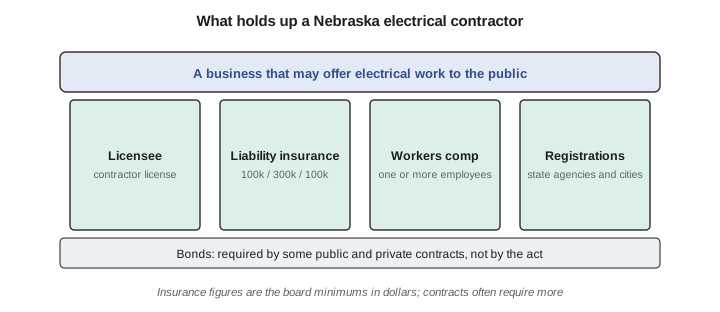
In Nebraska the electrical contractor license is issued to an individual. The act does not create a separate company license the way some states do. A business offers electrical work to the public through a licensee: a sole owner who holds the license, or a company that employs a licensed contractor who plans, lays out and supervises its work. Platte Valley is a corporation, and its right to sell electrical work depends on having a licensed contractor in charge of that work.
This makes the identity of the licensee central to the business. Customers and general contractors ask for the license number. Inspection requests carry it. Cities that register contractors, such as Lincoln, ask for it. And the board's insurance rule looks to the licensee who runs the firm.
Liability insurance
Section 81-2104 lets the board discipline a licensee who fails to keep the public liability insurance the board requires. The board's rule applies to holders of electrical contractor licenses, and of the older Class A and Class B contractor and Class A master licenses, who actively operate a contracting firm. In 2026 the rule's minimums are 100,000 dollars for bodily injury to one person, 300,000 dollars for bodily injury in one accident and 100,000 dollars for property damage. When a firm has more than one qualifying licensee, only one needs to carry the coverage.
These are minimums for the license, not a recommendation for the business. Most general contractors and public owners require much higher limits in their contracts, often one million dollars per occurrence or more with an umbrella above it. Carla's advice was blunt: the board's numbers keep your license; the contract numbers keep your customers.
| Coverage | Board minimum (rule 7, 2026) | What contracts often ask for (typical) |
|---|---|---|
| Bodily injury, per person | 100,000 dollars | Part of a 1 million dollar per occurrence limit |
| Bodily injury, per accident | 300,000 dollars | Part of a 1 million dollar per occurrence limit |
| Property damage | 100,000 dollars | Part of the same occurrence limit |
| Umbrella or excess | Not required by the rule | 1 to 5 million dollars on larger jobs |
| Additional insured status | Not required by the rule | Often required for the owner and general contractor |
Making the policy match the license
Carla's question about naming was practical. The certificate of insurance the division or a city sees should show coverage that applies to the work done under the licensee's license. If Jenna becomes the licensee for Platte Valley, the company's policy already covers its operations, but the agent should confirm that the certificate and any filing with the division reflect the new licensee and that the policy does not exclude any kind of work the company does, such as work on grain-handling structures or at heights.
Ask the agent to send the division and each city the updated certificate on the day the change takes effect, and to set the policy to notify those holders if it is canceled. A licensee who learns of a lapse from an inspector is already in trouble.
Workers' compensation
Nebraska's Workers' Compensation Act applies to employers with one or more employees in their regular business, including nonresident employers working in Nebraska. An electrical contractor with any employees must carry a workers' compensation policy or be approved to self-insure. The Nebraska Workers' Compensation Court publishes a free online lookup that shows whether an employer has coverage on a given date. Lesson 10 covers the injury side and the liability a contractor takes on when it uses uninsured subcontractors.
Insurers notify the court when they write a policy, so the contractor does not file proof itself. The contractor should still keep the policy and a current certificate on file, because general contractors ask for it before allowing a subcontractor on site.
Other registrations
Beyond the electrical license, a Nebraska contracting business may need several other registrations, and the details depend on the business and the work. A corporation or limited liability company registers with the Nebraska Secretary of State. Nebraska also has a contractor registration program run by the Nebraska Department of Labor for contractors and subcontractors doing business in the state, and the Department of Revenue has special sales and use tax rules for contractors, with options that decide whether the contractor or the owner pays tax on materials. Check each agency's current requirements when you start a business or change its structure.
Cities add their own layer. Lincoln requires electrical contractors to register with the city, with a certificate of insurance, before it will issue electrical permits in the city or within three miles of it, and renews that registration every two years. Omaha and other cities have their own permit and contractor processes. These local registrations are separate from the state license and do not replace it.
# Compliance calendar for a small contractor (example dates)
items = [
    ("State licenses and apprentice registrations", "2026-12-31", "even-year renewal"),
    ("Liability insurance policy", "2027-03-01", "annual policy renewal"),
    ("Workers' compensation policy", "2027-03-01", "annual policy renewal"),
    ("City of Lincoln registration", "2026-12-31", "two-year city cycle"),
    ("Commercial auto policy", "2027-06-15", "annual policy renewal"),
]
for name, due, note in sorted(items, key=lambda x: x[1]):
print(f"{due} {name:44} {note}")2026-12-31 State licenses and apprentice registrations even-year renewal 2026-12-31 City of Lincoln registration two-year city cycle 2027-03-01 Liability insurance policy annual policy renewal 2027-03-01 Workers' compensation policy annual policy renewal 2027-06-15 Commercial auto policy annual policy renewal
Bonds
The State Electrical Act does not require an electrical contractor to post a license bond. Bonds still appear in Nebraska contracting in other ways. Public owners commonly require performance and payment bonds on public construction, and Nebraska law gives subcontractors and suppliers on public projects rights against the payment bond in place of a lien, since public property cannot be liened. Lesson 9 says more. Private owners and general contractors sometimes require bonds on large jobs. Some cities may require a bond as part of their own registration or right-of-way permits.
A bond is not insurance for the contractor. If the surety pays a claim on a performance or payment bond, it will look to the contractor to repay it. Sureties therefore look closely at the contractor's finances, experience and backlog before writing bonds, and a contractor who wants to bid bonded public work should build a relationship with a surety agent well before the first bid.
Sureties usually ask for financial statements, a list of work in progress, references and personal indemnity from the owners. A small contractor starting out may get bonding only for modest jobs at first, with the limit growing as the company shows it can finish work and pay its bills. Keeping clean books, paying suppliers on time and avoiding claims are the habits that build bonding capacity.
Reading the insurance section of a contract
Every subcontract Platte Valley signs has an insurance section, and Jenna learned to read it before reading the scope. The section lists the limits required, the policies that must name the owner and general contractor as additional insureds, whether coverage must be primary and noncontributory, whether the insurer must waive subrogation, and how long completed-operations coverage must continue after the job. Each of those terms can change the premium or require an endorsement the company does not have.
The practical rule is to send the insurance section to the agent before signing. Carla would rather spend ten minutes on a contract before it is signed than an afternoon after a claim explaining why an endorsement was missing. Where a term cannot be met, negotiate it before signing; a contractor who signs a contract it cannot insure has taken on the risk itself.
Subcontractors and certificates
When Platte Valley hires its own subcontractors, such as a directional boring company or a fire alarm firm, it asks for the same proof it gives its own customers: a current certificate of liability insurance, proof of workers' compensation and, for electrical work, the license or registration that covers the work. The act lets directional boring contractors install underground conduit on the load side of the meter only under the direct supervision of a qualified licensee employed by an electrical contractor, so the supervising licensee must be identified for that work too.
Collecting certificates is not paperwork for its own sake. Lesson 10 explains how a contractor can become responsible for the workers' compensation of an uninsured subcontractor's employees, and an uninsured sub's liability claims can end up on the contractor's own policy. Marisol checks each certificate's dates and limits when it arrives and sets a reminder before it expires.
When the licensee changes
A business that changes licensees should treat the change as a project with a checklist. The new licensee's license must be issued and current. The insurance certificate must reflect the change and reach the division and each city that registers the company. City registrations must be updated. Inspection requests in progress should be reviewed so it is clear who will answer for them. The website, proposals, vehicle lettering and contracts that show a license number should be updated. And the old licensee should not walk away from open jobs until they are closed or formally handed over.
Roger and Jenna's plan followed that list. Roger would remain the licensee on jobs already under way, Jenna would be the licensee on jobs filed after her license issued, and the two would review the open list together each Monday until Roger's last job closed.
Worked problem
Is the insurance enough?
Platte Valley's liability policy has limits of 1 million dollars per occurrence and 2 million dollars aggregate. Does it meet the board's minimums?
Show solution
- The board's rule requires at least 100,000 dollars per person and 300,000 dollars per accident for bodily injury.
- It also requires at least 100,000 dollars for property damage.
- A combined single limit of 1 million dollars per occurrence exceeds each of those minimums.
- The licensee should confirm with the agent that the policy covers all the company's operations.
Answer: Yes; the policy exceeds the board's minimums.
Common mistakes
MistakeThinking the board's minimum limits are enough for commercial contracts.
InsteadContracts usually require much higher limits; read the insurance section of every contract.
MistakeAssuming the act requires an electrical license bond.
InsteadThe act does not; bonds come from public contracts, private contracts or local rules.
MistakeTreating a city registration as a license.
InsteadCity registrations sit alongside the state license and do not replace it.
MistakeWaiting for an inspector to mention a lapsed policy.
InsteadKeep renewal dates on a calendar and have the agent notify certificate holders.
Summary and key terms
- The Nebraska electrical contractor license is issued to an individual, through whom a business offers electrical work.
- Rule 7 requires a licensee operating a firm to carry at least 100,000 / 300,000 dollars of bodily injury and 100,000 dollars of property damage coverage.
- Employers with one or more employees must carry workers' compensation.
- Secretary of State, Department of Labor, Department of Revenue and city registrations may also apply.
- The act requires no license bond; bonds arise from public and private contracts and local rules.
- Certificate of insurance
- A document from the insurer or agent showing the coverage in force, sent to the division, cities and customers.
- Combined single limit
- A single liability limit per occurrence covering bodily injury and property damage together.
- Performance bond
- A surety's promise that the contractor will complete the work as contracted.
- Payment bond
- A surety's promise that the contractor will pay its subcontractors and suppliers.
- Rule 7
- The board's rule setting minimum public liability insurance for licensees who operate a contracting firm.
Practice problems
Work each problem on paper first, then reveal the answer to check.
What are the board's minimum liability limits for a licensee operating a firm?
Show answer
100,000 dollars per person and 300,000 dollars per accident for bodily injury, and 100,000 dollars for property damage.
If a firm has two licensed contractors, must both carry the insurance?
Show answer
No. Under the rule only one of the qualifying licensees needs to carry it.
Does the State Electrical Act require an electrical contractor license bond?
Show answer
No. Bonds come from contracts, public works law or local rules.
What should a contractor do with a subcontract's insurance section before signing?
Show answer
Send it to the insurance agent to confirm the limits and endorsements can be met.
Lesson quiz · 5 questions
Score 60% or more to complete this lesson.
Create a free account to save your progress, take quizzes and earn a certificate.