
MELU-302 · Lesson 10 of 12 · 19 min
Workplace safety law and OSHA for electrical contractors
▶ Video coming soon A video version of this lesson is on the way.
In August, Eli Brandt, a second-year apprentice, stepped off the top of a stepladder while pulling wire in the office of a grain elevator near Willow Bend. He caught himself on a shelf, but the fall broke his wrist. Tyler, the journeyman on site, drove him to the hospital in Kearney, and Marisol called the insurer that afternoon. A week later Roger sat down with Jenna and went through everything that had happened, from the ladder to the claim forms. When you are the licensee, he said, you will make these calls. Know who to call before you need to.
This lesson covers the safety and injury rules that apply to a Nebraska electrical contractor: who enforces workplace safety in Nebraska, the federal OSHA standards that matter most for electrical work, NFPA 70E, injury reporting, Nebraska workers' compensation and the contractor's liability when a subcontractor is uninsured. It connects those rules to the licensee's duties from lesson 7.
Who enforces workplace safety in Nebraska
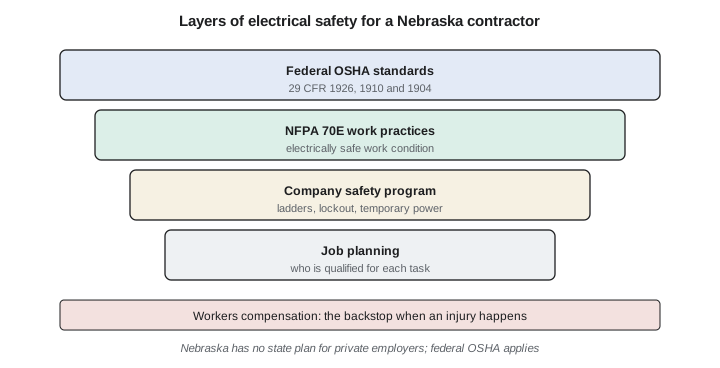
Some states run their own OSHA-approved state plans. Nebraska does not run a plan for private employers, so private-sector job sites in Nebraska are under federal OSHA, which has an area office in Omaha. Federal OSHA inspects, issues citations and penalties, and investigates fatalities and serious injuries. The State Electrical Division does not enforce OSHA standards, although an inspector who sees an obvious hazard on site will say so, and the act's rules on apprentice supervision and safe energizing overlap with good safety practice.
For a contractor the practical point is that the federal standards and federal reporting rules apply directly. There is no separate Nebraska OSHA manual to learn. Public employers such as cities and school districts are treated differently under federal law, but a contractor working on a public job is still a private employer and remains under federal OSHA.
The standards that matter most
Construction work, including new installation and most remodeling, falls under part 1926. Its electrical subpart covers installation safety, ground-fault protection for temporary power on construction sites and safety-related work practices. Its other subparts cover hazards electricians meet every day: ladders, scaffolds, fall protection, trenching for underground conduit, aerial lifts and hand tools. Maintenance and repair of existing systems in an operating facility may fall under part 1910 instead, including the general industry electrical rules and the lockout and tagout standard for controlling hazardous energy.
Both parts require employers to train workers for the hazards they face, keep equipment in safe condition and protect workers from contact with energized parts. Neither sets out every detail of how to work near energized equipment; for that, contractors and OSHA alike look to NFPA 70E.
| Source | What it covers (summary) | Who enforces it |
|---|---|---|
| 29 CFR 1926 (construction) | Electrical safety on construction sites, ladders, falls, trenching, lifts | Federal OSHA |
| 29 CFR 1910 (general industry) | Work in operating facilities, including lockout and tagout | Federal OSHA |
| 29 CFR 1904 (recordkeeping) | Injury logs and reporting of serious injuries | Federal OSHA |
| NFPA 70E | Electrical safety work practices, arc flash and shock risk assessment | Consensus standard used by OSHA and employers |
| Neb. Rev. Stat. chapter 48 | Workers' compensation coverage and benefits | Nebraska Workers' Compensation Court |
NFPA 70E and the energized work rule
NFPA 70E, the Standard for Electrical Safety in the Workplace, sets the work practices that keep workers from being shocked or burned. Its central rule is to put equipment in an electrically safe work condition before working on it: identify the sources, open the disconnects, lock and tag them, test for absence of voltage with a properly rated tester, and ground where needed. Work on energized equipment is justified only in limited situations, such as when de-energizing creates a greater hazard or is infeasible, and then requires a risk assessment, an energized work permit in most cases, and the right protective equipment.
Most electrical injuries happen during routine tasks: testing in a panel, replacing a breaker in a live panelboard, or working on a circuit that someone thought was off. Platte Valley's policy is that the person who opens a panel tests it, every time, with a tester checked on a known live source before and after.
Ladders, falls and the ordinary hazards
Eli's injury was not electrical, and that is typical. Falls from ladders and lifts are among the most common serious injuries in the electrical trade. OSHA's ladder rules cover selecting the right ladder, setting it up, keeping three points of contact and not standing on the top step or top cap. Fall protection rules apply when working at heights on roofs, open edges and lifts. A contractor's safety program should give these hazards as much attention as shock and arc flash.
After the incident, Roger and Jenna reviewed what happened. The stepladder was too short for the ceiling height, so Eli had stood on the top. The fix was not a new rule but enforcement of the existing one, and a taller ladder added to the truck inventory.
Reporting serious injuries
Federal OSHA requires an employer to report a work-related fatality within 8 hours, and an in-patient hospitalization, amputation or loss of an eye within 24 hours. Eli was treated and released, so no OSHA report was required, although the injury had to be recorded on the company's injury log if the company is required to keep one. Employers with more than ten employees in most industries, including construction, keep the OSHA injury and illness log and post the annual summary.
# Which OSHA report is due, and how soon (study aid)
rules = [
    ("fatality", 8),
    ("in-patient hospitalization", 24),
    ("amputation", 24),
    ("loss of an eye", 24),
]
for event, hours in rules:
    print(f"{event:28} report to OSHA within {hours} hours")
print("Treated and released: record on the log if required; no OSHA phone report")fatality report to OSHA within 8 hours in-patient hospitalization report to OSHA within 24 hours amputation report to OSHA within 24 hours loss of an eye report to OSHA within 24 hours Treated and released: record on the log if required; no OSHA phone report
Workers' compensation in Nebraska
The Nebraska Workers' Compensation Act applies to employers with one or more employees in their regular trade or business, including nonresident employers working in Nebraska for any length of time. An electrical contractor with employees must insure through a licensed insurer or be approved to self-insure. The Workers' Compensation Court's guidance lists the consequences of failing to insure: a civil fine of up to 1,000 dollars per violation, with each day counted as a separate violation; possible criminal charges; an injunction stopping the employer from doing business in Nebraska until it complies; and the right of injured employees to sue the employer in district court without the employer's usual defenses.
For an insured employer the process after an injury is straightforward. Get the worker care, notify the insurer promptly, and complete the employer's first report of injury through the insurer or as the court's rules require. The insurer handles medical bills and wage-loss benefits under the act. Keep a copy of every form and note in the job file what happened and what was changed afterward.
Uninsured subcontractors
Section 48-116 treats a person who uses a scheme or device to avoid workers' compensation responsibility as an employer, jointly liable with the immediate employer. The section does not apply to an owner or contractor who hires a contractor or subcontractor in good faith and requires it to carry workers' compensation insurance from a licensed insurer. Nebraska cases have held that a contractor who uses an uninsured subcontractor without requiring insurance can be liable for the subcontractor's injured workers.
That is why Platte Valley requires a current certificate of workers' compensation insurance from every subcontractor before it starts, checks the court's online coverage lookup for any sub it has not used before and keeps the certificates on file with the subcontract.
Temporary power on the job
Electrical contractors often provide the temporary power that every other trade on a construction site uses, which makes the contractor responsible for a hazard that affects the whole site. Part 1926 requires ground-fault protection for receptacles used by workers on construction sites, either through GFCI protection or, where the employer qualifies, an assured equipment grounding conductor program with regular testing and records. Cords must be rated for hard use, protected from damage and inspected before each shift.
Platte Valley's temporary power checklist covers the panel location and protection, GFCI testing at setup and weekly afterward, cord routing away from traffic and water, and a sign on each temporary panel with the company's phone number. On a busy commercial site, the company assigns one journeyman to walk the temporary system every morning.
Training and qualified persons
OSHA and NFPA 70E both rely on the idea of a qualified person: someone trained to recognize and avoid the electrical hazards of the specific equipment and tasks involved. An apprentice can be qualified for some tasks and not others. The employer decides who is qualified for what, documents the training and keeps unqualified workers out of the hazard area. This fits with the act's apprentice supervision rule from lesson 7: the supervising licensee on site is also the person best placed to decide whether an apprentice is ready to work on a given piece of equipment.
Training should be repeated when the work changes, when the standards change and when an incident or near miss shows a gap. Keep records of who was trained, on what and when. In an OSHA inspection after an accident, those records are among the first documents requested.
Getting the worker back
A good return-to-work plan helps both the worker and the company. Eli could not pull wire with a cast, but he could update the company's panel schedules, help Marisol organize the job files and attend classes. Light duty within the doctor's restrictions kept him connected to the crew, reduced the wage-loss part of the claim and brought him back to full duty sooner. Talk with the insurer about light duty early in any claim.
A safety program that fits the company
A written safety program does not need to be long, but it must be real. Platte Valley's covers energized work and lockout, ladders and fall protection, trenching, temporary power, vehicle use, first aid and reporting, and it names who is responsible for each. New hires go through it before their first day on a job. Crews hold a short safety talk each week, and the licensee reviews every incident and near miss.
Jenna added one thing after Eli's fall: a short review form for every incident, asking what happened, why, and what will change. The form is not about blame. It turns each event into a lesson for the whole crew, and over time it shows whether the same hazard keeps appearing.
Worked problem
After Eli's fall
Eli broke his wrist in a fall at work, was treated at the hospital and released the same day. What must Platte Valley do?
Show solution
- Make sure Eli received care, which Tyler did.
- Notify the workers' compensation insurer promptly and complete the first report of injury as required.
- No OSHA phone report is required, because there was no fatality, in-patient hospitalization, amputation or eye loss.
- Record the injury on the OSHA log if the company is required to keep one, and review the cause.
Answer: Notify the insurer and file the injury report, record the case if required, and fix the cause; no OSHA phone report is due.
Common mistakes
MistakeAssuming Nebraska has its own OSHA plan for private employers.
InsteadPrivate employers in Nebraska are under federal OSHA.
MistakeWorking a panel live because it is faster.
InsteadNFPA 70E requires an electrically safe work condition unless energized work is justified.
MistakeHiring a subcontractor without checking its workers' compensation.
InsteadUnder section 48-116 a contractor can become liable for an uninsured sub's workers.
MistakeThinking every hospital visit needs an OSHA report.
InsteadOnly fatalities, in-patient hospitalizations, amputations and eye losses must be reported.
Summary and key terms
- Private job sites in Nebraska are under federal OSHA; parts 1926, 1910 and 1904 apply directly.
- NFPA 70E sets the work practices for shock and arc flash; de-energize and test before work.
- Report fatalities to OSHA within 8 hours and in-patient hospitalizations, amputations or eye losses within 24 hours.
- Employers with one or more employees must carry Nebraska workers' compensation.
- Require subcontractors to carry workers' compensation, or risk liability under section 48-116.
- Federal OSHA
- The federal agency that enforces workplace safety for private employers in Nebraska.
- Electrically safe work condition
- A state in which equipment has been disconnected, locked out, tested and grounded as needed before work.
- NFPA 70E
- The consensus standard for electrical safety work practices.
- Workers' Compensation Court
- The Nebraska court that administers workers' compensation and publishes coverage information.
- Section 48-116
- The Nebraska statute that can make a contractor liable for an uninsured subcontractor's employees.
Practice problems
Work each problem on paper first, then reveal the answer to check.
Who enforces workplace safety on a private construction site in Nebraska?
Show answer
Federal OSHA.
Within how many hours must a work-related fatality be reported to OSHA?
Show answer
8 hours.
What must a contractor provide for workers' receptacles on temporary construction power?
Show answer
Ground-fault protection, by GFCI or a qualifying assured equipment grounding conductor program.
How can a contractor avoid liability under section 48-116 for a subcontractor's workers?
Show answer
Hire in good faith and require the subcontractor to carry workers' compensation insurance from a licensed insurer.
Lesson quiz · 5 questions
Score 60% or more to complete this lesson.
Create a free account to save your progress, take quizzes and earn a certificate.