
MELU-302 · Lesson 7 of 12 · 18 min
Duties and responsibilities of the Electrical Contractor License holder
▶ Video coming soon A video version of this lesson is on the way.
Roger keeps a folder in his desk labeled with one word: Mine. Inside are the things he says no one else at Platte Valley can be responsible for: the license, the insurance certificate, the list of apprentices and who supervises each one, the open inspection requests and every correction order from the past five years. When Jenna asked what she would really be taking on, he handed her the folder. This, he said, is the job. The wiring is the easy part.
This lesson covers the duties of the person who holds a Nebraska electrical contractor license and stands behind a contracting business: using the license honestly, supervising apprentices and crews, filing and following through on inspections, keeping insurance in force, meeting the code and the act, and avoiding the grounds for discipline and the criminal offenses in the act. Lesson 8 then looks at the business side of contracting.
What the license allows
The electrical contractor license allows the holder to plan, lay out, install and supervise the installation of electrical wiring and equipment for all purposes, and to offer that work to the public. Those verbs matter. Planning and layout include deciding how a service will be sized and where feeders will run. Supervising includes the work of journeymen and apprentices. Offering work to the public is what separates a contractor from an employee who does the same work for someone else.
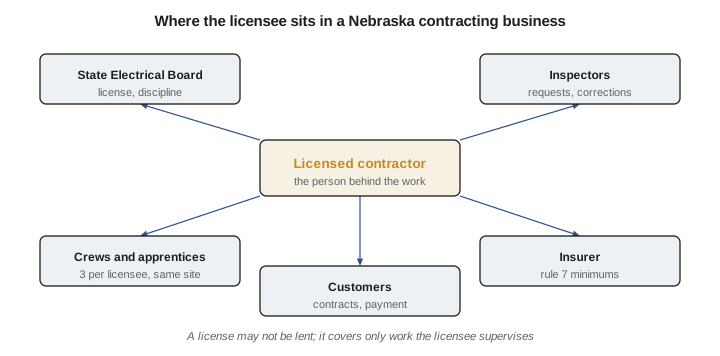
With the authority comes accountability. When Platte Valley's work is inspected, the inspector looks to the licensee. When a customer complains to the board, the complaint names the licensee. A journeyman on the crew answers for his or her own work too, but the contractor answers for the company's.
Using the license honestly
Section 81-2108 says a license may not be lent to another person, and a licensee may not knowingly allow another person to use it. The rule targets a familiar abuse: a licensed contractor who lets an unlicensed business file inspection requests under his or her number in return for a fee. The licensee who does that is responsible for work he or she never saw, and risks the license and criminal charges. A license is personal. It goes where the licensee goes and covers only work the licensee actually plans, lays out or supervises.
The same honesty rule applies to every document the licensee signs. Section 81-2143 lists knowingly making a false statement on an application, inspection request or certificate as an offense. An inspection request that names the wrong address, understates the scope of work to lower the fee, or claims a start date that is not true is a false statement.
Supervising apprentices
Section 81-2113 sets two rules that every contractor must build into scheduling. First, a registered apprentice may do electrical work only under the direct personal on-the-job supervision and control of a licensee who is at the same project location. The act says the licensee does not have to keep the apprentice in sight at every moment, but must be on the same job. Second, no licensee may supervise more than three apprentices at a time. Community college instruction in a classroom is exempt from the ratio.
For Platte Valley, with eight licensees and eleven apprentices, the ratio is rarely the problem. The location rule is. An apprentice cannot be sent alone to finish a punch list at a grain bin site while the journeyman is across the county on another job. Marisol's scheduling board shows every apprentice beside the licensee who will supervise him or her that day, at the same address.
# Daily apprentice check: same location and no more than three per licensee
crews = {
    "Willow Bend shop": {"licensees": ["Jenna", "Tyler"], "apprentices": ["Eli", "Ava", "Noah", "Liam"]},
    "Kearney duplex": {"licensees": ["Sam"], "apprentices": ["Mia", "Owen", "Ella", "Jack"]},
    "Gibbon grain site": {"licensees": [], "apprentices": ["Leo"]},
}
for site, c in crews.items():
    limit = 3 * len(c["licensees"])
    n = len(c["apprentices"])
    ok = n <= limit
print(f"{site:18} licensees {len(c['licensees'])} apprentices {n} limit {limit} {'OK' if ok else 'FIX'}")Willow Bend shop licensees 2 apprentices 4 limit 6 OK Kearney duplex licensees 1 apprentices 4 limit 3 FIX Gibbon grain site licensees 0 apprentices 1 limit 0 FIX
The check flags two problems in the example. The Kearney duplex has four apprentices and one licensee, one more than the ratio allows. The grain site has an apprentice with no licensee at all, which breaks the location rule entirely. Both are scheduling fixes, and both are the licensee's responsibility to catch before the trucks leave the shop.
Filing and following through on inspections
The licensee makes sure every covered job has an inspection request or local permit before work starts, that rough-in is called before concealment, that correction orders are cleared by the final date and that final approval is obtained. Lesson 6 covered the mechanics. The duty is personal: the act lists knowingly failing to file a required request, and refusing an inspector entry or interfering with an inspection, among its offenses.
Good contractors also make the inspector's job easy. Have the request number, plans and any load calculations ready on site. Leave covers off where the inspector will need to look. Answer the phone when the inspector calls. An inspector who trusts a contractor's work spends less time on each visit, which is good for everyone's schedule.
Plans, calculations and records
Planning and layout are part of the license, so the licensee owns the design decisions on jobs that have no engineer: service and feeder sizes, load calculations, panel schedules and grounding plans. On larger jobs an engineer's drawings set the design, but the contractor still answers for installing them correctly and for raising questions when the drawings conflict with the code. Keep the calculations with the job file. An inspector who questions a service size will ask how it was figured, and a written calculation answers in a minute.
Records also protect the licensee when something goes wrong later. A fire in a building wired years ago will lead investigators and insurers to ask who did the work and whether it passed inspection. A job file with the request number, inspection approvals and the as-built panel schedule is the contractor's best evidence.
Who may do the work
The act's licensing rules apply to everyone on the crew. Covered electrical work must be done by a licensee or by a registered apprentice under supervision. A laborer who carries material or digs a trench is not doing electrical work, but a helper who pulls and terminates conductors is, and must be registered as an apprentice or licensed. New hires should be registered before they start electrical tasks, and the registration should be renewed with the licenses at the end of each even-numbered year.
Special electricians and fire alarm installers hold licenses limited to their classes. A contractor who employs them should assign them only work within the classes on their cards, and should not count them as general licensees for apprentice supervision outside those classes without checking with the division.
Responding to a complaint
If the division contacts the licensee about a complaint, respond promptly, honestly and in writing, with the job file attached. Many complaints are resolved by showing that the work passed inspection or that a correction was made. Where there is a real problem, fixing it quickly and explaining what the company changed to prevent a repeat usually matters to the board. Ignoring a complaint is the worst choice: it turns a fixable problem into a discipline case.
Keeping insurance in force
Section 81-2104 lets the board revoke, suspend or refuse to renew a license for failing to keep the public liability insurance the board requires. The board's rule sets the minimums for contractors who actively run a contracting firm, covered in lesson 8. The duty for the licensee is to make sure the policy never lapses: a lapse is grounds for discipline even if no claim arises. Roger's folder holds the current certificate and a calendar reminder sixty days before each renewal.
Meeting the code and the act
The license may be disciplined for violations of the NEC or the act, for violating an approved local ordinance, for failing to pay required fees and for failing to complete continuing education. The board's options include revoking, suspending or refusing to renew the license. In practice, discipline usually follows a pattern: repeated correction orders on the same issue, work done without requests, or a serious defect that caused damage.
| Ground for discipline (summary) | How a contractor avoids it |
|---|---|
| NEC or act violations | Train crews, review plans, clear correction orders promptly |
| Violating an approved local ordinance | Read each city's code and permit rules before bidding |
| Unpaid fees | Pay inspection and license fees when filed |
| No required insurance | Renew the policy before it lapses; keep the certificate on file |
| Missing continuing education | Plan 12 hours across the license period |
Criminal offenses
Section 81-2143 makes certain knowing acts criminal. They include false statements on applications, requests or certificates; doing electrical work without the proper license while claiming to have one; failing to file a required inspection request; interfering with an inspector or refusing entry; and otherwise knowingly failing to comply with the act or the board's rules. The act sets the penalty class; read the current text for the classification, since the posted versions have been amended. The act also exempts work for close relatives, such as a parent, spouse, child, grandparent or sibling, from the licensing offense.
Most licensees never come near these provisions. They matter on the exam, and they matter in the rare case where a contractor is tempted to cut a corner on paperwork. The paperwork is where criminal exposure lives.
When the licensee leaves
A contracting business that depends on one licensee is exposed if that person dies, retires or leaves. Section 81-2119 gives some relief in the case of death: the board may allow a representative to finish work in progress for up to six months, provided the required insurance stays in force. It does not cover a licensee who simply quits. That is why Roger and Jenna planned an overlap: Roger stays the licensee until Jenna's license and insurance are in place, so the company is never without a licensee.
The overlap also gives the new licensee time to learn the parts of the job that never appear on a jobsite: the insurer's renewal questions, the city registrations, the open correction orders and the relationships with the inspectors in each area. Roger planned to spend the first three months after Jenna's license issued reviewing every inspection request with her before it was filed, and then to step back once she had a full season of jobs behind her.
Worked problem
The borrowed license
A handyman who has done some wiring asks Jenna, after she is licensed, whether he can list her license on his inspection requests for a monthly fee. She would not see the work. What does the act say?
Show solution
- Section 81-2108 forbids lending a license or knowingly allowing another person to use it.
- Each request she let him file would be a statement that she supervised the work, which would be false.
- Her license could be revoked, and the conduct could be criminal under section 81-2143.
- The handyman would also be doing covered work without a license.
Answer: Refuse; it would break the act and expose her license and herself to discipline and prosecution.
Common mistakes
MistakeSending an apprentice alone to a job.
InsteadApprentices must work under a licensee at the same project location.
MistakeCounting a licensee on another job toward the ratio.
InsteadThe ratio counts licensees supervising at the same location, up to three apprentices each.
MistakeLetting insurance lapse briefly between policies.
InsteadA lapse is a ground for discipline whether or not a claim arises.
MistakeTreating a false start date on a request as a minor slip.
InsteadA knowingly false statement on a request is a criminal offense.
Summary and key terms
- The contractor license allows planning, layout, installation and supervision for all purposes, and offering work to the public.
- A license may not be lent or knowingly used by another person.
- Apprentices work only under a licensee at the same location, no more than three per licensee.
- Discipline grounds include code or act violations, local ordinance violations, unpaid fees, no insurance and missing continuing education.
- Section 81-2143 makes knowing false statements, unlicensed work, unfiled requests and interference with inspectors criminal.
- Direct personal supervision
- Supervision by a licensee at the same project location, required for every apprentice.
- Ratio
- The limit of three apprentices per supervising licensee.
- Lending a license
- Allowing another person to use one's license number or authority, forbidden by section 81-2108.
- Representative
- A person the board may allow to finish a deceased contractor's work for up to six months.
- Relative exemption
- The act's exemption from the licensing offense for work done for close relatives.
Practice problems
Work each problem on paper first, then reveal the answer to check.
How many apprentices may one licensee supervise at a time?
Show answer
No more than three.
Must the supervising licensee keep the apprentice in sight at all times?
Show answer
No, but the licensee must be at the same project location and in control of the work.
For how long may the board allow a representative to finish a deceased contractor's work?
Show answer
Up to six months, with the required insurance in force.
Lesson quiz · 5 questions
Score 60% or more to complete this lesson.
Create a free account to save your progress, take quizzes and earn a certificate.