
MELU-302 · Lesson 3 of 12 · 19 min
Applying, approval and booking the exam
▶ Video coming soon A video version of this lesson is on the way.
With her eligibility confirmed, Jenna wanted to book the exam that afternoon. Marisol slowed her down. In Nebraska, she explained, the testing company cannot sell you a seat until the board has said you may sit. The order is application first, approval second, booking third, and the license itself comes only after a passing score and the license step. Getting the order right saves weeks.
This lesson walks through each stage: the application to the State Electrical Division, the board's approval, scheduling with PSI, the day of the exam, and what happens after a pass or a fail. Details such as fees and forms change, so treat the steps here as the shape of the process and confirm each one on electrical.nebraska.gov and in the current PSI candidate bulletin.
Step 1: the application
The application goes to the State Electrical Division, not to PSI. It asks for identifying information, the license applied for, the experience that qualifies the applicant and the signatures that verify it, and it carries an application or exam fee set by the board. Section 81-2104 lets the board set fees, which must cover the program's costs without building an unnecessary surplus, so the amounts change from time to time. Use the fee printed on the current form.
For the contractor license the experience section is the heart of the application. Jenna listed her journeyman license number and issue date, described her work since then and attached Roger's signed letter. She also answered the questions on prior discipline and criminal history truthfully. A false statement on an application is a criminal offense under section 81-2143, and an omission discovered later can cost the license.
Marisol made a copy of every page before mailing it, and noted the date it went out. If the division asks for more information, the copy lets you answer quickly and consistently.
Step 2: board approval
The board, through division staff, reviews the application and decides whether the applicant is eligible. Approval may come quickly when the records are complete, or the division may write back asking for more detail, especially about experience that is not plainly electrical installation for a licensed contractor. When the application is approved, the candidate receives notice that he or she may schedule the exam with PSI, together with the information PSI needs to recognize the candidate.
Section 81-2115 says exams are given at least twice a year. With computer-based testing through PSI, seats are usually available much more often than that, but the approval and the booking still have to line up with the candidate's study plan. An approval is not a promise of a particular date.
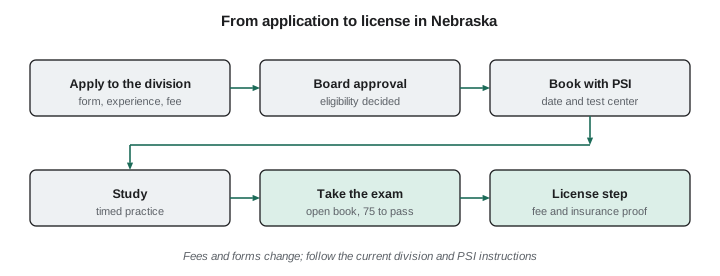
Step 3: booking with PSI
Once approved, the candidate schedules with PSI online or by phone, chooses a test center and a date, and pays any exam fee PSI collects. The bulletin explains the identification required, which is usually a current government-issued photo ID with a name that matches the registration exactly. A candidate who changed names should fix the mismatch before test day.
The bulletin also sets the rules for rescheduling and cancellation, which require notice in advance, and for what happens if a candidate is late or does not show up. Missing the appointment can forfeit the fee. Jenna booked a Saturday morning slot at the Kearney area center about six weeks out, which gave her time for two full timed practice exams.
| Stage | Who you deal with | What you need |
|---|---|---|
| Application | State Electrical Division | Form, experience verification, fee |
| Approval | State Electrical Board, through the division | Complete records; answers to any follow-up |
| Booking | PSI | Approval information, ID details, any PSI fee |
| Exam day | PSI test center | Photo ID, permitted code book, calculator |
| License issued | State Electrical Division | Passing score, license fee, insurance proof if operating a firm |
Choosing the date
The best test date is the one that sits at the end of a real study plan, not the first open seat. Count backward from the date: two weeks of review and rest, three or four weeks of timed practice, and before that the weeks of content study described in lesson 12. A candidate who books too early often reschedules, which costs fees, and a candidate who books too late tends to drift. Jenna chose a date six weeks out because she had already done most of her content study during the approval wait.
Think about the season as well. Platte Valley's busiest months are spring planting and harvest, when irrigation and grain-handling work crowd the schedule. A candidate who tests in the slow weeks of winter has more evenings to study and less risk of an emergency call the night before. Choose a test center you can reach easily, and drive there once beforehand if you have never been.
The board's training sessions
Section 81-2114 allows the board to hold training sessions before its exams and to charge an attendance fee, set in the act at 40 dollars per session. These sessions are not required, but they can help a candidate understand how the exam is organized and what parts of the act are most often tested. Check the division's site for current dates. Many candidates also take a prep course from a private provider or a community college.
Step 4: exam day
Plan to arrive early, with time to check in, store personal items and go through the center's security procedures. Bring only what the bulletin allows: identification, the permitted code book and a calculator of the allowed type. Lesson 4 covers the format and the references in detail. The exam is given on computer, one question at a time, and the candidate can usually mark questions to come back to while time remains.
At the end, PSI reports the result. Candidates who fail usually receive a score report showing their performance by content area, which is the most useful study document they will ever get. Lesson 12 explains how to use it.
Step 5: after a pass
A passing score is not yet a license. The candidate completes the license step with the division, which usually means paying the license fee and, for a contractor who will operate a contracting firm, providing proof of the liability insurance required by the board's rules. Lesson 8 covers the insurance. The license then issues and runs to December 31 of the next even-numbered year, the common expiration date for all Nebraska electrical licenses.
Jenna noticed that this timing matters. A license issued in early 2027 runs to December 31, 2028, close to two years. A license issued in November 2026 would expire on December 31, 2026, almost at once, and would need renewing right away. Marisol suggested Jenna confirm with the division how a license issued during a renewal window is handled before choosing her test date.
from datetime import date

def expires(issued):
    year = issued.year + (issued.year & 1)
    return date(year, 12, 31)

for issued in [date(2026, 11, 20), date(2027, 2, 10), date(2027, 11, 5), date(2028, 3, 1)]:
    end = expires(issued)
print(f"issued {issued} expires {end} days in force {(end - issued).days}")issued 2026-11-20 expires 2026-12-31 days in force 41 issued 2027-02-10 expires 2028-12-31 days in force 690 issued 2027-11-05 expires 2028-12-31 days in force 422 issued 2028-03-01 expires 2028-12-31 days in force 305
Why the division writes back
Most delays come from a handful of problems. The experience letter is unsigned, or signed by someone who did not supervise the work. The dates in the letter do not match the dates on the form. The description of the work is too vague for staff to tell whether it was electrical installation. The fee is missing or wrong because the applicant used an old form. Or the applicant answered a background question in a way that needs explanation. Each of these is easy to prevent by reading the form twice and asking the person who signs the letter to read the description before signing.
If the division does write back, answer promptly and completely, and keep a copy of what you send. A partial answer usually leads to a second letter and another wait. When in doubt about what staff want, call the division during business hours and ask. Staff can explain what a form asks for, even though they cannot decide eligibility on the phone.
Testing accommodations
A candidate with a disability who needs an accommodation, such as extra time or a separate room, should read the accommodation section of the PSI bulletin early. Requests usually need documentation and must be approved before the exam is scheduled, so they add time to the process. Do not wait until the week before the exam to ask.
Keeping a file
Roger has seen many electricians lose track of their own paperwork, so he asked Jenna to keep a single folder, paper or digital, with copies of the application, the experience letter, the approval notice, the PSI confirmation, the score report and the license. The same folder later holds her continuing education certificates and renewal receipts. When the division asks a question in four years, the answer will be in one place.
The folder also helps Platte Valley. Customers, general contractors and public owners sometimes ask for proof that the company's licensee is current, and the insurer asks for license details at each policy renewal. A clean file answers those requests in minutes.
Step 6: after a fail
The board's rule says an applicant who fails must reapply. Read the score report, plan the next round of study and then follow the division's current process for a retake, including any new fee and waiting period. Do not book a second attempt before the approval is in place.
A failed attempt is not a mark against the candidate's journeyman license or future eligibility. It is simply information about what to study. Most candidates who fail the first time pass on the next try when they study the weak areas instead of starting over.
Jenna's checklist
Marisol turned the process into a checklist taped above Jenna's desk: download and read the form and the bulletin; gather the license card, Roger's letter and the job list; submit the application and keep a copy; watch for the approval; book the PSI seat; confirm the ID name matches; schedule two timed practice exams; on test day bring only permitted items; after a pass, pay the license fee and send the insurance certificate. Every item had a date beside it.
The checklist did more than keep Jenna on schedule. It showed Roger, at a glance, where the transition stood, so he could plan the date he would step back as licensee. It also gave Marisol a list to reuse the next time a Platte Valley journeyman decided to go for the contractor license.
Worked problem
Fixing the order
A new Platte Valley journeyman, Dylan, says he plans to book the contractor exam with PSI this week, then send the division his application after he passes. What is wrong with the plan?
Show solution
- PSI books only candidates the board has approved.
- The application and its experience verification come first, to the division.
- After approval, Dylan can book with PSI using the information he receives.
- After passing, he completes the license step with the division.
Answer: The order is reversed; apply to the division first, then book with PSI after approval.
Common mistakes
MistakeBooking with PSI before the board approves the application.
InsteadApply to the division first; PSI schedules approved candidates.
MistakeTreating a passing score as the license.
InsteadThe license issues after the license step, including the fee and insurance proof where required.
MistakeIgnoring the even-year expiration date when choosing a test date.
InsteadAll licenses expire on December 31 of even-numbered years, so the issue date affects the first term.
MistakeArriving with an ID that does not match the registration.
InsteadFix name mismatches before test day; the bulletin's ID rules are strict.
Summary and key terms
- The application goes to the State Electrical Division with experience verification and a fee set by the board.
- The board approves eligible candidates; only then does PSI schedule the exam.
- Exams are computer based through PSI; the act requires exams at least twice a year.
- After a pass, the candidate pays the license fee and provides insurance proof if operating a firm.
- All licenses expire on December 31 of even-numbered years.
- Approval
- The board's decision that an applicant is eligible to test.
- Candidate bulletin
- PSI's document with the Nebraska exam rules, ID requirements and scheduling policies.
- License step
- The process after a passing score in which the license fee and any required documents are submitted.
- Training session
- An optional session the board may hold before exams, with an attendance fee of 40 dollars under section 81-2114.
- Even-year expiration
- The rule that all Nebraska electrical licenses expire on December 31 of each even-numbered year.
Practice problems
Work each problem on paper first, then reveal the answer to check.
Where does a Nebraska contractor exam application go?
Show answer
To the State Electrical Division, which processes it for the board.
What must a contractor operating a firm provide after passing, besides the license fee?
Show answer
Proof of the liability insurance the board's rules require.
If a license is issued on February 10, 2027, when does it expire?
Show answer
December 31, 2028.
What should a candidate do if the division asks for more information about experience?
Show answer
Answer promptly and completely, keep a copy, and call the division if the request is unclear.
Lesson quiz · 5 questions
Score 60% or more to complete this lesson.
Create a free account to save your progress, take quizzes and earn a certificate.