
MELU-302 · Lesson 5 of 12 · 21 min
The NEC as adopted in Nebraska and state amendments
▶ Video coming soon A video version of this lesson is on the way.
A week into her study, Jenna hit a practice question about ground-fault protection for a basement receptacle in a new house. She answered from the 2023 NEC, checked the key and found that the prep company had marked a different answer, with a note: Nebraska applies the 2017 edition for this section. Jenna took the book to Roger. He laughed and said it was the one part of the Nebraska code every new contractor trips over at least once. The state adopted the 2023 NEC, he said, but it kept a few dwelling rules from the 2017 edition, and the exam expects you to know which ones.
This lesson explains how the National Electrical Code becomes law in Nebraska, which edition is in force in 2026, which provisions the state kept from the 2017 edition, how local programs fit in, and how to handle all of this on the exam. It does not reproduce the code. Look up each section named here in your own copy.
How the code enters Nebraska law
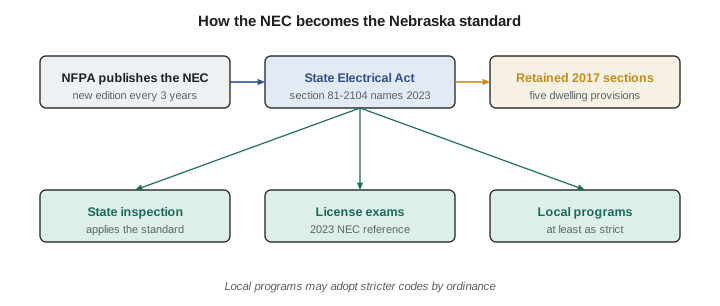
In many states a code edition is adopted by an agency rule. Nebraska writes the edition into its statute. Section 81-2104 directs the State Electrical Board to follow a named edition of NFPA 70, the National Electrical Code, and lists any provisions where another edition applies instead. The board then enforces that standard through state inspection, uses it for the license exams and expects local programs to meet it as a minimum.
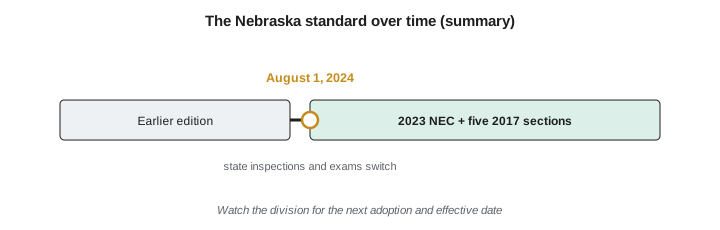
Because the edition is in the act, changing it usually involves the legislature as well as the board, and the change takes effect on a date the division announces. When the 2023 edition was adopted, the division announced that state inspections and the PSI license exams would move to the 2023 NEC on August 1, 2024. Work and exams before that date used the earlier edition.
The edition in force in 2026
In 2026 the state standard is the 2023 NEC, with one important qualification. The act says the 2017 edition applies instead for five provisions: section 210.8(A), its items (A)(3) and (A)(5), section 230.67(A) and section 230.85. Put simply, these are the general list of dwelling locations that need ground-fault circuit-interrupter protection, two of the specific locations on that list (outdoors and basements), surge protection for dwelling services, and the outdoor emergency disconnect for one- and two-family dwellings.
The surge and emergency disconnect requirements first appeared in the 2020 edition. Applying the 2017 edition to those sections means the later requirements are not part of the state standard, while the rest of the 2023 code applies as published. For the ground-fault sections, the 2017 edition's rules apply in place of the broader 2020 and 2023 versions, which extended protection to more receptacle types and voltages in dwellings.
| Section | Topic (plain description) | Edition that applies under the act |
|---|---|---|
| 210.8(A) | Dwelling locations needing GFCI protection | 2017 NEC |
| 210.8(A)(3) | Outdoor dwelling receptacles | 2017 NEC |
| 210.8(A)(5) | Dwelling basements | 2017 NEC |
| 230.67(A) | Surge protection for dwelling services | 2017 NEC (no equivalent requirement) |
| 230.85 | Outdoor emergency disconnect, one- and two-family dwellings | 2017 NEC (no equivalent requirement) |
| Everything else | All other provisions | 2023 NEC |
Look at what is not on the list. Ground-fault protection for kitchens, bathrooms, garages, laundry areas and other dwelling locations still exists in the state standard, through the 2017 edition's version of the list. Arc-fault protection, tamper-resistant receptacles and the many other dwelling rules follow the 2023 edition. Non-dwelling ground-fault rules in 210.8(B) follow the 2023 edition too.
Jenna wrote the five section numbers on a tab at 210.8 and another at 230.67, as the bulletin's marking rules allowed, so she would be reminded of the state rule every time she opened those pages.
Why a state keeps older provisions
States that hold back parts of a new edition usually cite cost and practicality. Expanded ground-fault requirements can cause nuisance tripping with some appliances and equipment, and surge protective devices and outdoor emergency disconnects add cost to every new home. Supporters of the newer rules point to safety for occupants and first responders. Nebraska's legislature chose to keep the 2017 rules for these provisions, at least for now. A contractor may still install the protection the newer editions call for, because the code is a minimum, and many do for customers who ask.
Local programs and the state minimum
Section 81-2125 requires a local inspection program's ordinance to be at least as strict as the state standard. A city may therefore adopt the 2023 edition with no exceptions, or a later edition, or add local amendments that go further. It may not adopt something less protective than the state standard. Omaha, Lincoln and the other cities with programs adopt their codes by ordinance, so the first step on a city job is to ask the city which edition and local amendments it enforces.
This creates a practical rule for Platte Valley: the state standard is the floor, and a city may be higher. A house wired in rural Buffalo County under state inspection may legally omit a surge device that a city program requires. Marisol keeps a one-page list of the code editions and key local amendments for each city in the company's area, updated whenever a city changes its ordinance.
# Which edition governs a given provision on a state-inspected job (study aid)
retained_2017 = {"210.8(A)", "210.8(A)(3)", "210.8(A)(5)", "230.67(A)", "230.85"}

def state_edition(section):
    return "2017 NEC" if section in retained_2017 else "2023 NEC"

for sec in ["210.8(A)(5)", "210.8(B)", "210.12", "230.67(A)", "230.85", "250.50"]:
    print(f"{sec:12} -> {state_edition(sec)}")
print("Local programs may be stricter; check the city's ordinance.")210.8(A)(5) -> 2017 NEC 210.8(B) -> 2023 NEC 210.12 -> 2023 NEC 230.67(A) -> 2017 NEC 230.85 -> 2017 NEC 250.50 -> 2023 NEC Local programs may be stricter; check the city's ordinance.
When the customer wants more than the minimum
Because the code is a minimum, nothing in the act stops a contractor from installing the protection the 2023 edition describes for a state-inspected house. Some customers ask for a whole-house surge device after a lightning strike in the neighborhood, and some builders specify an outdoor emergency disconnect because their homes also sell in towns that require one. Platte Valley's estimator, Sam Okafor, prices those items as options on every new-home quote and explains in a sentence why they are optional on state jobs and required in some cities.
The point for the contractor is to be clear in the contract about what is included. A customer who later reads that the 2023 NEC requires surge protection may assume the contractor cut a corner. A line in the proposal stating that the work meets the state standard, with surge protection offered as an option, prevents that misunderstanding.
Planning for the next edition
The NFPA publishes a new edition every three years, and the 2026 edition is already in print. Nebraska has not adopted it as of the sources for this course, and any adoption would come through a change to the act and an announced effective date. When that happens, inspections and exams will move together, and the list of retained provisions may change, grow or disappear.
A contractor should watch the division's website and news page for announcements, attend a code update class when the change comes, and replace the code books on the trucks. A license candidate who expects to test near a change date should ask the division which edition the exam will use on the scheduled date, and buy that book.
| Event | What changes | What to do |
|---|---|---|
| New edition adopted in the act | State standard and effective date | Read the act and the division notice |
| Effective date arrives | State inspections use the new edition | Update books, estimates and crew training |
| Exams switch editions | The permitted reference changes | Candidates buy and tab the new edition |
| City adopts its own edition | Local standard may differ | Update the company's city list |
Other parts of the act that work like code rules
The act also contains rules that affect installations directly even though they are not code amendments. Section 81-2124 says which installations require inspection. The act forbids newly connecting an installation until the inspection request has been filed and conditions are safe. Concealing wiring before a rough-in inspection without adequate notice makes the responsible person liable for the cost of uncovering it. These are covered in lesson 6, but they belong in the same mental box as the code: rules that decide whether a job passes.
The exam angle
The license exam uses the 2023 NEC as its reference, and most questions are answered straight from that book. But the exam also covers the State Electrical Act, and questions about the retained 2017 provisions are a natural way to test whether a candidate knows Nebraska law. If a question says it is about a state-inspected dwelling and asks about ground-fault, surge or emergency disconnect requirements, stop and ask whether the state rule changes the answer.
Read such questions carefully. A question asking what the 2023 NEC requires is asking about the book. A question asking what is required in Nebraska, or on a state-inspected job, is asking about the act. Prep materials written for other states will usually miss this distinction, so check any Nebraska practice answers against the act.
A good habit is to ask three questions before answering any dwelling question: Is the question about the book or about Nebraska? If it is about Nebraska, is the section one of the five retained ones? And is the job under state inspection or a local program that may be stricter? Most questions will pass the first test quickly as questions about the book, and the habit costs only a few seconds. On the few questions where it matters, it is the difference between a right and a wrong answer.
Jenna added a fourth question of her own: does the question name a year? A question that says the 2023 NEC requires something is a book question no matter where the house is. A question that says a contractor in Nebraska must do something brings the act into play.
Worked problem
The basement receptacle
Jenna is wiring an unfinished basement in a new single-family house in a village with no local program. Which edition governs the ground-fault protection requirement for the basement receptacles?
Show solution
- The job is under state inspection, because there is no local program.
- Ground-fault protection for dwelling basements is section 210.8(A)(5).
- Section 81-2104 applies the 2017 edition to 210.8(A)(5).
- So the 2017 edition's basement rule governs, and the rest of the job follows the 2023 NEC.
Answer: The 2017 NEC governs that requirement; the 2023 NEC governs the rest.
Worked problem
The city job
The next month Platte Valley wires a similar house inside a city that adopted the 2023 NEC without exceptions. Does the surge protection requirement apply?
Show solution
- The job is under the city's program, not state inspection.
- A local ordinance must be at least as strict as the state standard and may be stricter.
- The city adopted the 2023 edition without exceptions, which includes the dwelling surge requirement.
- So the requirement applies under the city's code.
Answer: Yes; the city's stricter adoption governs.
Common mistakes
MistakeAssuming the whole 2023 NEC applies on every Nebraska job.
InsteadThe act applies the 2017 edition to five dwelling provisions on state work, and cities may be stricter.
MistakeThinking the 2017 rule removes all dwelling GFCI protection.
InsteadThe 2017 edition's list of dwelling locations still applies; only the broader later versions are set aside.
MistakeAssuming a city cannot go beyond the state standard.
InsteadLocal ordinances must be at least as strict and may be stricter.
MistakeUsing prep answers written for other states.
InsteadCheck Nebraska answers against the act's retained sections.
Summary and key terms
- Section 81-2104 names the 2023 NEC as the Nebraska standard, effective for state work and exams from August 1, 2024.
- The 2017 edition applies to 210.8(A), 210.8(A)(3), 210.8(A)(5), 230.67(A) and 230.85.
- Those cover dwelling GFCI locations, surge protection for dwelling services and the outdoor emergency disconnect.
- Local programs must be at least as strict as the state standard and may adopt stricter codes.
- On the exam, separate what the book says from what Nebraska requires.
- State standard
- The NEC edition and exceptions named in section 81-2104.
- Retained provision
- A section for which the act applies the 2017 edition instead of the 2023 edition.
- Local amendment
- A change a city or county program makes to the code by ordinance; it may not be less strict than the state standard.
- GFCI
- Ground-fault circuit interrupter, a device that opens a circuit on a small ground-fault current.
- Effective date
- The date a code edition starts to apply; August 1, 2024 for the 2023 NEC in Nebraska.
Practice problems
Work each problem on paper first, then reveal the answer to check.
Which edition of the NEC is the Nebraska standard in 2026?
Show answer
The 2023 NEC, with the 2017 edition applying to five listed sections.
List the five sections where the 2017 edition applies.
Show answer
210.8(A), 210.8(A)(3), 210.8(A)(5), 230.67(A) and 230.85.
May Lincoln require surge protection for new dwelling services?
Show answer
Yes, if its ordinance adopts that requirement; local programs may be stricter than the state.
Does the 2017 rule for 210.8(A) apply to a ground-fault question about a commercial kitchen?
Show answer
No. Non-dwelling GFCI rules in 210.8(B) follow the 2023 edition.
Lesson quiz · 5 questions
Score 60% or more to complete this lesson.
Create a free account to save your progress, take quizzes and earn a certificate.