
MELU-302 · Lesson 6 of 12 · 21 min
Permits, inspections and the inspection authority
▶ Video coming soon A video version of this lesson is on the way.
Platte Valley had three new jobs on the board the week Jenna started studying the inspection rules: a metal shop building for a farm machinery dealer outside Willow Bend, a village with no inspection program; a duplex inside Kearney; and an addition to the elementary school in Willow Bend. Roger asked her to tell him, for each job, who would inspect it, what paperwork had to be filed and when. Jenna thought it would take five minutes. It took an hour, and she learned more about the act than in a week of reading.
This lesson explains which installations need inspection in Nebraska, how to find the inspection authority for a job, how the state inspection request works, what it costs, when inspections happen, what correction and condemnation orders are, how appeals work and which work is exempt. Lesson 7 then looks at the licensee's own duties on the job.
What must be inspected
Section 81-2124 lists the installations covered by state inspection. They include all commercial, industrial and public-use installations; residential installations that go beyond a single-family dwelling, or that require new service equipment; installations an owner asks to have inspected; and existing installations the board finds hazardous. In practice nearly all contractor work outside single-family homes is covered, and so is any job on a single-family home that includes a new service.
The act also says an installation may not be newly connected to a source of power until a certificate shows that the inspection request has been filed and that conditions are safe. For a contractor that rule means the paperwork has to be filed before the utility will energize the job.
Finding the inspection authority
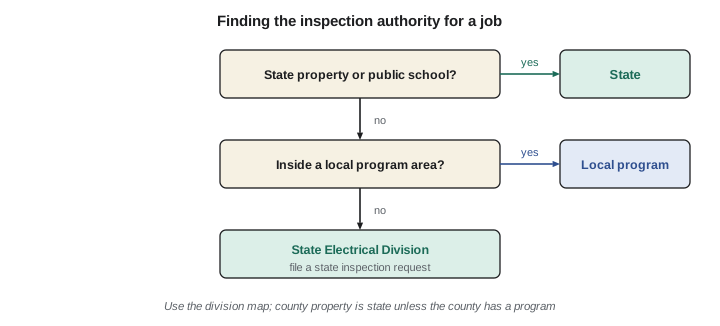
Before filing anything, decide who inspects. The state inspects covered work unless a local program has jurisdiction. Under section 81-2125 a city, village or county may run its own program with a certified inspector and an ordinance at least as strict as the state standard. The division lists the programs and maps them; the larger cities, such as Omaha, Lincoln, Grand Island and Kearney, run their own, as do several counties, such as Douglas, Lancaster, Hall and Sarpy, and a number of smaller cities.
Three exceptions override the map. State-owned property and public educational facilities remain under state jurisdiction wherever they are. County-owned property is under state jurisdiction unless the county itself has an approved program. And some city programs cover an area beyond the city limits; Lincoln, for example, requires its contractor registration for permits within the city and three miles beyond it.
| Job | Location | Authority |
|---|---|---|
| Machine dealer shop | Willow Bend, no local program | State Electrical Division |
| Duplex | Inside Kearney | City of Kearney program |
| School addition | Willow Bend, public school | State, because it is a public educational facility |
| County road shop | County without its own program | State |
The state inspection request
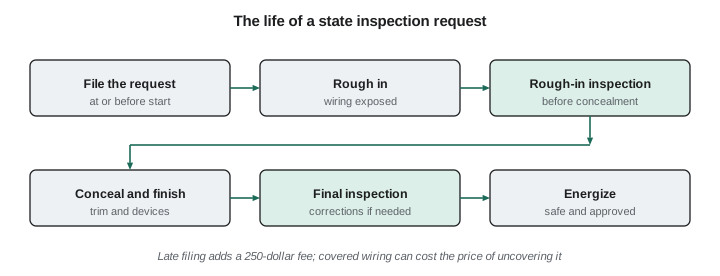
Where the state has jurisdiction, the licensee files an inspection request with the division at or before the start of work. Requests may be filed online, by email or by text, and the board's rule allows the installer to notify the area inspector by phone when work is ready. The request carries the inspection fee from the division's fee schedule plus a supervisory fee of 50 cents set in section 81-2126.
Filing late is expensive. Work started without a request carries a late fee, which the division set at 250 dollars when it adopted the 2023 code. If the division learns of work without a request, it sends written notice by certified mail giving 14 days to file. A person who still does not file may be referred to the county attorney, and knowingly failing to file a required request is listed among the offenses in section 81-2143.
Under the board's rule, a request becomes void if work has not started within five months, or if no progress is shown for five consecutive months, unless the division grants an extension. For long projects the act allows fees to be prorated when a project runs more than six months and the inspection fees exceed 300 dollars, with a minimum filing amount of 100 dollars.
# Rough cost of filing late on a state job (example; check the current fee schedule)
inspection_fee = 120.00    # example figure from a fee schedule
supervisory_fee = 0.50     # section 81-2126
late_fee = 250.00          # late filing fee announced by the division

on_time = inspection_fee + supervisory_fee
late = on_time + late_fee
print(f"Filed on time: {on_time:8.2f}")
print(f"Filed late:    {late:8.2f}")
print(f"Cost of forgetting: {late - on_time:.2f}")Filed on time: 120.50 Filed late: 370.50 Cost of forgetting: 250.00
When inspections happen
The board's rule requires the installer or contractor to notify the inspector when work is ready: at rough-in, before any wiring is concealed; at final; and after corrections. The act says inspections are to be made within about a week of the request. If wiring is concealed without adequate notice to the inspector, section 81-2134 makes the responsible person liable for the cost of uncovering it, so the rough-in call must come before the insulation and drywall crews arrive.
For transient projects, such as carnivals and temporary events, the request must reach the division at least five days before the installation is energized, and the board's rule asks for temporary service applications at least five working days ahead. Platte Valley uses a simple rule: no rough-in is covered until Marisol has logged the inspection result.
Correction and condemnation orders
When an inspector finds a defect that is not an immediate danger, the inspector issues a correction order. Under section 81-2138 the order sets a final inspection date between 10 and 17 calendar days later, by which the work must be corrected. The contractor makes the corrections and calls for reinspection; reinspections may carry their own fee.
When an installation seriously and proximately endangers health or property, the act allows the inspector to condemn it or order it disconnected immediately. These orders are rare on new work and more common on hazardous existing installations, but a licensee should know the difference: a correction order gives time, a condemnation order does not.
Treat every correction order as a deadline on the company calendar. Read it the day it arrives, assign the fix to a crew, and call for reinspection with a margin of a few days before the final date. A missed final date can lead to further enforcement and makes the next conversation with the inspector harder. Platte Valley also reviews each order at its Monday meeting, because the same defect showing up on two jobs usually points to a training gap.
Appeals
A person affected by an order may appeal in writing within 10 days under section 81-2141. An order based on immediate danger is not stayed by the appeal, so a disconnected installation stays disconnected while the appeal is heard. An order based only on code noncompliance is stayed until the board decides. Section 81-2142 requires a hearing within 14 days of the appeal, before a hearing officer or the full board, and a majority decides.
Omaha, Lincoln and other local programs in practice
Inside a local program the city or county issues the permit, collects its own fees, schedules its own inspections and enforces its own adopted code. The state inspection request is not used there, except for state property and public schools. The details differ from program to program, so treat each one as its own system and read its current permit pages before the first job.
Lincoln is a good example of what to expect. The city requires electrical contractors to register with it before it will issue an electrical permit within the city or three miles beyond, to renew that registration every two years and to provide a certificate of insurance; in 2026 its listed registration fee for a contractor was 125 dollars a year. The registration involves no exam; it is the city's way of confirming who is pulling permits and that they are insured. Omaha runs its own permits and inspections through its planning department, adopts its electrical code by ordinance and has its own permit application process; confirm its current registration and insurance requirements before bidding work there.
Kearney, where Platte Valley is based, also runs its own program. Marisol keeps the city's permit forms, fee schedule and inspection phone number in the same binder as the state forms, and she flags any address near the city limits for a check on the map, because a road can be the boundary between two inspection systems.
Worked problem
The Kearney duplex
Platte Valley is wiring a new duplex inside Kearney. Jenna starts filling in a state inspection request. What should she do instead?
Show solution
- The duplex is inside the city, which runs its own program.
- It is neither state property nor a public school, so the state exception does not apply.
- The city issues the permit and inspects under its adopted code.
- Jenna should apply for the city permit and follow the city's inspection steps.
Answer: Apply for a Kearney permit; the city, not the state, inspects.
Keeping the job file
Every inspected job should have a file showing the request or permit number, the date filed, the fees paid, each inspection date and result, any correction order and the date it was cleared, and the final approval. On state jobs, keep the confirmation that the request was filed before work started, because that is the evidence against a late fee. If an inspector later questions a concealed connection, a dated rough-in approval is the best defense.
Some contractors keep a single spreadsheet of open jobs with a column for the authority, the request or permit number and the next inspection due. It takes a few minutes a week and prevents the most common and most expensive mistakes: a job started without a request, a wall closed without a rough-in, and a correction order forgotten until the final date has passed.
Exempt work
Some work needs no license and no inspection. Under section 81-2121, an owner may do electrical work on his or her own principal residence, if it is no larger than a single-family dwelling, or on farm property, without a license. That exemption does not extend to commercial, industrial or public-use installations, and the division explains that it does not cover a relative's home, rental property or recreational property. Homeowners who do their own covered work, such as a new service, still file a homeowner inspection request.
Employees of utilities, public power and irrigation districts, cooperatives, railroads, telephone companies and industrial employers are exempt while working within their employment, and their employers' work of that kind is exempt from inspection. Plugging an appliance into an existing approved outlet needs no license. Elevators are excluded beyond the controller terminals. Licensed water well contractors may wire pumps to the first control.
Worked problem
Who files for the school addition?
Jenna notes that Willow Bend has no local program, and the school district is a local government. Should Platte Valley file with the village, the county or the state?
Show solution
- Public educational facilities stay under state jurisdiction wherever they are.
- So the state inspects the addition.
- Platte Valley files a state inspection request at or before the start of work.
- It calls for rough-in before concealment and for final when done.
Answer: The state; file a state inspection request.
Common mistakes
MistakeFiling a state request for a job inside a city program.
InsteadCheck the map first; local programs issue their own permits.
MistakeAssuming a public school follows the city program.
InsteadPublic educational facilities and state property stay under state inspection.
MistakeCovering wiring before the rough-in inspection.
InsteadThe responsible person can be liable for the cost of uncovering it.
MistakeTreating the homeowner exemption as covering a rental house.
InsteadIt covers only the owner's principal residence or farm property.
Summary and key terms
- Section 81-2124 covers commercial, industrial, public-use and most multi-family and new-service residential work.
- The state inspects unless a local program has jurisdiction; state property and public schools are always state.
- File the state request at or before the start of work with the fee plus the 50-cent supervisory fee; late filing costs 250 dollars.
- Call for rough-in before concealment; correction orders set a final date 10 to 17 days out.
- Appeals are due within 10 days; a hearing follows within 14 days.
- Inspection request
- The filing that tells the division a covered job is starting, with the fees.
- Supervisory fee
- The 50-cent fee added to each state inspection request under section 81-2126.
- Correction order
- An order to fix a non-dangerous defect by a final inspection date.
- Condemnation order
- An order that takes an installation out of service because it seriously endangers health or property.
- Homeowner exemption
- The rule allowing an owner to wire his or her own principal single-family residence or farm property without a license.
Practice problems
Work each problem on paper first, then reveal the answer to check.
Within how many days must an appeal of an inspection order be filed?
Show answer
Within 10 days, in writing.
Who inspects a new public school building inside a city with a local program?
Show answer
The state; public educational facilities remain under state jurisdiction.
What happens if a state inspection request shows no progress for five consecutive months?
Show answer
It becomes void unless the division grants an extension.
What must an electrical contractor do before pulling a permit in Lincoln?
Show answer
Hold a current City of Lincoln registration, which requires a certificate of insurance and is renewed every two years.
Lesson quiz · 5 questions
Score 60% or more to complete this lesson.
Create a free account to save your progress, take quizzes and earn a certificate.