
MELU-302 · Lesson 11 of 12 · 20 min
Renewal and continuing education
▶ Video coming soon A video version of this lesson is on the way.
The first week of November 2026 was renewal week at Platte Valley. Every Nebraska electrical license and apprentice registration in the company expired on December 31, and Marisol had a spreadsheet with twenty-two names on it. Roger's contractor license was at the top. He had finished his continuing education in the spring, eight hours in a code update class and four in a session on the State Electrical Act and safety, and he filed his renewal online in ten minutes. Two journeymen were not so lucky: one had six hours and the other had none. Jenna watched the scramble and decided that her own license would never be on the wrong half of that spreadsheet.
This lesson explains Nebraska's two-year license period, the renewal window, late renewal and expiration, and the continuing education every licensee must complete. It ends with a plan that spreads the work across the period so renewal is routine.
One expiration date for everyone
Nebraska uses a single expiration date for every electrical license and registration: December 31 of each even-numbered year. It does not matter when the license was issued. A contractor license issued in March 2025 and a journeyman license issued in October 2026 both expire on December 31, 2026. A license issued in 2027 expires on December 31, 2028.
That design makes renewal predictable. Every licensee in the state renews in the same season, the division can announce one schedule, and employers like Platte Valley can handle all their renewals at once. It also means a new licensee's first period may be short, as lesson 3 explained.
The renewal window
Under section 81-2118 the division accepts renewals from October 1 through November 30 of each even-numbered year. A licensee who misses that window may still renew from December 1 through December 31 by paying the renewal fee plus a late charge equal to one tenth of the renewal fee. Fees are set by the board and printed on the renewal notice.
After December 31 the license has expired. The act treats an expired license strictly: a person whose license has expired must apply for a new one, and section 81-2115 ties renewal after expiration to a short deadline after which the exam must be taken again. The posted act and the division's summary describe that deadline slightly differently, so if a license ever expires, call the division immediately to find out exactly what is still possible. Do not do electrical work on an expired license; work done without a valid license is a violation of the act.
| Period (even-numbered year) | Status | What it costs |
|---|---|---|
| October 1 to November 30 | Regular renewal | Renewal fee |
| December 1 to December 31 | Late renewal | Renewal fee plus one tenth |
| After December 31 | Expired | New application; may require the exam again |
Continuing education
Section 81-2117.01 requires every licensee to complete 12 contact hours of continuing education during each two-year license period before renewing. At least six of the hours must be on the National Electrical Code. A contact hour is 50 minutes of approved classroom instruction, and the board's rules require attendance for nearly the whole course: a licensee must attend at least nine tenths of a class to receive credit. Registered apprentices are not required to complete continuing education.
Courses must be approved by the board. Providers include community colleges, trade associations, unions, manufacturers and private schools, and the division posts approved courses. The provider issues a certificate or reports attendance; the licensee should keep a copy of every certificate for at least the current and previous periods.
Failing to complete the required hours is a ground for discipline under section 81-2104, and the renewal cannot be completed without them. That is why the two journeymen at Platte Valley spent two Saturdays in November in class.
# Tracking 12 hours, at least 6 on the NEC, across a two-year period (example)
classes = [
    ("2027-03-14", "NEC changes: services and feeders", 4, True),
    ("2027-10-02", "Nebraska State Electrical Act review", 2, False),
    ("2028-02-20", "Grounding and bonding", 3, True),
    ("2028-06-11", "Arc flash and NFPA 70E", 3, False),
]
total = sum(h for _, _, h, _ in classes)
nec = sum(h for _, _, h, is_nec in classes if is_nec)
for d, name, h, is_nec in classes:
    print(f"{d}  {h} h  {'NEC ' if is_nec else 'other'}  {name}")
print(f"Total {total} of 12 hours; NEC {nec} of at least 6")
print("Ready to renew:", total >= 12 and nec >= 6)2027-03-14 4 h NEC NEC changes: services and feeders 2027-10-02 2 h other Nebraska State Electrical Act review 2028-02-20 3 h NEC Grounding and bonding 2028-06-11 3 h other Arc flash and NFPA 70E Total 12 of 12 hours; NEC 7 of at least 6 Ready to renew: True
Choosing the hours
The minimum is six code hours and six of anything approved, but the best plan uses the hours to make the license more valuable. For a contractor, code hours spent on the topics the company sees most, such as services, grounding and agricultural buildings, pay off on every job. The other six hours can cover the State Electrical Act, which changes from time to time, NFPA 70E and safety, or specialized topics such as solar, energy storage and electric vehicle charging. When the state adopts a new code edition, a code update class is the obvious choice.
Avoid saving all twelve hours for the last month of the period. Classes fill up in the fall of renewal years, and an illness or a busy season can leave a licensee short. Two classes in each year of the period is a comfortable pace.
Renewing the company's people
A contractor depends on every licensee and apprentice on its payroll having a current card. Marisol's renewal spreadsheet lists each person, the license or registration type and number, the hours completed and the date the renewal was filed. She sends a reminder in the spring of each renewal year, another in September, and checks the list against the division's license lookup in December. Some contractors pay for employees' classes and renewal fees as a benefit; Platte Valley does, and requires the classes to be done by September 30 of the renewal year.
Apprentice registrations need attention too. They expire on the same date, need no continuing education, but must be renewed with a fee. An apprentice whose registration has lapsed may not do electrical work until it is renewed, and the hours worked during a lapse may not count toward the journeyman license.
What the late charge really costs
The late charge is modest compared with the cost of an expired license, but it adds up across a company. A contractor with twenty licensees who all renew in December pays twenty late charges for no benefit. The bigger risk is the licensee who intends to renew in December and then forgets over the holidays. Once January 1 arrives, the license has expired, and work must stop until the division says what can be done.
# Late renewal cost for a company (example fee; the board sets the real one)
renewal_fee = 60.00
late_charge = renewal_fee / 10
people = 22
print(f"Late charge per license: {late_charge:.2f}")
print(f"If everyone renews late: {late_charge * people:.2f} extra")
print("If one license expires: work stops for that person until the division resolves it")Late charge per license: 6.00 If everyone renews late: 132.00 extra If one license expires: work stops for that person until the division resolves it
Keeping records
The licensee, not the provider, is responsible for showing the hours were completed. Keep each certificate with the course name, approval number if any, date, hours and whether the hours were NEC hours. Store the certificates in the same folder as the license and renewal receipts, as lesson 3 suggested. If the division asks for proof after renewal, the folder answers in minutes.
Watch for courses that are not approved in Nebraska. A class approved in another state, or a manufacturer's product seminar, may not count unless the board has approved it. Check the division's list or ask the provider for the Nebraska approval before paying.
Changes during the period
The act, the rules and the code edition can all change between renewals. A licensee who takes a State Electrical Act course in the first year of a period may find the act amended by the end of it. Watch the division's news page, read renewal notices carefully and treat a code adoption as a reason to take a code update class even if the hours are already done. The exam, the inspectors and the customers will all move to the new rules, and the licensee should move with them.
Reciprocity and other licensees
A licensee who holds a Nebraska license by reciprocity renews on the same schedule and meets the same continuing education rules as everyone else. A licensee who also holds licenses in other states, such as Iowa or South Dakota, must meet each state's rules separately; some states accept another state's approved courses and some do not. Plan classes that count in every state where possible, and keep a separate record for each license.
After renewal
When the renewal is processed, the new license period runs to December 31 of the next even-numbered year. Check the division's online lookup to confirm the new date, update the company's records and send updated license information to the insurer and to any city that registers the company. Lincoln's registration, for example, runs on its own two-year cycle with its own renewal window.
Jenna's plan for her first full period
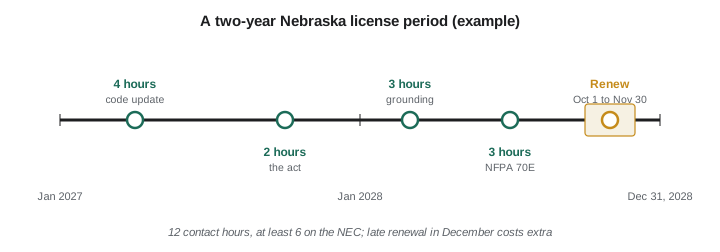
Jenna expected her contractor license to issue in early 2027, starting a period that runs to December 31, 2028. She sketched a plan on the company calendar: a four-hour code class in the spring of 2027, a two-hour State Electrical Act review that fall, a three-hour grounding and bonding class in early 2028 and a three-hour NFPA 70E class that summer. That gave her twelve hours, seven of them on the code, with the whole renewal season of 2028 free for the renewals of everyone else at Platte Valley.
She also put two dates on the calendar that had nothing to do with classes: October 1, 2028, to file her own renewal on the first day of the window, and September 30, 2028, as the company deadline for every employee's hours. Roger approved the plan with one comment. The year you plan it, he said, is the year it works.
| Date | Item | Hours (NEC) |
|---|---|---|
| Spring 2027 | Code update class | 4 (4) |
| Fall 2027 | State Electrical Act review | 2 (0) |
| Early 2028 | Grounding and bonding | 3 (3) |
| Summer 2028 | NFPA 70E | 3 (0) |
| October 1, 2028 | File renewal | Total 12 (7) |
Worked problem
Will Tyler renew on time?
On November 10, 2026, Tyler has completed 9 hours in the current period, 4 of them on the NEC. His license expires on December 31, 2026. What does he need and by when?
Show solution
- He needs 12 hours in total, so 3 more hours.
- At least 6 must be NEC, so at least 2 of the remaining hours must be NEC hours.
- He should finish the class and renew by November 30 to avoid the late charge.
- If he misses November 30, he can still renew in December by paying the late charge, but not after December 31.
Answer: Three more hours, at least two on the NEC, then renew by November 30, 2026.
Common mistakes
MistakeAssuming a license lasts two years from its issue date.
InsteadEvery license expires on December 31 of the next even-numbered year, whenever it was issued.
MistakeCounting a class attended for half its length.
InsteadCredit requires attendance for at least nine tenths of the class.
MistakeWaiting for the renewal notice to start classes.
InsteadSpread the 12 hours across the period.
MistakeWorking after December 31 on an unrenewed license.
InsteadAn expired license does not authorize work; call the division at once.
Summary and key terms
- All Nebraska electrical licenses and registrations expire on December 31 of each even-numbered year.
- Renew from October 1 to November 30; late renewal in December costs an extra one tenth of the fee.
- An expired license requires a new application and may require the exam again.
- Licensees need 12 contact hours of approved education each period, at least 6 on the NEC; apprentices need none.
- A contact hour is 50 minutes; credit requires attending at least nine tenths of the class.
- Renewal window
- October 1 to November 30 of each even-numbered year.
- Late renewal
- Renewal from December 1 to December 31 with a late charge.
- Contact hour
- Fifty minutes of approved classroom instruction.
- Approved course
- A continuing education course approved by the board.
- Section 81-2117.01
- The section of the act that sets the continuing education requirement.
Practice problems
Work each problem on paper first, then reveal the answer to check.
When does a Nebraska electrical license issued in April 2027 expire?
Show answer
December 31, 2028.
How many continuing education hours are required each period, and how many must be on the NEC?
Show answer
12 hours, at least 6 on the NEC.
Do registered apprentices need continuing education to renew?
Show answer
No, but they must renew the registration and pay the fee.
What late charge applies to a renewal filed on December 15 of a renewal year?
Show answer
One tenth of the renewal fee, on top of the fee itself.
Does a class approved only in another state count toward Nebraska hours?
Show answer
Not unless the Nebraska board has approved it; check before paying.
Lesson quiz · 5 questions
Score 60% or more to complete this lesson.
Create a free account to save your progress, take quizzes and earn a certificate.