
MELU-302 · Lesson 1 of 12 · 18 min
How electrical licensing works in Nebraska
▶ Video coming soon A video version of this lesson is on the way.
Platte Valley Electric has wired farmsteads, grain sites, shops and small commercial buildings around Kearney since 1988. Its owner, Roger Hanssen, holds a Nebraska electrical contractor license, and for more than thirty years the company has met the state's rules because Roger is both the owner and the licensee who carries the insurance. This fall Roger told the crew he plans to step back within two years, and he asked Jenna Kowalski whether she would take over as the company's licensed contractor. Jenna finished her apprenticeship at Platte Valley, earned her journeyman license in the spring of 2024 and has run crews ever since. She said yes, then asked the obvious question: what exactly would she be taking on? Roger's answer was short. In Nebraska, he said, almost everything runs through one state board and one statute. Learn how the pieces fit before you start tabbing a code book.
This course follows Jenna from that conversation to the day Platte Valley lists her as its licensee. It builds on the master electrician core courses (MELU-101 to MELU-107), which teach the National Electrical Code and the business topics common to every state. This course adds what is specific to Nebraska: the board and the act behind it, the license classes and eligibility, the application and the exam, the code as adopted, permits and inspection, the licensee's duties, contractor insurance, construction liens, workplace safety and renewal.
A word about the name of the license
Many states call the top license a master electrician license, and so does the title of this course. Nebraska once did too. The act still defines a Class A master electrician, but it also says that no new Class A or Class B master licenses have been issued since September 9, 1993. Existing holders may keep renewing, so a few older electricians still carry the title. A candidate who wants to plan, lay out and supervise electrical work for all purposes today earns the electrical contractor license. The exam for it is often listed by the testing company and by national groups as the electrical contractor or master electrician exam, which is why the two names travel together.
So when this course says master level, it means the electrical contractor license held by an individual such as Jenna. The license is personal, but it is the license that lets a business offer electrical work to the public, which is the role a master license plays in many other states. Lesson 2 looks at the eligibility rules in detail.
The board and the division
Statewide electrical licensing in Nebraska comes from the State Electrical Act. The act creates the State Electrical Board, seven members appointed by the governor with the consent of the legislature for staggered five-year terms. The seats are set aside for particular interests: a journeyman electrician, an electrical contractor or master electrician, a certified electrical inspector, a licensed professional engineer, a representative of public power or a rural electric cooperative, a representative of municipal electric systems, and one more member drawn from those groups. Members must live in Nebraska.
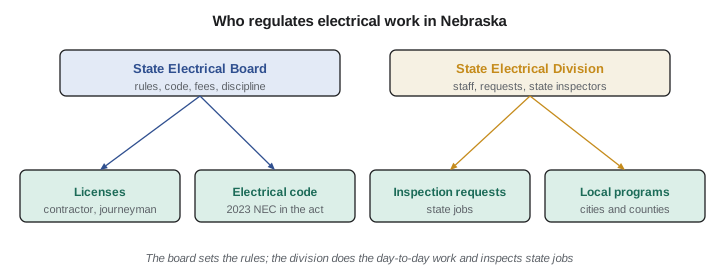
The board adopts rules, sets fees, decides who may sit for exams, adopts the edition of the National Electrical Code used in the state, and disciplines licensees. Day-to-day work is done by the State Electrical Division, the agency staff in Lincoln who process applications and renewals, take inspection requests, employ the state electrical inspectors and answer questions for the board. The division's website, electrical.nebraska.gov, is where the current act, the rules, application forms and the inspection map are posted.
A useful way to remember the arrangement is that the board makes the rules and the division carries them out. When the code edition changes, the board adopts it. When Jenna applies to test, renews her license or files an inspection request, she deals with division staff and the division's online systems. When a complaint is filed, the division investigates and the board decides what discipline, if any, follows.
The license classes
The act sets out a ladder of individual licenses. A registered apprentice may do electrical work only under the direct supervision of a licensee on the same project. A journeyman electrician has at least four years of experience acceptable to the board and has passed the journeyman exam; a journeyman may wire and install equipment and supervise apprentices, but may not offer work to the public as a contractor. A residential journeyman has at least three years of experience and is limited to residential installations. An electrical contractor has the extra experience described in lesson 2 and has passed the contractor exam, and may plan, lay out, install and supervise electrical work for all purposes.
Alongside the main ladder the act provides a special electrician license for limited classes of work, such as irrigation systems, water well pumps, air conditioning and refrigeration, and signs, and a fire alarm installer license for fire alarm components operating at 50 volts or less. It also keeps the older Class B licenses, which were limited to services of 400 amperes or less in dwellings of up to four families in towns under 100,000 people; like the master licenses, no new Class B licenses have been issued since 1993.
| License | What it allows (summary) | How it is earned (summary) |
|---|---|---|
| Registered apprentice | Work under the direct supervision of a licensee on the same job | Register with the board and pay the fee |
| Residential journeyman | Residential wiring; supervise apprentices | Three years of acceptable experience, then the exam |
| Journeyman electrician | Wire and install for all purposes; supervise apprentices | Four years of acceptable experience, then the exam |
| Electrical contractor | Plan, lay out, install and supervise all work; offer it to the public | Journeyman experience or an engineering route, then the exam |
| Special electrician | Limited classes such as irrigation or signs | Experience in each class listed |
| Fire alarm installer | Fire alarm components at 50 volts or less | Two years of acceptable experience |
One license for the whole state
A Nebraska license is a state license. Cities, villages and counties may run their own inspection programs, but section 81-2130 says that a person holding a board license of an equal or higher class may not be charged a local license fee or made to pass a local exam. A city may still require registration and proof of insurance before it issues a permit, and Lincoln, for example, registers electrical contractors who pull permits there. For Platte Valley this means Jenna's license will be good in Kearney, in Omaha and in the smallest village in the Sandhills on the same terms, even where the paperwork differs.
State and local inspection
Licensing is statewide, but inspection is shared. The state inspects covered work where no local program exists. Under section 81-2125 a city, village or county may run its own program if its ordinance is at least as strict as the state standard and its inspector is certified. The division lists the local programs on its website; the larger cities, including Omaha, Lincoln, Grand Island and Kearney, run their own, and so do several counties, such as Douglas, Lancaster, Hall and Sarpy. Even inside a local program, state-owned property and public schools stay under state inspection.
For a contractor the first question on any new job is therefore who inspects there. Marisol Vega, Platte Valley's office manager, keeps a map of the local programs in the company's service area and checks every new address against it. Lesson 6 covers inspection requests in detail.
# Who handles what in Nebraska electrical regulation (study aid)
roles = {
    "adopts the electrical code": "State Electrical Board",
    "adopts licensing rules and fees": "State Electrical Board",
    "processes license applications": "State Electrical Division",
    "takes state inspection requests": "State Electrical Division",
    "inspects where no local program": "State electrical inspectors",
    "inspects inside a local program": "City, village or county inspector",
    "decides discipline": "State Electrical Board",
}
for task in sorted(roles):
print(f"{task:34} -> {roles[task]}")adopts licensing rules and fees -> State Electrical Board adopts the electrical code -> State Electrical Board decides discipline -> State Electrical Board inspects inside a local program -> City, village or county inspector inspects where no local program -> State electrical inspectors processes license applications -> State Electrical Division takes state inspection requests -> State Electrical Division
The code
The board adopts the National Electrical Code as the state standard. In 2026 the edition in force is the 2023 NEC, which took effect for state work and for the license exams on August 1, 2024. The act keeps the 2017 edition for a handful of provisions, mainly ground-fault protection in dwellings, surge protection for dwelling services and the outdoor emergency disconnect for one- and two-family homes. Lesson 5 explains those differences and why they matter on the job and on the exam.
Jenna asked whether the code book on the truck was still good. It was a 2023 edition, so the answer was yes, but Roger made a point of it: the edition that matters is the one the board has adopted, not the newest one on the shelf. When the board moves to a later edition, the inspectors and the exams follow, and a candidate who studied the wrong book can lose easy points.
The exam vendor
Nebraska's license exams are given on computer by PSI, a national testing company, after the board approves the candidate. The exam is open book, the board's rules set the passing score at 75, and the subjects include the code, electrical theory and the State Electrical Act itself. Lessons 3 and 4 explain how to get approved, how to book and what the exam looks like.
What the contractor license adds
Jenna already does nearly every kind of work Platte Valley sells. What changes when she becomes its licensee is responsibility. She will be the person whose license stands behind the company's inspection requests, the person who must keep the required liability insurance in force, and the person accountable for how apprentices are supervised. An inspector with a correction order will call her. A board complaint about the company's work will name her license.
That is why the contractor exam goes further than the journeyman exam into design-level calculations, services and feeders, special occupancies, plans and the act itself. The core courses in this series prepare you for the code and calculation side. This course prepares you for the Nebraska side: who regulates, how the code is adopted, how inspection requests work and what a licensee must do to stay licensed.
Roger summed it up in one sentence. Your license says you can do it and sell it, the inspection request says this job is happening, and the inspector checks that it was done right. Each of the following lessons takes one of those links and looks at it closely.
Worked problem
Sorting the roles
Marisol asks Jenna to sort four tasks: (1) deciding which NEC edition applies in Nebraska, (2) processing Jenna's contractor exam application, (3) inspecting a new service at a grain site outside any local program, and (4) inspecting a remodel in Kearney, which runs its own program.
Show solution
- Adopting the code edition is an act of the State Electrical Board.
- Applications are processed by State Electrical Division staff; the board decides eligibility.
- Outside a local program, a state electrical inspector handles the request and the inspection.
- Inside Kearney's program, the city's certified inspector handles the permit and inspection.
Answer: The board; division staff for the board; a state inspector; the city inspector.
Common mistakes
MistakeLooking for a new master electrician license to apply for.
InsteadNo new master licenses have been issued since 1993; the license to earn is the electrical contractor license.
MistakeAssuming a city can make a state licensee pass its own exam.
InsteadSection 81-2130 bars a local license fee or exam for an equal or higher state license, although a city may require registration.
MistakeFiling a state inspection request for a job inside a local program.
InsteadCheck the location first; local programs handle their own permits and inspections.
MistakeAssuming state property inside a city follows the city program.
InsteadState-owned property and public schools stay under state inspection.
Summary and key terms
- The State Electrical Act, Neb. Rev. Stat. 81-2101 and following, creates statewide electrical licensing.
- The seven-member State Electrical Board makes the rules; the State Electrical Division carries them out.
- No new master licenses have been issued since 1993; the top license earned today is the electrical contractor license.
- Licenses are statewide; a local program may not charge a local license fee or give a local exam to an equal or higher state licensee.
- Inspection is shared: the state inspects where no local program exists, and always on state property.
- State Electrical Board
- The seven-member board that adopts the code and rules, approves candidates and disciplines licensees.
- State Electrical Division
- The agency staff who process licenses, take inspection requests and employ state inspectors.
- Electrical contractor license
- The Nebraska license that allows an individual to plan, lay out, install and supervise electrical work for all purposes.
- Local program
- A city, village or county inspection program run under section 81-2125 with a certified inspector.
- PSI
- The testing company that gives Nebraska's electrical license exams.
Practice problems
Work each problem on paper first, then reveal the answer to check.
Since what date has Nebraska stopped issuing new master electrician licenses?
Show answer
September 9, 1993. Existing holders may renew; new candidates earn the electrical contractor license.
How many members sit on the State Electrical Board, and who appoints them?
Show answer
Seven, appointed by the governor with the consent of the legislature.
May Omaha require a state-licensed electrical contractor to pass a city license exam?
Show answer
No. Section 81-2130 bars a local exam or license fee for an equal or higher state license.
Lesson quiz · 5 questions
Score 60% or more to complete this lesson.
Create a free account to save your progress, take quizzes and earn a certificate.