
MELU-301 · Lesson 9 of 12 · 21 min
Contracts and construction liens in Montana
▶ Video coming soon A video version of this lesson is on the way.
Every year Yellowstone Bend writes off a few invoices, and every year Rosa reminds Dale that most of those losses were avoidable. A customer who does not pay is usually a customer the company could have protected itself against with a written contract, a notice sent on time or a lien filed before the deadline. Montana calls these rights construction liens, under the Construction Lien Act in Title 71, chapter 3, part 5 of the Montana Code Annotated. This lesson covers the contract basics a master needs, the notice of right to claim a lien, the lien itself and its deadlines, foreclosure, payment protections in Montana's prompt payment law, and bonds on public work.
A caution before the details: lien law is technical and Montana courts apply its procedural requirements strictly. A lien that misses a deadline, leaves out required language or is not served correctly can be lost entirely. This lesson explains the system for the exam and for planning; a contractor with a real claim should get advice from a Montana construction attorney.
Contract basics
A contract is an agreement the law will enforce: an offer, acceptance, consideration and parties with capacity, for a lawful purpose. A good electrical contract also states the scope of work and what is excluded, the price and how it is paid, the schedule, how changes are priced and approved, who buys permits, warranty terms, and what happens when there is a dispute. Montana requires a written contract for certain residential construction work under MCA 28-2-2201, and the Montana Supreme Court has held that a contractor without the required written contract can lose its lien and contract claims, keeping at most a claim for unjust enrichment. For residential work, put it in writing every time.
Several Montana statutes reshape common contract terms. Under MCA 28-2-2111, a construction contract clause that makes one party indemnify the other for the other's own negligence, recklessness or intentional misconduct is generally void, although indemnity for the indemnitor's own conduct and for third-party losses is allowed. Under MCA 28-2-723, a contract may not require a party to waive lien or bond rights before being paid. And under the Prompt Payment Act, discussed below, clauses that bar a contractor from suspending work for nonpayment are void. Montana's statute of limitations for an action on a written contract is eight years under MCA 27-2-202, and a ten-year statute of repose under MCA 27-2-208 limits claims arising from improvements to real property.
Who may claim a lien
A person who furnishes services or materials under a real estate improvement contract may claim a construction lien on the property improved. That includes the original contractor who contracts with the owner, subcontractors, suppliers and, in some cases, workers. The lien secures payment for the services and materials furnished, and it attaches to the owner's interest in the property, so the owner may have to pay twice if it pays the general contractor and the general contractor does not pay its subcontractors.
Public property is different. A construction lien cannot be claimed against property owned by the state or a local government, so subcontractors and suppliers on public works rely on the contractor's payment bond, discussed at the end of the lesson.
The notice of right to claim a lien
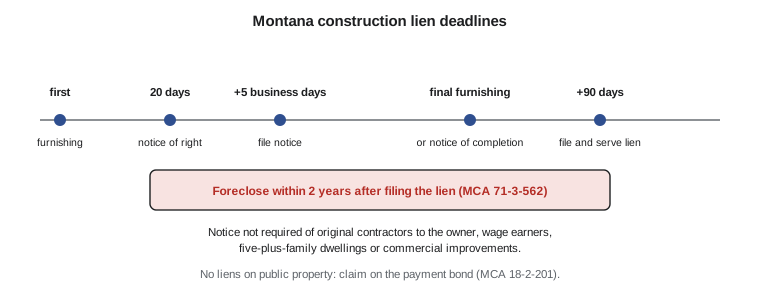
Montana requires many claimants to give a notice early in the job. Under MCA 71-3-531, a person who furnishes services or materials and wants to preserve lien rights must give the contracting owner a notice of right to claim a lien within 20 days after first furnishing, by certified mail or personal delivery, and then file the notice with the county clerk and recorder within five business days after the owner receives it. The statute supplies a sample form. A notice given late still preserves a lien, but only for services and materials furnished during the 20 days before the notice and afterward.
The notice is not required of everyone. The statute exempts an original contractor who furnishes services or materials directly to the owner at the owner's request, a wage earner performing personal services for a claimant, a person furnishing services or materials for a dwelling for five or more families, and a person furnishing services or materials for an improvement that is partly or wholly commercial. In practice the notice matters most to subcontractors and suppliers on single-family and small multifamily residential work. A filed notice remains effective for one year and expires unless a notice of continuation is filed.
Filing the lien
The lien itself is a document recorded with the county clerk and recorder in the county where the property sits. Under MCA 71-3-535, it must be filed within 90 days after the claimant's final furnishing of services or materials, or within 90 days after the owner files a notice of completion, as the statute provides. The lien must contain the information the statute requires, including a description of the property, the amount claimed and the services or materials furnished, and must certify that a copy was served on each record owner by certified mail, return receipt requested, or by personal delivery. The statute supplies a sample form in MCA 71-3-536.
Two traps catch electrical contractors. The first is the meaning of final furnishing: returning to a job months later to replace a device under warranty or to fix a punch-list item usually does not restart the clock, so the 90 days run from the last real contract work. The second is the notice of completion: an owner who files one can shorten the period, so a contractor finishing a job should check the county records for a notice of completion as well as watching its own calendar.
| Step | Deadline | Who |
|---|---|---|
| 20-day notice of right to claim a lien | Within 20 days after first furnishing | Claimants not exempt, mainly on small residential jobs |
| File the notice | Within 5 business days after the owner receives it | Same claimants |
| Continuation of the notice | Before the notice's one-year life ends, if needed | Same claimants |
| File the lien and serve the owner | Within 90 days after final furnishing or notice of completion | Any lien claimant |
| Foreclose | Within 2 years after filing the lien | Lien claimant |
Foreclosure and priority
A recorded lien does not pay anyone by itself. If the debt is not paid, the claimant must sue to foreclose the lien within two years after filing it, under MCA 71-3-562, or the lien is lost. In a foreclosure the court can order the property sold and the lien paid from the proceeds according to priority rules in MCA 71-3-541 and 71-3-542. The prevailing party in a lien foreclosure may recover reasonable attorney fees and costs under MCA 71-3-124, which cuts both ways: a contractor that files an inflated or improper lien can end up paying the owner's fees.
Owners have tools to remove a lien without waiting for a foreclosure, such as posting a bond or a deposit to release the property, and a lien that is satisfied must be released of record. A contractor should never use a lien as leverage for an amount it does not believe is owed; an inflated or unsupported lien exposes the claimant to a fee award and to claims by the owner, and it damages the contractor's credibility with the court on the part that is owed.
Worked problem
Counting the days
Yellowstone Bend is a subcontractor to a builder on a single-family house in Laurel. It first delivers material on March 3 and finishes its contract work on August 14. The builder has not paid the last draw. What are the deadlines?
Show solution
- The job is residential and the company did not contract with the owner, so it is not exempt from the notice: notice was due within 20 days after March 3, by March 23.
- If notice was given on time, it had to be filed within five business days after the owner received it.
- The lien must be filed within 90 days after August 14: by November 12, unless an earlier notice of completion was filed.
- If the lien is filed November 1, foreclosure must be filed within two years, by November 1 two years later.
Answer: The notice by March 23 (and filed within five business days after receipt), lien by November 12, foreclosure within two years after filing.
# Montana lien calendar (illustrative dates; confirm with counsel)
from datetime import date, timedelta
first, last = date(2026, 3, 3), date(2026, 8, 14)
notice_due = first + timedelta(days=20)
lien_due = last + timedelta(days=90)
lien_filed = date(2026, 11, 1)
foreclose_by = lien_filed.replace(year=lien_filed.year + 2)
print("notice of right to claim lien due:", notice_due)
print("lien filing deadline:", lien_due)
print("foreclosure deadline if filed", lien_filed, ":", foreclose_by)notice of right to claim lien due: 2026-03-23 lien filing deadline: 2026-11-12 foreclosure deadline if filed 2026-11-01 : 2028-11-01
Prompt payment
Montana's construction Prompt Payment Act, MCA 28-2-2101 and the sections after it, entitles a contractor that performs under its contract to payment from the owner, and a subcontractor that performs to payment from the contractor, within the periods the act sets after a proper payment request. It allows interest on late payments, lets a prevailing contractor or subcontractor recover attorney fees in a collection action under MCA 28-2-2105, and makes void any clause that bars suspension or termination for nonpayment under MCA 28-2-2116. Montana courts have not squarely addressed pay-if-paid clauses, and a contractor relying on one should get advice. Public owners pay under the prompt payment rules in MCA 18-2-123.
Waivers and releases at payment
Although Montana voids contract terms that require a waiver of lien or bond rights before payment, waivers given in exchange for payment are normal. General contractors and lenders ask for a lien release with each progress payment. The safe practice is to give a release that is conditional on the payment actually clearing and limited to the amount and period being paid, and to give an unconditional release only after the funds are in the bank. A release that covers all work through a date can waive a claim for unpaid change orders from that period, so Rosa lists any disputed or unbilled amounts as exceptions on every release Yellowstone Bend signs.
Good records make every one of these steps easier. A daily log that shows first and last furnishing dates, delivery tickets, signed change orders and copies of every notice and release is what a lawyer needs to prove a lien. Without them, the strongest claim in the world can fail on a date nobody can prove.
Public works bonds
On public works, the payment bond replaces the lien. MCA 18-2-201 and the sections after it require contractors on public works contracts to furnish bonds, with some small-project waivers set in the statute. A subcontractor or supplier that is not paid must present and file a written claim on the bond with the public body and the contractor within the period the statute sets, using the statutory form, and then sue on the bond if the claim is not paid. The deadlines are short and strict; a subcontractor on a public job should calendar them as soon as it starts work. A party who prevails against a surety can recover attorney fees under MCA 18-2-207.
Common mistakes
MistakeCalling it a mechanics' lien and assuming another state's rules.
InsteadMontana's Construction Lien Act sets its own notices and deadlines.
MistakeSkipping the 20-day notice on a small residential subcontract.
InsteadNon-exempt claimants must give the notice within 20 days and file it within five business days after receipt.
MistakeCounting the 90 days from a warranty visit.
InsteadThe period runs from final furnishing of contract work or an owner's notice of completion.
MistakeFiling a lien on a county building.
InsteadPublic property cannot be liened; claim on the payment bond.
MistakeSigning an advance lien waiver to get a contract.
InsteadMontana law voids requirements to waive lien or bond rights before payment.
Summary and key terms
- Montana calls them construction liens, under MCA Title 71, chapter 3, part 5.
- Non-exempt claimants give a notice of right to claim a lien within 20 days of first furnishing and file it within five business days after receipt.
- Original contractors dealing directly with the owner, wage earners, five-plus-family dwellings and commercial work are exempt from the notice.
- The lien is filed within 90 days after final furnishing or the owner's notice of completion and served on the owner.
- Foreclosure must be filed within two years after the lien is filed.
- Public work is protected by payment bonds under MCA 18-2-201, not liens.
- Construction lien
- A claim on improved real property securing payment for services or materials furnished.
- 20-day notice of right to claim a lien
- The early notice under MCA 71-3-531 that preserves lien rights for non-exempt claimants.
- Final furnishing
- The last day the claimant furnished contract services or materials, which starts the 90-day period.
- Owner's notice of completion
- A document an owner may file that can shorten the lien filing period.
- Payment bond
- A surety bond on public work that protects unpaid subcontractors and suppliers.
Practice problems
Work each problem on paper first, then reveal the answer to check.
Does Yellowstone Bend, as original contractor to a homeowner, need to give a notice of right to claim a lien?
Show answer
No; an original contractor furnishing directly to the owner at the owner's request is exempt.
A supplier to Yellowstone Bend on a strip mall job wants lien rights. Must it send the 20-day notice?
Show answer
No; work on a partly or wholly commercial improvement is exempt from the notice.
Final work was June 30. What is the lien deadline?
Show answer
Within 90 days, by September 28, unless an earlier notice of completion shortens it.
How long after filing does a claimant have to foreclose?
Show answer
Two years under MCA 71-3-562.
A school district has not paid its general contractor, who has not paid Yellowstone Bend. What protects the company?
Show answer
The contractor's public works payment bond, through a timely written claim.
Lesson quiz · 5 questions
Score 60% or more to complete this lesson.
Create a free account to save your progress, take quizzes and earn a certificate.