
MELU-301 · Lesson 12 of 12 · 19 min
Practice exam review and test-day strategy
▶ Video coming soon A video version of this lesson is on the way.
Six weeks before her exam, Maren took her first full practice test under real conditions: the code book, print reading book and Montana amendments she would bring, the calculator she would bring, a four-hour timer and no interruptions. She scored 67. Two weeks later she scored 74, and the week before the exam she scored 82. The improvement did not come from reading more of the code. It came from studying her mistakes. This last lesson sets out the method she used: how to take a practice exam, how to review it, how to turn the review into a study plan, and how to manage the clock and the book on test day. It ends with what happens in Montana after the score appears on the screen.
The method fits the Montana master exam as the board's information sheet describes it, 80 questions in 240 minutes with a passing score of 75, and it works for any timed open book licensing exam. The proportions in this lesson's examples are illustrative. Use the question count, time and scoring rules in your own admission notice and PSI bulletin.
Taking a practice exam properly
A practice exam is useful only if it is taken the way the real exam will be. That means the full number of questions in one sitting, the real time limit, only the references the bulletin allows, the same calculator, and no looking at answers until the end. Maren took hers at the kitchen table on Sunday mornings, with her phone in the truck. Partial practice sets are fine for drilling a topic, but at least three full timed exams, spaced out over the study period, show whether pacing and endurance are where they need to be.
Use practice exams written for the same kind of exam and the same code edition. Questions written for an older edition can teach the wrong answer, and questions written for a journeyman exam will not show the depth of a master exam. The core courses in this series, MELU-101 through MELU-107, include practice questions by topic that can be used for drilling between full exams.
Reviewing every question
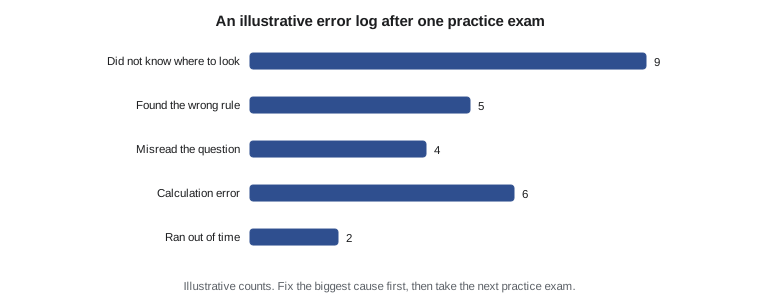
The review is where the learning happens, and it should take longer than the exam. Go through every question, not just the wrong ones, because a right answer reached by a lucky guess is a weakness too. For each question, find the code section that answers it, confirm the answer, and if you got it wrong or guessed, decide why. Maren sorted every miss into one of five causes.
- Did not know where to look: the section was not familiar, and the index search failed or took too long.
- Found the wrong rule: the right article, but the wrong section, exception or table.
- Misread the question: missed a word such as minimum, maximum, not or except, or a detail such as the voltage or the occupancy.
- Calculation error: a wrong step, a skipped factor or a keying mistake.
- Ran out of time: never reached the question or guessed in the last minutes.
Each cause has its own fix. Not knowing where to look calls for more index practice and better tabs. Finding the wrong rule calls for reading the whole section, including exceptions, when looking something up. Misreading calls for slowing down on the question stem. Calculation errors call for working each calculation the same way every time and checking units. Running out of time calls for the pacing plan below.
The error log
Maren kept an error log: a list with one line for each missed or guessed question, giving the topic, the code section, the cause and a one-sentence note on what she should have done. After each practice exam, she counted misses by topic and by cause. The counts told her where to spend the next two weeks. After her first exam, her biggest cause was not knowing where to look, mostly in the special occupancy chapters, so she spent a week on those chapters and their index entries. After her second, the biggest cause was calculation errors, so she reworked every load calculation in MELU-102.
# Error log summary after a practice exam (illustrative entries)
from collections import Counter
log = [("special occupancies", "where to look"), ("calculations", "calc error"), ("grounding", "wrong rule"),
       ("calculations", "calc error"), ("special occupancies", "where to look"), ("services", "misread"),
       ("motors", "calc error"), ("special occupancies", "where to look"), ("wiring methods", "time")]
by_cause = Counter(cause for _, cause in log)
by_topic = Counter(topic for topic, _ in log)
print("By cause:", ", ".join(f"{c} {n}" for c, n in by_cause.most_common()))
print("By topic:", ", ".join(f"{t} {n}" for t, n in by_topic.most_common()))By cause: where to look 3, calc error 3, wrong rule 1, misread 1, time 1 By topic: special occupancies 3, calculations 2, grounding 1, services 1, motors 1, wiring methods 1
The last two weeks
The last two weeks are for consolidation, not new material. Take a final full practice exam about a week out, review it the same way, and use the remaining days to drill the topics and causes the log still shows. Re-read the bulletin. Check that the code book has no notes or loose material that the bulletin forbids. Confirm the test center address or the remote setup, the start time and the identification needed. And sleep. A tired candidate misreads questions that a rested one would not.
A pacing plan
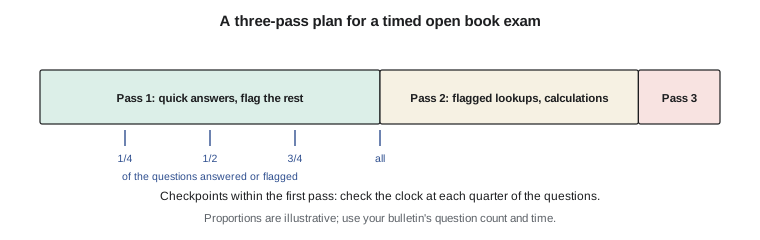
Timed exams reward a plan. The usual approach is three passes. On the first pass, answer every question you can answer quickly, from memory or with a fast lookup, and flag the rest without dwelling on them. On the second pass, work the flagged questions that need a longer lookup or a calculation. On the third pass, use the time left to check flagged answers and make your best choice on anything still open. The passes keep a few hard questions from eating the time needed for many easy ones.
Set checkpoints. With four hours for eighty questions on the Montana master exam, the first pass might aim to finish within about half the time, leaving the rest for the second and third passes. Check the clock at each quarter of the questions and adjust.
# Three-pass time plan (illustrative; use your bulletin's real numbers)
total_minutes = 240
plan = {"first pass: quick answers, flag the rest": 0.50,
        "second pass: flagged lookups and calculations": 0.38,
        "third pass: check flags, final choices": 0.12}
start = 0
for step, share in plan.items():
    minutes = round(total_minutes * share)
    print(f"{step}: minutes {start} to {start + minutes}")
start += minutesfirst pass: quick answers, flag the rest: minutes 0 to 120 second pass: flagged lookups and calculations: minutes 120 to 211 third pass: check flags, final choices: minutes 211 to 240
Using the book under time pressure
On test day the book is for confirming, not for learning. For a lookup question, go to the index or a tab, find the section, confirm the detail and move on. For an application question, read the question first and decide what rule you are looking for before opening the book. For a calculation, write the steps on the scratch material the test center provides, in the same order every time, and use the book only for the tables and factors. If a lookup takes more than about two minutes, flag the question and come back.
Answering when unsure
Licensing exams like Montana's typically score only correct answers, with no penalty for a wrong one, which means a blank answer is always a lost point. Confirm the scoring rule in your bulletin. If it scores only correct answers, answer every question, even if the last few minutes go to making educated guesses. Eliminate options you know are wrong first; on a four-option question, eliminating two doubles the chance of a right guess.
Be wary of changing answers on the third pass without a reason. Change an answer when the code shows the first one was wrong, not because of a vague feeling. And watch for options built from common mistakes, as Lesson 4 explains: if a calculation matches an option suspiciously easily, check the step the question writer was most likely testing.
Using the core courses for final review
The error log points to topics, and the core courses supply the review for each. Lookups in general requirements and definitions go back to MELU-101 on navigating the code. Service, feeder and dwelling calculations go to MELU-102. Conductor sizing, adjustment and overcurrent protection go to MELU-103. Grounding and bonding go to MELU-104, motors, transformers and generators to MELU-105, and the special occupancy chapters to MELU-106. Business and law topics go to MELU-107 and, for Montana's own rules, Lessons 1 to 3 and 7 to 11 of this course. Maren kept a short table matching each line of her error log to a lesson in one of those courses, so that each study session had a clear target and ended with a set of practice questions on the same topic.
Drill sets should be short and specific. Twenty questions on motor branch circuits, timed at the exam pace, teach more than an hour of reading about motors, because they force the same lookup and calculation steps the exam will. Maren ended each drill set by adding any new misses to the error log, so that the log stayed current until the last week.
Managing nerves
Most candidates are nervous, and some nervousness helps concentration. Too much makes people misread questions and forget lookups they know. The best cure is familiarity: by exam day, the format, the clock, the book and the calculator should all feel routine because the practice exams made them so. On the day, if a run of hard questions shakes your confidence, remember that the exam is built with a spread of difficulty, flag the hard ones, and go back to answering what you can. One bad stretch rarely decides the result; a panic that wastes twenty minutes can.
A Montana checklist for the last week
- Re-read the admission notice and the PSI bulletin, and confirm the NEC edition your exam uses.
- Check that the code book, the American Technical Publishers print reading book and the Montana Building Codes Amendments are your own bound copies, with no notes or loose pages.
- Check that the name on your identification matches your PSI registration exactly.
- Know the retake rules: no wait after one failure; six months and an eight-hour code seminar after two.
- Tell the office manager the exam date, so the change of responsible electrician can be filed as soon as the license issues.
Test day
Arrive early, with the identification PSI requires, the three allowed references, the allowed calculator and a spare battery. Expect the proctor to inspect each book page by page, and allow time for it. Store everything else in the locker. In winter, allow for the roads: a candidate driving to Billings from Roundup or to Helena from White Sulfur Springs should check the pass conditions the night before and leave early. During the exam, use breaks if they are allowed and you need them, but know whether the clock stops; often it does not. Eat beforehand, because four hours is a long time on an empty stomach.
After the exam
PSI's computer-based exam gives a result at the end of the session, with a score report. In Montana the application came first, so a pass does not start a new filing: PSI reports the score to the board, and the department issues the license once any remaining requirements are met. Then the contractor's work begins. For Yellowstone Bend that means Maren signing the acknowledgment of responsibility, Rosa filing the change of responsible electrician with the board, and an update to the binder pages that list the company's master. If you did not pass, the score report shows performance by content area. Add it to your error log, apply Montana's retake rules from Lesson 3, and plan the next sitting with the same method.
Maren passed with 84. Her license issued two weeks later. Rosa filed the change of responsible electrician the same afternoon, with Maren's signed acknowledgment, and Dale spent the next month teaching Maren the estimating side of the business before taking his first full week of fishing in eleven years.
Common mistakes
MistakeTaking practice exams untimed with extra notes.
InsteadTake them under real conditions with only allowed references.
MistakeReviewing only the wrong answers.
InsteadReview every question, including lucky guesses.
MistakeStudying new topics in the last week.
InsteadConsolidate the topics and causes the error log shows.
MistakeSpending ten minutes on one hard question.
InsteadFlag it and return on the second pass.
MistakeLeaving questions blank on an exam that scores only correct answers.
InsteadAnswer every question; eliminate options first.
Summary and key terms
- Take at least three full practice exams under real conditions, with the allowed references and calculator.
- Review every question and sort each miss by cause: where to look, wrong rule, misread, calculation or time.
- Keep an error log and study the biggest causes and topics first.
- Use three passes on test day: quick answers, flagged lookups and calculations, then checks and final choices.
- If the exam scores only correct answers, answer every question.
- After passing, the board issues the license; then the contractor names the new responsible electrician with a signed acknowledgment.
- Error log
- A record of missed or guessed questions with topic, section and cause.
- Three-pass method
- Answering quick questions first, then flagged ones, then checking.
- Flag
- A mark on a question to return to it later.
- Checkpoint
- A planned time for reaching a given question number.
- Score report
- The testing company's record of the result, often by topic.
Practice problems
Work each problem on paper first, then reveal the answer to check.
Maren's log shows most misses as did not know where to look. What should she do?
Show answer
Practice index searches and improve her tabs in those chapters.
A lookup is taking four minutes in pass one. What should she do?
Show answer
Flag the question and return on the second pass.
The bulletin says only correct answers are scored. Should she leave hard questions blank?
Show answer
No; answer every question, eliminating options first.
What should Maren do the day she passes?
Show answer
Watch for the license from the board, then have the company file the change of responsible electrician with her signed acknowledgment.
How long should a review of a four-hour practice exam take?
Show answer
Longer than the exam itself, ideally.
Lesson quiz · 5 questions
Score 60% or more to complete this lesson.
Create a free account to save your progress, take quizzes and earn a certificate.