
MELU-301 · Lesson 2 of 12 · 22 min
Eligibility for the Master Electrician License
▶ Video coming soon A video version of this lesson is on the way.
Maren's first real question for Dale was simple: does she qualify yet? She has held a journeyman license for seven years and has worked steadily the whole time, but she knows that Montana counts hours, not years, and that the board looks hard at how those hours are documented. This lesson works through the master eligibility rules in MCA 37-68-304, the board's application form and its checklist, and the related rules for the journeyman and residential licenses that sit below the master level.
Two paths to the master license
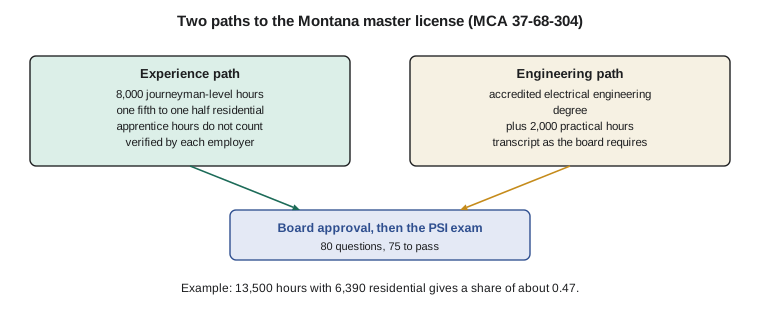
MCA 37-68-304 gives two routes. The first, which nearly every candidate uses, is experience: at least 8,000 hours of legally obtained journeyman-level experience in planning, laying out or supervising the installation and repair of wiring, apparatus or equipment for electric light, heat and power. The second is education: graduation as an electrical engineer from an accredited college or university, plus at least 2,000 hours of legally obtained practical electrical experience. The applicant must give written evidence of one path or the other, and must then pass the master examination.
Eight thousand hours is about four years of full-time work at roughly 2,000 hours a year. The word that matters is journeyman-level. The statute's definitions in MCA 37-68-102 treat journeyman-level experience as experience while holding a recognized journeyman license, or experience at the level a journeyman performs. Hours worked as an apprentice do not count toward the master's 8,000, and the board's checklist says so directly. A candidate's master clock therefore usually starts when the journeyman license is issued.
The residential share
The master application adds a detail that catches candidates who have spent their careers in one corner of the trade. Of the 8,000 journeyman-level hours, the application requires that between 20 and 50 out of every hundred, that is, between one fifth and one half, be residential. A candidate with 8,000 hours of industrial work only, or of residential work only, does not meet the mix and must keep working until the balance is right. The rule reflects what the master license allows: an unlimited contractor's responsible electrician may oversee both residential and commercial work, so the board wants experience in both.
Maren's hours are mixed. Yellowstone Bend does roughly two thirds commercial work and one third residential, and her early journeyman years with a smaller shop were almost all houses. She will check the residential share on each employer's form before she sends anything, because a verification form that shows the wrong mix is one of the most common reasons an application goes back to the candidate.
Worked problem
Checking Maren's hours
Maren has 3,900 journeyman hours at a residential shop (about 90 out of every hundred residential) and 9,600 journeyman hours at Yellowstone Bend (about 30 out of every hundred residential). Does she meet 8,000 hours with a residential share of one fifth to one half?
Show solution
- Residential hours: 3,900 times 0.9 is 3,510; 9,600 times 0.3 is 2,880; total 6,390.
- Total journeyman-level hours: 3,900 plus 9,600 is 13,500.
- Residential share: 6,390 divided by 13,500 is about 0.47, inside the one fifth to one half range.
- She could also submit only part of her history, as long as the hours she claims meet both tests.
Answer: Yes. She has well over 8,000 hours and a residential share of about 0.47.
# Check total hours and residential share (illustrative numbers)
employers = {
    "residential shop": (3900, 0.90),
    "Yellowstone Bend": (9600, 0.30),
}
total = sum(h for h, _ in employers.values())
res = sum(h * r for h, r in employers.values())
share = res / total
print(f"total journeyman-level hours: {total}")
print(f"residential hours: {res:.0f}  share: {share:.2f}")
print("meets 8,000 hours:", total >= 8000)
print("share between 0.20 and 0.50:", 0.20 <= share <= 0.50)total journeyman-level hours: 13500 residential hours: 6390 share: 0.47 meets 8,000 hours: True share between 0.20 and 0.50: True
Legally obtained, third-party verified
Two more words from the statute carry weight. Experience must be legally obtained, which in practice means earned while properly licensed and while working for a licensed electrical contractor or under one of the statutory exemptions. Hours earned doing unlicensed side work do not count, and claiming them is a false statement. The Legislature added a statutory definition of legally obtained practical experience in 2025, and the board removed its own rule definition to match, so a candidate whose history includes work in another state or an unusual employment arrangement should read the current definition before filing.
The hours must also be verified by a third party. The board's master experience verification form is completed by the employer, usually a corporate officer, registered agent or owner, one form for each employer whose hours the candidate wants counted. The candidate cannot verify her own hours, even if she owned the company, and union records alone are not accepted as verification. For an employer that has closed, the candidate should ask the board how to prove the hours, typically with payroll records, tax forms and statements from people who supervised the work.
| Item | What the board wants |
|---|---|
| Experience | 8,000 journeyman-level hours, or an EE degree plus 2,000 practical hours |
| Residential share | Between one fifth and one half of the hours claimed |
| Who verifies | Each employer, through a corporate officer, registered agent or owner |
| Not accepted | Self-verification, union records alone, apprenticeship hours |
| Other licenses | Verification from every state where the applicant holds or held a license |
| Personal history | Truthful answers; false or incomplete answers can lead to denial or revocation |
The engineering path
The second path is rare but real. An applicant who graduated as an electrical engineer from an accredited program needs 2,000 hours of practical experience instead of 8,000 journeyman-level hours. The board asks for proof of the degree, usually an official transcript, together with the practical experience verification. The checklist and the application describe the transcript slightly differently, one asking that it come directly from the school and the other asking for a copy, so a candidate on this path should confirm which the board wants. The engineering path leads to the same exam and the same license; it is not a separate engineer's credential.
The journeyman and residential licenses
A master candidate already holds a journeyman license in most cases, but the lower levels appear on the exam's law questions and in a master's daily work supervising others. MCA 37-68-305 sets the journeyman paths: completion of an approved apprenticeship or a union or trade association training program, or 8,000 hours of practical experience in wiring, installing and repairing electrical apparatus, or 20,000 hours in electrical maintenance of which at least 8,000 are practical. The journeyman exam has at least 60 questions. The residential license requires a residential apprenticeship, 4,000 hours of residential practical experience, a training program or the maintenance route, and its exam has at least 50 questions. Residential work under the statute means structures of fewer than five living units.
Out-of-state licenses
Montana does not have a general reciprocity agreement for the master license; the board's published information has listed reciprocal arrangements only at the journeyman level, with a group of neighboring and western states. In 2025 the Legislature strengthened the general licensing statute, MCA 37-1-304, which lets boards license people who hold substantially equivalent licenses elsewhere, and the board proposed a rule adopting a published list of states it considers substantially equivalent. A master from another state should check that list and the current rule. Even under equivalency, the applicant must list every jurisdiction where a license is or was held, and each board must send its verification directly to Montana.
Military service members, veterans and military spouses have additional routes under MCA 37-1-145 and related rules, and the board's FAQ describes a provisional license for military spouses while verification is pending. These routes change often; check the current rule before relying on them.
Character and history
Every Montana licensing application asks personal history questions about prior discipline, criminal convictions and unresolved complaints. The application warns that a false or incomplete answer can be grounds for denial or later revocation, and the duty to update the board continues after licensure. Under MCA 37-1-203, a criminal conviction is not by itself enough to deny a license, but the board can consider it. A candidate with history should answer fully and attach the explanation the form asks for; leaving a box blank or answering no when the answer is yes is the way most of these applications fail.
Dale gave Maren one more piece of advice: keep a copy of everything sent and a log of every call to the board. Applications that go back for corrections are common, and the candidate who can show exactly what was sent and when has the easiest time getting the file moving again.
Counting hours honestly
Hours on a verification form should match what payroll records would show. Employers usually count paid hours on electrical work, not hours on the clock spent driving between towns, sitting in a safety meeting or sweeping the shop, although reasonable jobsite time in the course of electrical work is ordinarily included. A candidate who worked overtime-heavy seasons may have more than 2,000 hours in a year; one who was laid off every winter may have fewer. The board does not ask for a diary, but it can ask questions, and a form that shows 3,000 hours in a single year with no overtime records behind it invites them.
Part-time and seasonal work counts at its real value. A journeyman who spends half the year on a ranch and half in the trade adds hours more slowly than one who works full time, and the residential share is computed on the hours actually claimed, not on calendar time. Hours in maintenance work for an employer's own plant can count as practical experience on the journeyman route, but the master route asks for journeyman-level hours on installation and repair work for light, heat and power, so a candidate whose experience is mainly maintenance should read the definitions closely and ask the board before filing.
Worked problem
A short-history candidate
Jesse Rourke, a journeyman at another Billings shop, got his license in March 2023. He has worked about 1,950 journeyman hours a year since then, roughly one quarter residential. In November 2026, about how many hours does he have, and is he eligible?
Show solution
- From March 2023 to November 2026 is about 3 years and 8 months, or about 3.67 years.
- 3.67 times 1,950 is about 7,150 hours.
- That is short of 8,000 hours by about 850 hours, a little under half a year of full-time work.
- His residential share of about one quarter is inside the one fifth to one half range.
Answer: Not yet. He needs about 850 more journeyman-level hours, so he should plan to apply in mid 2027.
When to apply
There is no benefit to applying early. An application filed before the hours are complete will be returned or held, and the fee is not refundable. Because the board processes routine, complete applications within about 30 days, and the exam can then be scheduled soon after approval, a candidate who has the hours in hand can usually move from application to exam within two months. Maren plans to file once all of her verification forms are back and checked, not before.
Common mistakes
MistakeCounting apprenticeship hours toward the master's 8,000.
InsteadThe master application excludes apprenticeship hours; journeyman-level experience is required.
MistakeHaving all hours in one kind of work.
InsteadBetween one fifth and one half of the claimed hours must be residential.
MistakeVerifying your own hours or relying on a union printout.
InsteadHours must be verified by the employer through an officer, agent or owner; union records alone are not accepted.
MistakeAssuming an out-of-state master license transfers automatically.
InsteadThere is no general master reciprocity; check the substantial equivalency rule and supply verification from every state.
MistakeLeaving a personal history question blank.
InsteadIncomplete or false answers can lead to denial or revocation.
Summary and key terms
- MCA 37-68-304 sets two master paths: 8,000 journeyman-level hours, or an electrical engineering degree plus 2,000 practical hours.
- Apprenticeship hours do not count toward the master's 8,000.
- Between one fifth and one half of the hours claimed must be residential.
- Each employer verifies the hours; self-verification and union records alone are not accepted.
- Journeyman and residential paths are in MCA 37-68-305; residential work means structures of fewer than five living units.
- Out-of-state masters rely on substantial equivalency, not reciprocity; answer personal history questions fully.
- Journeyman-level experience
- Experience while holding a recognized journeyman license or at the level a journeyman performs.
- Legally obtained
- Earned while properly licensed and working lawfully, as defined in statute since 2025.
- Experience verification form
- The board form completed by each employer to confirm hours and the residential share.
- Substantial equivalency
- A route under MCA 37-1-304 for applicants licensed in states with comparable standards.
- Residential electrician
- A Montana license for work on residential structures of fewer than five living units.
Practice problems
Work each problem on paper first, then reveal the answer to check.
Maren has 7,400 journeyman hours plus 2,000 apprentice hours. Does she qualify?
Show answer
Not yet; apprenticeship hours do not count, so she needs 600 more journeyman-level hours.
A candidate has 9,000 journeyman hours, all industrial. What is missing?
Show answer
The residential share; at least one fifth of the claimed hours must be residential.
Who signs the verification for hours at Yellowstone Bend?
Show answer
A company officer, registered agent or owner, such as Dale as owner.
What does the engineering path require?
Show answer
An accredited electrical engineering degree plus 2,000 hours of practical experience.
A Wyoming master moves to Billings. What should he check first?
Show answer
The board's substantial equivalency list and current rule, since there is no general master reciprocity.
Lesson quiz · 5 questions
Score 60% or more to complete this lesson.
Create a free account to save your progress, take quizzes and earn a certificate.