
MELU-301 · Lesson 4 of 12 · 20 min
The exam format and the references allowed
▶ Video coming soon A video version of this lesson is on the way.
Maren has taken one licensing exam already, the journeyman exam in 2019, and she remembers two things about it: the clock ran faster than she expected, and the questions she missed were the ones where she knew the answer but could not find the section in time. The master exam is longer and harder, and it adds load calculations and a print reading reference. This lesson describes the exam as the board's information sheet sets it out, the references a candidate may bring, how to prepare the code book, and how to plan the time.
The exam at a glance
The board's exam information sheet describes the Montana master electrician exam as 80 questions with 240 minutes allowed and a passing score of 75. MCA 37-68-304 sets a floor of at least 80 questions covering the National Electrical Code and the laws and rules in Title 37, so the statute and the sheet agree. The journeyman exam is 60 questions in 180 minutes and the residential exam 50 questions in 150 minutes, both with the same passing score. All three exams are computer-based, given by PSI, and open book.
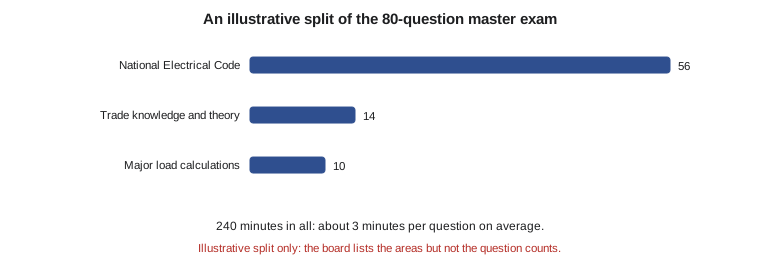
Two hundred forty minutes for 80 questions is three minutes a question on average. That sounds generous until a candidate meets a feeder calculation with five steps or a question that turns on one exception in a long section. Most candidates who fail do not run out of knowledge; they run out of time on the hard questions and then rush the easy ones. The time plan later in this lesson is built to prevent that.
| Exam | Questions | Time | Pass | Board-listed fee |
|---|---|---|---|---|
| Master electrician | 80 | 240 minutes | 75 | 85 dollars |
| Journeyman electrician | 60 | 180 minutes | 75 | 75 dollars |
| Residential electrician | 50 | 150 minutes | 75 | 75 dollars |
What is tested
For the exams based on the 2020 NEC, the information sheet lists three content areas for the master exam: the National Electrical Code, general trade knowledge and theory, and major load calculations. The earlier exams based on the 2017 NEC listed a longer set for masters, including cost estimating, procurement and material handling, print reading, layout of electrical circuits and electrical theory. The shorter list does not mean less work. Code questions remain the large majority, theory questions test Ohm's law, power, transformers and motors at the level of the MELU-101 to 107 core, and load calculation questions test the dwelling and nonresidential methods of Article 220 that MELU-102 covers.
The information sheet does not publish the number of questions in each area. Courses that sell Montana practice exams often describe a code-heavy split, with load calculations a small but expensive share because each takes several minutes. The figure below uses an illustrative split to plan study time; it is not the official blueprint.
The references allowed
All three exams are open book, but only for the references the information sheet lists, and each must be the candidate's own bound copy, unmarked except as PSI's rules allow. For the master exam the sheet lists three: the National Electrical Code edition the exam is based on; a print reading book based on the same NEC edition from American Technical Publishers; and the Montana Building Codes Amendments. The journeyman and residential exams allow the NEC and the Montana amendments but not the print reading book. Loose papers, attached notes and photocopies are not permitted.
Check the PSI candidate bulletin for the exact title and edition of the print reading book and for the rules about tabs and highlighting. PSI bulletins in many states allow permanent tabs and highlighting but forbid handwritten notes, sticky notes that can be moved and inserted pages. The safest preparation is a book whose only additions are permanently attached tabs and highlighting, with nothing written in the margins. Proctors inspect the books, and a book that fails inspection stays outside the room.
Calculators are allowed under PSI's general rules if they are silent, battery-powered and not programmable, with no alphabetic keyboard or communication ability. A basic scientific calculator that handles square roots is the usual choice. Bring a spare battery or a second approved calculator.
Which NEC edition
The information sheet in force in November 2026 describes 2020 NEC master exams, and it also lists 2017 exams for the transition that followed the 2022 adoption. The Building Codes Bureau lists the 2023 NEC as Montana's adopted code effective September 26, 2026. When an exam changes editions, the board and PSI announce it and usually run a transition period. Maren's rule, and the rule for every Montana candidate in late 2026 and 2027, is to buy the code book only after checking the admission notice and the current bulletin. Studying the 2023 edition for a 2020 exam, or the reverse, costs points on every question where the two editions differ.
Preparing the code book
A tabbed code book is the single best investment a candidate can make. Tab the start of each chapter and the articles that appear on nearly every master exam: Article 100 for definitions, Article 110 for general requirements and working space, Article 210 for branch circuits, Article 215 for feeders, Article 220 for load calculations, Article 230 for services, Article 240 for overcurrent protection, Article 250 for grounding and bonding, Article 310 for conductors, Article 314 for boxes, the raceway articles of Chapter 3, Article 430 for motors, Article 450 for transformers, Article 517 for health care facilities, Article 680 for pools, Article 690 for solar and Chapter 9 for conduit fill. Tab the index too; under time pressure the index is often faster than paging.
Then tab the Montana amendments. The amendments book is short, and the exam can ask about a Montana change directly. Under the 2020 adoption, the state rule amended the ground-fault protection requirements of 210.8(A) and (B) for certain 250-volt receptacles and removed kitchens from the arc-fault requirements of 210.12. Whether those amendments carried into the 2023 adoption is a question to settle from the current amendments document; Lesson 5 explains how to read it.
Worked problem
Building a time plan
Maren wants a plan for 80 questions in 240 minutes that leaves time to review. How should she budget?
Show solution
- Reserve 20 minutes at the end for review and flagged questions: 220 minutes remain.
- Pass one: answer every question that takes under two minutes, flag the rest. Suppose 55 questions at an average of 1.8 minutes: about 99 minutes.
- Pass two: work the 25 flagged questions at about 4.5 minutes each: about 112 minutes.
- Total for passes one and two is about 211 minutes, leaving about 9 minutes of slack before the review block.
Answer: A two-pass plan with a 20-minute review block fits inside 240 minutes with a little slack.
# Time plan for an 80-question, 240-minute exam (illustrative)
total_min, questions, review = 240, 80, 20
quick, quick_avg = 55, 1.8
hard = questions - quick
hard_avg = 4.5
used = quick * quick_avg + hard * hard_avg
print(f"pass one: {quick} questions, {quick * quick_avg:.0f} min")
print(f"pass two: {hard} questions, {hard * hard_avg:.0f} min")
print(f"slack before review: {total_min - review - used:.0f} min")
print(f"checkpoint: question 40 by minute {40 * (total_min - review) / questions:.0f}")pass one: 55 questions, 99 min pass two: 25 questions, 112 min slack before review: 8 min checkpoint: question 40 by minute 110
How questions are written
Licensing questions are written to have one best answer among four. Distractors are built from real code values: the right number from the wrong table, the right rule for the wrong occupancy, or the rule before an exception. Read the stem twice, underline mentally the words that decide the article: dwelling or not, continuous or not, copper or aluminum, wet or dry location. Then find the section, read the whole sentence and any exception, and only then look at the answers. Candidates who look at the answers first tend to pick the familiar number.
Law questions on the master exam come from MCA Title 37 chapter 68 and the board's rules, so they test the material of Lessons 1 to 3, 7, 8 and 11. They are usually the fastest points on the exam because they need no code lookup. Load calculation questions are the slowest, so a candidate should know Article 220 so well that the only lookup is the occasional demand factor.
Sample questions in the Montana style
The two examples below show the kind of reasoning the exam rewards. They are written for this course, not taken from the exam, and they cite the code by article rather than quoting it. Work them with your own code book open.
First, a law question. A journeyman holding a provisional master credential is asked by the company owner to sign the acknowledgment of responsibility for a new limited contractor license the owner is forming for a second company. May she? No: a provisional credential never allows acting as a responsible electrician, and a limited contractor's responsible electrician must be a licensed journeyman or master employed full time by that contractor. The question tests Lessons 3 and 8 without any code lookup, and a prepared candidate answers it in thirty seconds.
Second, a code question. A candidate is asked for the minimum working space depth in front of a 480-volt panelboard with grounded parts on the opposite wall. The answer is in Article 110, in the working space table, under the condition that matches exposed live parts on one side and grounded parts on the other. A candidate who has tabbed Article 110 finds it in under a minute; one who starts in the index under panelboards may lose three. The value itself is not the lesson. The lesson is that the condition number decides the answer, and the wrong conditions supply the distractors.
A study plan that matches the exam
Maren set aside four months. She plans six to eight hours a week, more in the last month, and she has divided the time roughly in proportion to the exam: most of it on code navigation, a solid block on load calculations because each one is expensive on the exam, a smaller block on theory, and a few evenings on the Montana law material in this course. Every second week she takes a timed practice set under exam conditions, with only the books she will bring, and logs every miss by cause, as Lesson 12 describes.
She also practices with the computer interface. PSI exams let the candidate flag questions, move back and forth and see a timer. A candidate who has never used a flagging screen should try PSI's demonstration or a practice test that mimics it, so that on exam day the only new thing is the questions.
In the testing room
Expect a check-in that takes time: identification, a photo, a search of pockets, and an inspection of every reference book page by page. Personal items, including phones, watches and bags, go in a locker. Scratch paper or an erasable board and a pencil are provided under PSI's rules and collected at the end. Breaks may be allowed, but the clock usually keeps running. If something goes wrong, such as a frozen screen or a noisy room, tell the proctor at once and ask that it be written up; a complaint made after leaving the center is much harder to act on.
Common mistakes
MistakeBringing a print reading book to the journeyman exam.
InsteadThe print reading book is listed only for the master exam.
MistakeWriting notes in the code book margins.
InsteadReferences must be unmarked except for the tabs and highlighting the bulletin allows.
MistakeBuying the newest NEC without checking the exam edition.
InsteadConfirm the edition on the admission notice and current bulletin.
MistakeSpending ten minutes on one load calculation in pass one.
InsteadFlag slow questions and come back in pass two.
MistakeLeaving the Montana amendments at home.
InsteadThe amendments are an allowed reference, and the exam can ask about them.
Summary and key terms
- The Montana master exam has 80 questions, 240 minutes and a passing score of 75.
- Content areas: the NEC, general trade knowledge and theory, and major load calculations.
- Master references: the NEC edition tested, an American Technical Publishers print reading book on the same edition, and the Montana Building Codes Amendments.
- References must be the candidate's own unmarked bound copies; loose papers are not allowed.
- The 2023 NEC took effect September 26, 2026; confirm the exam edition before buying books.
- A two-pass time plan with a review block keeps hard questions from crowding out easy ones.
- Open book
- An exam that allows listed references, but only those references.
- Montana Building Codes Amendments
- The state document setting out Montana's changes to the adopted codes, allowed in the exam room.
- Distractor
- A wrong answer designed to look right, often a real value from the wrong place.
- Flagging
- Marking a question to return to later in the exam.
- Major load calculations
- Service and feeder calculations under Article 220, a listed master content area.
Practice problems
Work each problem on paper first, then reveal the answer to check.
How many minutes per question does the master exam allow on average?
Show answer
Three minutes: 240 minutes for 80 questions.
Which reference may a master candidate bring that a journeyman may not?
Show answer
The American Technical Publishers print reading book based on the same NEC edition.
May Maren bring a photocopy of Table 310.16 with notes?
Show answer
No; loose papers and notes are not allowed.
What is the passing score?
Show answer
75.
What should Maren do before buying a 2023 NEC?
Show answer
Check her admission notice and the current PSI bulletin for the exam edition.
Lesson quiz · 5 questions
Score 60% or more to complete this lesson.
Create a free account to save your progress, take quizzes and earn a certificate.