
MELU-301 · Lesson 10 of 12 · 20 min
Workplace safety law and OSHA for electrical contractors
▶ Video coming soon A video version of this lesson is on the way.
Two winters ago a Yellowstone Bend journeyman slipped on an icy ladder at a Billings job, broke his wrist and was off work for seven weeks. The company handled it well: first aid, a ride to the clinic, a report to its insurer the same day, light duty when the doctor allowed, and a review that changed how the crews handle ladders in freezing weather. Maren was the crew lead that day, and she learned how many separate clocks start when someone is hurt. This lesson covers who enforces workplace safety for a Montana electrical contractor, the federal OSHA standards that matter most to electrical work, Montana's Safety Culture Act, the reporting deadlines after an injury and the basics of Montana workers' compensation.
Who enforces safety
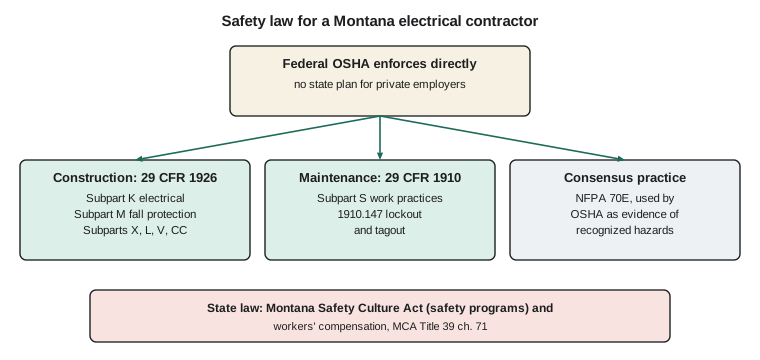
Montana does not run a state OSHA plan for private employers. Private-sector workplaces in Montana, including electrical contractors and their jobsites, are under federal OSHA, which enforces the Occupational Safety and Health Act through its area office for the state. Federal OSHA inspects after complaints, referrals, serious injuries and fatalities, and through targeted programs, and it issues citations and penalties under the federal standards. State and local government employers in Montana are covered instead by the state's public-sector safety program in the Department of Labor and Industry.
Montana adds its own law on top of federal OSHA. The Montana Safety Culture Act, MCA 39-71-1501 and the sections after it, requires employers to establish safety programs suited to their size and hazards, with employee participation, training and periodic review, and the department's rules describe what a program includes. The Act is administered by the Department of Labor and Industry rather than enforced through federal-style citations, and it is one reason Montana insurers and the State Fund ask employers about their safety programs and training.
The federal standards that matter
Most electrical contractor work is construction, governed by 29 CFR Part 1926. Subpart K covers electrical safety in construction, including ground-fault protection for temporary power through GFCIs or an assured equipment grounding conductor program, and lockout and tagging of circuits. Subpart M covers fall protection, with the general six-foot trigger height for construction. Subpart X covers ladders and stairways, and Subpart L scaffolds. Subpart V covers power transmission and distribution work, which applies when a contractor works on utility-type lines. Subpart CC covers cranes and derricks, including the clearances from overhead lines that come up on every job with a boom truck or crane. General industry rules in Part 1910 apply to maintenance work in existing facilities, including the electrical safety-related work practices in Subpart S and the lockout/tagout rule in 1910.147.
OSHA's general duty clause requires every employer to keep the workplace free of recognized hazards likely to cause death or serious harm, even where no specific standard applies. NFPA 70E, the standard for electrical safety in the workplace, is not itself a law, but OSHA treats it as evidence of recognized hazards and feasible protections for arc flash and shock, and a contractor that ignores it risks citation under the general duty clause and the electrical work practice standards. Yellowstone Bend's policy is to establish an electrically safe work condition before work whenever possible, and to use an energized electrical work permit, shock and arc flash risk assessments and the right PPE in the rare cases where de-energizing is not feasible.
| Topic | Main federal rule | Common electrical-job issue |
|---|---|---|
| Temporary power | 1926 Subpart K | GFCI or assured grounding program for cords and tools |
| Lockout and tagging | 1926.417; 1910.147 for maintenance | Locks on every source before work |
| Falls | 1926 Subpart M | Protection at six feet; lifts and roofs |
| Ladders | 1926 Subpart X | Inspection, setup and three points of contact |
| Overhead lines | 1926 Subpart CC and Subpart K | Boom trucks and lifts near power lines |
| Arc flash | General duty clause; NFPA 70E as guidance | Risk assessment and PPE for energized work |
Montana conditions
Some hazards are sharper in Montana than in many states. Winter work brings ice on ladders and roofs, short daylight and cold that stiffens hands and cable jackets; crews need traction devices, heated breaks and a plan for daylight. Rural jobs can be an hour or more from a hospital, so every truck carries a trauma kit, the crew knows the site's address or coordinates for emergency dispatch, and someone checks in by phone or satellite messenger at set times where there is no cell service. Agricultural jobs put crews near grain bins, augers, livestock and irrigation pivots, each with its own hazards, and near overhead distribution lines crossing fields and yards.
Overhead lines are the most common cause of electrical fatalities in construction nationally, and Montana's farm and ranch work multiplies the exposure. Before a boom truck, lift or long ladder goes up near a line, the crew identifies the line voltage, keeps the clearances the OSHA rules require, uses a dedicated spotter where the rules call for one and calls the utility to de-energize or cover the line when the work cannot be kept clear. The call costs a day at most. Yellowstone Bend's rule is that nobody raises a boom near a line until the crew lead has signed the overhead line checklist.
Training and the competent person
Many OSHA construction standards require training and a competent person: someone able to identify existing and predictable hazards and authorized to correct them. Fall protection, ladders, scaffolds and excavations all have training requirements, and the electrical standards require that only qualified persons work on or near exposed energized parts. Under NFPA 70E, a qualified person has the skills and knowledge for the equipment and has received safety training to identify and avoid the hazards. Training must be documented. When OSHA investigates, the first questions are what training the workers had and who the competent person on the site was.
Reporting clocks after an injury
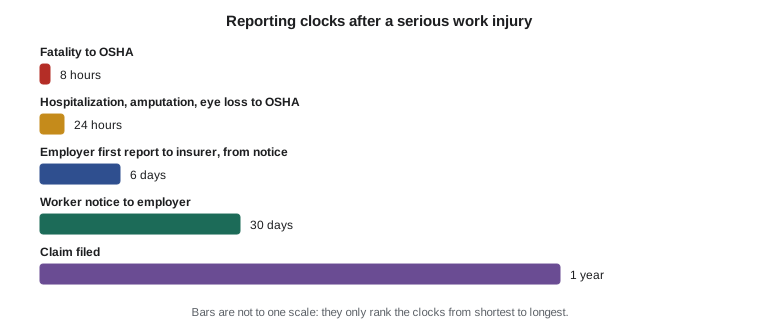
Several reports may be due after a work injury, each with its own deadline and recipient. Under federal OSHA's rule in 29 CFR 1904.39, an employer must report a work-related fatality to OSHA within eight hours, and an in-patient hospitalization, amputation or loss of an eye within 24 hours. Separately, OSHA's recordkeeping rules require many employers to record injuries on the OSHA 300 log, although some low-hazard industries and small employers are partially exempt; electrical contractors are generally not in an exempt industry.
Montana's workers' compensation law adds its own clocks. An injured worker must notify the employer of the injury within 30 days under MCA 39-71-603, and a claim must be filed within one year under MCA 39-71-601. The employer must report the injury to its insurer, and the department's rules, as insurers' claims kits describe them, require the first report of injury within six days after the employer has notice. An employer that fails to file required reports can be assessed a penalty for each offense under MCA 39-71-307.
Worked problem
Sorting the clocks
At 2 p.m. on a Tuesday, an apprentice on a Yellowstone Bend job falls from a ladder and is admitted to the hospital overnight with a fractured hip. What reports are due, and when?
Show solution
- In-patient hospitalization: report to OSHA within 24 hours, by about 2 p.m. Wednesday.
- Workers' compensation: the apprentice has given notice to the employer at once, well within 30 days.
- First report of injury to the insurer within six days after the employer's notice.
- Record the case on the OSHA 300 log within the recordkeeping deadline, and keep the company's own incident report.
Answer: OSHA within 24 hours, the insurer within six days, and the OSHA log; the claim itself must be filed within one year.
# Reporting deadlines from the time of the event (illustrative)
from datetime import datetime, timedelta
event = datetime(2026, 2, 10, 14, 0)
deadlines = {
    "OSHA: fatality (8 hours)": event + timedelta(hours=8),
    "OSHA: hospitalization, amputation, eye loss (24 hours)": event + timedelta(hours=24),
    "Insurer: first report of injury (6 days from notice)": event + timedelta(days=6),
    "Worker: notice to employer (30 days)": event + timedelta(days=30),
    "Claim filed (1 year)": event.replace(year=event.year + 1),
}
for name, when in deadlines.items():
print(f"{name}: {when:%Y-%m-%d %H:%M}")OSHA: fatality (8 hours): 2026-02-10 22:00 OSHA: hospitalization, amputation, eye loss (24 hours): 2026-02-11 14:00 Insurer: first report of injury (6 days from notice): 2026-02-16 14:00 Worker: notice to employer (30 days): 2026-03-12 14:00 Claim filed (1 year): 2027-02-10 14:00
Workers' compensation basics
Montana workers' compensation is a no-fault system. An employee injured in the course of employment receives medical benefits and wage-loss benefits regardless of who was at fault, and in exchange the employer is generally protected from being sued by the employee for the injury. Employers insure through Plan 1 self-insurance, Plan 2 private insurers or Plan 3, the Montana State Fund. An employer that should have coverage and does not is an uninsured employer; the department's Uninsured Employers' Fund pays some benefits to injured workers of uninsured employers and then pursues the employer for the cost and substantial penalties.
For a contractor, the hardest workers' compensation questions are about who is an employee. A worker who takes direction from a crew lead, uses the company's tools and is paid by the hour is an employee, whatever the paperwork says. Montana's independent contractor exemption certificate, discussed in Lesson 8, is the way a genuinely independent worker shows the status, and a hiring contractor that uses a worker without a required certificate or coverage can become that worker's employer for compensation purposes. Since January 2026, misclassification is also unprofessional conduct under the department's construction contractor licensing law.
After the incident
The hours after an injury set the tone for everything that follows. Care for the injured worker comes first, then making the scene safe, then preserving it: photographs, the ladder or tool involved set aside, names of witnesses and short written statements while memories are fresh. The crew lead calls the office, and the office calls the insurer and, if the injury meets OSHA's reporting criteria, OSHA. A short incident review within a few days asks what happened, why the controls in place did not prevent it and what will change, without hunting for someone to blame. The review's results go into the safety program the Safety Culture Act requires, and into the next toolbox talk.
Return to work and premiums
Workers' compensation premiums depend on payroll, job classification and the employer's claims history through the experience modification factor. A company with frequent or expensive claims pays more and may lose bids that require a low experience modifier. Return-to-work programs that offer modified duty as soon as a doctor allows are good for the injured worker, who keeps working and earning, and for the employer, whose claim costs fall. Montana's Safety Culture Act and the State Fund's safety programs both push employers in this direction.
After the ladder injury, Yellowstone Bend gave the journeyman light duty in the shop prefabricating assemblies and reviewing drawings, which he could do with one hand in a cast. The claim stayed small, the worker stayed connected to the crew, and the company's experience modifier did not move.
Common mistakes
MistakeAssuming Montana runs a state OSHA plan for private contractors.
InsteadPrivate employers in Montana are under federal OSHA.
MistakeTreating NFPA 70E as irrelevant because it is not a statute.
InsteadOSHA uses it as evidence of recognized hazards and protections.
MistakeWaiting 30 days to tell the insurer about an injury.
InsteadThe 30 days is the worker's notice deadline; the employer's first report is due within six days of notice.
MistakeCalling every one-person sub an independent contractor.
InsteadWithout a valid exemption certificate or coverage, the hiring contractor can become the employer.
MistakeReporting a hospitalization to OSHA after a week.
InsteadIn-patient hospitalizations must be reported within 24 hours.
Summary and key terms
- Federal OSHA covers private employers in Montana; public employers are under the state program.
- Key construction rules: 1926 Subparts K, M, X, L, V and CC; maintenance work falls under 1910 Subpart S and 1910.147.
- NFPA 70E is the consensus electrical safety standard OSHA treats as evidence of recognized hazards.
- The Montana Safety Culture Act requires employers to have safety programs.
- OSHA reporting: fatality 8 hours; hospitalization, amputation or eye loss 24 hours.
- Workers' compensation: worker notice 30 days, employer first report within six days of notice, claim within one year.
- General duty clause
- The OSHA duty to keep the workplace free of recognized serious hazards.
- Competent person
- Someone able to identify hazards and authorized to correct them.
- Qualified person
- A person with the skills, knowledge and safety training for the electrical equipment involved.
- Montana Safety Culture Act
- The state law requiring employers to maintain safety programs.
- Uninsured Employers' Fund
- The state fund that pays some benefits to injured workers of uninsured employers.
Practice problems
Work each problem on paper first, then reveal the answer to check.
Who inspects a private Billings jobsite after a serious injury?
Show answer
Federal OSHA.
An electrician is killed on a job at 9 a.m. By when must OSHA be told?
Show answer
Within eight hours, by 5 p.m.
Within what time must the injured worker tell the employer?
Show answer
Within 30 days under MCA 39-71-603.
What Montana law requires a safety program?
Show answer
The Montana Safety Culture Act, MCA 39-71-1501 and following.
Which plan is the Montana State Fund?
Show answer
Plan 3.
Lesson quiz · 5 questions
Score 60% or more to complete this lesson.
Create a free account to save your progress, take quizzes and earn a certificate.