
MELU-301 · Lesson 6 of 12 · 20 min
Permits, inspections and the inspection authority
▶ Video coming soon A video version of this lesson is on the way.
Yellowstone Bend buys about three hundred electrical permits a year, and Rosa Kaminski can tell from the job address alone which office will issue each one. Maren needs the same skill, because as responsible electrician she will answer for every permit the company buys. This lesson explains who has inspection authority in Montana, when a permit is needed and who may buy it, the inspection stages and the green tag, how long a permit lasts, and what happens when work fails or is done without a permit.
Who has inspection authority
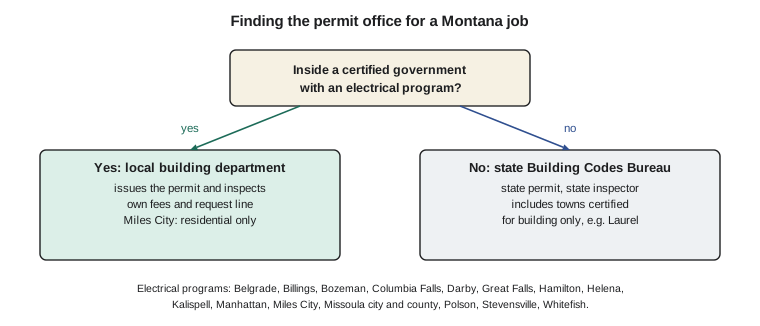
The Department of Labor and Industry, through the Building Codes Bureau, has authority to issue electrical permits and inspect electrical work across Montana, directly or through authorized representatives. A city, county or town may take over that work inside its area by having its code enforcement program certified under MCA 50-60-302. Certification requires that the local government file its adopted codes, its fee schedule and an enforcement plan, that the bureau approve them, and that its inspectors who approve work normally requiring a state license hold a current Montana journeyman license or an approved national certification. Certified programs file annual reports and, in some cases, independent audits.
The bureau's list of certified governments shows sixteen with electrical programs: Belgrade, Billings, Bozeman, Columbia Falls, Darby, Great Falls, Hamilton, Helena, Kalispell, Manhattan, Miles City (residential electrical only), the City of Missoula, Missoula County, Polson, Stevensville and Whitefish. Most cover their city limits; Missoula County covers the county. Many other certified governments, such as Laurel, Livingston and Havre, run building programs but not electrical ones, so electrical permits there come from the state. All other areas are under the state Building Codes Bureau.
| Job location | Permit office | Why |
|---|---|---|
| Inside Billings city limits | City of Billings | Certified electrical program, city limits |
| Rural Yellowstone County | State Building Codes Bureau | No certified electrical program there |
| Inside Laurel | State Building Codes Bureau | Laurel is certified for building, not electrical |
| Commercial job in Miles City | State Building Codes Bureau | Miles City's electrical program is residential only |
| Rural Missoula County | Missoula County | County-wide certified electrical program |
When a permit is needed
An electrical permit is required for installations in new construction, remodeling and repair, unless an exception in MCA 50-60-602 applies. The state issues residential, commercial, alternative energy and homeowner permits. The exceptions are narrow: signal and communication work and street lighting owned by public entities, low-voltage signal, communication and fiber work, certain work at refineries and regulated mines, a regularly employed maintenance electrician working on the employer's own premises, plugging an appliance into an existing approved outlet, and vendors connecting appliances that need no new wiring. The maintenance exception applies to employees on the payroll, not to contractors hired to do maintenance.
The permit must be requested before work starts. Under the state program, an electrical permit is not issued until the building permit has been issued or the building official has determined none is needed, which ties the electrical work to the building review. Certified local programs follow similar rules and may require plan review for commercial work.
Who may buy a permit
The permittee is responsible for all work done under the permit, and only the permittee or the permittee's licensed employees and registered apprentices may do the work. For a contractor, that means the permit is bought in the name of the licensed electrical contractor, and the work is done by its own licensed electricians and apprentices, not by a subcontractor's crew or a temporary worker paid in cash. A limited contractor may buy permits only for the residential work its license allows.
A homeowner may do electrical work on the homeowner's own residence or property without a license, if the property is maintained for personal use, and may buy a homeowner permit. The exemption does not cover property built for sale or rent, and it does not cover a grid-tied generator. Work on a rental must be done by a licensed contractor. For a farm or ranch, the state treats the owner, the owner's agent and full-time farm or ranch employees as the permittee for the operation's agricultural buildings, and an owner working on the owner's own farm or ranch for private use falls under the homeowner provisions.
The inspection stages
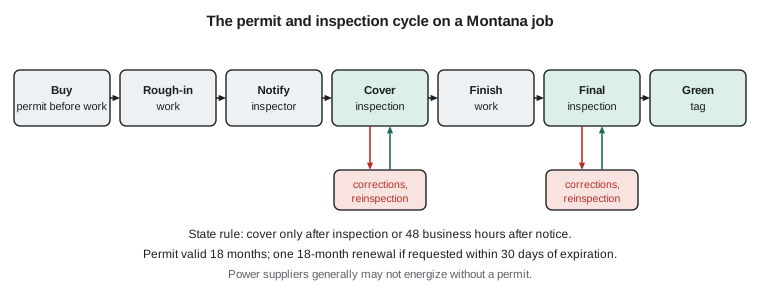
The state program describes two main inspections, and certified programs add others for larger jobs. The cover inspection, often called rough-in, comes before wiring is concealed. The permittee notifies the inspector when work is ready, and under the state rules insulation and wallboard may not be installed until 48 business hours after notice unless the inspection has already happened. The final inspection comes when the work is complete; the permittee notifies the inspector and provides access. Larger jobs may need underground, service and other intermediate inspections, and certified cities post their own lists.
When an installation is approved, the inspector issues a green tag, and any provisional power is removed in favor of the permanent service. When an installation is disapproved, the inspector lists the corrections; the permittee makes them and requests reinspection. An inspector who finds an immediate fire or shock hazard may have provisional power removed. Inspectors represent the state or the certified government; they cannot design circuits or do engineering for the permittee.
Power and the utility
A power supplier generally may not energize an installation that needs a permit unless a permit has been issued. The state allows a few exceptions, including temporary connections of up to 14 days and provisional power for construction. Energizing an installation without a permit is a misdemeanor. A certified local government may require proof of an approved inspection before a power supplier energizes, if it first gives the supplier written notice. In practice, Yellowstone Bend's jobs connect only after the utility sees the permit, and in certified cities, after the inspection.
How long a permit lasts
A state electrical permit is valid for 18 months. It may be renewed once for another 18 months if the renewal is requested within 30 days of expiration. A permit may be transferred in writing to another permittee for a small fee before the new permittee starts work, which matters when a contractor leaves a job and another finishes it. The state's fee schedule prices residential permits by service size, rewiring by circuit count and commercial work on a sliding scale by project cost, and certified programs set their own fees. The state also charges an hourly investigation fee when it investigates work done without a permit.
Worked problem
A stalled permit
Yellowstone Bend bought a state permit for a farm shop near Huntley on May 1, 2025. The owner stopped the project in the fall, and in October 2026 asks the company to finish. What should Rosa check?
Show solution
- A state permit is valid for 18 months from May 1, 2025, so it expires about November 1, 2026.
- A renewal for 18 more months is available once, if requested within 30 days of expiration.
- Rosa should request the renewal before the deadline, or the company will need a new permit.
- A new permit after September 26, 2026 would be under the 2023 NEC; a renewed permit may keep its original edition, subject to the bureau's rule.
Answer: Request the one-time renewal before the permit lapses and confirm the code edition with the bureau.
# Permit expiry and renewal window (state permit, illustrative date)
from datetime import date
issued = date(2025, 5, 1)
def add_months(d, m):
    y, mo = divmod(d.month - 1 + m, 12)
    return date(d.year + y, mo + 1, min(d.day, 28))
expires = add_months(issued, 18)
print("issued:", issued)
print("expires about:", expires)
print("renewal: request within 30 days of expiration; one renewal of 18 months")
print("renewed permit expires about:", add_months(expires, 18))issued: 2025-05-01 expires about: 2026-11-01 renewal: request within 30 days of expiration; one renewal of 18 months renewed permit expires about: 2028-05-01
Working in a certified city
A certified city runs its own process within the state framework. It has its own permit portal or counter, its own fee schedule, its own inspection request line and often its own submittal rules for commercial plans. Some require plan review for commercial electrical work above a size threshold, a load calculation with each new service, or a one-line diagram for larger jobs. Inspection lists may be longer than the state's two-stage model, with separate underground, service, rough-in, above-ceiling and final inspections. None of this changes the code, which is the state's, or the license, which is the board's; it changes the paperwork and the schedule.
Rosa's binder tab for each certified city lists exactly those items, and she updates it whenever a city changes its portal or fee schedule. When Yellowstone Bend starts work in a city it has not worked in before, Maren calls the electrical inspector first to ask how the city likes inspection requests made, how much notice it needs and what it expects on site, such as the permit card posted and the approved plans available.
Inspection day habits
Passing inspections is mostly preparation. Before calling for a cover inspection, the lead electrician walks the job with the plans, checks box fill and support, confirms that every required ground-fault and arc-fault device is shown on the plan for the final, labels home runs and makes sure the panel schedule is started. On the day, someone who knows the job meets the inspector, the area is safe to walk and lit, and ladders are available. A failed inspection costs a return trip and a reinspection request, and on a tight schedule it can cost the drywall crew a day.
When an inspector writes a correction, the crew fixes exactly what was written, photographs the correction and requests reinspection promptly. When the correction seems wrong, Maren asks for the section and reads it with the inspector rather than arguing on site. Most disagreements end there, because either the inspector or the contractor finds that the other had read the section more carefully.
Corrections, appeals and work without a permit
A contractor who disagrees with an inspector's decision should first ask for the code section relied on and discuss it with the inspector's supervisor. If that fails, the state building code statutes provide an appeal process, and certified governments have their own boards of appeals. Appeals turn on what the adopted code says, so the contractor should bring the section and any bureau interpretation, not opinions.
Work done without a permit is a violation by the person who did it and, for a contractor, a licensing matter for the board as well. The bureau can investigate and charge its investigation fee, require a permit after the fact, require that work be uncovered for inspection, and refer the matter to the board. Repeated failure to buy permits is one of the patterns the board treats as unprofessional conduct, and a responsible electrician who allows it can be disciplined along with the company.
Common mistakes
MistakeAssuming every certified city issues electrical permits.
InsteadMany certified governments run building programs only; check the electrical column of the list.
MistakeTreating a contractor doing maintenance as exempt.
InsteadThe maintenance exception covers regularly employed maintenance electricians on the employer's premises, not contractors.
MistakeCovering rough-in wiring the day after calling for inspection.
InsteadUnder the state rules, cover only after inspection or 48 business hours after notice.
MistakeLetting a homeowner permit cover a rental.
InsteadRental and resale property requires a licensed contractor.
MistakeLetting a permit expire on a stalled job.
InsteadRequest the one-time 18-month renewal within 30 days of expiration.
Summary and key terms
- The Building Codes Bureau permits and inspects statewide except inside sixteen certified electrical programs.
- MCA 50-60-602 lists narrow exceptions; the maintenance exception covers employees, not contractors.
- The permittee is responsible for the work, which must be done by its licensed employees and registered apprentices.
- Homeowners may work on their own personal-use property, but not on rentals, resale property or grid-tied generators.
- State permits last 18 months with one 18-month renewal requested within 30 days of expiration.
- Power suppliers generally may not energize without a permit; energizing without one is a misdemeanor.
- Certified electrical program
- A local government's state-certified program for electrical permits and inspections.
- Cover inspection
- The rough-in inspection before wiring is concealed.
- Green tag
- The approval issued when an installation passes inspection.
- Provisional power
- Temporary power allowed during construction, removed once the installation is approved.
- Permittee
- The person or contractor who holds the permit and is responsible for the work under it.
Practice problems
Work each problem on paper first, then reveal the answer to check.
Who issues the permit for a commercial remodel in Miles City?
Show answer
The state Building Codes Bureau, because Miles City's electrical program is residential only.
May the rancher's full-time hand do the shop wiring under the ranch's permit?
Show answer
For the operation's agricultural buildings, the state treats full-time farm employees as part of the permittee; check the current rule.
When may drywall go up after Maren calls for a state cover inspection?
Show answer
After the inspection, or 48 business hours after notice.
A homeowner wants a homeowner permit to wire a duplex he rents out. May he?
Show answer
No; rental property must be wired by a licensed contractor.
What does the utility need before energizing a new service?
Show answer
A permit, and in some certified cities, proof of an approved inspection.
Lesson quiz · 5 questions
Score 60% or more to complete this lesson.
Create a free account to save your progress, take quizzes and earn a certificate.