
MELU-301 · Lesson 5 of 12 · 20 min
The NEC as adopted in Montana and state amendments
▶ Video coming soon A video version of this lesson is on the way.
In October 2026 Yellowstone Bend's estimator, Cole Ferrin, asked Maren a question she could not answer on the spot: a school addition the company was bidding would be permitted in November, so which code edition should he price? A month earlier the answer would have been the 2020 NEC. The Building Codes Bureau's code page now lists the 2023 NEC as Montana's adopted electrical code, effective September 26, 2026. This lesson explains how Montana adopts the National Electrical Code, how the state amends it, how a change of edition reaches a job, and where the line between the NEC and the utility's own code falls.
Statewide adoption by rule
Montana adopts its building codes through the Department of Labor and Industry under the building code statutes in Title 50, chapter 60 of the Montana Code Annotated. The department's Building Codes Bureau writes an administrative rule that incorporates the code by reference, publishes notice in the Montana Administrative Register, takes public comment and adopts the rule. The electrical code rule is in ARM Title 24, chapter 301, subchapter 4. The rule incorporates the NFPA 70 National Electrical Code and then lists the state's amendments, section by section.
Because the adoption is a state rule, it applies across Montana. Certified local governments that run their own electrical programs enforce the state-adopted code; they do not pick an edition of their own. This is the most important difference between Montana and states such as Kansas or Missouri, where each city adopts its own edition. In Montana a job in Kalispell and a job in Glendive are under the same NEC edition on the same day.
The recent adoptions
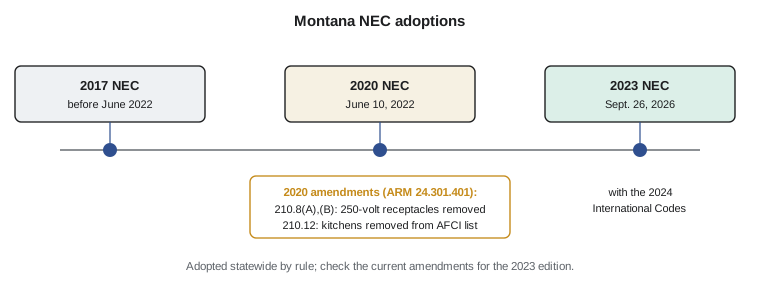
The 2020 NEC took effect in Montana on June 10, 2022, together with the 2021 International Building and Residential Codes and the 2021 Uniform Plumbing Code. The rule incorporated the 2020 NEC with a short list of amendments. In September 2026 the bureau moved the electrical code to the 2023 NEC on the same date it moved the building, residential, existing building, energy, mechanical, fuel gas, pool and wildland-urban interface codes to their 2024 editions. The bureau's current codes page lists the 2023 NEC with an effective date of September 26, 2026, and notes that all listed codes are amended by ARM Title 24, chapter 301.
Montana's amendments have historically been few and narrow. The 2020 adoption changed three provisions. In 210.8(A), the ground-fault protection rules for dwelling units, and in 210.8(B), the rules for other than dwelling units, the state removed 250-volt receptacles from the requirement, leaving the protection in place for the lower-voltage receptacles. In 210.12, the arc-fault rules, the state removed kitchens from the list of dwelling areas requiring protection. Each change reflected concerns raised in Montana about nuisance tripping and cost, and each is the kind of detail an exam can ask about because it differs from the published code.
| Section (2020 adoption) | Published NEC | Montana change |
|---|---|---|
| 210.8(A) dwelling GFCI | Protection for listed receptacles, including certain 250-volt receptacles | 250-volt receptacles removed from the requirement |
| 210.8(B) other than dwelling GFCI | Protection for listed receptacles, including certain 250-volt receptacles | 250-volt receptacles removed from the requirement |
| 210.12 dwelling AFCI | Kitchens among the areas requiring AFCI protection | Kitchens removed from the list |
Whether the same amendments, or new ones, apply under the 2023 adoption is the first thing to check in the current rule and the Montana Building Codes Amendments document. The 2023 NEC reorganized parts of 210.8 and added new ground-fault provisions, so an amendment written for the 2020 section numbers had to be rewritten or dropped. The bureau's code interpretation pages show that it has already addressed questions about the 2023 ground-fault rules, including a tentative interim amendment affecting outdoor outlets under 210.8(F). A master who bids work under the 2023 edition should read the amendments before pricing GFCI and AFCI devices.
Which edition applies to a job
When a new edition takes effect, jobs already under way do not change codes in the middle. The usual rule in Montana, as in most states, ties the edition to the job's permit or plan review: work permitted or submitted for review before the effective date may proceed under the code in force at that time, and new permits after the date use the new edition. The bureau's adoption notice and transition guidance state the exact rule, and certified local programs follow the state's dates. A contractor who is unsure should ask the permitting office in writing which edition it will inspect to and keep the answer in the job file.
The transition creates a few predictable traps. A permit that expires and is renewed may come back under the new edition, so a job that stalls for a winter should be checked before work resumes. A change order that adds a new circuit or a service upgrade on an older permit may be reviewed under the new edition if it needs a new permit. A design completed under the old edition but submitted after the effective date will be reviewed to the new one, so the engineer may need to revise it. And a residential builder who buys several permits before the effective date to lock in the old code should expect the permit's 18-month life, discussed in Lesson 6, to limit how far that strategy goes.
Worked problem
Pricing the school addition
Cole is pricing a school addition. The design team expects to submit plans for review in late November 2026, and the job sits inside a certified city. Which edition should he price?
Show solution
- The 2023 NEC took effect statewide on September 26, 2026.
- A submission in late November is after the effective date.
- The certified city enforces the state-adopted code, so it uses the same edition.
- He should price the 2023 NEC as amended by ARM Title 24, chapter 301, and confirm with the plan reviewer.
Answer: The 2023 NEC with Montana's current amendments.
The NEC and the utility's code
The NEC covers premises wiring: the installation on the customer's side of the service point. Utility installations, such as generation, transmission and distribution lines and the equipment the utility owns up to the service point, are outside the NEC's scope under its own Article 90 and fall instead under the National Electrical Safety Code, which MCA 69-4-201 applies to utility lines and equipment in Montana. Montana's major utilities, including NorthWestern Energy and the rural electric cooperatives, also publish service requirements that set meter locations, service entrance details and clearances. A master needs to know where the line falls, because a question about overhead line clearances over a farmyard may be an NESC or utility question, not an NEC one, depending on who owns the conductors.
Utility requirements can be stricter than the NEC in practice. A utility may require a particular meter socket, a specific location for the meter on the building or a disconnect outside the building, and it will not connect a service that does not meet its book even if the electrical inspector has approved the premises wiring. Yellowstone Bend keeps the current NorthWestern Energy service manual and the manuals of the two cooperatives it works with in the truck binder.
Other codes that touch electrical work
Several other state-adopted codes contain electrical requirements. The International Residential Code includes electrical chapters drawn from the NEC, but electrical permits and inspections in Montana are run under the adopted NEC, so a residential electrician works from the NEC and treats the residential code's electrical chapters as a building official's reference. The International Energy Conservation Code sets lighting power and control requirements for commercial buildings and some dwelling lighting requirements. The International Fire Code and the building code govern items such as emergency lighting and fire alarm placement in coordination with the NEC. Elevator wiring meets the NEC and the adopted ASME A17.1 elevator code. A master's job is to know which code an inspector will cite and to keep the editions straight.
How a rule change is made
A new edition does not arrive by surprise. The bureau publishes a proposal notice in the Montana Administrative Register with the text of the rule, the reasons for each amendment and a date for a public hearing. Anyone may comment in writing or at the hearing, and contractors, inspectors, utilities and trade associations usually do. After the comment period, the department publishes an adoption notice that responds to the comments and states the effective date, which is often several months after adoption so that designers, contractors and inspectors can train. Contractors who track the Register see the change coming a year ahead.
Masters have a practical reason to take part. An amendment that removes a requirement, like the 2020 kitchen AFCI change, starts as a comment from someone who has seen the cost or the nuisance tripping in the field. An amendment that a contractor finds unworkable can only be fixed in the next rulemaking. Maren has added the bureau's rule notice list to her email so that she sees proposals as they are published.
What a new edition changes for a contractor
Each NEC edition changes hundreds of sections. For a Montana contractor the changes that matter most are the ones that alter what goes on the truck and what it costs: wider ground-fault and arc-fault coverage in dwellings, surge protection and emergency disconnect requirements for dwelling services that arrived in the 2020 edition and were refined in 2023, reorganized rules for medium-voltage conductors and equipment, and expanded requirements for energy storage, solar and electric vehicle equipment. Continuing education in the first renewal cycle after an adoption concentrates on these changes, and Lesson 11 explains why at least half of each cycle's hours must cover code updates.
Estimators and project managers need the changes earlier than electricians do, because a bid priced on the old edition can lose money on the new one. Yellowstone Bend holds a short meeting after each adoption where Maren walks the estimators through the changes that affect material and labor, and Cole updates the company's pricing templates the same week.
Reading an amendment
An amendment in ARM is written as a set of instructions: delete a phrase, add an exception, replace a subsection. Reading one takes three steps. First, find the section in the adopted NEC edition and read the published text. Second, apply the amendment's instruction to that text. Third, read the result as a whole, including exceptions, and compare it with the published text to see what changed. Maren keeps a single page at the front of her code book, allowed only during study and not in the exam room, that lists each Montana amendment by section so she can find them quickly.
Code interpretations are a separate source. The bureau publishes interpretations and responses to code questions, and certified local building officials may issue their own determinations on how they apply a section. These do not amend the code, but they show how inspectors read it. When an interpretation affects a job, keep a copy with the permit.
Common mistakes
MistakeAssuming each certified city adopts its own NEC edition.
InsteadMontana adopts the electrical code statewide by rule; certified programs enforce the state edition.
MistakeApplying the 2020-era amendments to 2023 work without checking.
InsteadRead the current ARM rule and amendments document for the 2023 adoption.
MistakeChanging editions in the middle of a permitted job.
InsteadJobs generally proceed under the code in force when permitted or submitted; confirm the transition rule.
MistakeTreating utility line clearances as NEC questions.
InsteadUtility-owned lines fall under the NESC and utility rules, applied in Montana by MCA 69-4-201.
MistakeIgnoring the utility's service manual.
InsteadThe utility will not connect a service that does not meet its requirements.
Summary and key terms
- Montana adopts the NEC statewide by administrative rule in ARM Title 24, chapter 301.
- The 2020 NEC took effect June 10, 2022; the 2023 NEC took effect September 26, 2026.
- The 2020 adoption amended 210.8(A) and (B) for 250-volt receptacles and removed kitchens from 210.12; check the 2023 rule.
- Certified local programs enforce the state-adopted code.
- The NESC and utility requirements govern utility-owned installations; the NEC governs premises wiring.
- Keep written confirmation of the edition a permitting office will inspect to.
- Incorporation by reference
- Adopting a published code in a rule by citing it rather than reprinting it.
- Amendment
- A state change to a section of the adopted code, published in the rule.
- Montana Administrative Register
- The publication where proposed and adopted rules appear.
- National Electrical Safety Code
- The code for utility installations, applied in Montana by MCA 69-4-201.
- Service point
- The point of connection between the utility's facilities and the premises wiring.
Practice problems
Work each problem on paper first, then reveal the answer to check.
Which NEC edition applies to a new permit in Bozeman in December 2026?
Show answer
The 2023 NEC as amended by ARM Title 24, chapter 301.
Who adopts Montana's electrical code?
Show answer
The Department of Labor and Industry, through the Building Codes Bureau, by rule.
Did the 2020 adoption require AFCI protection in dwelling kitchens?
Show answer
No; Montana removed kitchens from 210.12.
Which code governs a utility-owned distribution line across a ranch?
Show answer
The National Electrical Safety Code and the utility's rules.
What should Cole get from the plan reviewer?
Show answer
Written confirmation of the code edition the job will be reviewed and inspected under.
Lesson quiz · 5 questions
Score 60% or more to complete this lesson.
Create a free account to save your progress, take quizzes and earn a certificate.