
MELU-301 · Lesson 8 of 12 · 20 min
Contractor licensing, insurance and bonding
▶ Video coming soon A video version of this lesson is on the way.
Yellowstone Bend Electric, LLC is a business with a license of its own. That license, not Maren's or Dale's personal license, is what lets the company sign contracts, buy permits and send crews to customers' buildings. When Maren becomes responsible electrician, she will need to understand how the contractor license works, what it requires the company to carry, and the difference between the insurance the company buys to protect itself and the bonds owners require to protect themselves. This lesson covers the board's contractor license, workers' compensation and unemployment insurance, the department's construction contractor rules, liability insurance, and bonds on private and public work.
The electrical contractor license
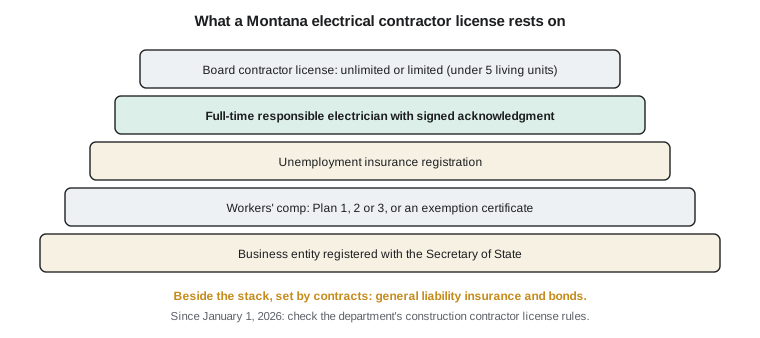
Under MCA 37-68-301, no person or business may work as an electrical contractor in Montana, or hold itself out as one, without a contractor license from the State Electrical Board. MCA 37-68-312 requires each firm to file an application and pay the fees. The board issues two kinds of contractor license. An unlimited electrical contractor may do residential, commercial, industrial and institutional work and must have a master electrician as its responsible electrician. A limited electrical contractor is restricted to residential work in structures of fewer than five living units and must have at least a journeyman as its responsible electrician.
The contractor application asks for the business name and address, the federal employer identification number or the owner's Social Security number, a business email, any prior board license, and information about each owner. It asks the same personal history questions as the individual applications and requires a signed affidavit. It requires the responsible electrician's acknowledgment of responsibility, verification from every other state where the business has held a license, and the fee, listed on the board's form as 210 dollars. A Montana contractor license is statewide; there is no separate city electrical contractor license, although certified cities may require registration or a business license to buy permits.
| Item | Unlimited contractor | Limited contractor |
|---|---|---|
| Responsible electrician | Master, full time | Journeyman or master, full time |
| Scope | Residential, commercial, industrial, institutional | Residential, fewer than five living units |
| Workers' comp and unemployment insurance | Required, or a valid exemption | Required, or a valid exemption |
| Board license bond | None listed on the application | None listed on the application |
| Board liability insurance requirement | None listed on the application | None listed on the application |
Workers' compensation and unemployment insurance
The contractor application requires compliance with the Workers' Compensation Act, MCA Title 39, chapter 71, and the Unemployment Insurance Law, MCA Title 39, chapter 51. An employer with employees must carry workers' compensation coverage under one of Montana's three plans: Plan 1, self-insurance approved by the department; Plan 2, a policy from a private insurer; or Plan 3, a policy from the Montana State Fund. The employer must also register for unemployment insurance with the department and pay contributions on wages.
The application warns that out-of-state policies may not be valid in Montana. A contractor based in another state whose workers' compensation policy does not list Montana in the section for other states' coverage does not have Montana coverage, and its employees injured in Montana may not be covered. Contractors moving work across state lines should ask the insurer to confirm Montana coverage in writing before the first job.
A business with no employees can comply differently. Montana's independent contractor exemption certificate, issued by the department under MCA 39-71-417, is the usual way for a sole proprietor or working owner in construction to show that he or she is an independent contractor rather than someone else's employee. The certificate covers the holder only; once the business hires an employee, it needs workers' compensation coverage for that employee. A company that hires a one-person business as a subcontractor without seeing its exemption certificate or proof of coverage can become liable as that person's employer.
The department's construction contractor rules
Separately from the electrical board, Montana regulates construction contractors generally through the Department of Labor and Industry. For years this was a construction contractor registration program tied to workers' compensation compliance. In 2025 the Legislature passed House Bill 239, effective January 1, 2026, which replaced registration with a construction contractor license in a new chapter of Title 37. The new law requires a construction contractor to hold a current department license, requires proof of workers' compensation compliance, lists unprofessional conduct such as misclassifying workers or hiring someone without a required exemption certificate, and protects a hiring party from employer liability for a contractor that was licensed on the contract date.
Whether a contractor that already holds a State Electrical Board license must also hold the new construction contractor license depends on the statute's definitions and exemptions, which the department's pages explain. Maren will ask the department directly and keep the answer in the company's file. Either way, the protection for hiring parties is a reason to check the license or registration of every subcontractor, and the misclassification rules are a reason to treat every person who works under a crew lead's direction as an employee unless a valid exemption says otherwise.
Liability insurance
The board's contractor application does not list a commercial general liability requirement, and Montana does not set a statewide liability minimum for electrical contractors. In practice, general liability insurance is required by almost every commercial customer, general contractor and public owner, and by many homeowners, through the contract. A typical commercial subcontract requires certificates showing general liability, automobile liability, workers' compensation with employer's liability, and often an umbrella policy, with the general contractor and owner named as additional insureds. Some certified cities may also ask for proof of insurance before issuing permits; check each city's requirements.
Liability insurance protects the contractor. It pays claims by others for bodily injury or property damage the contractor causes, such as a fire traced to a faulty connection, up to the policy limits, and it pays the cost of defending covered claims. It generally does not pay to redo the contractor's own defective work. Yellowstone Bend carries general liability, auto, workers' compensation through a private insurer, an umbrella and an inland marine policy for tools and equipment, and Rosa sends certificates to customers on request.
Bonds
A bond is a three-party promise. The surety promises the obligee, usually the owner or a general contractor, that the principal, the contractor, will perform the contract or pay its subcontractors and suppliers; if the contractor fails, the surety pays and then seeks reimbursement from the contractor. Unlike insurance, a bond protects others, not the contractor, and the contractor signs an indemnity agreement that makes it responsible for anything the surety pays.
The board does not require an electrical contractor license bond. Bonds appear through contracts. On private work, owners and general contractors may require performance and payment bonds on larger jobs. On public work, MCA 18-2-201 and the sections after it require contractors on state and local public works contracts to furnish bonds, with the amount and any small-project waivers set in the statute; because property owned by the public cannot be subject to a construction lien, the payment bond is how subcontractors and suppliers on public work are protected. Public bids often require a bid security as well. Lesson 9 covers claims on public payment bonds.
Insurance and bonds are often confused on exams, so it helps to keep one test in mind: ask who gets paid if something goes wrong. Insurance pays others on the contractor's behalf for covered harm and protects the contractor's balance sheet. A performance bond pays the owner when the contractor fails to finish. A payment bond pays the people the contractor failed to pay. The contractor ultimately bears the cost of a bond claim, through its indemnity agreement with the surety.
The business behind the license
The contractor license is issued to a specific business. Yellowstone Bend is a limited liability company registered with the Montana Secretary of State, and its license is in the company's legal name. If the owners change the business form, for example by converting to a corporation or selling the assets to a new company, the new entity generally needs its own contractor license, its own workers' compensation and unemployment accounts, and its own acknowledgment from a responsible electrician. Ownership changes within the same entity are reported to the board as changes of information. A trade name used in advertising must be registered and should match the license record, so that customers who look up the license find the business they hired.
Dale and Maren have discussed whether Maren should buy into the company. That is a business decision, not a licensing requirement: a responsible electrician need not own any part of the contractor. What the law requires is that she work for it full time and supervise its electrical work. If she does buy in, the company's attorney will handle the ownership change and Rosa will update the board's record.
Certificates and proof
Contractors are asked for proof constantly. General contractors ask for certificates of insurance before a subcontractor mobilizes; owners ask for the license number for their files; public owners ask for bonds, wage forms and tax registrations. A certificate of insurance is evidence of coverage on the date issued; it does not change the policy, and a certificate that names an additional insured does not create that status unless the policy has the endorsement. Rosa keeps a current folder with the contractor license, Maren's and every electrician's license, the workers' compensation and liability certificates and the company's tax identifiers, so that any request can be answered the same day.
Certificates also expire. A policy that renews on April 1 makes every certificate issued in March out of date on April 2, and a general contractor that audits its files will stop payment until a new certificate arrives. Rosa sets a reminder two weeks before each policy renewal to request fresh certificates from the agent and send them to every active customer that holds an old one.
Public works extras
Public jobs carry obligations beyond bonds. Montana's prevailing wage law in MCA Title 18, chapter 2, part 4 requires payment of the department's standard prevailing wage rates on public works contracts above a threshold, with certified payroll and posting requirements. Montana also imposes a small gross receipts tax on public contracts above a threshold, withheld by the public owner. Public contracts often require a preference or certification process for resident contractors. An estimator who prices a public job like a private one can lose the margin on wages and taxes alone.
Worked problem
Checking a new subcontractor
Yellowstone Bend wants to subcontract a small low-voltage scope to a one-person business in Bozeman. What should Rosa check before the subcontractor starts?
Show solution
- Whether the scope needs an electrical license; if so, the business must be a licensed electrical contractor.
- That the owner holds a valid independent contractor exemption certificate, or that the business has workers' compensation coverage.
- The department's construction contractor license or registration status, as required by current law.
- A certificate of liability insurance meeting the subcontract's requirements.
Answer: License if required, exemption certificate or coverage, department license status, and an insurance certificate, all before work starts.
Common mistakes
MistakeThinking a limited contractor may wire a six-unit apartment building.
InsteadLimited contractors are restricted to structures of fewer than five living units.
MistakeAssuming an out-of-state workers' compensation policy covers Montana work.
InsteadConfirm that the policy lists Montana; otherwise coverage may not apply.
MistakeHiring a one-person subcontractor without checking an exemption certificate or coverage.
InsteadThe hiring contractor can become liable as the worker's employer.
MistakeBelieving the board requires a license bond.
InsteadThe board's application lists no bond; bonds come through contracts and public works law.
MistakeTreating a performance bond as the contractor's insurance.
InsteadA bond protects the owner; the contractor must reimburse the surety.
Summary and key terms
- The board issues unlimited contractor licenses with a master responsible electrician and limited licenses with a journeyman or master.
- Limited contractors may do residential work in structures of fewer than five living units only.
- Contractors must comply with workers' compensation (Plans 1, 2 or 3) and unemployment insurance, or hold a valid exemption.
- HB 239 replaced construction contractor registration with a department license effective January 1, 2026.
- Liability insurance comes from contracts, not the board; bonds protect owners, subcontractors and suppliers.
- Public works add bonds under MCA 18-2-201, prevailing wages and a gross receipts tax.
- Unlimited electrical contractor
- A contractor license for all classes of electrical work, resting on a master.
- Limited electrical contractor
- A contractor license for residential work in structures of fewer than five living units.
- Independent contractor exemption certificate
- A department certificate under MCA 39-71-417 showing a worker is an independent contractor.
- Montana State Fund
- The state's workers' compensation insurer, Plan 3.
- Surety
- The company that issues a bond and pays valid claims, then seeks reimbursement from the contractor.
Practice problems
Work each problem on paper first, then reveal the answer to check.
May Yellowstone Bend's license support a hospital job?
Show answer
Yes; it is an unlimited contractor with a master responsible electrician.
A limited contractor bids a twelve-unit apartment building. May it do the work?
Show answer
No; its license covers only structures of fewer than five living units.
Does the board require Yellowstone Bend to carry general liability insurance?
Show answer
Not on the application; customers and general contractors require it by contract.
Who is protected by a payment bond on a county jail project?
Show answer
Subcontractors and suppliers who are not paid.
What does a Wyoming contractor's insurer need to show before a Billings job?
Show answer
That the workers' compensation policy covers Montana.
Lesson quiz · 5 questions
Score 60% or more to complete this lesson.
Create a free account to save your progress, take quizzes and earn a certificate.