
MELU-301 · Lesson 1 of 12 · 19 min
How electrical licensing works in Montana
▶ Video coming soon A video version of this lesson is on the way.
Maren Lindqvist has worked in the electrical trade in Billings for eleven years. She started as a residential helper in 2015, finished a registered apprenticeship in 2019, passed the journeyman exam and has held a Montana journeyman electrician license ever since. For the last five years she has run commercial and residential crews for Yellowstone Bend Electric, LLC, a sixteen-person contractor on the south side of Billings. The company is invented for this course, but the questions it faces are real. Its owner, Dale Brekke, has held a Montana master electrician license since 1997 and is the responsible electrician named on the company's unlimited electrical contractor license. Dale is sixty-three and wants to step back. He has asked Maren to earn her master license so that she can take his place as the company's responsible electrician, and this course follows her from her first question to exam day.
This is the Montana course in the HSM University master electrician exam prep series. The core courses, MELU-101 through MELU-107, teach the National Electrical Code skills that every master-level exam tests: navigating the code, load calculations, conductors and overcurrent protection, grounding and bonding, motors and transformers, special occupancies, and business and law. This course adds what is specific to Montana: who licenses electricians and contractors, how to qualify and apply, what the state exam looks like, which code edition applies and who enforces it, and the business law that a master and a contractor must know.
Two cautions apply to every lesson. First, licensing rules change. Montana's Legislature passed several bills in 2025 that changed licensing procedure across the state's boards, and the State Electrical Board updates its rules and forms on its own schedule. The facts in this course were checked in November 2026 against the Montana Code Annotated, the Administrative Rules of Montana, the State Electrical Board's application forms, exam information sheet and FAQ, and the Building Codes Bureau's permit and code pages, and the lessons say so when a fact comes from an older source or could not be confirmed. Before you apply, pay a fee or book an exam, check the current pages yourself. Second, electrical codes are copyrighted. This course cites code articles and sections by number and explains them in plain words, but it never reproduces their text, tables or figures. Keep your own copy of the code your exam uses open beside you.
One state system
Montana licenses electricians at the state level. Unlike states where every city runs its own exam, Montana has one licensing authority for the whole state: the State Electrical Board, which is attached to the Department of Labor and Industry and supported by the department's Business Standards Division. The board's statute is Title 37, chapter 68 of the Montana Code Annotated, and its rules are in chapter 141 of Title 24 of the Administrative Rules of Montana, usually cited as ARM 24.141 followed by a rule number. A Montana master license is good anywhere in the state, from Libby to Glendive, and cities do not issue electrician licenses of their own.
The board licenses four kinds of credential. The residential electrician license covers work on residential structures of fewer than five living units. The journeyman electrician license covers the full range of electrical work under supervision of a contractor. The master electrician license is the top individual credential. The electrical contractor license is issued to the business, not to a person, and comes in two forms: an unlimited license that needs a master as its responsible electrician, and a limited license, restricted to residential work in structures of fewer than five living units, that needs a journeyman. Lessons 2, 7 and 8 work through these credentials in detail.
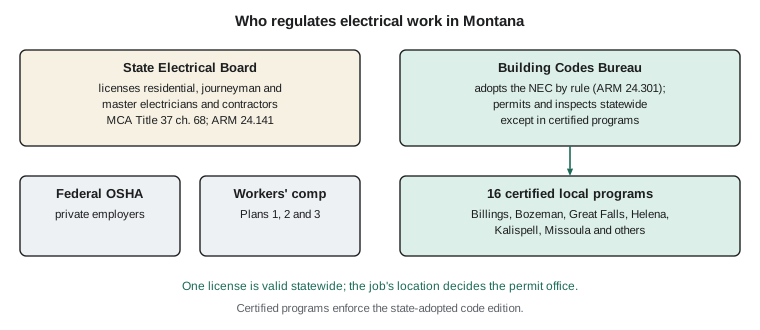
Two agencies inside one department
Licensing and code enforcement sit in different places. The State Electrical Board decides who may do electrical work. The Building Codes Bureau, also within the Department of Labor and Industry, adopts the electrical code by rule, sells electrical permits and inspects electrical work across most of the state. The two cooperate closely, and a permit can be issued only to a licensed contractor or an exempt homeowner, but they answer different questions. When an exam question asks who disciplines a master for lending a license, the answer is the board. When it asks who issues the permit for a new house outside any certified city, the answer is the Building Codes Bureau.
The bureau does not inspect everywhere. Under MCA 50-60-302, a city, county or town can apply to have its own code enforcement program certified. Sixteen local governments run certified electrical programs, including Billings, Bozeman, Great Falls, Helena, Kalispell, the City of Missoula and Missoula County. Inside those areas the local building department issues electrical permits, sets its own permit fees within state rules and sends its own inspectors. Everywhere else, the state bureau has jurisdiction. Lesson 6 covers the list and how to tell which office handles a job.
| Question | State Electrical Board | Building Codes Bureau or certified local program |
|---|---|---|
| Who may do electrical work? | Yes: licenses electricians and contractors | No |
| Which code edition applies? | No | The bureau adopts the code by rule; certified locals enforce it |
| Who issues the permit? | No | The bureau, or the certified local office where the job sits |
| Who inspects? | No | State inspectors, or certified local inspectors |
| Who disciplines a licensee? | Yes | Can refer complaints to the board |
Individuals and companies
Montana separates the person from the business. A master license belongs to Maren and follows her if she changes employers. The electrical contractor license belongs to Yellowstone Bend Electric, LLC, and it rests on a responsible electrician who works full time for the company. When the company applied, Dale signed an acknowledgment of responsibility declaring that he is the master of record and will supervise all of the electrical work the company performs. If Dale retired tomorrow without a replacement, the company would have no responsible electrician and could not keep contracting for unlimited electrical work. That is the gap Maren is training to fill.
The license is also a jobsite document. MCA 37-68-301 requires a licensee to carry the license while working, and department staff and others named in the statute can ask a worker to show it. A worker who cannot produce a license can be cited, and the citation fines rise for repeat offenses. Dale makes every crew member keep a photo of the license card on the phone and the card itself in a wallet, because a missing card on a busy site in Bozeman once cost the company an afternoon.
What stays with each job
Every job still has a local side even in a state system. The location decides which office sells the permit and sends the inspector, and the certified cities may have their own fee schedules, plan review rules and inspection request lines. The electrical code itself, however, is adopted statewide: certified local governments must enforce the codes the state adopts, so the NEC edition does not change at the city line the way it does in states without a statewide code. Lesson 5 covers the code adoption and Montana's amendments, and Lesson 6 covers permits and inspections.
Maren has seen the pattern. Last summer Yellowstone Bend wired a dental clinic inside Billings, a shop building for a rancher outside Laurel and a remodel in Bozeman in the same month. The Billings and Bozeman jobs ran through those cities' building departments, because both run certified electrical programs. Laurel's certified program covers building but not electrical, and the ranch shop sat outside town anyway, so that permit came from the state Building Codes Bureau in Helena and a state inspector drove out for the rough-in. The company's office manager, Rosa Kaminski, keeps a binder with a tab for every jurisdiction the company works in, listing its permit portal, fees and inspection request line.
The exam picture
Montana gives its own licensing exams through a testing company. The board's exam information sheet names PSI as the vendor and describes the master exam as 80 questions in 240 minutes, open book, with a passing score of 75. The content areas are the National Electrical Code, general trade knowledge and theory, and major load calculations. The board must approve an application before the candidate can register with PSI. Lessons 3 and 4 cover the application, the booking and the exam itself.
One wrinkle matters for anyone testing in late 2026 or 2027. The Building Codes Bureau lists the 2023 NEC as Montana's adopted electrical code effective September 26, 2026, replacing the 2020 edition that took effect in June 2022. The exam information sheet available in November 2026 still described 2020 NEC exams. Exams usually switch editions some months after a new adoption, and the board announces the change. Maren will confirm the edition on her admission letter and on the PSI bulletin before she buys a new code book.
Enforcement
Licensing would mean little without enforcement. The board enforces mainly through complaints, screening panels and discipline under MCA 37-1-307 and 37-1-312, the general rules for Montana's licensing boards. Department staff can issue citations for working without a license or failing to show one, and a knowing violation of the licensing law is a criminal misdemeanor that the county attorney can prosecute at the board's request. The Building Codes Bureau enforces through the permit process: work without a permit is a violation, a power supplier generally may not energize an installation without a permit, and an inspector can reject work and pull provisional power when a hazard is immediate.
For a master, enforcement is personal. The responsible electrician is accountable for the electrical work the company does, and discipline can reach both the person and the company. Dale has told Maren that the best protection is dull paperwork: a current license, a current contractor license, workers' compensation and unemployment insurance in force, permits bought before work starts, inspections called on time, apprentices registered and supervised, and a file for every job. Lesson 7 returns to these habits.
How this course is organized
The lessons follow Maren's path. Lesson 2 covers eligibility for the master license, Lesson 3 the application and booking process, and Lesson 4 the exam format and references. Lesson 5 explains the NEC as adopted in Montana and Lesson 6 permits and inspections. Lesson 7 covers the duties of the master, Lesson 8 contractor licensing, insurance and bonding, and Lesson 9 contracts and construction liens. Lesson 10 covers safety law, OSHA and workers' compensation, Lesson 11 renewal and continuing education, and Lesson 12 a practice review and test-day strategy. Every lesson ends with a quiz that mixes multiple choice, true or false, number, ordering and matching questions, and the course ends with a final exam.
The calculator below shows the first planning Maren did. Dale wants to step back in about fifteen months. Maren needs time to gather her experience verifications, apply, wait for approval, study, sit the exam, possibly retake it, receive her license and let the company name her as its responsible electrician. Change the numbers to fit your own plan.
# Maren's planning check (illustrative months)
months_until_dale_steps_back = 15
steps = {
    "collect experience verification forms": 1,
    "application review and board approval": 1,
    "study for the master exam": 4,
    "sit the exam": 1,
    "retake allowance, if needed": 2,
    "license issued; company names new responsible electrician": 1,
}
needed = sum(steps.values())
for step, months in steps.items():
    print(f"{step}: {months} months")
print(f"Total: {needed} months; margin: {months_until_dale_steps_back - needed} months")collect experience verification forms: 1 months application review and board approval: 1 months study for the master exam: 4 months sit the exam: 1 months retake allowance, if needed: 2 months license issued; company names new responsible electrician: 1 months Total: 10 months; margin: 5 months
Common mistakes
MistakeAssuming each Montana city licenses its own electricians.
InsteadMontana licenses electricians statewide through the State Electrical Board; cities do not issue electrician licenses.
MistakeThinking the State Electrical Board sells permits.
InsteadPermits come from the Building Codes Bureau or a certified local government.
MistakeTreating a master license as a contractor license.
InsteadThe contractor license is a separate business license that names a responsible electrician.
MistakeAssuming the exam always uses the newest adopted NEC.
InsteadCheck the edition on the exam information sheet, admission letter and PSI bulletin; exams change on their own schedule.
MistakeBelieving certified cities may pick their own NEC edition.
InsteadCertified local programs enforce the codes the state adopts.
Summary and key terms
- Montana licenses residential, journeyman and master electricians and electrical contractors through the State Electrical Board.
- The board's statute is MCA Title 37, chapter 68, and its rules are ARM 24.141.
- The Building Codes Bureau adopts the electrical code, issues permits and inspects, except in sixteen certified local electrical programs.
- The contractor license is issued to the business and rests on a full-time responsible electrician; unlimited contractors need a master.
- PSI gives the master exam: 80 questions, 240 minutes, open book, 75 to pass, per the board's information sheet.
- The 2023 NEC took effect statewide on September 26, 2026; confirm which edition your exam uses.
- State Electrical Board
- The Montana board that licenses electricians and electrical contractors under MCA Title 37, chapter 68.
- Building Codes Bureau
- The Department of Labor and Industry bureau that adopts building and electrical codes, sells permits and inspects.
- Certified local government
- A city, county or town whose code enforcement program the state has certified under MCA 50-60-302.
- Responsible electrician
- The licensed master or journeyman, employed full time, who is accountable for a contractor's electrical work.
- ARM
- The Administrative Rules of Montana, where the board's and bureau's rules are published.
Practice problems
Work each problem on paper first, then reveal the answer to check.
Who issues Maren's master license?
Show answer
The State Electrical Board; Montana cities do not license electricians.
Who issues the permit for the ranch shop outside Laurel?
Show answer
The state Building Codes Bureau, because Laurel's certified program does not cover electrical and the site is outside town.
Can the City of Billings require its own electrician license from Maren?
Show answer
No; licensing is statewide. Billings issues permits and inspects inside its city limits.
What happens to the contractor license if Dale leaves with no replacement?
Show answer
The company loses its responsible electrician and cannot keep doing unlimited contractor work until a qualified master is named.
Which code edition did the state adopt effective September 26, 2026?
Show answer
The 2023 NEC, amended by ARM Title 24, chapter 301.
Lesson quiz · 5 questions
Score 60% or more to complete this lesson.
Create a free account to save your progress, take quizzes and earn a certificate.