
MELU-301 · Lesson 3 of 12 · 20 min
Applying, approval and booking the exam
▶ Video coming soon A video version of this lesson is on the way.
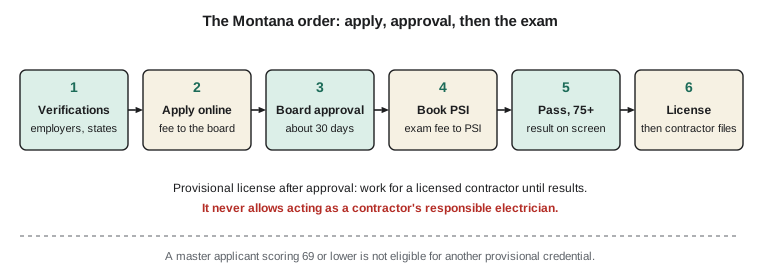
By December Maren had her two verification forms back, one from her first shop and one signed by Dale, and her hours checked out. The next step is the application itself. In Montana the order matters: the candidate applies to the State Electrical Board first, the board reviews and approves the application, and only then may the candidate register with PSI for the exam. This lesson walks through that sequence, the provisional license that lets an approved candidate keep working while waiting for results, and what happens after the exam.
Apply first, then test
Some states let candidates book a national exam on their own and bring a score report to the licensing agency. Montana does the reverse. The board's FAQ says only applicants the board has approved may register for the exam, and approved applicants receive an admission letter or notice with the information they need to schedule. An exam taken without board approval does not lead to a Montana license. The sequence protects both sides: the board confirms the hours before the candidate spends time and money on the exam, and the candidate knows before testing that a passing score will lead straight to a license.
The application package
The board recommends applying online through the department's licensing portal, which accepts credit card or electronic check, and requires a valid email address because most notices now go by email. A paper application is possible but slower and must be paid by check or money order payable to the State Electrical Board; the board does not accept cash. The 2024 master application lists an application fee of 240 dollars and a separate 50 dollar fee for the temporary journeyman work permit that an exam candidate may request. The exam fee itself is paid to PSI, not to the board, and the exam information sheet lists it as 85 dollars for the master exam. Fees change, so check the current schedule.
The package includes the completed application with its signed affidavit, made under penalty of perjury; a master experience verification form from each employer whose hours are claimed, or the engineering degree proof and practical hours; verification of licensure from every state or jurisdiction where the applicant holds or has held any professional license, sent directly by each board; the Social Security number attestation and the citizenship or immigration status attestation required of all Montana licensees; and any certified translations for documents not in English. A candidate who needs testing accommodations files a request for modification of the electrical exam with a physician's letter at the same time.
| Item | Who sends it | Common problem |
|---|---|---|
| Application and affidavit | Candidate | Unsigned affidavit or blank personal history answers |
| Experience verification | Each employer | Wrong residential share or unsigned form |
| Other-state license verification | Each other board, directly | Candidate sends a copy instead |
| Fees | Candidate | Cash, or exam fee sent to the board instead of PSI |
| Accommodation request | Candidate with physician's letter | Filed after the exam is booked |
Review and approval
The board's staff reviews each application for completeness. Incomplete or illegible applications are returned. The application says routine applications are processed within 30 days of being complete. An application is routine when it meets every requirement on its face; one with unusual experience, out-of-state history, a criminal record or prior discipline may be nonroutine and go to a board member or the full board, which takes longer. Since the 2025 legislative session, Montana's boards also screen applicants from substantially equivalent states through a published list, which should make those files routine more often.
Maren's application should be routine: two clean verification forms, one Montana journeyman license and nothing on her personal history. She will apply online in January, watch her email and check the portal weekly.
The provisional license
While the application is under review and the exam is pending, a master candidate may want to keep working at a higher level. Montana's system for this has changed. For years the board issued a temporary practice permit; for a master applicant, it was a temporary journeyman work permit that let the candidate work while employed by a licensed electrical contractor. In 2025 the Legislature replaced temporary practice permits across the licensing boards with provisional licenses, effective October 1, 2025, and the board proposed matching rule changes in November 2025.
The essentials are the same either way. The provisional credential is issued only after the board or its representative approves a complete application, verifies experience and receives the fee. It lets the holder work while employed by a licensed electrical contractor. It expires after a fixed period or when exam results arrive, whichever comes first; the 2024 form said 60 days, and the 2025 rule notice describes a longer period, so check the current rule. It does not allow the holder to act as the responsible electrician for a contractor. And a master applicant who scores 69 or lower on the exam is not eligible for another provisional credential. Additional provisional credentials are at the board's discretion.
For Maren, the provisional credential matters less than it would for a new journeyman, because she already holds a journeyman license that lets her work. What she cannot do until the master license issues is become the company's responsible electrician, and no provisional credential changes that.
Booking with PSI
Once approved, the candidate registers with PSI online or by phone. The board's FAQ lists Montana test centers in Belgrade, Big Timber, Billings, Helena, Kalispell and Missoula, with nearby centers in Blackfoot and Post Falls in Idaho, Spokane in Washington and Sheridan in Wyoming. Some PSI exams may also be offered with remote proctoring; check whether the Montana master exam is. The FAQ says approved applicants must take the exam within a short window after approval, so read the admission notice carefully and book promptly. The exam fee is valid for one year from payment and is not refundable or transferable.
On exam day PSI requires current, government-issued photo identification whose name matches the registration exactly. A candidate whose license shows a different last name from her driver's license, for example after marriage, should fix the mismatch before test day. Arrive early; late arrivals can forfeit the fee.
Maren chose the Billings center because it is fifteen minutes from home, and she booked a morning seat on a Tuesday, when she would not have to leave a crew short on a busy Friday. A candidate who lives far from a center should consider the drive: a four-hour exam after a three-hour winter drive over a mountain pass is a poor plan, and many candidates from eastern Montana book a hotel the night before. Accommodation requests must be approved before booking, so a candidate who needs extra time, a separate room or another adjustment should file the request with the application, not after receiving the admission notice. Rescheduling rules and deadlines are in the PSI bulletin; a candidate who must cancel should do it well before the deadline to keep the fee.
After the exam
The exam is computer-based and the candidate sees the result at the test center. A pass is a score of 75 or higher. PSI reports the result to the board, and the department issues the license once any remaining requirements are met. A candidate who fails receives a score report that shows performance by content area, which is the most useful study tool there is; Lesson 12 shows how to use it.
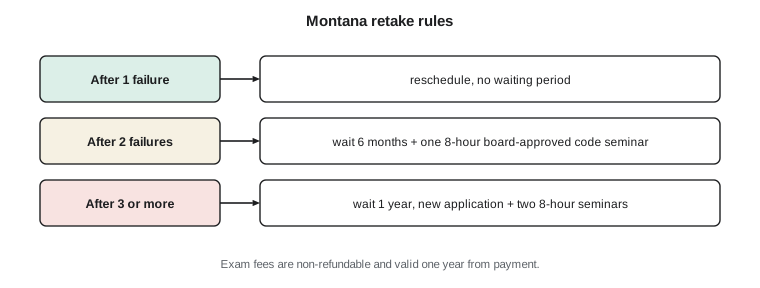
Montana's retake rules, as the board's exam information sheet describes them, step up with each failure. After a first failure, the candidate may reschedule with no waiting period. After a second failure, the candidate must wait six months and show proof of attending at least one board-approved eight-hour electrical code seminar since the first failure. After three or more failures, the candidate must wait one year, submit a new application to the board and attend at least two board-approved eight-hour code seminars. MCA 37-68-311 also lets a candidate who fails obtain a second provisional credential if retesting within three months, as the statute was written before the 2025 changes; check how that works today.
Worked problem
Planning a retake buffer
Maren is approved on February 2, 2027 and sits the exam on February 20. Suppose she fails twice, the second time on March 15. When is the earliest she could test a third time, and what must she show?
Show solution
- A first failure allows rescheduling with no waiting period, so a March retake is possible.
- After the second failure on March 15, she must wait six months: the earliest date is about September 15, 2027.
- She must show proof of at least one board-approved eight-hour code seminar since her first failure.
- If Dale steps back in about fifteen months from November 2026, around February 2028, a September 2027 attempt still leaves a margin.
Answer: About September 15, 2027, with proof of one eight-hour board-approved code seminar.
When the file is returned
A returned application is not a denial. Staff send back a file that is incomplete or unclear with a note saying what is missing, and the candidate fixes it and resubmits. The usual causes are predictable: an employer form missing a signature or the residential share, a verification of licensure that the candidate sent herself instead of having the other board send it, a personal history answer left blank, or a fee paid the wrong way. A candidate who answers promptly and keeps copies loses a few weeks. One who ignores the notice can find the file closed.
A nonroutine file is different. When an application raises a question the staff cannot resolve, such as experience gained in an unusual arrangement, out-of-state hours that are hard to verify, or a criminal history, it goes to the board or a board member for a decision. The board can approve, ask for more information or propose a denial, and a proposed denial comes with the right to a hearing under the Montana Administrative Procedure Act. A candidate in that position should answer in writing, attach records and consider getting advice before the hearing.
Keeping the board informed
The duty to keep information current starts with the application. A 2025 law requires licensees to keep a current mailing address on file and report changes within 30 days, and lets them consent to receive legal notices by email. A candidate who moves between applying and testing, or changes an email address, should update the portal at once, because the admission notice and any request for more information will go to the address on file. Name changes must be supported with documents so that PSI's records and the board's match.
# Maren's application calendar (illustrative dates)
from datetime import date, timedelta
apply_on = date(2027, 1, 11)
review_days = 30            # routine processing target
book_lead_days = 10         # time to find a seat at a PSI center
approved = apply_on + timedelta(days=review_days)
exam = approved + timedelta(days=book_lead_days)
print("apply:", apply_on)
print("expected approval by:", approved)
print("target exam date:", exam)
print("retake after a first failure: no waiting period")apply: 2027-01-11 expected approval by: 2027-02-10 target exam date: 2027-02-20 retake after a first failure: no waiting period
Common mistakes
MistakeBooking the PSI exam before the board approves the application.
InsteadOnly approved applicants may register; apply to the board first.
MistakeSending the exam fee to the board.
InsteadThe exam fee is paid to PSI; the application fee goes to the board.
MistakeUsing a provisional credential to become the company's responsible electrician.
InsteadA provisional credential never allows acting as the responsible electrician.
MistakeAssuming unlimited immediate retakes.
InsteadAfter a second failure the candidate waits six months and completes a code seminar; after three, one year, a new application and two seminars.
MistakeBringing ID that does not match the registration name.
InsteadPSI requires a current government photo ID whose name matches exactly.
Summary and key terms
- In Montana the candidate applies to the board first; only approved applicants may register with PSI.
- The package includes employer verifications, other-state license verifications sent directly, attestations and the fee.
- Routine complete applications are processed within about 30 days.
- Provisional licenses replaced temporary practice permits in 2025; they never allow acting as the responsible electrician.
- PSI test centers include Belgrade, Big Timber, Billings, Helena, Kalispell and Missoula.
- Retakes: no wait after one failure; six months and one seminar after two; one year, reapplication and two seminars after three.
- Admission notice
- The notice an approved applicant receives with instructions to schedule the exam.
- Provisional license
- A short-term credential that lets an approved applicant work for a licensed contractor until results arrive.
- Routine application
- A complete application that meets every requirement on its face and can be approved by staff.
- PSI
- The testing company that gives Montana's electrical licensing exams.
- Code seminar
- A board-approved eight-hour electrical code class required before later retakes.
Practice problems
Work each problem on paper first, then reveal the answer to check.
Can Maren book the exam in December before applying?
Show answer
No; she must apply and receive board approval first.
Who pays the 85 dollar exam fee, and to whom?
Show answer
The candidate pays PSI.
A candidate scores 68 on the master exam. Can he get another provisional credential?
Show answer
No; a master applicant scoring 69 or lower is not eligible.
Where is the closest PSI center for a candidate in Miles City?
Show answer
Billings is the nearest Montana center on the FAQ's list.
What must a candidate show before a third attempt after two failures?
Show answer
That six months have passed and that she attended at least one board-approved eight-hour code seminar since the first failure.
Lesson quiz · 5 questions
Score 60% or more to complete this lesson.
Create a free account to save your progress, take quizzes and earn a certificate.