
MELU-301 · Lesson 7 of 12 · 20 min
Duties and responsibilities of the Master Electrician License holder
▶ Video coming soon A video version of this lesson is on the way.
When Maren passes her exam, the license itself will be the easy part. The harder part will come a few weeks later, when Dale steps back and Maren signs the acknowledgment of responsibility that makes her Yellowstone Bend's responsible electrician. From that day, every installation the company's crews make, in every jurisdiction where it works, is work she has declared she will supervise. This lesson covers what a Montana master license allows, what the responsible electrician role adds, how apprentices and other workers must be supervised, what the board treats as unprofessional conduct, and how discipline works.
What the master license allows
A Montana master electrician may do and supervise every kind of electrical work the licensing law covers, residential, commercial, industrial and institutional, and may serve as the responsible electrician for an unlimited electrical contractor. The license is personal: it authorizes the individual, not a company, and it does not by itself allow the holder to contract for electrical work with the public. To contract, the master must either work for a licensed electrical contractor or hold a contractor license through a business, as Lesson 8 explains.
Only licensees may use the titles. MCA 37-68-302 makes it unlawful to call oneself a master electrician, journeyman or electrical contractor without the license, and MCA 37-68-301 forbids working as or holding oneself out as an electrician or contractor without one. The same section requires licensees to carry the license at the jobsite and bars referral agencies and unions from referring unlicensed people for electrical work. A master who advertises should make sure the company's advertising names the licensed contractor and does not imply licenses the company does not hold.
The responsible electrician
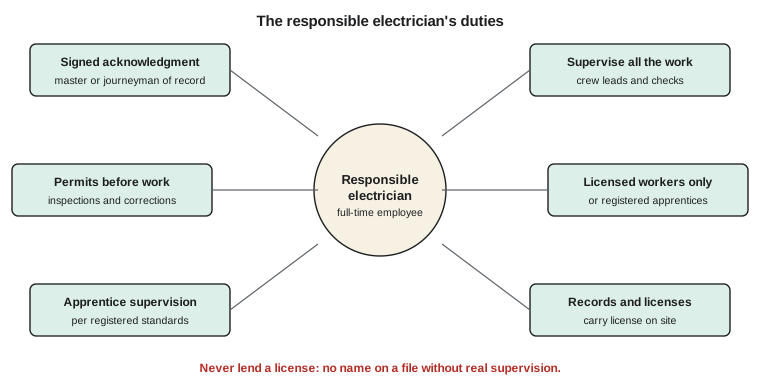
Every electrical contractor license rests on a responsible electrician. For an unlimited contractor it is a master; for a limited contractor it may be a journeyman or a master. The board's contractor application requires that the responsible electrician be employed full time by the contractor and be responsible for all licensed electrical work the contractor performs. The responsible electrician signs an acknowledgment of responsibility declaring that he or she is the master or journeyman of record and will supervise all of the electrical work.
Full-time employment means the responsible electrician is on the contractor's payroll and works for it as a regular employee, not as a name rented for a fee. Supervision does not mean standing over every electrician every hour. It means having the authority and the systems to make sure the work is planned, installed and inspected correctly: assigning qualified people, checking plans and work, making sure permits are bought, reviewing inspection results and correcting problems. A sixteen-person company with jobs in four jurisdictions cannot be supervised by one person's eyes; it is supervised by the responsible electrician's rules, crew leads and checks.
Who may do the work
On a Montana electrical job every person doing electrical work must be licensed for that work, be a registered apprentice working under supervision, or fall within a statutory exemption. MCA 37-68-103 exempts supervised apprentices and students in accredited programs, among others, but students may not work on occupied structures. Helpers who are not registered apprentices may carry material and clean up but may not do the electrical work itself. A journeyman may do the full range of work; a residential electrician only work on residential structures of fewer than five living units.
Apprentices are governed by Montana's registered apprenticeship rules in ARM Title 24, chapter 21, administered by the department's Registered Apprenticeship program. ARM 24.21.1002 requires that a journeyworker or master supervise each apprentice at the ratio set in the apprenticeship program's registered standards. It describes the levels of supervision: in the ordinary case a journeyworker or master is assigned to the job and able to direct and check the apprentice's work; after the apprentice completes a large share of the term and is current on related instruction, limited supervision with a daily check is allowed; and in the last part of the term, an apprentice may work without direct supervision if a journeyworker or master checks the work weekly. Montana changed its apprenticeship ratio rules in 2022 to allow more apprentices per journeyworker, so the current registered standards are the place to check the ratio for a given program.
| Worker | May do electrical work? | Limits |
|---|---|---|
| Master | Yes | All work; may be responsible electrician for an unlimited contractor |
| Journeyman | Yes | All work; may be responsible electrician for a limited contractor |
| Residential electrician | Yes, residential only | Structures of fewer than five living units |
| Registered apprentice | Yes, under supervision | Ratio and supervision level from registered standards |
| Unregistered helper | No | Material handling and cleanup only |
Lending a license
The most serious misuse of a master license is lending it. A master who signs as responsible electrician for a company he does not work for full time, who lets another business buy permits in his name, or who accepts a monthly fee to have his license on a company's file while unlicensed people do the work, is lending the license. Montana's general licensing statute, MCA 37-1-316, lists unprofessional conduct for all boards, including aiding unlicensed practice and misrepresentation, and the board's own rules add conduct specific to electricians. Discipline for license lending can reach the master, the company and anyone who knowingly took part, and it can also be prosecuted.
The pressure to lend a license often arrives as a friendly offer. A retired master is asked to keep his name on a small company's file while the owner, who has no master license, runs the work. A Wyoming contractor asks a Montana master to buy permits for a few jobs in Billings. Each offer asks the master to declare supervision that will not happen. Dale's answer has always been the same: the license is his name on someone else's work, and he does not lend his name.
Changing the responsible electrician
A contractor whose responsible electrician leaves must replace that person before it continues licensed electrical work. The replacement signs a new acknowledgment of responsibility and the contractor updates its license record with the board. The board's application does not state a grace period, so a contractor should plan the handover so that the new responsible electrician is in place on the day the old one leaves. A sudden departure, such as a death or a resignation without notice, should be reported to the board at once, with a question about what the company may finish in the meantime.
Yellowstone Bend's plan is orderly. Once Maren is licensed, she and Dale will both be on the payroll for a short overlap, Maren will sign the acknowledgment, Rosa will file the change through the portal, and only then will Dale step back. Dale may keep working part time as a master, but he will no longer be the master of record. Maren has also asked the company's attorney to confirm that the change does not affect any contract that named Dale personally.
Supervising work you cannot see
The practical problem of supervision is span. Maren cannot visit every job every day, so she will supervise through people and checkpoints: a licensed crew lead on every job, a plan review before work starts, a walk-through before every cover inspection, a weekly visit to each larger job, a review of every inspection report, and a rule that any correction notice reaches her the day it is issued. She will set each apprentice's supervision level from the registered standards and the apprentice's progress, not from convenience. And she will keep a simple log of her own checks, because if a complaint ever arrives, the record of supervision is the best defense.
# Maren's weekly supervision span (illustrative)
jobs = {"Billings clinic": 6, "Laurel shop": 2, "Bozeman remodel": 3, "Huntley farm": 2}
crew_leads = {"Billings clinic": "J. Ruiz", "Laurel shop": "T. Groff (journeyman)",
              "Bozeman remodel": "A. Pettit", "Huntley farm": "J. Ruiz"}
visits_per_week = {name: (1 if size < 4 else 2) for name, size in jobs.items()}
for name in jobs:
    print(f"{name}: {jobs[name]} workers, lead {crew_leads[name]}, visits {visits_per_week[name]}/week")
print("total visits planned:", sum(visits_per_week.values()))Billings clinic: 6 workers, lead J. Ruiz, visits 2/week Laurel shop: 2 workers, lead T. Groff (journeyman), visits 1/week Bozeman remodel: 3 workers, lead A. Pettit, visits 1/week Huntley farm: 2 workers, lead J. Ruiz, visits 1/week total visits planned: 5
Records and paperwork
A responsible electrician needs records that would show, months later, who did what work where. Yellowstone Bend keeps for each job the permit and any renewals or transfers, the approved plans and changes, inspection results and correction notices, a list of the licensed electricians and apprentices who worked on it with their license or registration numbers, and the green tag. It keeps copies of every employee's current license and every apprentice's registration, and it checks expiration dates monthly. It keeps payroll records that show hours by person and job, which also support the experience verifications its electricians will someday ask for.
Citations, penalties and discipline
Montana uses three enforcement tools against licensing violations. Department employees can issue citations under MCA 37-68-316 for working without a license or failing to show one; the fines rise for second and later offenses, each day can be a separate offense, and a first-offense fine for failing to show a license is excused if the person produces proof of licensure within a few days. Knowing violations of the licensing law are criminal under MCA 37-68-322, punishable by fine, jail or both, with higher fines for businesses, and the county attorney prosecutes at the board's request. And the board can discipline licensees under MCA 37-1-312, from a reprimand or probation to suspension or revocation, with fines, costs and conditions such as additional education.
The disciplinary process is the same for all Montana boards. A complaint goes to the department, which investigates. A screening panel of board members decides whether there is reasonable cause to believe a violation occurred. If it finds cause, the case goes to an adjudication panel and, unless settled, to a contested case hearing under the Montana Administrative Procedure Act. The 2025 rule changes adjusted the size of the electrical board's screening and adjudication panels. A licensee who receives a complaint should respond in writing, on time, with records.
Worked problem
A permit in the wrong name
A friend of Dale's who owns an unlicensed handyman business asks Yellowstone Bend to buy a permit for a basement finish so the friend's crew can wire it. What is wrong, and who is exposed?
Show solution
- Only the permittee or its licensed employees and registered apprentices may do the work under a permit.
- The friend's crew is not employed by Yellowstone Bend and is not licensed.
- Buying the permit would aid unlicensed practice and misstate who does the work.
- The company, its responsible electrician and the friend could all face discipline, citations or prosecution.
Answer: Decline. Offer to do the work with Yellowstone Bend's own licensed crew under its own permit.
Common mistakes
MistakeThinking a master license alone allows contracting with the public.
InsteadContracting requires an electrical contractor license; the master license is personal.
MistakeServing as responsible electrician for a company you do not work for full time.
InsteadThe responsible electrician must be employed full time and supervise all the work.
MistakeLetting unregistered helpers pull wire.
InsteadElectrical work must be done by licensees or registered apprentices under supervision.
MistakeAssuming the apprentice ratio is fixed in statute.
InsteadThe ratio is set in the program's registered standards under ARM 24.21.1002.
MistakeIgnoring a complaint letter.
InsteadRespond in writing and on time; the screening panel decides on the record.
Summary and key terms
- A master may do and supervise all electrical work and may be responsible electrician for an unlimited contractor.
- The responsible electrician is a full-time employee who signs an acknowledgment of responsibility for all the contractor's electrical work.
- Only licensees, registered apprentices under supervision and exempt persons may do electrical work.
- Apprentice ratios and supervision levels come from registered standards under ARM 24.21.1002.
- Lending a license is unprofessional conduct and can lead to discipline and prosecution.
- Enforcement tools: citations under 37-68-316, criminal penalties under 37-68-322, and board discipline under 37-1-312.
- Acknowledgment of responsibility
- The form by which the responsible electrician declares that he or she will supervise all the contractor's electrical work.
- License lending
- Allowing one's license to support work one does not actually supervise.
- Registered standards
- The approved terms of an apprenticeship program, including the supervision ratio.
- Screening panel
- Board members who decide whether a complaint shows reasonable cause of a violation.
- Unprofessional conduct
- Conduct listed in MCA 37-1-316 and board rules that can lead to discipline.
Practice problems
Work each problem on paper first, then reveal the answer to check.
May Maren, once licensed, contract with a homeowner on her own without a contractor license?
Show answer
No; she needs to work for a licensed contractor or hold a contractor license.
A crew lead wants an unregistered helper to make up devices. May he?
Show answer
No; the helper may handle material but not do electrical work.
Where does Maren find the apprentice ratio for her company's program?
Show answer
In the program's registered standards under ARM 24.21.1002.
A retired master is offered a fee to keep his name on a company's license. What is this?
Show answer
License lending, which is unprofessional conduct.
Who decides whether a complaint against Maren goes forward?
Show answer
A screening panel of the board, after the department investigates.
Lesson quiz · 5 questions
Score 60% or more to complete this lesson.
Create a free account to save your progress, take quizzes and earn a certificate.