
MELU-225 · Lesson 9 of 12 · 20 min
Contracts and mechanics' liens in Missouri
▶ Video coming soon A video version of this lesson is on the way.
In 2019 a homeowner in Ballwin hired Gateway Bend to rewire an older house and upgrade the service. The job went well, the final inspection passed, and the homeowner stopped answering the phone with 9,800 dollars still owed. Ron's first thought was a mechanic's lien. Joyce checked the job file and found the problem: the company had started work with a handshake and an emailed estimate, and nobody had given the homeowner the written notice Missouri requires before an original contractor receives payment. Without it, the company's lien rights were in doubt. The company eventually collected through small claims and a payment plan, but Ron rewrote every contract form that winter.
This lesson covers the contract terms a master electrician should insist on and the core of Missouri's mechanics' lien law in Chapter 429 of the Revised Statutes of Missouri: the notice to owner, the consent rule for owner-occupied homes, the notice a subcontractor gives before filing, the filing deadline, and the deadline to sue. It describes the law in plain words for exam preparation and does not replace advice from a Missouri attorney on a real claim.
Contracts first
A lien is a remedy for an unpaid contract. The contract is where most payment problems are prevented. A good electrical contract, written or on a form the company uses for every job, identifies the parties and the property, describes the scope of work and what is excluded, names the code and permit responsibilities, states the price and payment schedule, explains how change orders are priced and approved, sets a schedule or start and completion expectations, describes warranty terms, and includes the notices Missouri law requires. Larger contracts add insurance, indemnity, retainage and dispute resolution clauses.
Change orders deserve special attention. Most payment disputes on electrical work start with extra work done on a verbal request and billed later. Gateway Bend's rule since 2019: no extra work without a signed change order or, in an emergency, a same-day email confirming the request and the price basis.
| Contract term | Why it matters |
|---|---|
| Scope and exclusions | Prevents disputes over what the price includes |
| Price and payment schedule | Sets when money is due and what triggers each payment |
| Change orders | Requires written approval and a price basis for extra work |
| Permits and code | States who pulls permits and which code applies |
| Required lien notices | Preserves lien rights under Chapter 429 |
| Warranty | Sets the period and remedy for defects |
Who can claim a mechanic's lien
Missouri's mechanics' lien statutes allow people who perform work or furnish materials for a building or improvement on land, under a contract with the owner or with the owner's contractor, to claim a lien on the property for the unpaid amount, subject to the statute's conditions and deadlines. The law distinguishes the original contractor, who contracts directly with the owner, from everyone else: subcontractors, sub-subcontractors, laborers and suppliers. The duties and protections differ for each.
Public property is generally not subject to mechanics' liens. On public projects, subcontractors and suppliers usually look to the payment bond, as Lesson 8 noted.
The notice to owner
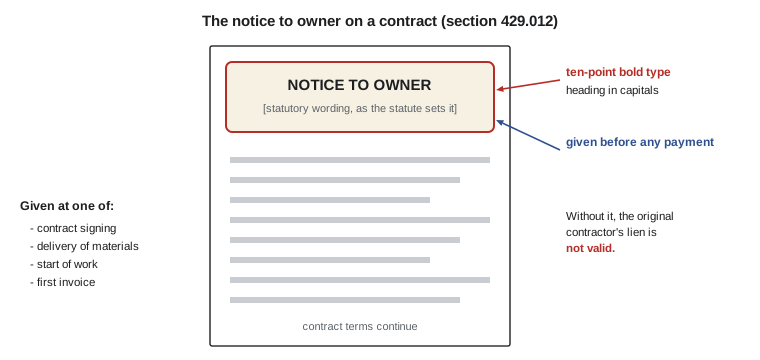
Section 429.012 requires an original contractor who performs work or furnishes materials for a building, improvement or repair on land to give the person it contracts with, or the owner if there is no contract, a written notice before receiving any payment. The notice must be given at the signing of the contract, at the delivery of materials, at the start of work or with the first invoice. It must appear in ten-point bold type, begin with a heading that reads notice to owner, in capital letters, and state, in the words the statute sets out, that a contractor's failure to pay those who supplied materials or services can result in a mechanic's lien on the property.
Compliance is a condition of the original contractor's own lien: under section 429.012, the lien does not exist and is not valid unless the notice was given. The section also makes failing to give the notice with intent to defraud a class B misdemeanor, and it makes knowingly issuing a fraudulent lien waiver or false affidavit a class D felony. The notice requirement does not apply to a new residence where the buyer has mechanics' lien protection from a title insurance company registered in Missouri.
This is the notice Gateway Bend missed in 2019. Joyce now prints the statutory notice, in the required type size, on the face of every contract and on the first invoice of every job, so the notice is given at the first possible point and again at the latest one.
Owner-occupied homes: the consent rule
Section 429.013 adds a rule for repair, remodeling or additions to owner-occupied residential property of four units or less. It does not apply to original construction. On these jobs, anyone other than the original contractor, such as a subcontractor or supplier, can claim a lien only if the owner signed a written consent agreeing to be liable for those costs if they go unpaid. The consent must be in ten-point bold type, must follow the statute's wording, and must be signed by the owner separately from the notice to owner. A copy must be attached to any lien claim, or the lien is invalid. One owner's signature binds all owners.
The section also gives the homeowner a strong defense. Without a signed consent, paying the original contractor in full is a complete defense to subcontractor and supplier liens; partial payment offsets liens up to the amount paid. The original contractor must keep copies of the notice and any signed consent and provide them on request to anyone working on or supplying the job. Forging an owner's signature on a consent or knowingly issuing a fraudulent consent is a class D felony.
For Gateway Bend this matters in both directions. When Gateway Bend is the original contractor on a home remodel, it gives the notice to owner and, if the owner agrees, obtains the separate consent so its suppliers and any subcontractors have lien rights. When Gateway Bend is a subcontractor to a remodeler, it asks for a copy of the signed consent before starting. If there is none, it knows it will have no lien against the house and should protect itself in the subcontract and by tight billing.
The subcontractor's notice before filing
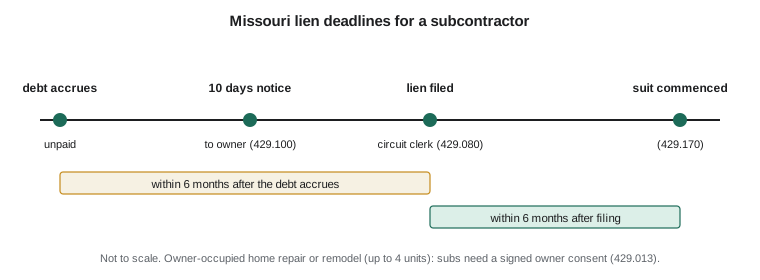
Section 429.100 requires every person other than the original contractor who wants the benefit of the lien statutes to give ten days' notice to the owner, owners or their agent before filing the lien. The notice states that the person holds a claim against the building or improvement, the amount, and from whom it is due. Missing the ten days' notice defeats the lien.
Filing the lien statement
Section 429.080 requires the lien statement to be filed with the clerk of the circuit court of the county where the property is, within six months after the indebtedness accrues. The six-month period applies to original contractors, journeymen, day laborers and others seeking the lien. For rented machinery or equipment, the period is sixty days after the last of the rented equipment is removed from the property. The statement must contain a just and true account of the amount due after all credits, a description of the property sufficient to identify it, the name of the owner or contractor or both if known, and verification by the oath of the claimant or someone credible on the claimant's behalf. The annotated statute notes court decisions holding that the filing period cannot be extended or waived.
When the indebtedness accrues is a legal question that can depend on the facts, such as the last day of work or delivery under the contract. Warranty or punch-list work done only to stretch the deadline may not count. Do not wait for the last week to file; consult an attorney early.
The suit to enforce
A filed lien does not last by itself. Section 429.170 requires a suit to enforce the lien to be commenced within six months after the lien is filed, and the lien expires if no action is brought in that time. The suit must then be prosecuted without unnecessary delay to final judgment.
import calendar
from datetime import date, timedelta

def add_months(d, n):
    m = d.month - 1 + n
    y = d.year + m // 12
    m = m - 12 * (m // 12) + 1
    days = [31, 29 if calendar.isleap(y) else 28,
            31, 30, 31, 30, 31, 31, 30, 31, 30, 31][m - 1]
    return date(y, m, min(d.day, days))

# Illustrative dates for a subcontractor's lien (confirm accrual with an attorney)
accrued = date(2026, 8, 14)
file_by = add_months(accrued, 6)
notice_by = file_by - timedelta(days=10)
filed = date(2026, 12, 18)
sue_by = add_months(filed, 6)
print(f"Debt accrued: {accrued}")
print(f"Give the ten days' notice no later than: {notice_by}")
print(f"File the lien statement by: {file_by}")
print(f"Lien filed on {filed}; suit must be commenced by: {sue_by}")Debt accrued: 2026-08-14 Give the ten days' notice no later than: 2027-02-04 File the lien statement by: 2027-02-14 Lien filed on 2026-12-18; suit must be commenced by: 2027-06-18
Lien waivers
Owners, lenders and general contractors routinely ask for lien waivers in exchange for payment. A conditional waiver takes effect only when the payment clears; an unconditional waiver takes effect when signed. Sign an unconditional waiver only for money actually received. Section 429.012 makes knowingly issuing a fraudulent lien waiver a class D felony, which makes accurate waivers a legal duty, not just good business.
Putting it together
Ron's rewritten contract package now has four parts. The contract form includes the notice to owner in the required type on its first page. For repair or remodeling work on owner-occupied homes of up to four units, a separate consent form is offered for signature. The first invoice repeats the notice. And the job file has a lien calendar that Joyce starts on the day a payment is late.
Worked problem
A subcontractor on a home remodel
Gateway Bend is a subcontractor to a remodeler adding a kitchen to an owner-occupied single-family home. The remodeler stops paying with 6,400 dollars owed. No consent was signed by the homeowner. The homeowner has paid the remodeler in full.
Show solution
- Identify the job type: repair or remodeling of an owner-occupied home of four units or less, so section 429.013 applies.
- Check for a consent: none was signed, so a subcontractor has no lien against the home.
- Note the homeowner's defense: full payment to the original contractor is a complete defense.
- Pursue the remodeler on the subcontract instead.
Answer: Gateway Bend has no lien against the home; its claim is against the remodeler under the subcontract.
Common mistakes
MistakeStarting work for an owner without giving the notice to owner.
InsteadThe original contractor's lien is not valid unless the section 429.012 notice was given before payment.
MistakeAssuming a subcontractor always has lien rights on a home remodel.
InsteadOn owner-occupied homes of up to four units, a signed owner consent is required.
MistakeFiling a subcontractor lien without the ten days' notice.
InsteadSection 429.100 requires ten days' notice to the owner before filing.
MistakeFiling a lien and waiting more than six months to sue.
InsteadSuit must be commenced within six months after filing.
MistakeSigning an unconditional waiver before being paid.
InsteadUse a conditional waiver until payment clears.
Summary and key terms
- An original contractor must give a written notice to owner, in ten-point bold type, before receiving payment, or its lien is not valid.
- On repair or remodeling of owner-occupied homes of up to four units, subcontractors and suppliers need a separately signed owner consent to claim a lien.
- Without a consent, an owner's full payment to the original contractor is a complete defense.
- Persons other than the original contractor must give the owner ten days' notice before filing.
- The lien statement is filed with the circuit clerk within six months after the debt accrues.
- Suit to enforce must be commenced within six months after filing.
- Original contractor
- The contractor who contracts directly with the owner.
- Mechanic's lien
- A claim against real property for unpaid work or materials.
- Owner notice
- The written notice section 429.012 requires before payment.
- Consent
- The owner's separately signed agreement allowing subcontractor and supplier liens on an owner-occupied home.
- Lien waiver
- A document giving up lien rights, usually in exchange for payment.
Practice problems
Work each problem on paper first, then reveal the answer to check.
When must an original contractor give the notice to owner?
Show answer
Before receiving any payment, at contract signing, material delivery, start of work or with the first invoice.
What type size does the notice require?
Show answer
Ten-point bold type.
How many days' notice must a subcontractor give before filing a lien?
Show answer
Ten days.
Within what period must the lien statement be filed?
Show answer
Six months after the debt accrues.
Within what period must suit be commenced after filing?
Show answer
Six months.
Lesson quiz · 5 questions
Score 60% or more to complete this lesson.
Create a free account to save your progress, take quizzes and earn a certificate.