
MELU-225 · Lesson 1 of 12 · 21 min
How electrical licensing works in Missouri
▶ Video coming soon A video version of this lesson is on the way.
Tamika Reed has been pulling wire in the St. Louis area for fourteen years. She started as a helper for a residential shop in Hazelwood, finished a registered apprenticeship in 2018 with more than 8,000 hours on the job and the classroom hours that went with it, and has spent the last six years as a journeyman and then a foreman at Gateway Bend Electric, LLC, a twelve-person contractor in Florissant, in north St. Louis County. The company is invented for this course, but the questions it faces are real. Its owner, Ron Haskell, has held a St. Louis County master electrician license since 1996, and in 2020 he also qualified for the Missouri statewide electrical contractor license. Ron is sixty-five and plans to step back within two years. He wants Tamika to earn the licenses that will let the company keep working across the region, and this course follows her from her first question to exam day.
This is the Missouri course in the HSM University master electrician exam prep series. The core courses, MELU-101 through MELU-107, teach the National Electrical Code skills that every master-level exam tests: navigating the code, load calculations, conductors and overcurrent protection, grounding and bonding, motors and transformers, special occupancies, and business and law. This course adds what is specific to Missouri, and Missouri is unusual. It has no mandatory statewide electrician license. Instead, it has a voluntary statewide electrical contractor license created in 2017, and underneath it a patchwork of city and county licenses, with Kansas City, the City of St. Louis and St. Louis County as the largest local licensing authorities.
Two cautions apply to every lesson. First, licensing rules change, and local rules change with little notice. The facts in this course were checked in November 2026 against the Missouri statutes, the state's administrative rules for statewide electrical contractors, the Division of Professional Registration's pages, the exam vendor's candidate bulletins, and Kansas City and St. Louis pages, and the lessons say so when a fact comes from a secondary source or could not be confirmed. Before you apply, pay a fee or book an exam, check the current pages yourself. Second, electrical codes are copyrighted. This course cites code articles and sections by number and explains them in plain words, but it never reproduces their text, tables or figures. Keep your own copy of the code your exam uses open beside you.
A state with a voluntary license
In most states a single state board licenses electricians, and a license earned in one city is good across the state. Missouri did not follow that path. For most of its history the state left electrical licensing to cities and counties, and many of them built their own systems. Kansas City, the City of St. Louis, St. Louis County, Springfield, Columbia and dozens of smaller cities and counties license or register electrical contractors and electricians under their own ordinances. Many rural areas license no one at all.
The result was a patchwork that frustrated contractors who worked across city and county lines. A contractor licensed by examination in St. Louis County could be asked to pass another examination in a neighboring city, register in a third and post a bond in a fourth. In 2017 the General Assembly passed Senate Bill 240, which created a statewide electrical contractor license in sections 324.900 to 324.945 of the Revised Statutes of Missouri, effective August 28, 2017. The state's Division of Professional Registration administers it through an office it calls the Office of Statewide Electrical Contractors.
The key word is voluntary. The division's own frequently asked questions describe the statewide license as optional, not mandatory. A contractor who works only where it already holds a local license, or only where no license is required, does not need a statewide license to work there. The statewide license matters when a contractor wants to work in many places without passing a separate local examination in each one.
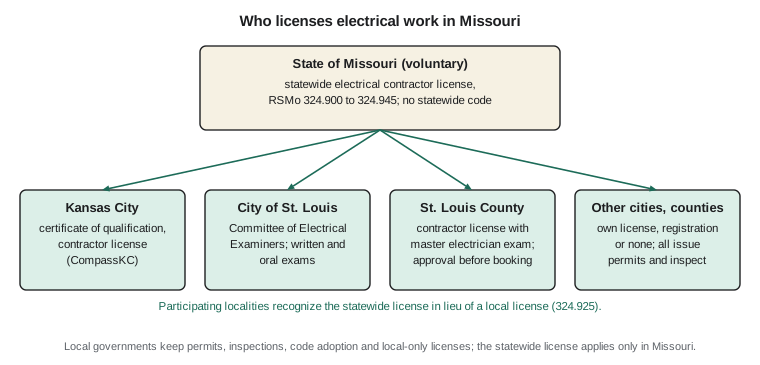
What the statewide license does
Section 324.925 is the heart of the statewide system. It requires political subdivisions, meaning cities, counties and similar local governments, to recognize a statewide license in lieu of a local license for doing electrical contracting work and for getting permits. It also bars them from requiring a statewide licensee to get a local business or occupation license that involves an examination or other special requirement to assess proficiency. A statewide licensee is treated as eligible to do electrical contracting work and pull permits in any political subdivision in Missouri.
The same section keeps important local powers in place. A city or county may still enforce its codes and ordinances, adopt an electrical code based on the National Electrical Code, issue its own local contractor license valid only within its borders, require a business license, issue electrical permits and inspect the work of statewide licensees. It may also license electricians, but only on the basis of professional experience and passage of a nationally accredited electrical assessment examination offered on a routine, accessible schedule. And a subdivision that had no authority to license electricians before August 28, 2017 did not gain that authority from the statute.
The statute has teeth. A statewide licensee who is refused recognition can complain to the division. If the division finds that the city or county is not complying, the subdivision has 30 days to comply, and if it still does not, the state Department of Revenue withholds certain local sales tax distributions until it does. That provision explains why the larger cities, which once insisted on their own examinations for outside contractors, now accept the statewide license for contracting and permits.
| Question | Statewide license | Local license |
|---|---|---|
| Who issues it | Division of Professional Registration | The city or county |
| Where it is good | Any Missouri political subdivision, for contracting and permits | Only inside that city or county |
| Who holds it | An individual electrical contractor | Varies: individual, business or both |
| Is it required | No; it is voluntary | Where the local ordinance requires it |
| Permits and inspection | Still local | Local |
Individuals and companies
The statewide license belongs to a person, not to a company. Under section 324.920, a corporation, firm or other entity that engages in electrical contracting under the statewide system must employ at least one statewide licensed electrical contractor at a supervisory level, and a statewide licensee may represent only one firm at a time. Gateway Bend Electric is covered statewide because Ron, its owner, holds the license and works for no one else. When Ron retires, the company needs another licensed person in that supervisory role, and that is the job Tamika is training for.
Local systems vary more. Kansas City issues certificates of qualification to individuals, such as a master electrician certificate, and a separate contractor license to the business, which must have a qualified individual behind it. St. Louis County licenses electrical contractors and ties that license to a person who has passed its master electrician examination. The City of St. Louis has its own examining committee. Lessons 2, 7 and 8 work through these structures in detail.
What stays local
Whatever license a contractor holds, the job itself is regulated where it sits. The state issues no electrical permits and does no electrical inspections, as the division's FAQ points out. The city or county where the work is done decides whether a permit is needed, which edition of the National Electrical Code applies and with what amendments, who inspects, and whether the contractor must hold a local business license, register, post a bond or file an insurance certificate. Missouri has no statewide adoption of the National Electrical Code for private buildings, so editions differ from place to place, sometimes across a single street. Lesson 5 covers code adoption and Lesson 6 permits and inspections.
Tamika has seen this in practice. Last spring Gateway Bend wired a dental office in an unincorporated part of St. Louis County, a restaurant in the City of St. Louis and a townhouse project in St. Charles County, all in the same month. Each job had a different permit office, a different inspector and, as it turned out, a different code edition. The license on file was the same; the paperwork was not. Ron's office manager, Joyce Pruitt, keeps a binder with a tab for every jurisdiction the company works in, listing its permit portal, code edition, inspection request line and any registration or bond the company has on file.
The licensing authorities in this course
The course concentrates on four authorities. The first is the state, through the Office of Statewide Electrical Contractors and its administrative rules in Title 20, Division 2117 of the Code of State Regulations. The second is Kansas City, Missouri, where the City Planning and Development Department's Permits Division issues certificates of qualification and contractor licenses. The third is the City of St. Louis, whose Committee of Electrical Examiners grants certificates and licenses after written and oral examinations. The fourth is St. Louis County, which licenses electrical contractors and gives a master electrician examination through an outside testing company. Other cities, such as Springfield, Independence and Columbia, appear as examples of how the rest of the state works.
Throughout, the course separates verified facts from general descriptions. The state statute and rules, the statewide exam bulletin and the St. Louis County exam bulletin were read directly. Kansas City's public pages describe its process but not every requirement, so where a detail could not be confirmed the lesson says so and tells you whom to call.
The exam picture
Every route to a master-level credential in Missouri runs through an examination based on the National Electrical Code. For the statewide license, section 324.920 requires a nationally accredited electrical assessment examination created and administered by an independent third party, and the division accepts exams given by a testing company at the contractor, master and journeyman levels. The bulletin the testing company published in August 2026 lists a master electrician exam on the 2017 or 2020 edition of the code, among others. St. Louis County's bulletin lists its own master electrician exam. Kansas City and the City of St. Louis set their own examinations. Lessons 3 and 4 cover booking and the exam format.
Because the state accepts local licenses earned by examination as evidence toward the statewide license, and because cities must accept the statewide license, the order in which a candidate earns licenses matters. Tamika could take a statewide-accepted master exam and apply for the statewide license directly, or she could first earn a St. Louis County license and later use it. Lesson 2 compares the paths.
Enforcement
Licensing would mean little without enforcement. At the state level, the division can discipline a statewide licensee under the general professional registration laws, and the rules note that even an inactive license can be disciplined. At the local level, cities and counties enforce mainly through the permit process: no qualifying license or registration, no permit; no permit, no legal work. Inspectors can reject work, post stop-work orders and refer violations for prosecution under local ordinances. The exam is more likely to ask who has which power than to ask for a fine amount, and fine amounts change. Check the current ordinance before relying on a number.
For a master or supervising licensee, enforcement is personal. Under both the statewide and most local systems, the licensed person is responsible for the electrical work the company does. Ron has told Tamika that the best protection is dull paperwork: a current license and insurance certificate, permits pulled before work starts, inspections called on time, electricians and apprentices on the payroll as employees, and a file for every job. Lesson 7 returns to these habits.
How this course is organized
The lessons follow Tamika's path. Lesson 2 covers eligibility for the statewide and local licenses, Lesson 3 the application and booking process, and Lesson 4 the exam format and references. Lesson 5 explains local code adoption and Lesson 6 permits and inspections. Lesson 7 covers the duties of the license holder, Lesson 8 contractor licensing, insurance and bonding, and Lesson 9 contracts and mechanic's liens. Lesson 10 covers safety law, OSHA and workers compensation, Lesson 11 renewal and working in other jurisdictions, and Lesson 12 a practice review and test-day strategy. Every lesson ends with a quiz that mixes multiple choice, true or false, number, ordering and matching questions, and the course ends with a final exam.
The calculator below shows the first planning Tamika did. Ron wants to step back in about two years. Tamika needs time to document her hours, choose and book an exam, study, sit it, possibly retake it, apply for the license and let the company update its records. Change the numbers to fit your own plan.
# Tamika's planning check (illustrative months)
months_until_ron_steps_back = 24
steps = {
    "document hours and gather employer letters": 2,
    "study for the master exam": 4,
    "book and sit the exam": 1,
    "retake allowance, if needed": 2,
    "apply for the statewide license and wait": 3,
    "company updates its supervising licensee": 1,
}
needed = sum(steps.values())
for step, months in steps.items():
    print(f"{step}: {months} months")
print(f"Total: {needed} months; margin: {months_until_ron_steps_back - needed} months")document hours and gather employer letters: 2 months study for the master exam: 4 months book and sit the exam: 1 months retake allowance, if needed: 2 months apply for the statewide license and wait: 3 months company updates its supervising licensee: 1 months Total: 13 months; margin: 11 months
Common mistakes
MistakeAssuming Missouri requires a statewide electrician license.
InsteadThe statewide electrical contractor license is voluntary; local licensing still exists.
MistakeThinking the statewide license replaces local permits and inspections.
InsteadThe state issues no permits and does no inspections; those stay local.
MistakeTreating the statewide license as a company license.
InsteadIt is held by an individual, and a firm must employ a statewide licensee at a supervisory level.
MistakeBelieving a city may demand its own exam from a statewide licensee.
InsteadSection 324.925 bars a local license that involves an exam or proficiency test for statewide licensees.
MistakeAssuming the whole state uses one NEC edition.
InsteadMissouri has no statewide NEC adoption for private buildings; each locality adopts its own.
Summary and key terms
- Missouri has a voluntary statewide electrical contractor license under sections 324.900 to 324.945 RSMo, created by Senate Bill 240 in 2017.
- Cities and counties must recognize the statewide license for contracting and permits and may not require a local proficiency exam of statewide licensees.
- Local governments still issue permits, inspect, adopt codes, require business licenses and may license electricians on accredited exams.
- The statewide license is held by an individual; a firm must employ one at a supervisory level, and a licensee may represent only one firm.
- Kansas City, the City of St. Louis and St. Louis County run the largest local systems.
- Check current statutes, rules and local pages before relying on any detail.
- Statewide electrical contractor license
- A voluntary license issued by the Missouri Division of Professional Registration under sections 324.900 to 324.945 RSMo.
- Political subdivision
- A city, county or similar local government.
- Office of Statewide Electrical Contractors
- The division office that administers the statewide license.
- Section 324.925
- The statute requiring local governments to recognize the statewide license.
- Certificate of qualification
- Kansas City's credential for a qualified individual, such as a master electrician.
Practice problems
Work each problem on paper first, then reveal the answer to check.
Does Gateway Bend need a statewide license to work in a rural county with no electrical licensing?
Show answer
No; where no license is required, the statewide license is not needed, though it may still be useful.
Can a city refuse Ron's statewide license and insist he pass its own exam to pull a permit?
Show answer
No; section 324.925 requires recognition for contracting and permits and bars a local proficiency exam for statewide licensees.
Who issues the electrical permit for a job in the City of St. Louis?
Show answer
The City of St. Louis, through its building division; the state issues no permits.
What happens if a city keeps refusing recognition after a division finding?
Show answer
After 30 days the Department of Revenue withholds certain local sales tax distributions until it complies.
May Ron represent two firms with his statewide license?
Show answer
No; a statewide licensee may represent only one firm at a time.
Lesson quiz · 5 questions
Score 60% or more to complete this lesson.
Create a free account to save your progress, take quizzes and earn a certificate.