
MELU-225 · Lesson 7 of 12 · 20 min
Duties and responsibilities of the Local Master Electrician Licenses holder
▶ Video coming soon A video version of this lesson is on the way.
Ron keeps a framed copy of his first St. Louis County master electrician license in his office. Under it he hung a sheet of paper with a single sentence in his own handwriting: every job with my name on it is my job. When Tamika asked what it meant, he told her about a contractor he knew in the 1990s who rented his license to three small shops and never visited their jobs. One of those shops wired a duplex badly, the duplex burned, and the license holder lost his license and his business. Ron wanted Tamika to understand before she earned a license that the license is not a certificate on a wall. It is a set of duties that follow every permit and every crew.
This lesson covers the duties of a master-level license holder in Missouri, at both the statewide and the local level: the qualifier relationship with a firm, supervision, permits and records, honesty with the licensing body and inspectors, and the discipline that follows when duties are not met. Local duties vary by ordinance and are described generally; state duties come from the statute and the division's rules.
The qualifier and the firm
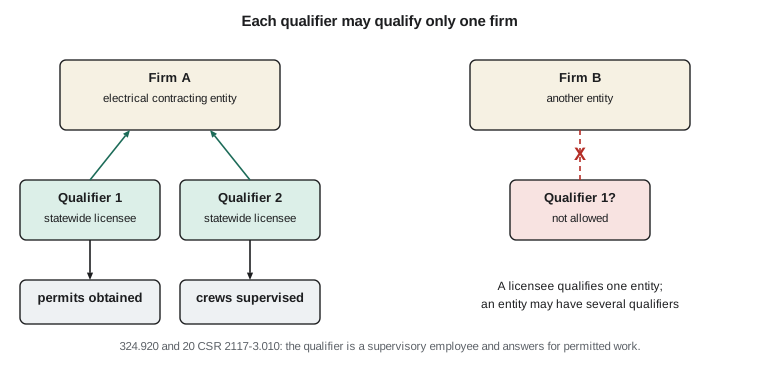
Under section 324.920 of the Revised Statutes of Missouri, a firm doing statewide-licensed electrical contracting must employ, at a supervisory level, at least one statewide-licensed electrical contractor, and a statewide licensee may represent only one firm at a time. The division's rule at 20 CSR 2117-3.010 calls that person the qualifier. Each electrical contracting entity must name at least one qualifier, who must be a supervisory employee of the entity and must notify the division in writing. A licensee may qualify only one entity, though an entity may have several qualifiers.
The one-firm rule is the legal answer to Ron's story about license rental. A licensee cannot lend a license to a second company, and the qualifier must actually be employed at a supervisory level, not merely named on a form. Local licensing systems in the region generally have similar rules for the master or supervising electrician who qualifies a local contractor license; read the local ordinance for the exact wording.
| Duty | Source | What it means in practice |
|---|---|---|
| Be a supervisory employee of the firm | 324.920; 20 CSR 2117-3.010 | Actually employed and supervising, not just named |
| Qualify only one firm | 324.920; 20 CSR 2117-3.010 | No lending or renting the license |
| Notify the division in writing as qualifier | 20 CSR 2117-3.010 | Keep the division's records current |
| Keep employer details on file | 20 CSR 2117-3.020 | Name, address and phone number of the employer |
| Clear permits before changing employers | 20 CSR 2117-3.020 | File the change form at least 10 business days ahead |
| Answer for permitted and supervised work | 20 CSR 2117-3.010 | Responsibility follows the permit |
Responsibility follows the permit
The rule at 20 CSR 2117-3.010 makes the qualifier responsible for work under permits the qualifier obtained and for work done under the qualifier's supervision. That responsibility does not end when a crew leader makes a mistake. If an apprentice on a Gateway Bend job installs a service without the required bonding, the inspector will write the correction against the permit, and if a pattern of poor work leads to a complaint, the complaint will name the qualifier.
Responsibility has three parts in practice. First, review: the qualifier reads every permit application and knows the scope. Second, supervision: the qualifier makes sure each crew has a competent lead and visits or reviews the work at critical stages. Third, correction: when an inspector or customer finds a problem, the qualifier makes sure it is fixed and the cause is addressed.
# Gateway Bend's weekly qualifier review (illustrative numbers)
open_permits = 23
visited_this_week = 9
critical_stages_due = {"rough-in": 5, "service": 2, "final": 4}
due = sum(critical_stages_due.values())
print(f"Open permits: {open_permits}")
print(f"Critical inspections due this week: {due}")
print(f"Jobs visited by the qualifier this week: {visited_this_week}")
if visited_this_week < due:
print(f"Plan {due - visited_this_week} more visits or photo reviews before inspections")Open permits: 23 Critical inspections due this week: 11 Jobs visited by the qualifier this week: 9 Plan 2 more visits or photo reviews before inspections
Supervision and the people on the job
Missouri's statewide law licenses contractors, not individual journeymen or apprentices, though section 324.925 allows a political subdivision to license electricians if the licenses are based on professional experience and a nationally accredited examination offered on a routine and accessible schedule. Some cities and counties in the region do license or register journeymen and apprentices and set ratios or supervision rules. Where they do, the contractor and its qualifier must follow them. Where they do not, the code and the general duty to supervise competent work still apply.
Good supervision is a matter of judgment, not just paperwork: matching crew skills to the task, keeping apprentices with experienced electricians on energized or hazardous work, and stopping work when conditions are unsafe. Lesson 10 covers the safety law that applies.
Honesty with the division and the inspector
Section 324.940 lists the grounds on which the division may file a complaint against a licensee. They include fraud, deception, misrepresentation or bribery in obtaining a license or permission to take an exam; obtaining fees by fraud or misrepresentation; incompetence, misconduct, gross negligence, fraud, misrepresentation or dishonesty in professional duties; violating the statute or rules, or helping someone else violate them; impersonating a licensee or letting someone else use one's license; helping an unregistered or ineligible person practice; obtaining a license or permit based on a material mistake of fact; and certain criminal findings directly related to the occupation.
Read that list again from Tamika's point of view. Signing an experience affidavit for someone who did not do the work is misrepresentation. Letting a friend's company pull permits under her license is letting someone use it. Telling a customer the work passed inspection when it did not is dishonesty in professional duties. Each could cost her the license.
What discipline looks like
Under section 324.940, the division may refuse to issue or renew, or may suspend, a license for the listed causes, with written notice and the right to a hearing before the Administrative Hearing Commission. If the commission finds grounds, the division may censure the licensee, place the licensee on probation for up to five years with conditions, suspend the license for up to three years, or revoke it. A person whose license is revoked must wait at least one year before applying again, and relicensure is at the division's discretion. The statute also requires the division to publish, and update weekly, a list of valid licensees and current enforcement actions.
| Action | Limit in section 324.940 |
|---|---|
| Censure | A formal reprimand |
| Probation | Up to five years, with conditions |
| Suspension | Up to three years |
| Revocation | Wait at least one year to reapply |
Local licenses have their own discipline under each ordinance, often through the same board that examines applicants. A local suspension of work under section 324.940, described in Lesson 6, can run alongside a state complaint.
Records the license holder should keep
The statute and rules require some records, such as current employer information with the division. Good practice requires more. Gateway Bend keeps, for each job, the permit, inspection results and corrections, the plans and change orders, the material submittals for special equipment, and the names of the crew. It keeps them for at least the period during which a lien, warranty or negligence claim could arise. Tamika added one more: a log of her qualifier reviews, so that if a complaint ever arrives she can show what she checked and when.
Duties to customers
Missouri law gives customers protections that a license holder must respect, and Lesson 9 covers the key ones for contracts and liens, including the notice an original contractor must give an owner before receiving payment. Beyond the statutes, a license holder's duty includes doing work to the adopted code, explaining clearly what is and is not included in the price, getting permits before work starts, and telling the customer when an inspection fails and what will be done about it.
Worked problem
A request to pull a permit
A friend who runs a small handyman business asks Tamika, once licensed, to pull permits under her license for his jobs. He offers her a fee per permit and promises his crew is competent.
Show solution
- Identify the duty: a statewide licensee may qualify only one firm, and must be a supervisory employee of it.
- Identify the ground for discipline: letting another person use one's license and helping an ineligible person practice.
- Identify the risk: responsibility for the work would follow the permit to Tamika.
- Decline, and suggest the friend hire a licensed contractor or qualify his own firm.
Answer: Tamika must decline; pulling permits for another firm's work would breach the one-firm rule and is a ground for discipline.
Ron's sentence on the wall turns out to be close to the rule. Every job with a qualifier's permit on it is that qualifier's job.
Supervising across many jobs
A master electrician at a twelve-person company rarely stands beside every crew. On a busy week Gateway Bend may have six or seven jobs open at once, spread from Florissant to St. Charles County. The duty to supervise does not require the qualifier to be on every site every day, but it does require a system that puts competent leadership on each job and gives the qualifier real knowledge of the work. Tamika's system has four parts. Each job has a named lead who holds at least a journeyman's level of skill. Each lead sends photos of the rough-in, the service and any special equipment before inspection. Tamika visits every job at least once before rough-in inspection, and more often on commercial or unusual work. And any lead who is unsure about a code question calls her before installing, not after.
The photos have a second use. When an inspector raises a question after the walls are closed, a dated photo of the rough-in can show what was installed. When a customer disputes a change order, a photo can show what was there before. Joyce files them by job number with the permit.
When the qualifier leaves
Because a firm relying on the statewide license must employ a statewide licensee at a supervisory level, the departure of the only qualifier is a business emergency. Gateway Bend has planned for it: Tamika will be named as a second qualifier before Ron steps back, so the firm is never without one. A firm whose only qualifier quits without notice should stop pulling new permits under the statewide license, contact the division and the affected building departments, and find out what each requires for open permits while a new qualifier is named. Work under local licenses follows each jurisdiction's own rules for a change of license holder.
The same planning protects the qualifier. A licensee who leaves a firm with open permits under her name remains connected to that work until the permits are cleared or transferred. The change of employment rule in Lesson 6 exists for this reason, and a careful qualifier keeps a running list of every open permit so that a departure, planned or not, can be handled in days rather than months.
Ethics beyond the rules
Not every duty is written in a statute. A license holder who learns that a former employee is advertising under the company's name, that a supplier delivered counterfeit breakers, or that a previous contractor left a hazard in a building the company is now working in has a professional duty to act: report the misuse of a license to the division, quarantine and report counterfeit equipment, and tell the owner and the inspector about the hazard. These are the situations in which the reputation of a license holder, and of the trade, is made.
Common mistakes
MistakeLending or renting a license to another firm.
InsteadA licensee may qualify only one firm and must be its supervisory employee.
MistakeThinking responsibility ends with the crew lead.
InsteadThe qualifier answers for permitted and supervised work.
MistakeSigning an experience affidavit as a favor.
InsteadMisrepresentation is a ground for discipline.
MistakeAssuming the state licenses every electrician.
InsteadThe statewide law licenses contractors; some localities license other workers.
MistakeForgetting to update the division after a change of employer.
InsteadEmployer details must be kept on file and changes filed in advance.
Summary and key terms
- A firm must employ at least one statewide licensee at a supervisory level, and a licensee may represent only one firm at a time.
- The qualifier must notify the division in writing and is responsible for permitted and supervised work.
- Section 324.940 lists the grounds for discipline, including misrepresentation and letting another use a license.
- Discipline may be censure, probation up to five years, suspension up to three years or revocation.
- A revoked licensee must wait at least one year to reapply.
- Keep job records and a log of qualifier reviews.
- Qualifier
- The statewide licensee who qualifies a firm and answers for its permitted work.
- Censure
- A formal reprimand by the licensing body.
- Probation
- Continued licensure under conditions for a set period.
- Revocation
- Cancellation of a license.
- Administrative Hearing Commission
- The Missouri body that hears licensing complaints.
Practice problems
Work each problem on paper first, then reveal the answer to check.
How many firms may a statewide licensee qualify at once?
Show answer
One.
What is the longest probation the division may impose?
Show answer
Up to five years.
A licensee's license was revoked. When may she reapply?
Show answer
At least one year after revocation, at the division's discretion.
Does a firm need a qualifier who is actually employed by it?
Show answer
Yes; the qualifier must be a supervisory employee.
Name two grounds for discipline in section 324.940.
Show answer
For example, letting another use one's license and misrepresentation in obtaining a license.
Lesson quiz · 5 questions
Score 60% or more to complete this lesson.
Create a free account to save your progress, take quizzes and earn a certificate.