
MELU-225 · Lesson 4 of 12 · 18 min
The exam format and the references allowed
▶ Video coming soon A video version of this lesson is on the way.
Six weeks before her exam date, Tamika laid her code book on the shop's break-room table and asked Ron what he remembered of his own exam. Ron laughed. His county exam in 1996 was a paper booklet, a pencil and a code book he had owned for a decade, full of notes in the margins. Tamika's exam would be on a computer, timed by the screen, with an on-screen calculator and strict rules about what could be written in her book. Joyce printed the testing company's bulletin, and the three of them went through it page by page.
This lesson explains the format of the master electrician exams Missouri candidates most often take, what the bulletins allow in the testing room, and how to prepare a code book that meets the rules. The facts come from the testing company's candidate bulletins for the statewide-accepted exams, published in August 2026, and for St. Louis County, published in October 2025. Kansas City and the City of St. Louis set their own exams, and their formats were not published on the pages reviewed for this course, so the lesson describes them only in general terms.
The statewide-accepted master exam at a glance
The August 2026 bulletin offers the master electrician exam in two code editions. The candidate chooses the edition when booking. Both versions are open book, both allow three hours, and both are scored against a cut score of 70 out of 100. They differ in length and in how the questions are spread across subjects.
| Feature | 2017 edition exam | 2020 edition exam |
|---|---|---|
| Questions | 60 | 51 |
| Time | 3 hours | 3 hours |
| Passing score | 70 out of 100 | 70 out of 100 |
| Book | Open book, the 2017 code | Open book, the 2020 code |
| Calculator | On-screen testing company calculator only | On-screen testing company calculator only |
| Results | At the test center when finished | At the test center when finished |
Sixty questions in three hours allows three minutes per question; 51 questions allows about three and a half. That sounds comfortable, but code lookups take time, and a single load calculation can take ten minutes. Lesson 12 shows how to budget the clock.
What the questions cover
The bulletin breaks each exam into ten subject areas and gives the number of questions in each. Grounding and bonding carry ten questions in both versions, the largest single area. The 2020 version shifts weight away from services, feeders and overcurrent protection, which fall from ten questions to five, and toward special occupancies, which rise from five to six. Motors and controls fall from six to four. Safety stays at three questions and low-voltage circuits, including alarms and communications, at two.
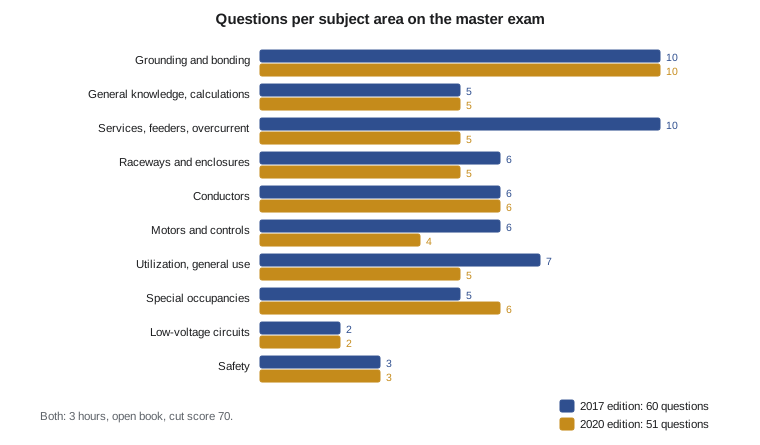
The outline tells Tamika where to put her study hours. Grounding and bonding alone are about a fifth of the 2020 exam. General knowledge of the trade and calculations is five questions, and the other areas range from two to six. She decided to spend a third of her time on Article 250 and the bonding rules, a fifth on calculations across Articles 220, 310 and 430, and the rest spread across the remaining areas in proportion to their counts.
# Share of each subject area on the 2020 master exam (counts from the bulletin)
outline = {
    "Grounding and bonding": 10,
    "Conductors": 6,
    "Special occupancies and equipment": 6,
    "General knowledge and calculations": 5,
    "Services, feeders, branch circuits and overcurrent": 5,
    "Raceways and enclosures": 5,
    "Utilization and general use equipment": 5,
    "Motors and controls": 4,
    "Safety": 3,
    "Low-voltage circuits": 2,
}
total = sum(outline.values())
print(f"Total questions: {total}")
for area, n in outline.items():
    print(f"{area}: {n} questions, about {round(100 * n / total)} in every 100 questions")
study_hours = 60
print(f"With {study_hours} study hours, grounding and bonding gets about "
f"{round(study_hours * outline['Grounding and bonding'] / total)} hours")Total questions: 51 Grounding and bonding: 10 questions, about 20 in every 100 questions Conductors: 6 questions, about 12 in every 100 questions Special occupancies and equipment: 6 questions, about 12 in every 100 questions General knowledge and calculations: 5 questions, about 10 in every 100 questions Services, feeders, branch circuits and overcurrent: 5 questions, about 10 in every 100 questions Raceways and enclosures: 5 questions, about 10 in every 100 questions Utilization and general use equipment: 5 questions, about 10 in every 100 questions Motors and controls: 4 questions, about 8 in every 100 questions Safety: 3 questions, about 6 in every 100 questions Low-voltage circuits: 2 questions, about 4 in every 100 questions With 60 study hours, grounding and bonding gets about 12 hours
Which edition to choose
The choice of edition matters more than it seems. The exam edition need not match the code adopted where the candidate works, because the statewide license is based on passing an accepted exam, not on knowing one city's code. But studying one edition and working in another doubles the reading. Tamika's daily work in north St. Louis County, and many of Gateway Bend's jobs in the City of St. Louis and St. Charles County, ran under editions that varied by jurisdiction, as Lesson 5 explains. She chose the 2020 exam because it was the newest edition offered and because the code book she had been using for side study was the 2020 edition.
Before booking, confirm with the division that the exam and edition you choose are accepted. The bulletin is explicit that the testing company does not decide which exam a candidate needs.
Reference rules
The bulletin's reference rules are the part most worth reading twice. Each exam allows one reference, the National Fire Protection Association's NFPA 70, National Electrical Code, in the edition of the exam. The bulletin states that current and previous year code books are permitted, that older and newer editions are permitted, and that the book title must match exactly. Read that carefully against your booking: if you take the 2020 exam with a 2017 book, the article numbers and rules you rely on may have moved or changed, so bring the edition your exam is based on.
The bulletin lists what may and may not be in the book.
| Allowed in the code book | Not allowed |
|---|---|
| Highlighting | Pencil notes (erase them before the exam) |
| Permanent tabs | Movable tabs or sticky notes |
| Handwritten notes in pen (see the caution below) | Photocopied pages added to the book or photocopied books |
| Study guides or practice exams | |
| Formula sheets or stickers glued or taped into the book |
There is one conflict in the bulletin. Its permitted items section allows handwritten notes in pen, but its test day handout says handwritten notes are not allowed unless the licensing jurisdiction authorizes them. The bulletin does not resolve the conflict. Joyce called the division's number before Tamika marked anything in pen, and the safe course for any candidate is to do the same, or to keep notes off the pages until the question is settled.
During the exam, candidates may not share books, and may not highlight, underline, mark or write in their references. Everything you want in the book must be there before you walk in, and everything that breaks a rule must be out of it. Staff may inspect books, and a book that fails inspection may not be allowed into the room.
Tabbing a code book that passes inspection
Permanent tabs are allowed, which in practice means tabs that are glued or fixed so they cannot be moved without tearing. Tamika bought a set of preprinted permanent tabs for the 2020 code. She also highlighted the first line of each article so she could find the start of an article by flipping, and she used one color for sections she looked up often. She did not add a single loose sheet, and she did not write formulas inside the cover; formula sheets are not allowed even if handwritten.
A short checklist the night before: every tab permanent; no sticky notes anywhere; no loose sheets, receipts or business cards between pages; no pencil marks; and the book's title and edition match the exam booked.
The calculator
The statewide bulletin allows only the testing company's on-screen calculator and states that no other calculator will be permitted. The bulletin links to a page where candidates can practice with it, and recommends doing so. Tamika used it for every practice calculation during her last two weeks of study so the keystrokes would feel familiar.
St. Louis County's exam
St. Louis County's bulletin follows the same testing company's format: computer-based testing at the testing company's sites, an open book exam, on-site scoring and the same retake rules described in Lesson 3. Its master electrician exam is tied to the county's electrical contractor license, and the county exam covers the code the county has adopted as well as county requirements. Read the county's current bulletin for its question count, time and allowed references, which may differ from the statewide-accepted exams, and follow its book rules exactly.
Kansas City and the City of St. Louis
Kansas City's contractor licensing page did not describe the exam format for its certificates of qualification on the date reviewed. The City of St. Louis Committee of Electrical Examiners gives written and oral examinations covering practical installation, electrical theory and practice, and the St. Louis Electrical Code. An oral exam is unusual in the trade, and it tests whether the candidate can explain a rule and its purpose aloud. If you plan to sit the city's exam, ask the Building Division what the oral portion covers and practice explaining code rules in your own words to a colleague.
Test day logistics
The statewide bulletin requires current, valid, government-issued photo identification, with the name exactly as entered at booking. It lists a driver's license, passport, military identification or permanent resident card as examples, and it requires candidates to sign the site log and be photographed. Personal items, including phones, watches and bags, stay outside the testing room. Arrive early; candidates who arrive after the session has started forfeit the fee.
Results are shown at the testing center when the exam is finished, and the testing company notifies the state automatically. A score report shows performance by subject area, which is valuable if a retake is needed.
# Time budget for the 2020 master exam (51 questions, 180 minutes)
questions = 51
minutes = 180
reserve = 20  # minutes kept back for flagged questions
per_q = (minutes - reserve) / questions
print(f"Working time per question: {per_q:.1f} minutes")
checkpoints = [17, 34, 51]
for c in checkpoints:
print(f"Aim to have finished question {c} by minute {round(c * per_q)}")Working time per question: 3.1 minutes Aim to have finished question 17 by minute 53 Aim to have finished question 34 by minute 107 Aim to have finished question 51 by minute 160
Tamika's book and plan
By the end of the evening, Tamika had a 2020 code book with permanent tabs, highlighting and no pen notes, a two-page list of the articles she looked up most, kept at home as a study sheet and not in the book, and a study calendar weighted by the bulletin outline. Ron added one piece of advice from his own exam. The code is not a textbook, so the exam rewards knowing where a rule lives more than memorizing it. Practice finding things.
Common mistakes
MistakeBringing a book with sticky notes or movable tabs.
InsteadOnly permanent tabs are allowed; sticky notes and movable tabs are prohibited.
MistakeWriting a formula sheet inside the front cover.
InsteadFormula sheets or stickers added to the book are prohibited.
MistakeBringing a personal calculator.
InsteadOnly the testing company's on-screen calculator is allowed.
MistakeBooking the 2020 exam and bringing an older edition to save money.
InsteadBring the edition the exam is based on; rules and section numbers change between editions.
MistakeAssuming pen notes are fine because one page of the bulletin allows them.
InsteadThe bulletin conflicts on this point; confirm with the division first.
Summary and key terms
- The statewide-accepted master exam is offered on the 2017 code (60 questions) or the 2020 code (51 questions), each in three hours.
- Both are open book and scored against a cut score of 70.
- Grounding and bonding carry ten questions on both versions, the largest subject area.
- Highlighting and permanent tabs are allowed; movable tabs, sticky notes, photocopies, study guides and formula sheets are not.
- Only the testing company's on-screen calculator may be used.
- St. Louis County, Kansas City and the City of St. Louis set their own exams; read each bulletin or ask the office.
- Open book
- An exam that allows a listed reference in the testing room.
- Cut score
- The score a candidate must reach to pass.
- Permanent tab
- A tab fixed to the page so it cannot be moved without damage.
- Content outline
- The bulletin's list of subject areas and question counts.
- Score report
- The result sheet showing performance by subject area.
Practice problems
Work each problem on paper first, then reveal the answer to check.
How many minutes per question does the 2017 master exam allow on average?
Show answer
180 minutes for 60 questions, or 3 minutes per question.
Tamika wants to add a page of formulas to her code book in pen. Is that allowed?
Show answer
No; formula sheets added to the book are prohibited.
Which subject area drops from 10 questions to 5 between the 2017 and 2020 exams?
Show answer
Services, feeders, branch circuits and overcurrent protection.
Can a candidate highlight a rule in the book during the exam?
Show answer
No; marking references during the exam is prohibited.
What identification must a candidate present?
Show answer
Current, valid, government-issued photo ID with the name exactly as booked.
Lesson quiz · 5 questions
Score 60% or more to complete this lesson.
Create a free account to save your progress, take quizzes and earn a certificate.