
MELU-225 · Lesson 6 of 12 · 20 min
Permits, inspections and the inspection authority
▶ Video coming soon A video version of this lesson is on the way.
Ron's favorite story about inspections is from 2004. A crew he had sent to a church hall in a small St. Louis County city covered a ceiling before the rough-in inspection. The inspector made them take it down. The drywall contractor's bill was larger than Gateway Bend's profit on the job, and Ron has insisted ever since that nobody covers anything until the inspection card is signed. Tamika has heard the story many times. Now, as she prepares to become the license holder who pulls permits, she needs to know not just the habit but the law behind it: who issues permits in Missouri, who inspects, what a statewide license changes, and what happens when a permit is left open.
This lesson covers the permit and inspection system as it works in Missouri: local authority, the effect of the statewide license, typical inspection stages, how to deal with corrections, and the special rules that tie permits to a statewide licensee's employment.
Who issues permits and inspects
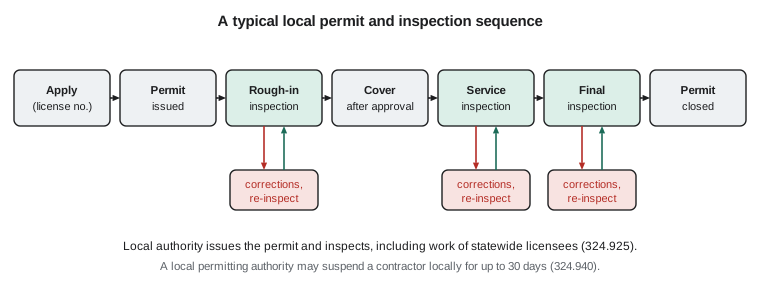
In Missouri, electrical permits and inspections are local. Section 324.925 of the Revised Statutes of Missouri, the section that requires participating local governments to recognize the statewide license, also states what they keep: the power to issue electrical contracting permits, to enforce their own codes and to inspect the work of statewide license holders. The state's Office of Statewide Electrical Contractors licenses people. It does not issue permits for private jobs, does not inspect them and does not approve installations.
The inspection authority for a job is therefore the building department, permits division or code enforcement office of the city or county where the job is. Some small cities contract with a county or a private inspection firm to perform inspections on their behalf. The permit card, the portal or the city's website will name the authority.
| Role | Who does it in Missouri | Notes |
|---|---|---|
| Licenses the statewide contractor | Office of Statewide Electrical Contractors | Within the Division of Professional Registration |
| Licenses local contractors and masters | Cities and counties with licensing authority | Valid only in that jurisdiction |
| Adopts the code | Cities and counties, by ordinance | Lesson 5 |
| Issues permits | The local building or permits office | Statewide licensees are eligible for permits |
| Inspects work | The local inspection authority, or its contractor | Includes work of statewide licensees |
| Disciplines the statewide license | The division, through the hearing commission | Lesson 7 and Lesson 11 |
What the statewide license changes
Section 324.925 states that a statewide licensee is eligible to do electrical contracting work and obtain permits in any political subdivision in the state, and that participating local governments must recognize the statewide license in lieu of a local license for contracting and permits. A city cannot make a statewide licensee pass a local exam or meet special trade proficiency requirements as a condition of a business or occupation license.
The statewide license does not exempt the work from local rules. The city can still require a permit, charge its permit fee, require a general business license, require bonds where the statute allows, apply its adopted code and amendments, and inspect. The statute also gives the division an enforcement route if a local government refuses to recognize the statewide license, ending in the possible withholding of local sales tax money until the government complies.
Applying for a permit
Most jurisdictions in the region now take permit applications online. Kansas City uses its CompassKC system for both contractor licensing and permits. St. Louis County and the City of St. Louis have their own systems. The applicant typically identifies the licensed contractor and license holder, the address and scope of work, the size of the service or the number of circuits or fixtures, and pays a fee based on a local schedule. Many jurisdictions require the license holder or the licensed firm to be registered in the local system before the first permit, and some require proof of insurance or a bond on file.
Gateway Bend's practice is that the license holder reviews every permit application before it is filed. A permit filed under a license holder's name puts that person's license behind the work, and the division's rule at 20 CSR 2117-3.010 makes a statewide qualifier responsible for work under permits the qualifier obtained and for work done under the qualifier's supervision.
Typical inspection stages
The stages and their names vary by jurisdiction, so the list below is general. Read the permit card and local rules for the actual stages.
- Underground or slab: conduits and grounding electrodes before concrete or backfill covers them.
- Rough-in: boxes, raceways and cables before insulation or wall and ceiling coverings are installed.
- Service or temporary power: service equipment, grounding and bonding, often before the utility will connect or release power.
- Above-ceiling or special system inspections on commercial jobs, scheduled before ceiling tiles go in.
- Final: devices, fixtures, panel labeling and equipment installed and working.
Requests for inspection are usually made by phone line, portal or app, with a cutoff time for next-day service. An inspection is not passed until the inspector records it. A crew that covers work before approval may have to uncover it at the contractor's cost, which is the lesson of Ron's 2004 story.
# Inspection log for a small commercial job (illustrative)
stages = [
    ("Underground", "passed", 0),
    ("Rough-in", "corrections", 2),
    ("Rough-in re-inspection", "passed", 0),
    ("Above ceiling", "passed", 0),
    ("Final", "corrections", 1),
    ("Final re-inspection", "passed", 0),
]
open_items = 0
for name, result, items in stages:
    open_items += items if result == "corrections" else 0
    print(f"{name}: {result}" + (f" ({items} items)" if items else ""))
visits = len(stages)
print(f"Inspection visits: {visits}; correction items raised: {open_items}")Underground: passed Rough-in: corrections (2 items) Rough-in re-inspection: passed Above ceiling: passed Final: corrections (1 items) Final re-inspection: passed Inspection visits: 6; correction items raised: 3
Corrections and disagreements
When an inspection fails, the inspector leaves a correction notice listing what must be fixed. The contractor corrects the work and requests a re-inspection, which some jurisdictions charge for. Read each item, fix it, and keep a photo record of the corrected work.
If the contractor disagrees with an inspector's reading of the code, the professional path is to ask the inspector for the code section relied on, discuss it calmly, and if needed take it to the chief electrical inspector or building official. Most adopted codes include an appeals board or a board of adjustment for technical disputes. Arguing on site rarely helps, and an inspector's decision stands until it is changed through the jurisdiction's process.
Local suspension of a statewide licensee's work
Missouri gives local permitting authorities a specific power over statewide licensees. Section 324.940 allows a political subdivision's permitting authority to suspend a contractor's work in that jurisdiction for up to thirty days while a complaint is forwarded to the division. The division's rule at 20 CSR 2117-3.030 says what the local government must send: the licensee's details, the reasons and laws or ordinances involved, supporting evidence, witness contacts, the suspension dates and a local contact. The division then reviews the notice, investigates as needed, decides whether disciplinary or other legal action is warranted and tells the local government the outcome.
The practical lesson: a statewide license does not shield a contractor from a local stop. A city that finds serious problems can halt that contractor's work within its limits and start the state process.
Permits and changing employers
The division's rule at 20 CSR 2117-3.020 links a statewide licensee's permits to the licensee's employment. A licensee must keep the employer's name, address and phone number on file with the division. Before changing employers, the licensee must clear active permits and file a change of employment form at least ten business days ahead. The division notifies the affected political subdivisions, which have 72 hours, excluding weekends and holidays, to report uncleared permits or other open issues; if none are reported in that window, the division treats the permits as cleared.
This rule matters to Tamika and Ron. When Ron retires and Tamika becomes the company's qualifier, any permits still open under Ron's name must be closed or transferred under each jurisdiction's procedure. Joyce added a step to the company's retirement plan: list every open permit in every jurisdiction three months before the change and work it down to zero.
from datetime import date, timedelta

# Counting ten business days before a planned employment change (holidays ignored here)
change_day = date(2027, 3, 1)
d = change_day
count = 0
while count < 10:
    d -= timedelta(days=1)
    if d.weekday() < 5:
        count += 1
names = ['Monday', 'Tuesday', 'Wednesday', 'Thursday', 'Friday', 'Saturday', 'Sunday']
print(f"Planned change: {change_day} ({names[change_day.weekday()]})")
print(f"File the change of employment form by: {d} ({names[d.weekday()]})")Planned change: 2027-03-01 (Monday) File the change of employment form by: 2027-02-15 (Monday)
Closing permits
A permit is closed when the final inspection passes and the jurisdiction records it. Open permits cause trouble later: some jurisdictions will not issue new permits to a contractor with expired open ones, a buyer's title or inspection report may flag them, and under the employment rule above they can delay a license holder's move. Many jurisdictions also expire permits when no inspection is requested within a set time. Track every permit to closure.
Worked problem
An open permit and a retirement
Ron plans to retire on March 1. A permit for a small warehouse job is still open because the owner has not finished the tenant space, and the final inspection cannot be scheduled.
Show solution
- List the permit and its jurisdiction in the open permits register.
- Ask the building department how a permit can be transferred to a new license holder for the same firm, or closed with a partial final.
- Agree the plan with the owner and record it in writing.
- Complete the transfer or closure before the change of employment form is filed.
Answer: Transfer or close the permit under the jurisdiction's procedure before Ron's change takes effect, so the division's 72-hour check finds no open issues.
Working with inspectors well
Inspectors in the region see the same contractors week after week, and a contractor's reputation with them affects how smoothly jobs go. Gateway Bend's habits are simple. Request inspections only when the work is truly ready. Have the permit card, the approved plans and any equipment submittals on site. Leave panel covers off and boxes accessible for rough-in. Meet the inspector if possible, and if not, leave a clear contact number. Treat a correction notice as information, not an insult, and fix the items before asking for re-inspection.
Some jurisdictions publish inspection guidelines or checklists for common work, such as residential service changes or basement finishes. They are worth reading even for experienced electricians, because they show what that office looks for first. Joyce keeps the current versions in the jurisdiction binder.
When a job involves a new service or a service change, the utility is part of the sequence too. The electric utility will usually not set a meter or reconnect until the local inspection authority has approved the service, and in some areas the inspector notifies the utility directly. Build the utility's lead time into the schedule, and tell the customer early that power depends on both the inspection and the utility.
Common mistakes
MistakeCovering work before the rough-in inspection is recorded as passed.
InsteadWait for approval; uncovering costs fall on the contractor.
MistakeBelieving the state issues electrical permits.
InsteadPermits and inspections are local.
MistakeAssuming a statewide license exempts work from local inspection.
InsteadSection 324.925 preserves local inspection of statewide licensees.
MistakeArguing with an inspector on site instead of using the appeals process.
InsteadAsk for the code section and use the local appeal route if needed.
MistakeChanging employers with permits still open.
InsteadClear permits and file the change form at least ten business days ahead.
Summary and key terms
- Permits and inspections in Missouri are local; the state licenses but does not permit or inspect private work.
- A statewide licensee is eligible for permits in any political subdivision, which must recognize the statewide license in lieu of a local license.
- Local governments keep the power to require permits, apply their codes and inspect statewide licensees.
- A local permitting authority may suspend a contractor's work for up to thirty days while a complaint goes to the division.
- A statewide licensee must clear permits and file a change of employment form at least ten business days before changing employers.
- Track every permit to a recorded final inspection.
- Permit
- Local permission to perform specific electrical work at an address.
- Inspection authority
- The local office that inspects work under its adopted code.
- Correction notice
- An inspector's list of items that must be fixed before approval.
- Qualifier
- The statewide licensee named as the firm's responsible person.
- Change of employment form
- The division's form a licensee files before changing employers.
Practice problems
Work each problem on paper first, then reveal the answer to check.
Who inspects a statewide licensee's job in a Missouri city?
Show answer
The city's inspection authority.
How long may a local permitting authority suspend a contractor's work while a complaint goes to the division?
Show answer
Up to thirty days.
How many days do political subdivisions have to report open permits after the division's notice?
Show answer
72 hours, excluding weekends and holidays.
A crew covers a ceiling before inspection, and the inspector orders it opened. Who pays?
Show answer
The contractor, as a rule.
Can a city require a statewide licensee to pass its local exam to get a permit?
Show answer
No; it must recognize the statewide license in lieu of a local license.
Lesson quiz · 5 questions
Score 60% or more to complete this lesson.
Create a free account to save your progress, take quizzes and earn a certificate.