
MELU-225 · Lesson 2 of 12 · 18 min
Eligibility for the Local Master Electrician Licenses
▶ Video coming soon A video version of this lesson is on the way.
On a slow Friday afternoon, Tamika sat at Joyce Pruitt's desk in the Gateway Bend office with a folder of pay stubs, her apprenticeship completion certificate and a printout of the state's rules. Ron had told her the first question was not which exam to take but which door she qualified to walk through. In Missouri, there are several doors. The statewide license has four experience routes and a fifth route for people who already hold a local license. The local licenses in Kansas City, the City of St. Louis and St. Louis County each have their own requirements, and they are not identical. This lesson sorts them out.
The course title speaks of local master electrician licenses, and that is where most Missouri electricians start. But since 2017 the statewide license has become the credential that lets a contractor work across city and county lines, and its rules also define how local licenses count. So the lesson begins with the state and then turns to the local authorities.
The four experience routes to the statewide license
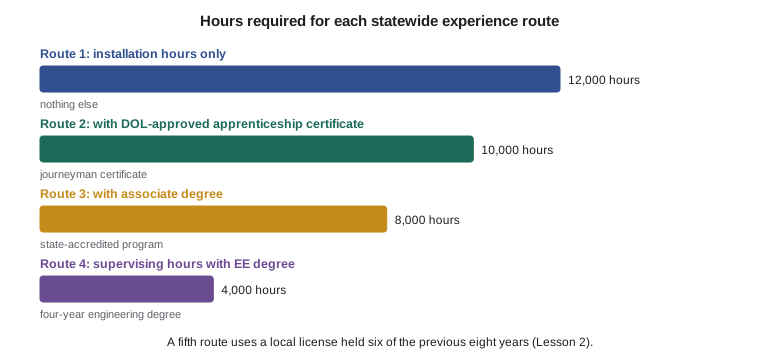
Section 324.920 of the Revised Statutes of Missouri and the division's rule at 20 CSR 2117-2.010 set out the experience an applicant needs. An applicant must show one of the following. The first route is 12,000 verifiable hours of practical experience installing electrical equipment and associated wiring. The second is 10,000 hours of that experience plus an electrical journeyman certificate from an apprenticeship program approved by the United States Department of Labor. The third is 8,000 hours plus an associate degree from a state-accredited program. The fourth is 4,000 hours supervising the installation of electrical equipment plus a four-year degree in electrical engineering from a qualifying program.
The routes trade hours for training. A registered apprenticeship is worth 2,000 hours against the base figure; an associate degree is worth 4,000; an electrical engineering degree changes the kind of experience required, from installation to supervision, and cuts the hours to 4,000. In every route the hours must be verifiable, and the experience must be installation work, or for the engineering route supervision of installation work, not sales, estimating or design alone.
| Route | Hours needed | Plus |
|---|---|---|
| 1 | 12,000 installation hours | Nothing else |
| 2 | 10,000 installation hours | Journeyman certificate from a DOL-approved apprenticeship |
| 3 | 8,000 installation hours | Associate degree from a state-accredited program |
| 4 | 4,000 hours supervising installation | Four-year electrical engineering degree |
| 5 | Local license held 6 of the last 8 years | Verified by the issuing city or county |
The local license route
The fifth route is for people who already hold a local license. Section 324.920 and the rule allow an applicant who holds a current, active local electrical contractor or master electrician license that has not been disciplined to qualify if the license was held for six of the previous eight years and earned under a qualifying examination, with the issuing city or county verifying it. The statute also provided a grandfather path for people licensed before January 1, 2018, and the division's FAQ describes it as covering local licensees in good standing whose local exam was nationally accredited and based on the National Electrical Code and who had 12,000 hours of experience.
Ron used this kind of route in 2020. He had held his St. Louis County master license for more than two decades, and the county had examined him on the code, so the division accepted his county license as evidence of both the exam and the experience. Tamika does not hold a local license yet, so for her the question is which of the first four routes she meets.
Counting Tamika's hours
Tamika completed her registered apprenticeship in 2018, and her completion certificate names a program registered with the Department of Labor. That certificate is what route 2 needs. Her hours come from three employers: the residential shop where she started as a helper, the apprenticeship employer, and Gateway Bend since 2020. Joyce helped her total them from her W-2 forms and pay records.
# Tamika's verifiable installation hours (illustrative records)
records = {
    "helper, residential shop (2012-2013)": 1640,
    "apprenticeship employer (2013-2018)": 8420,
    "Gateway Bend journeyman and foreman (2020-2026)": 11800,
}
total = sum(records.values())
for job, hours in records.items():
    print(f"{job}: {hours:,} hours")
print(f"Total: {total:,} hours")
routes = {"route 1 (no credential)": 12000, "route 2 (apprenticeship certificate)": 10000}
for name, need in routes.items():
print(f"{name}: needs {need:,}, has {total:,}, met: {total >= need}")helper, residential shop (2012-2013): 1,640 hours apprenticeship employer (2013-2018): 8,420 hours Gateway Bend journeyman and foreman (2020-2026): 11,800 hours Total: 21,860 hours route 1 (no credential): needs 12,000, has 21,860, met: True route 2 (apprenticeship certificate): needs 10,000, has 21,860, met: True
Tamika qualifies under either of the first two routes. She will apply under route 2 because her apprenticeship certificate is strong evidence and her hours are well above the 10,000 needed. Joyce suggested listing route 1 hours too, in case an employer's records for the helper years prove hard to verify; dropping those hours would still leave her above 10,000.
What counts as proof
The rule at 20 CSR 2117-2.010 lists the kinds of proof the division accepts for experience hours. They include W-2 forms accompanied by an affidavit or a notarized letter from the company, affidavits from employers or other witnesses who can verify the work, qualifying local or state licenses, and other documents the division accepts. A degree must be verified by a sealed original transcript or one sent electronically by the school, and it must come from an accredited institution.
The practical lesson is that proof takes time to collect. Former employers close, move or lose records, and a notarized letter needs someone willing to sign it. Tamika's first employer had retired, so Joyce helped her contact the former office manager, who still had payroll summaries and agreed to sign an affidavit. Ron signed a notarized letter for Gateway Bend. Her apprenticeship program supplied a letter and a copy of her completion certificate.
Experience must be the right kind. Hours spent driving a delivery truck for an electrical supply house, selling fixtures or estimating jobs do not count as installation experience. Hours doing side jobs for cash with no records are hard to verify. Hours as a helper installing wiring under supervision usually count, if the employer can verify them. When in doubt, ask the division before submitting.
Other statewide requirements
Experience is only one part of eligibility. The applicant must also pass an accepted examination, covered in Lessons 3 and 4, and show proof of insurance. The rule requires general liability insurance of at least 500,000 dollars, shown by a certificate of insurance from an insurer authorized to do business in Missouri, and it states that certificates issued by agents are not accepted. The statute also requires the applicant to post bonds with each political subdivision where the applicant works, as that subdivision requires, and the division's FAQ says the bonds stay with the city or county while the state receives proof that they were posted.
The rule adds a deadline. An application not completed within 24 months of the date it was first submitted is no longer valid, and the applicant must start again with a new application and new fees. The rule also requires the division to consider military education, training and service toward the requirements and to construe them liberally, which matters for veterans who trained as electricians in uniform.
Common mistakes
MistakeCounting estimating or supply-house hours as installation experience.
InsteadOnly verifiable installation work, or supervision of installation for the engineering route, counts.
MistakeAssuming an agent's insurance certificate will do.
InsteadThe rule calls for a certificate from the insurer itself; agent-issued certificates are not accepted.
MistakeLetting an application sit for two years.
InsteadAn application not completed within 24 months is void and must be redone with new fees.
Local licenses: Kansas City
Kansas City, Missouri issues individual credentials it calls certificates of qualification. Its public contractor licensing page lists three electrical certificates: electrical supervisor, master electrician and master limited electrician. It describes them as authorizing qualified individuals to supervise and perform electrical installation work. The qualified individual applies through the city's online system, CompassKC, and the city's page refers applicants to reference-letter and trade requirements published on its contractor licensing site. The specific experience years, examinations and fees for each certificate were not stated on the page reviewed for this course, so check the city's contractor licensing page or call the Permits Division before planning around a number.
A business that wants to contract in Kansas City needs more than an individual certificate. The city requires a Kansas City business license first, then the qualified individual's certificate, and then a contractor license for the business. Lesson 8 covers that sequence.
Local licenses: the City of St. Louis
The City of St. Louis has a Committee of Electrical Examiners. The city's page says the committee awards certificates and licenses to engage in electrical work in the city, that applicants must show the knowledge and experience needed, and that it gives written and oral examinations covering practical installation, electrical theory and practice, and the St. Louis Electrical Code. The page does not list experience hours or the names of each license class, so a candidate should contact the city's Building Division before applying.
Local licenses: St. Louis County
St. Louis County licenses electrical contractors and examines the person who qualifies the license. The county's candidate bulletin, published by its testing company in October 2025, ties a master electrician examination to the electrical contractor license and states that a candidate must apply to the county and be approved before scheduling. The bulletin does not list the county's experience requirements; those are in the county's application materials and ordinances, so read the current county application before planning. The bulletin also lists other county examinations for electrical communication and sound, elevator electrical work and industrial maintenance electricians.
Because the county approves applicants before testing, the eligibility question comes first in the county too. Tamika's twelve years of supervised installation and her apprenticeship would likely carry weight, but the county, not the testing company, decides.
Choosing a path
Tamika weighed three options. She could take an exam the state accepts and apply for the statewide license directly. She could apply to St. Louis County, pass its master exam and hold a county license, and later use it toward the statewide license. Or she could do both: the county license for its local standing and the statewide license for its reach. Ron's advice was to start with the statewide license, because Gateway Bend works in several counties and the statute requires them all to recognize it for contracting and permits. If the county later required something only a county licensee could do, she could add the county license.
Another candidate in the course, Cody Albers, works in Springfield in southwest Missouri. Springfield has its own licensing system, and most of his work is inside the city. For Cody, a local license may be enough, and the statewide license is useful only if his company starts bidding work in surrounding counties. The point is the same as in Lesson 1: the right credential depends on where you work.
Common mistakes
MistakeUsing 10,000 hours without a DOL-approved apprenticeship certificate.
InsteadRoute 2 requires both; without the certificate, route 1's 12,000 hours applies.
MistakeAssuming the testing company decides eligibility.
InsteadThe state or the local authority decides; the testing company only gives the exam.
MistakeApplying the statewide experience numbers to a city certificate.
InsteadEach city or county sets its own requirements; read its application.
Summary and key terms
- The statewide license has four experience routes: 12,000 hours; 10,000 with a DOL-approved journeyman certificate; 8,000 with an associate degree; 4,000 supervising with an electrical engineering degree.
- A local contractor or master license held 6 of the last 8 years, verified by the issuer, also qualifies.
- Proof includes W-2s with an affidavit or notarized letter, employer or witness affidavits, licenses and sealed transcripts.
- Applicants need 500,000 dollars of liability insurance on an insurer's certificate and must post any local bonds.
- Applications expire 24 months after first submission.
- Kansas City, the City of St. Louis and St. Louis County each set their own eligibility rules.
- Verifiable hours
- Experience hours that can be confirmed by records, letters or affidavits.
- Journeyman certificate
- Completion credential from a registered apprenticeship program.
- Affidavit
- A sworn written statement.
- Certificate of insurance
- A document from the insurer showing coverage and limits.
- Grandfather path
- A route for existing local licensees to qualify for the statewide license.
Practice problems
Work each problem on paper first, then reveal the answer to check.
An applicant has 11,000 installation hours and no credentials. Which route applies and is it met?
Show answer
Route 1 needs 12,000 hours; 11,000 is not enough.
An applicant has 9,000 hours and an associate degree from a state-accredited program. Is route 3 met?
Show answer
Yes; route 3 needs 8,000 hours plus the degree.
An engineer with a four-year electrical engineering degree has 4,500 hours supervising installation. Eligible?
Show answer
Yes, under route 4, which needs 4,000 supervising hours.
An applicant submitted an application in March 2025 and has not completed it by May 2027. What happens?
Show answer
It is more than 24 months old and void; a new application and fees are required.
Who decides whether a St. Louis County applicant may take the county's master exam?
Show answer
St. Louis County; the testing company schedules only approved candidates.
Lesson quiz · 5 questions
Score 60% or more to complete this lesson.
Create a free account to save your progress, take quizzes and earn a certificate.