
MELU-225 · Lesson 5 of 12 · 20 min
Local code adoption and amendments in Missouri
▶ Video coming soon A video version of this lesson is on the way.
In her first month as a foreman, Tamika ran two jobs in the same week: a kitchen remodel in an unincorporated part of north St. Louis County and a small retail fit-out across the city line in the City of St. Louis. The plans for both called for the same kind of receptacle protection. The inspectors did not agree. Each was right under the code his jurisdiction had adopted, and the two jurisdictions had adopted different editions with different local changes. Tamika learned that week what every Missouri electrician learns sooner or later: the question is never just what the code says, but which code, which edition and which amendments apply at this address.
This lesson explains how electrical codes become law in Missouri, why the edition and amendments change from one place to the next, and how a master electrician finds out which rules govern a job. As always in this course, the code is cited by article and described in plain words; its text and tables are not reproduced.
No statewide electrical code
Missouri has no statewide electrical code for most private construction. A trade magazine article published in July 2023 counted Missouri among the few states with no statewide adoption of the National Electrical Code, and described adoption as happening city by city and county by county. The statewide licensing law leaves code adoption with local governments: section 324.925 of the Revised Statutes of Missouri expressly preserves a political subdivision's power to adopt an electrical code based on the National Electrical Code, to issue permits, to enforce its own codes and to inspect the work of statewide license holders.
That means the statewide license and the code are separate questions. A statewide license lets a contractor be recognized for contracting and permits in participating places. It does not bring a statewide code with it. The code at each job is whatever that city or county has adopted, as amended by its own ordinance.
State agencies may apply codes to some state-owned or state-regulated work, and certain facilities, such as those licensed by state health or fire authorities, may be subject to codes the agency adopts. Those rules are outside the scope of this course; on such jobs, ask the owner and the agency which code applies.
How a city or county adopts a code
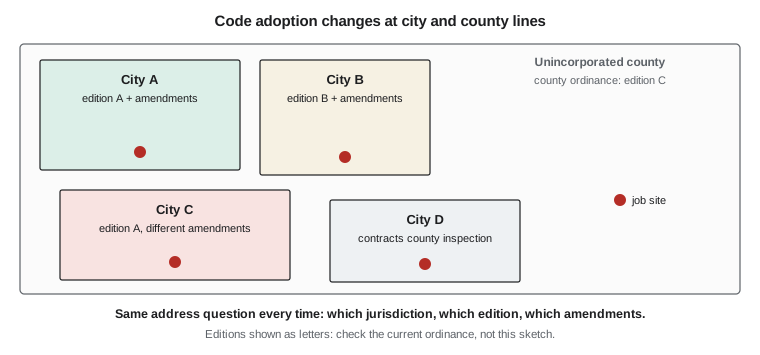
A Missouri city or county adopts a model code by ordinance. The ordinance names the code and the edition, adopts it by reference and lists local amendments: sections deleted, changed or added. The ordinance usually sits in the building or construction chapter of the municipal code. A city may also adopt a related set of codes at once, such as the International Building Code, the International Residential Code, the energy code and the electrical code, and the electrical code may then be amended by sections of the building code that change wiring rules for dwellings.
Adoption takes time. The 2023 article described adoption in St. Louis County as a legal matter handled by attorneys, which slowed the process. Many jurisdictions skip editions, and many wait two or more years after a new edition is published before adopting it. As a result, the edition in force at a given address may be one, two or more cycles behind the newest edition.
| Step | What happens | What the contractor should do |
|---|---|---|
| Publication | A new code edition is published | Note it, but do not assume it applies |
| Review | Local staff or a code board reviews the edition and drafts amendments | Watch for public hearings and drafts |
| Ordinance | The council or county legislature adopts the code and amendments | Read the ordinance and the amendment list |
| Effective date | The ordinance names a date, sometimes with a transition period | Ask which code applies to permits filed before and after |
| Enforcement | Plans review and inspections apply the adopted code | Design and install to the adopted edition and amendments |
Editions vary, sometimes widely
The July 2023 article gave examples of the variation at that time: the City of St. Louis using the 2017 edition, St. Louis County the 2014 edition and the city of Arnold, in Jefferson County, the 2020 edition. Those examples are a snapshot. Several of those jurisdictions may have adopted newer editions since, and a contractor should never rely on a magazine article, an old permit or another contractor's memory for the edition in force. Check the current ordinance or ask the building department.
Kansas City's building and rehabilitation code page, reviewed for this course, said the city adopted the 2018 International Building Code effective June 28, 2020, and the 2021 International Energy Conservation Code effective July 1, 2023, with a grace period for plans under the earlier energy code. Kansas City Public Radio reported in February 2026 that the city later rolled back some of its energy efficiency rules. The page reviewed did not state the electrical code edition, so confirm it with the City Planning and Development Department.
Smaller cities often post adopted-code lists without editions. One suburban city's adopted codes page in the Kansas City area, reviewed for this course, listed the National Electrical Code among its adopted codes but gave no edition and pointed to its building chapter for details. That is common, and it is why the ordinance itself, not a summary page, is the source to read.
Amendments: where the real differences are
Two jurisdictions on the same edition can still have very different rules. Common subjects for local electrical amendments in the region include the following, described generally because they vary by place and change over time: the wiring methods allowed in certain occupancies, such as limits on nonmetallic sheathed cable in commercial or multifamily buildings; changes to ground-fault and arc-fault protection requirements for dwellings; service equipment location and disconnect rules tied to local fire department practice; requirements for permits and licensed workers for low-voltage systems; and administrative chapters that set permit fees, inspection stages and penalties.
Some local amendments delete rules from a newer edition while keeping the rest. A contractor who reads only the model code and not the amendments will design to rules that do not apply, or miss local rules that do.
Finding the code that applies to a job
Joyce's binder, mentioned in Lesson 1, has a page for each jurisdiction where Gateway Bend works. Each page records the edition in force, the ordinance number and effective date, a link to the online municipal code, a list of the electrical amendments that matter most to the company's work, and the date the page was last checked. Ron's rule is that the page is checked whenever the company bids a job in that jurisdiction if the last check is more than six months old.
from datetime import date

# Which jurisdiction pages in the binder need re-checking before bidding?
binder = {
    "Unincorporated St. Louis County": date(2026, 2, 3),
    "City of St. Louis": date(2026, 9, 14),
    "St. Charles (city)": date(2025, 11, 20),
    "Florissant": date(2026, 6, 1),
}
bid_date = date(2026, 11, 9)
for place, checked in binder.items():
    age = (bid_date - checked).days
    flag = "RE-CHECK" if age > 182 else "ok"
print(f"{place}: last checked {checked}, {age} days ago -> {flag}")Unincorporated St. Louis County: last checked 2026-02-03, 279 days ago -> RE-CHECK City of St. Louis: last checked 2026-09-14, 56 days ago -> ok St. Charles (city): last checked 2025-11-20, 354 days ago -> RE-CHECK Florissant: last checked 2026-06-01, 161 days ago -> ok
A practical sequence for any new job:
- Confirm the jurisdiction. An address can be in a city, in unincorporated county, or in a city that contracts with the county for inspections. The property's tax record or the permit portal usually settles it.
- Find the adopted code ordinance in the municipal or county code and note the edition and effective date.
- Read the electrical amendments in full, including administrative sections on permits and inspections.
- Check for code changes pending before the council or county legislature that could take effect during the job.
- Note which code applies to permits applied for before and after a new effective date, if a change is near.
- Record what you found and where, so the next estimator does not repeat the work.
Codes on the exam versus codes on the job
The statewide-accepted exam, as Lesson 4 explained, is on the 2017 or 2020 edition of the National Electrical Code, without any local amendments. St. Louis County's exam, the City of St. Louis's exam and Kansas City's exam may test the code as that jurisdiction adopted and amended it. For exam purposes, answer from the edition and amendments the exam covers. On the job, install to the edition and amendments the jurisdiction has adopted.
This matters for study. A candidate who has spent years working under one edition with local amendments may answer from habit. On an exam that tests the unamended model code, the habit is wrong. Tamika made a list of the local amendments she knew best and, for each one, wrote what the unamended 2020 code says, so she would recognize the difference on exam day.
Worked problem
Choosing the rule for a job
Gateway Bend wins a bid for a small office in a St. Louis County municipality. The estimator priced the job using the newest edition of the code. The city's ordinance, checked that morning, adopts an older edition with amendments that limit nonmetallic sheathed cable in commercial buildings.
Show solution
- Identify the jurisdiction: the municipality, not the county or the state.
- Identify the edition: the older edition in the city's ordinance, not the newest edition.
- Identify the amendments: the wiring method limit changes the material list.
- Re-price the job with the adopted edition and amendments before signing the contract.
Answer: Install to the city's adopted edition and amendments, and adjust the bid for the wiring method limit before contracting.
When the code changes mid-job
Most ordinances apply a new edition to permits applied for after the effective date, and allow work under an existing permit to finish under the code in force when the permit was issued. Some allow designers to choose either edition during a transition period. Others set a different rule. Read the effective date provision of the ordinance, and if it is unclear, get the building official's answer in writing before relying on it.
Joyce also subscribes to the agenda notices of the councils and county bodies where Gateway Bend works most. A proposed code adoption usually appears on an agenda weeks before the vote, and the draft ordinance shows the amendments before they take effect. Knowing a change is coming lets the company price long jobs correctly and train crews before the new rules apply.
For exam study, Tamika also kept a short list of the articles she expected local amendments to touch most often in her area, so that she would read those articles in the unamended 2020 code with extra care. Knowing where the local rules differ is useful on the job and on the exam alike, because it tells you exactly where habit is most likely to mislead you.
Common mistakes
MistakeAssuming the statewide license brings a statewide code.
InsteadLicensing and code adoption are separate; codes are adopted locally.
MistakeUsing the newest edition because it is the newest.
InsteadUse the edition the jurisdiction adopted by ordinance.
MistakeReading the model code but not the local amendments.
InsteadAmendments can delete, change or add rules; read them in full.
MistakeRelying on an article or an old permit for the edition in force.
InsteadCheck the current ordinance or ask the building department.
MistakeAnswering exam questions from local habit.
InsteadAnswer from the edition and amendments the exam covers.
Summary and key terms
- Missouri has no statewide electrical code for most private construction; cities and counties adopt codes by ordinance.
- Section 324.925 preserves local power to adopt an electrical code based on the National Electrical Code, issue permits and inspect.
- Editions in force vary widely and are often one or more cycles behind the newest edition.
- Local amendments can change wiring methods, protection rules and administrative requirements.
- Always confirm the jurisdiction, edition and amendments before bidding or installing.
- The statewide-accepted exam tests the unamended 2017 or 2020 edition.
- Adoption by reference
- Making a model code law by naming it in an ordinance rather than printing it.
- Local amendment
- An ordinance change that deletes, alters or adds to a model code section.
- Effective date
- The date an adopted code begins to apply, usually to new permits.
- Political subdivision
- A city, county or other local government.
- Transition period
- A window when either the old or new edition may be used.
Practice problems
Work each problem on paper first, then reveal the answer to check.
Who adopts the electrical code for a private building in a Missouri city?
Show answer
The city, by ordinance.
Does section 324.925 take code adoption away from cities?
Show answer
No; it preserves their power to adopt an electrical code based on the National Electrical Code.
A city's adopted codes page lists the code but not the edition. What should you do?
Show answer
Read the adopting ordinance or ask the building department.
Two jurisdictions use the same edition. Can their rules differ?
Show answer
Yes, through local amendments.
On the statewide-accepted exam, should you apply a city's amendments?
Show answer
No; answer from the unamended edition the exam covers.
Lesson quiz · 5 questions
Score 60% or more to complete this lesson.
Create a free account to save your progress, take quizzes and earn a certificate.