
MELU-225 · Lesson 3 of 12 · 18 min
Applying, approval and booking the exam
▶ Video coming soon A video version of this lesson is on the way.
Tamika's folder of proof was nearly complete. Now she had to decide in what order to do things. Should she apply to the state first and then take the exam, or take the exam first and send the score with her application? Did St. Louis County need to approve her before she could even book its exam? Which phone number answered which question? Joyce had seen several electricians lose months by booking the wrong exam or waiting on an application that was missing one page, so she drew a timeline on the whiteboard before Tamika touched a website.
This lesson covers the paperwork side of the Missouri licenses: how applications are filed, who approves what, how the exams are booked, and the calendar traps. The exam itself, its format and the books allowed, is the subject of Lesson 4.
The statewide license: what the application contains
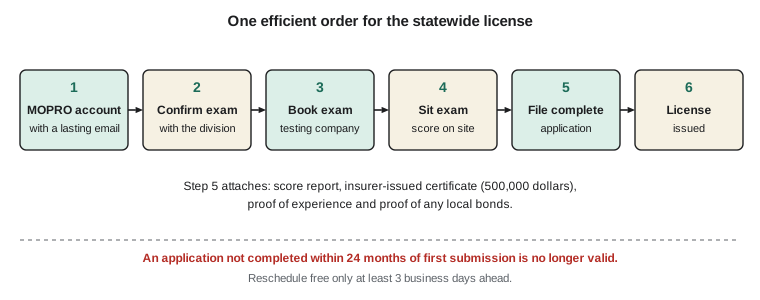
The division's rule at 20 CSR 2117-2.010 lists what a complete statewide application includes. The applicant files the division's application form and pays the application fee, and attaches proof of insurance, proof of any bonds the political subdivisions where the applicant works require, proof of passing an accepted examination, and proof of qualifying experience or education. Lesson 2 covered the proof of experience; this lesson covers the rest.
Proof of passing the exam can come in three ways under the rule: the testing company can send the score to the division, the applicant can provide the score report, or the applicant can rely on a qualifying current license whose issuer required an accepted exam. The rule also states that the applicant pays all examination costs directly to the testing company. That means there is no rule forcing a particular order. Many applicants pass the exam first and then file a complete application with the score report attached, so the application does not sit incomplete.
The division's fees are set by rule and published on its fee schedule rather than in the statute, and the rule text reviewed for this course refers only to applicable fees without listing amounts. Check the current fee schedule on the division's website before paying.
Filing online
The Division of Professional Registration moved its boards and offices onto an online system called MOPRO. The division's statewide electrical contractor FAQ says registration in MOPRO began January 14, 2025, that it requires an email address on file with the board, and that MOPRO is used for applications, renewals, payments and contact updates. Tamika created her MOPRO account with a personal email address she expected to keep for years, not her work email, because license notices follow the person, not the employer.
A practical habit: before submitting, save a copy of every document as a single, clearly named file, and keep a list of what was uploaded and when. If the division asks for something again, you can answer the same day.
The 24-month limit
The rule puts a clock on applications. An application that is not completed within 24 months of the date it was first submitted is no longer valid, and the applicant must start over with a new application and fees. Twenty-four months sounds generous, but an applicant who files early, fails the exam twice and then waits on a former employer's affidavit can run out of time. Joyce's whiteboard plan had Tamika file only when every piece was ready.
from datetime import date

# The 24-month validity window for a statewide application (illustrative date)
first_submitted = date(2026, 3, 9)
expires = date(first_submitted.year + 2, first_submitted.month, first_submitted.day)
print(f"First submitted: {first_submitted}")
print(f"Must be completed before: {expires}")
today = date(2027, 11, 20)
days_left = (expires - today).days
print(f"On {today}, days left: {days_left}")First submitted: 2026-03-09 Must be completed before: 2028-03-09 On 2027-11-20, days left: 110
Booking the statewide-accepted exam
The division posts the examinations it accepts on its website. The bulletin published in August 2026 by the testing company Prov for Missouri electrical contractor licensing lists journeyman, master, residential journeyman and residential master electrician exams, each based on the 2017 or 2020 edition of the National Electrical Code. The bulletin tells candidates that the testing company does not decide which exam a candidate needs and that fees paid for the wrong exam are not refunded. It directs candidates to confirm with the board, giving the number 573-522-3280, before registering.
Booking is done through the testing company. The bulletin describes an online scheduler, where the candidate selects the Missouri electrical contractor licensing program, chooses the license and the code year, enters personal information and picks a date, time and location, and a phone line answered weekday mornings through evenings Mountain time. It lists testing locations in Cape Girardeau, Carthage, Jefferson City, Joplin, Independence, Springfield, two in St. Louis, St. Peters, Union, Warrensburg and West Plains. The fee in the bulletin is 80 dollars per exam, paid when booking.
Three booking rules in the bulletin cause most problems. The name entered must match the candidate's government-issued photo ID exactly. Canceling or rescheduling is free only if done at least three business days before the appointment; later changes and no-shows forfeit the fee. And candidates who arrive after the session starts are turned away and forfeit the fee, so the bulletin advises arriving early, with doors opening at least 15 minutes before appointments.
| Item | Statewide-accepted exam (Prov bulletin, Aug 2026) | St. Louis County exam (Prov bulletin, Oct 2025) |
|---|---|---|
| Who approves first | Confirm the exam with the division; testing company schedules | The county must approve the application first |
| Fee per exam | 80 dollars | 100 dollars |
| Free reschedule | At least 3 business days before | At least 3 business days before |
| Wrong exam booked | No refund | No refund |
| Scored | On site | On site |
St. Louis County: approval before booking
St. Louis County runs the order the other way around. Its bulletin states that a candidate must apply to the county and be approved before scheduling with the testing company, and that the testing company is not authorized to determine which examination a candidate must take. Candidates contact the county licensing office first. Once approved, the candidate books the county's master electrician exam with the testing company. The county bulletin lists a fee of 100 dollars per exam and optional practice exams for 25 dollars each.
The county's application materials are published by the county and should be read before applying. The bulletin itself does not list the county's experience requirements or its license fee, only the exam rules.
Kansas City: the certificate of qualification process
Kansas City's process, as its contractor licensing page describes it, runs in three steps. First, the business obtains a Kansas City business license. The page lists three ways: the city's QuickTax online system or the RD-100 form, both of which typically take seven to ten business days, or an on-the-spot license at City Hall. Second, the qualified individual applies for a certificate of qualification through the CompassKC online system, using the reference letters and trade requirements described on the city's contractor licensing page. Third, once the business license and certificate are in place, the business applies for its contractor license through CompassKC.
The page gives contact information for the City Planning and Development Department's Permits Division at 414 East 12th Street, fifth floor, with walk-in hours Monday through Friday from 8:30 in the morning to 4 in the afternoon and a request to arrive by 3:45. The examinations required for each Kansas City certificate were not described on the page reviewed, so confirm the exam and how to book it with the Permits Division.
The City of St. Louis
The City of St. Louis Committee of Electrical Examiners gives written and oral examinations. Its page directs applicants to the Building Division, at City Hall, 1200 Market Street, room 426, with a phone number of 314-622-3313. The page does not describe the booking steps, so a candidate should call or visit before assuming the process matches the county's or the state's.
Retakes and reviews
Both Prov bulletins allow a candidate who fails to retake the exam as often as needed with no waiting period, at the same fee each time, and both state that a candidate cannot retake an exam already passed. Both allow a review session only after the candidate has failed the same exam at least twice and scored within 10 points of the passing score of 70, and the review lasts an hour and a half at the same cost as the exam. The statewide bulletin also offers a hand-scoring check for 25 dollars, requested within 90 days.
No waiting period does not mean no cost. Each attempt costs the full fee, and a candidate who retakes without studying the weak areas often fails again. Ron's rule was to wait at least two weeks between attempts and spend them on the subject areas the score report showed as weakest.
# Cost of exam attempts (fees from the candidate bulletins)
statewide_fee = 80
county_fee = 100
for attempts in (1, 2, 3):
    print(f"{attempts} statewide attempt(s): {attempts * statewide_fee} dollars; "
f"{attempts} county attempt(s): {attempts * county_fee} dollars")1 statewide attempt(s): 80 dollars; 1 county attempt(s): 100 dollars 2 statewide attempt(s): 160 dollars; 2 county attempt(s): 200 dollars 3 statewide attempt(s): 240 dollars; 3 county attempt(s): 300 dollars
Tamika's plan
Joyce's whiteboard ended up like this. Week 1: create the MOPRO account and confirm with the division which master exam it accepts. Week 2: book the master exam on the 2020 code at the St. Peters site, the nearest one with Saturday seats, at least six weeks out. Weeks 3 to 8: study. Week 9: sit the exam. Week 10: if passed, upload the score report, the insurance certificate Gateway Bend's insurer issues in Tamika's name, the experience affidavits and the apprenticeship certificate, and submit. If failed, rebook after two weeks of focused study.
Tamika decided to apply to St. Louis County later, after the statewide license was in hand, if the company still needed it.
Before booking anything, Joyce also checked two small details that cause outsized trouble. The email address in MOPRO had to be one Tamika would read, because the division sends notices there. And the name on Tamika's driver's license, which included her middle initial, had to match the name she entered at booking. Both took five minutes and could have cost weeks.
Questions to ask before you pay
Joyce kept a short list of questions to ask on the phone before paying any fee. For the division: which master exam and code edition it accepts, whether pen notes are allowed in the book, and the current application fee. For the testing company: the nearest site with open seats, the exact name format required, and the deadline to reschedule for free. For the county or city: whether its approval comes before booking, which exam it requires, and what its application packet includes. Writing the answers down, with the date and the name of the person who gave them, gave Tamika a record if anything was later disputed.
Common mistakes
MistakeBooking a county exam before the county approves the application.
InsteadSt. Louis County must approve the candidate before the testing company schedules the exam.
MistakeBooking an exam without confirming it is the one the division accepts.
InsteadConfirm with the division first; the testing company does not refund the wrong exam.
MistakeRescheduling the day before the exam and expecting a refund.
InsteadChanges must be made at least three business days before to avoid forfeiting the fee.
MistakeUsing a nickname at booking.
InsteadThe name must match the government photo ID exactly.
MistakeFiling an incomplete statewide application early and letting it sit.
InsteadApplications expire 24 months after first submission.
Summary and key terms
- A statewide application includes the form, fee, insurance proof, bond proof, exam proof and experience proof.
- The exam score can be sent by the testing company or supplied by the applicant; the applicant pays the exam fee to the testing company.
- MOPRO is the division's online system for applications and renewals.
- The statewide-accepted exams are booked with the testing company after confirming the exam with the division; the fee in the 2026 bulletin is 80 dollars.
- St. Louis County must approve a candidate before its 100-dollar exam can be scheduled.
- Kansas City requires a business license, a certificate of qualification and then a contractor license, all through CompassKC.
- MOPRO
- The Division of Professional Registration's online licensing system.
- Candidate information bulletin
- The testing company's published rules for an exam.
- CompassKC
- Kansas City's online permits and licensing system.
- Hand score
- A manual rescoring of an exam answer sheet for a fee.
- Review session
- A supervised look at a failed exam, allowed only under set conditions.
Practice problems
Work each problem on paper first, then reveal the answer to check.
Tamika books a statewide-accepted exam for a Saturday and wants to move it on the Wednesday before. Can she do so free?
Show answer
No; Wednesday to Saturday is fewer than three business days, so the fee is forfeited.
A candidate fails the master exam twice with scores of 58 and 62. Can he request a review?
Show answer
Yes for the 62, which is within 10 points of 70; the rule requires two failures and a score within 10 points.
What is the cost of three attempts at the St. Louis County exam?
Show answer
Three times 100 dollars, or 300 dollars.
What must a Kansas City business have before applying for a contractor license?
Show answer
A Kansas City business license and a qualified individual's certificate of qualification.
A statewide application was first submitted on June 1, 2026. By when must it be completed?
Show answer
Before June 1, 2028.
Lesson quiz · 5 questions
Score 60% or more to complete this lesson.
Create a free account to save your progress, take quizzes and earn a certificate.