
MELU-225 · Lesson 8 of 12 · 20 min
Contractor licensing, insurance and bonding
▶ Video coming soon A video version of this lesson is on the way.
Gateway Bend's office has a gray filing cabinet that Joyce calls the drawer of proof. In it are the company's Missouri business registration, its city and county business licenses, the statewide license certificate for Ron, a folder of bonds with a different city's name on each, and the insurance certificates the company sends to customers and building departments every year. When Tamika becomes the company's licensed person, that drawer becomes her responsibility too. This lesson explains what goes in it and why.
The lesson covers the difference between the license a person holds and the registrations a business needs, the statewide insurance requirement, local bonds, local business licenses, the Kansas City contractor license sequence, and how insurance and bonds work in practice. Workers' compensation insurance, which Missouri requires of almost every electrical contractor, is covered in Lesson 10.
Person, firm and business
Three layers are easy to confuse. The person holds a license: a statewide electrical contractor license from the division, or a local master electrician or contractor license from a city or county. The firm is the business entity that contracts for work, and under section 324.920 of the Revised Statutes of Missouri it must employ at least one statewide licensee at a supervisory level if it relies on the statewide license. The business also needs the ordinary registrations any Missouri business needs, such as registration with the Secretary of State for an LLC or corporation and state tax registrations, plus any local business license a city requires.
Section 324.925 preserves a city's power to require a business license to perform electrical contracting work. What a city cannot do is make a statewide licensee obtain a local business or occupation license that requires an examination or other special trade proficiency. A general business license and its fee are allowed; a local trade exam as a condition of that license is not, for a statewide licensee in a participating jurisdiction.
| Layer | Example for Gateway Bend | Who issues it |
|---|---|---|
| Personal license | Ron's statewide license; Ron's St. Louis County master license | The division; St. Louis County |
| Firm qualification | Gateway Bend named with Ron as qualifier | Filed with the division |
| Business registration | Gateway Bend Electric, LLC | Missouri Secretary of State |
| Local business license | Business licenses in cities where it works | Each city that requires one |
| Local contractor license | A local license where the company works without relying on the statewide license | The city or county |
| Insurance and bonds | Liability insurance; city bonds | Insurer; each city's bond requirement |
The statewide insurance requirement
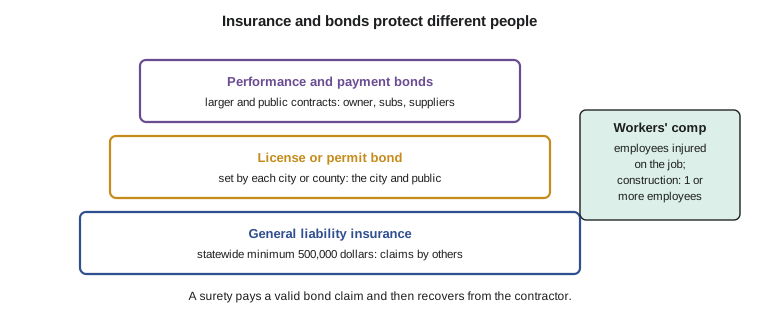
Section 324.920 requires an applicant for the statewide license to show liability insurance of 500,000 dollars. The division's rule at 20 CSR 2117-2.010 adds detail on proof: the coverage must be shown by a certificate of insurance issued by an insurer authorized to do business in Missouri, and a certificate of insurance issued by an agent is not acceptable. Joyce learned that rule the hard way when Ron first applied in 2020: the agency sent its usual certificate, and the division sent it back. The fix was to ask the insurer itself to issue the certificate.
The rule reviewed for this course states the insurance requirement for applications. It does not spell out a separate rule for notifying the division of changes in coverage, but the license is issued on the premise that the coverage exists, and many local governments also require proof of insurance before they register a contractor or issue a permit. Keep the coverage in force without gaps, and keep current certificates on file for every jurisdiction that asked for one.
What liability insurance does
Commercial general liability insurance pays, within its limits and terms, for injury to other people and damage to their property caused by the contractor's operations or completed work. It does not pay to fix the contractor's own defective work in most policies, and it does not cover the contractor's employees, who are covered by workers' compensation. The 500,000-dollar figure is the statewide minimum for licensing. Many customers, general contractors and public owners require higher limits, additional insured endorsements and an umbrella policy. Read each contract's insurance clause before bidding, because the cost of meeting it belongs in the price.
# Does Gateway Bend's coverage meet each contract's requirement? (illustrative limits)
policy = {"general_liability_per_occurrence": 1_000_000, "umbrella": 2_000_000}
contracts = {
    "Statewide license minimum": 500_000,
    "Hospital renovation": 2_000_000,
    "School district": 3_000_000,
    "Big-box retailer": 5_000_000,
}
available = policy["general_liability_per_occurrence"] + policy["umbrella"]
for name, required in contracts.items():
    ok = "meets" if available >= required else f"short by {required - available:,} dollars"
print(f"{name}: requires {required:,}; coverage {available:,} -> {ok}")Statewide license minimum: requires 500,000; coverage 3,000,000 -> meets Hospital renovation: requires 2,000,000; coverage 3,000,000 -> meets School district: requires 3,000,000; coverage 3,000,000 -> meets Big-box retailer: requires 5,000,000; coverage 3,000,000 -> short by 2,000,000 dollars
Local bonds
Section 324.920 also requires a statewide applicant to post bonds with each political subdivision where the applicant works, if that political subdivision requires one, and the division's rule asks for proof of those bonds in the application. Bonds are local: each city or county decides whether to require one and in what amount and form. Amounts and terms vary, so check each jurisdiction's current requirement rather than relying on another city's figure.
A license or permit bond is a promise by a surety company to the city that the contractor will comply with the city's ordinances. If the contractor fails to, for example by leaving work uninspected or failing to pay permit fees, the city or an injured party may claim against the bond. The surety pays, within the bond amount, and then seeks repayment from the contractor. A bond is therefore not insurance for the contractor. It is credit, backed by the contractor's own promise to repay.
| Feature | Liability insurance | License or permit bond |
|---|---|---|
| Who it protects | The contractor, against claims by others | The city and the public |
| Who pays in the end | The insurer, within the policy | The contractor, who must repay the surety |
| Required by | The statewide license; many contracts and cities | Cities and counties that require one |
| Amount | 500,000 dollars minimum for the statewide license | Set by each local government |
Performance and payment bonds
Larger contracts, and public works contracts in particular, often require performance and payment bonds. A performance bond protects the owner if the contractor fails to complete the work. A payment bond protects subcontractors and suppliers who are not paid. Missouri public works are generally not subject to mechanics' liens, so payment bonds are the main protection for subcontractors on public projects. The bond requirements for a public project are set by the governing statutes and the contract documents; read them before bidding. Surety companies look at the contractor's financial statements, work in progress and experience before issuing bonds, and the amount of bonded work a contractor can carry depends on that review.
Kansas City's contractor license
Kansas City follows a three-step sequence described on its contractor licensing page and covered in Lesson 3: the business obtains a Kansas City business license, the qualified individual obtains a certificate of qualification, and then the business applies for the contractor license through the CompassKC system. The page reviewed did not list Kansas City's insurance or bond amounts; ask the City Planning and Development Department's Permits Division for the current requirements before applying.
St. Louis County and the City of St. Louis
St. Louis County licenses electrical contractors, with the master electrician exam described in Lessons 3 and 4 tied to the contractor license. The City of St. Louis licenses through its Committee of Electrical Examiners. Both have their own insurance, bond and registration requirements set by ordinance, and both may change them. Read each application packet in full, and keep a list of what each jurisdiction requires and when each item expires.
from datetime import date

# Joyce's expiration tracker (illustrative dates)
items = {
    "General liability certificate (insurer-issued)": date(2027, 1, 15),
    "City A license bond": date(2026, 12, 31),
    "City B business license": date(2026, 12, 31),
    "St. Louis County contractor license": date(2027, 6, 30),
    "Statewide license (renews every third year)": date(2026, 9, 30),
}
today = date(2026, 11, 9)
for name, exp in sorted(items.items(), key=lambda kv: kv[1]):
    days = (exp - today).days
    status = "EXPIRED" if days < 0 else ("renew now" if days <= 60 else "ok")
print(f"{exp} {name}: {status}")2026-09-30 Statewide license (renews every third year): EXPIRED 2026-12-31 City A license bond: renew now 2026-12-31 City B business license: renew now 2027-01-15 General liability certificate (insurer-issued): ok 2027-06-30 St. Louis County contractor license: ok
The tracker's first line is a warning sign. In the illustrative data, the statewide license shows a September 30 date already passed. Lesson 11 explains the renewal cycle and what happens when a license lapses.
Subcontractors and independent contractors
When Gateway Bend hires a subcontractor, for example a low-voltage firm, it collects the subcontractor's certificate of insurance, confirms its licenses in the job's jurisdiction, and requires in the subcontract that the subcontractor carry workers' compensation and name Gateway Bend as an additional insured. A subcontractor without coverage can leave the hiring contractor exposed to claims, including workers' compensation claims by the subcontractor's employees. Lesson 10 explains why.
A company also cannot avoid its obligations by calling employees independent contractors. Whether a worker is an employee depends on the facts of the relationship, not the label. A worker who uses the company's tools, works the company's hours and does the company's core work under its direction is likely an employee.
Worked problem
Meeting a contract's insurance clause
A general contractor's subcontract requires Gateway Bend to carry 2,000,000 dollars of liability coverage per occurrence, name the general contractor as additional insured and provide a certificate before mobilizing. Gateway Bend carries 1,000,000 dollars per occurrence plus a 2,000,000-dollar umbrella.
Show solution
- Ask the insurer or agent whether the umbrella follows the form of the underlying policy and counts toward the per occurrence requirement.
- Request the additional insured endorsement for the general contractor.
- Get the certificate issued before mobilizing, and price any added premium into the bid.
- Keep the certificate and endorsement in the job file.
Answer: Confirm the umbrella satisfies the clause, add the endorsement and deliver the certificate before work starts.
Annual insurance review
Gateway Bend reviews its insurance every year, a month before renewal. Ron, Tamika and the company's agent go through the list of current and expected contracts and their insurance clauses, any changes in the kind of work the company does, such as adding solar or low-voltage work, the claims of the past year, and the certificates and endorsements the company must reissue. The review catches gaps before a customer does. One year it found that a new contract for a manufacturing plant required pollution liability coverage that the company did not carry; Ron priced it into the bid rather than discovering the gap after signing.
Tamika's drawer of proof
When Tamika becomes a qualifier, the drawer of proof will hold a new set of papers in her name: her statewide license, the division's record naming her as Gateway Bend's qualifier, the insurer-issued certificate she used for her application, and any local registrations that list her as the responsible person. Joyce added a one-page index to the front of the drawer listing each item, its issuer, its expiration date and where the digital copy is saved. When a building department or a general contractor asks for proof, the answer now takes minutes, not an afternoon.
Common mistakes
MistakeSending an agent-issued certificate with the statewide application.
InsteadThe rule requires a certificate issued by an insurer authorized in Missouri.
MistakeTreating a bond as insurance for the contractor.
InsteadThe surety pays claims and then recovers from the contractor.
MistakeAssuming one city's bond amount applies everywhere.
InsteadEach local government sets its own bond requirement.
MistakeBelieving a city may require a statewide licensee to pass a local exam for a business license.
InsteadSection 324.925 forbids exam or proficiency conditions for statewide licensees.
MistakeCalling employees independent contractors to save on coverage.
InsteadStatus depends on the facts, not the label.
Summary and key terms
- A statewide applicant must show 500,000 dollars of liability insurance, proven by a certificate from an insurer authorized in Missouri.
- Agent-issued certificates are not accepted for the statewide application.
- Statewide applicants must post any bonds required by each political subdivision where they work.
- Cities may require a business license, but not a trade exam, of a statewide licensee.
- Kansas City requires a business license, a certificate of qualification and then a contractor license.
- Public works rely on payment bonds rather than liens to protect subcontractors.
- Certificate of insurance
- A document summarizing a policy's coverage and limits.
- Surety
- The company that issues a bond and pays valid claims within its amount.
- License bond
- A bond guaranteeing compliance with local ordinances.
- Payment bond
- A bond protecting subcontractors and suppliers from nonpayment.
- Additional insured
- A party added to a policy's protection by endorsement.
Practice problems
Work each problem on paper first, then reveal the answer to check.
What minimum liability insurance does the statewide license require?
Show answer
500,000 dollars.
Who must issue the certificate of insurance for the statewide application?
Show answer
An insurer authorized to do business in Missouri, not an agent.
A surety pays a city's claim on Gateway Bend's bond. Who ultimately bears the cost?
Show answer
Gateway Bend, which must repay the surety.
May a participating city charge a statewide licensee for a general business license?
Show answer
Yes; it may require a business license but not an exam.
What protects an unpaid subcontractor on a public project?
Show answer
Usually the payment bond, since public works are generally not subject to liens.
Lesson quiz · 5 questions
Score 60% or more to complete this lesson.
Create a free account to save your progress, take quizzes and earn a certificate.