
MELU-225 · Lesson 10 of 12 · 18 min
Workplace safety law and OSHA for electrical contractors
▶ Video coming soon A video version of this lesson is on the way.
On a Tuesday in March, one of Gateway Bend's second-year apprentices reached into a panel at a warehouse in Hazelwood to tighten a neutral, assuming the main had been shut off. It had not. He was lucky: a minor burn to two fingers, a trip to urgent care and a day off work. That evening Ron, Tamika and Joyce went through what had gone wrong and what the law required next. Was the injury reportable to OSHA? Did the company need to report it to its workers' compensation insurer, and by when? What did the apprentice need to do? And how had a crew working under Tamika's supervision come to put hands into live equipment at all?
This lesson covers the safety and injury law that applies to a Missouri electrical contractor: who enforces workplace safety, the OSHA rules most relevant to electrical work, injury reporting, Missouri's training requirement on public works, and Missouri workers' compensation. Regulations are cited by number and described in plain words.
Who enforces workplace safety in Missouri
Missouri does not operate an OSHA-approved state plan for private employers, so federal OSHA enforces the Occupational Safety and Health Act for private-sector workplaces in the state, through its area offices. That means the federal construction standards in 29 CFR Part 1926 and the general industry standards in 29 CFR Part 1910 apply directly to Gateway Bend's crews, along with the general duty to keep the workplace free of recognized serious hazards. Missouri's Department of Labor and Industrial Relations administers workers' compensation and some state safety programs, and the state offers on-site safety consultation for small employers that is separate from enforcement.
| Subject | Who handles it in Missouri | Main source |
|---|---|---|
| Private-sector workplace safety | Federal OSHA | 29 CFR Parts 1910 and 1926 |
| Workers' compensation | Missouri Division of Workers' Compensation | Chapter 287, RSMo |
| Training on public works projects | Missouri Department of Labor and Industrial Relations | Section 292.675, RSMo |
| Electrical installation code | Local governments | Adopted local code (Lesson 5) |
OSHA rules most relevant to electrical contractors
Several groups of federal rules matter most to an electrical contractor. Subpart K of Part 1926 covers electrical safety in construction, including ground-fault protection for temporary power on construction sites, through ground-fault circuit interrupters or an assured equipment grounding conductor program, and rules on working near energized parts. Subpart V of Part 1926 covers power transmission and distribution work. Part 1910 Subpart S covers electrical safety-related work practices in general industry, which can apply when crews work in operating plants and buildings. The control of hazardous energy standard in 29 CFR 1910.147 governs lockout and tagout in general industry, and the construction rules have their own requirements for deenergizing and locking out circuits.
Other OSHA rules regularly apply to electrical crews: fall protection in Subpart M, ladders in Subpart X, scaffolds in Subpart L, excavations in Subpart P, personal protective equipment and the hazard communication standard. The OSHA rules set the legal minimum; the consensus standard NFPA 70E, Standard for Electrical Safety in the Workplace, provides the detailed methods many employers use to meet OSHA's requirements for electrical hazard assessment, arc flash protection and safe work practices. OSHA cites recognized consensus standards as evidence of hazards and feasible protections, so following NFPA 70E is the industry norm.
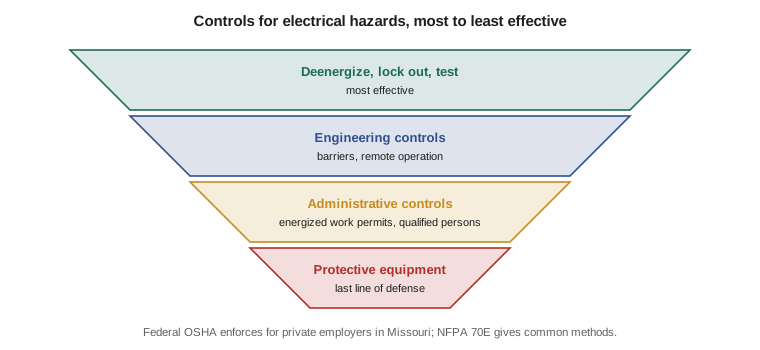
The apprentice's injury: what went wrong
The apprentice's injury had a simple cause: the circuit was not deenergized, locked out and tested before he touched it. The fix was equally simple and, in Ron's view, not optional. Gateway Bend's written program now requires every crew to treat equipment as energized until it has been shut off, locked and tagged by the person working on it, and tested for absence of voltage with a meter that is itself checked before and after. Energized work requires the crew lead to justify it in writing and to follow the company's energized work permit, which is based on NFPA 70E. Apprentices do not perform energized work.
Tamika added a training step. Every new hire and apprentice completes the company's lockout and tagout training before being assigned to service or panel work, and the training is documented, because OSHA's lockout rules require training and its records show whether it happened.
Injury reporting to OSHA
Under 29 CFR 1904.39, an employer must report a work-related fatality to OSHA within eight hours of learning of it, and an in-patient hospitalization, an amputation or the loss of an eye within 24 hours. The apprentice's burn, treated at urgent care without hospitalization, did not require a report to OSHA. Whether it had to be recorded on the company's injury and illness log depends on the recordkeeping rules in Part 1904 and the company's size and industry; medical treatment beyond first aid is generally recordable for employers required to keep the log.
# Which events must be reported to OSHA, and how fast? (29 CFR 1904.39)
events = [
    ("Fatality", 8),
    ("In-patient hospitalization", 24),
    ("Amputation", 24),
    ("Loss of an eye", 24),
    ("Burn treated at urgent care and released", None),
]
for event, hours in events:
    if hours:
        print(f"{event}: report to OSHA within {hours} hours")
    else:
print(f"{event}: no OSHA report required; check recordkeeping rules")Fatality: report to OSHA within 8 hours In-patient hospitalization: report to OSHA within 24 hours Amputation: report to OSHA within 24 hours Loss of an eye: report to OSHA within 24 hours Burn treated at urgent care and released: no OSHA report required; check recordkeeping rules
Missouri's public works training requirement
Section 292.675 of the Revised Statutes of Missouri requires contractors and subcontractors on public works contracts to provide a ten-hour OSHA construction safety program, or an approved equivalent, for their on-site employees who have not already completed one. Employees must complete it within sixty days of beginning work on the project, and an employee found on site without documentation has twenty days to produce it before being removed from the project. A contractor forfeits 2,500 dollars plus 100 dollars per employee for each day an employee works without the training, after those periods run. The Department of Labor and Industrial Relations investigates, and the public body can withhold payment to cover penalties. The section excludes public utility work under Public Service Commission jurisdiction and certain rail crossing projects.
Gateway Bend bids school and municipal work, so every field employee completes the ten-hour course in the first sixty days of employment and the cards are kept in the job file.
# Penalty exposure under section 292.675 (illustrative)
base = 2_500
per_employee = 100
untrained = 3
days = 4
total = days * (base + per_employee * untrained)
print(f"{untrained} untrained employees for {days} days after the grace periods: {total:,} dollars")3 untrained employees for 4 days after the grace periods: 11,200 dollars
Missouri workers' compensation: who must carry it
Chapter 287 of the Revised Statutes of Missouri requires covered employers to provide workers' compensation, through insurance or approved self-insurance. Section 287.030 sets a general threshold of five or more employees for many employers, but it treats construction industry employers, those who build, tear down, remodel or repair improvements, as employers with one or more employees. Relatives within the third degree are counted. In practice, nearly every electrical contractor with any employee must carry workers' compensation in Missouri.
A contractor that hires an uninsured subcontractor can also be exposed. Missouri law generally treats a general contractor as the statutory employer of a subcontractor's workers for compensation purposes in certain circumstances, which is why Lesson 8 recommended collecting every subcontractor's certificate of coverage. The details of statutory employment are fact-specific and are worded generally here.
Injury notice and reporting deadlines
Missouri's workers' compensation law sets deadlines for the employee, the employer and the claim.
| Step | Deadline | Source |
|---|---|---|
| Employee gives written notice of an accident to the employer | Within 30 days after the accident (from diagnosis for occupational disease or repetitive trauma) | Section 287.420 |
| Employer reports to its insurer or third-party administrator | Within 5 days | Section 287.380 |
| Employer or insurer reports to the division | Within 30 days after knowledge of the injury | Section 287.380 |
| Claim for compensation filed with the division | Within 2 years of the injury, death or last payment; 3 years if the employer failed to file its report | Section 287.430 |
The employee notice rule has an exception if the employer was not prejudiced by the lack of notice, but the safe course for an employee is to give written notice promptly. Section 287.380 makes knowingly failing to report, or making a false report, a misdemeanor. Gateway Bend reported the apprentice's burn to its insurer the next morning and kept a copy of his written notice in his file.
from datetime import date, timedelta

# Deadlines for the apprentice's injury (illustrative dates)
injury = date(2026, 3, 10)
employer_knew = injury
print(f"Employee written notice due by: {injury + timedelta(days=30)}")
print(f"Report to insurer due by: {employer_knew + timedelta(days=5)}")
print(f"Report to the division due by: {employer_knew + timedelta(days=30)}")
print(f"Claim deadline if no payments are made: {injury.replace(year=injury.year + 2)}")Employee written notice due by: 2026-04-09 Report to insurer due by: 2026-03-15 Report to the division due by: 2026-04-09 Claim deadline if no payments are made: 2028-03-10
Building a safety program
Federal OSHA does not require every construction employer to have a single written safety program, but many specific standards require written plans or training records, and customers, general contractors and insurers usually ask for a written program. A practical program for an electrical contractor covers hazard assessment, lockout and tagout, energized work permits, arc flash and shock protection, fall protection, ladders, excavation, hazard communication, first aid and emergency response, injury reporting and investigation, and training records.
The master electrician's role is central because the code knowledge that keeps an installation safe for its users is the same knowledge that keeps a crew safe while installing it. Tamika now spends ten minutes of every Monday crew meeting on one safety topic, and she writes the topic and attendance in the meeting log.
Investigating an incident
After the apprentice's injury, Tamika led a short investigation the next morning. She talked to the apprentice and the crew lead separately, looked at the panel, and wrote a one-page report: what happened, why it happened, and what would change. The root cause was not the apprentice's mistake alone. The crew lead had told him the main was off without locking it out, and the company had no rule requiring each worker to apply a personal lock. The fix addressed the system as well as the person. A short, blame-free investigation of every injury and near miss is one of the best ways to find hazards before they hurt someone.
Tamika also asked the insurer about return-to-work options. Missouri employers and insurers often arrange light duty for an injured worker who can do some tasks, which keeps the worker connected to the job and can reduce lost-time costs. The apprentice spent two days helping Joyce organize the material room while his fingers healed, then returned to his crew.
Common mistakes
MistakeAssuming Missouri runs its own OSHA plan for private employers.
InsteadFederal OSHA covers private-sector workplaces in Missouri.
MistakeThinking a construction company with two employees is exempt from workers' compensation.
InsteadConstruction employers with one or more employees are covered.
MistakeReporting a hospitalization to OSHA a week later.
InsteadIn-patient hospitalizations must be reported within 24 hours.
MistakeLetting an employee start a public works job without the ten-hour course and forgetting about it.
InsteadIt must be completed within sixty days, with daily penalties after the grace periods.
MistakeRelying on protective equipment instead of deenergizing.
InsteadDeenergize, lock out and test first; protective equipment is the last line of defense.
Summary and key terms
- Federal OSHA enforces workplace safety for private employers in Missouri.
- Key standards include 29 CFR 1926 Subpart K, 1910 Subpart S and the lockout and tagout rules, with NFPA 70E as the common method of compliance.
- Fatalities must be reported to OSHA within 8 hours, and in-patient hospitalizations, amputations and eye losses within 24 hours.
- Section 292.675 requires ten-hour OSHA training for on-site employees on public works within sixty days.
- Construction employers with one or more employees must carry Missouri workers' compensation.
- Employees give written notice within 30 days; employers report within 30 days; claims are filed within 2 years, or 3 if no report was filed.
- OSHA
- The federal Occupational Safety and Health Administration.
- Lockout and tagout
- Procedures for isolating energy sources and securing them before work.
- NFPA 70E
- The consensus standard for electrical safety in the workplace.
- Statutory employer
- A contractor treated as the employer of a subcontractor's workers for compensation purposes.
- Recordable injury
- A work injury that must be entered on the employer's injury log under Part 1904.
Practice problems
Work each problem on paper first, then reveal the answer to check.
Within how many hours must an amputation be reported to OSHA?
Show answer
24 hours.
Does federal or state OSHA cover Gateway Bend's crews?
Show answer
Federal OSHA.
How many employees make a construction company an employer for Missouri workers' compensation?
Show answer
One or more.
How long does an employee on a public works project have to complete the ten-hour course?
Show answer
Sixty days from beginning work on the project.
An employer never filed the injury report. How long does the employee have to file a claim?
Show answer
Three years.
Lesson quiz · 5 questions
Score 60% or more to complete this lesson.
Create a free account to save your progress, take quizzes and earn a certificate.