
MELU-225 · Lesson 12 of 12 · 20 min
Practice exam review and test-day strategy
▶ Video coming soon A video version of this lesson is on the way.
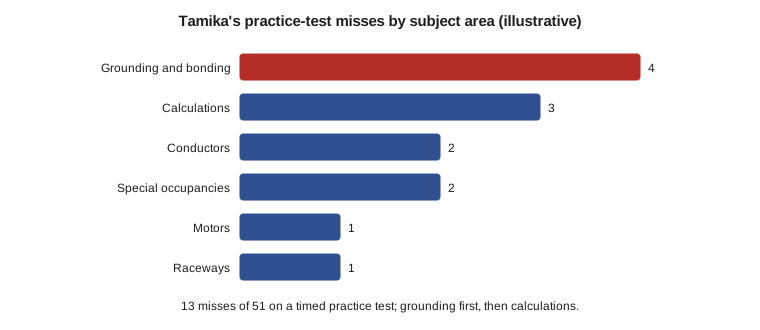
Two weeks before her exam, Tamika sat a full timed practice test at the kitchen table on a Saturday morning, with her tabbed 2020 code book, a practice version of the on-screen calculator and a kitchen timer set to three hours. She finished with eighteen minutes left and scored 75. That was a pass, but not by enough to feel safe. More useful than the score was the pattern of her misses: four of her thirteen wrong answers were grounding and bonding questions she had answered from memory without opening the book, and three were questions she had run out of time to check. This lesson turns that kind of review into a plan, and then walks through exam day.
The lesson has three parts: a review of the Missouri-specific facts from Lessons 1 to 11 that candidates and exam writers both focus on, a method for working code questions under time pressure, and a test-day routine built around the testing company's bulletin. The practice questions here are written for this course; they do not reproduce questions from any real exam, and the code is referred to by article number only.
What the exam measures
The statewide-accepted master exam, as Lesson 4 explained, is an open book test of the National Electrical Code in the 2017 or 2020 edition, with ten subject areas and a cut score of 70. St. Louis County's, Kansas City's and the City of St. Louis's exams can also test local requirements. A candidate who will take both a code exam and a local exam should prepare for two kinds of questions: code questions answered with the book, and law and business questions answered from knowledge of the jurisdiction's rules.
| Question type | How to answer | Typical time |
|---|---|---|
| Direct lookup | Go to the article by tab, find the section, confirm the exact condition | 1 to 2 minutes |
| Rule with conditions | Find the rule, then read every exception and the scope of the article | 2 to 4 minutes |
| Calculation | Identify the method in the code, work it on the calculator, check units | 4 to 8 minutes |
| Local law or business | Answer from knowledge; there may be no book reference | Under 1 minute |
Missouri facts worth knowing cold
Law and business questions reward recall. The facts below are the ones this course flagged most often; each comes from the lesson indicated.
| Fact | Value | Lesson |
|---|---|---|
| Statewide license type | Voluntary statewide electrical contractor license, sections 324.900 to 324.945 | 1 |
| Experience routes | 12,000 hours; 10,000 plus a DOL-approved apprenticeship certificate; 8,000 plus an associate degree; 4,000 supervising plus an engineering degree | 2 |
| Local license route | Local license held six of the previous eight years, earned by qualifying exam | 2 |
| Application validity | 24 months from first submission | 3 |
| Free reschedule | At least 3 business days before the exam | 3 |
| 2020 master exam | 51 questions, 3 hours, cut score 70 | 4 |
| Code adoption | Local, by ordinance; no statewide code for most private work | 5 |
| Local suspension | Up to 30 days while a complaint goes to the division | 6 |
| Firms per qualifier | One | 7 |
| Liability insurance | 500,000 dollars, certificate from an authorized insurer | 8 |
| Lien filing | Within 6 months after the debt accrues; suit within 6 months of filing | 9 |
| Workers' compensation | Construction employers with one or more employees | 10 |
| Renewal | Every third year by September 30; void after 2 years unrenewed | 11 |
Reviewing a practice test
A practice score matters less than the reasons for each miss. Tamika sorted her thirteen misses into three causes: did not know where to look, found the rule but misread a condition or exception, and ran out of time. Each cause has its own fix. For where to look, practice locating rules by tab and index without answering the question. For misreading, slow down on the last step and reread the section's conditions. For time, drill the clock checkpoints below.
# Sorting practice-test misses by cause and subject (Tamika's data, illustrative)
misses = [
    ("grounding", "answered from memory"), ("grounding", "answered from memory"),
    ("grounding", "misread exception"), ("grounding", "answered from memory"),
    ("calculations", "time"), ("calculations", "time"), ("calculations", "misread exception"),
    ("conductors", "could not find"), ("conductors", "time"),
    ("special occupancies", "could not find"), ("special occupancies", "misread exception"),
    ("motors", "misread exception"), ("raceways", "could not find"),
]
from collections import Counter
by_cause = Counter(c for _, c in misses)
by_subject = Counter(s for s, _ in misses)
print("By cause:", dict(by_cause))
print("By subject:", dict(by_subject))
score = 51 - len(misses)
print(f"Correct: {score} of 51 -> scaled {round(100 * score / 51)}")By cause: {'answered from memory': 3, 'misread exception': 4, 'time': 3, 'could not find': 3}
By subject: {'grounding': 4, 'calculations': 3, 'conductors': 2, 'special occupancies': 2, 'motors': 1, 'raceways': 1}
Correct: 38 of 51 -> scaled 75The data told Tamika two things. Answering from memory cost her more than any other habit, so on exam day she would open the book for every grounding question, even ones she felt sure of. And calculations ran long, so she would flag any calculation that passed six minutes and return to it.
Working a code question
A reliable method for open book code questions:
- Read the question stem twice and underline, mentally, the occupancy, the equipment, the voltage and any numbers.
- Decide which article governs before turning pages. Grounding goes to Article 250, branch circuits to 210, feeders to 215, services to 230, conductors to 310, motors to 430, and so on.
- Use the tab to reach the article, then the article's internal structure, or the index if needed, to find the section.
- Read the rule and its exceptions, and check that the question's facts fit the rule's scope.
- Answer, then check that the option you chose matches the exact condition in the question, such as a minimum versus a maximum.
Many wrong options on code exams are correct for a slightly different condition: the right number for copper when the question says aluminum, the right rule for a dwelling when the question is about a commercial kitchen. The last step of the method catches those.
Worked problem
A sample lookup, worked without code text
A practice question asks for the minimum size of a grounding electrode conductor to a ground rod for a given service. The candidate remembers a general rule but is not sure whether a special limit applies to rod electrodes.
Show solution
- Identify the article: grounding electrode conductors are in Article 250.
- Find the section on sizing the grounding electrode conductor and its table, and the section that sets a limit for connections to rod, pipe and plate electrodes.
- Read the special limit for the rod and check that the conductor in question connects only to the rod.
- Choose the answer that applies the special limit, not the general table, if the facts fit.
Answer: Answer from the section that governs the specific electrode, after checking that its conditions match the question; the general table alone gives the wrong answer here.
Managing the clock
The 2020 version gives 180 minutes for 51 questions. Tamika's plan was to work through all questions once, answering quick ones and flagging long ones, keep twenty minutes in reserve, and use checkpoints: question 17 by about minute 53, question 34 by about minute 107, and all 51 by minute 160. If she was behind at a checkpoint, she would flag the next long calculation and move on.
# Clock checkpoints for a three-hour exam
def checkpoints(questions, minutes, reserve, parts=3):
    per_q = (minutes - reserve) / questions
    step = questions // parts
    return [(k * step if k < parts else questions,
             round((k * step if k < parts else questions) * per_q)) for k in range(1, parts + 1)]

for version, n in (("2017", 60), ("2020", 51)):
    marks = checkpoints(n, 180, 20)
print(version + ": " + "; ".join(f"question {q} by minute {m}" for q, m in marks))2017: question 20 by minute 53; question 40 by minute 107; question 60 by minute 160 2020: question 17 by minute 53; question 34 by minute 107; question 51 by minute 160
Never leave a question blank. The score counts correct answers, and the bulletins do not describe any penalty for a wrong answer, so an educated guess on a flagged question is better than nothing. Eliminate options that conflict with the facts and choose among the rest.
The last two weeks
Tamika's final plan had four parts. First, one hour each weekday on her weakest subject areas from the score report of her practice test, opening the book for every question. Second, one more timed full practice test the Saturday before the exam, with the same checkpoints. Third, a final check of her code book against the bulletin rules: permanent tabs only, no sticky notes, no loose sheets, no pencil marks, and no pen notes unless the division had confirmed they were allowed. Fourth, a review of the Missouri facts table above for the law and business questions she would face on the county exam later.
Exam day
The testing company's bulletin sets the rules for the day, and following them removes avoidable risk.
- Bring current, valid, government-issued photo ID with the name exactly as booked.
- Arrive early; doors open before the appointment, and late arrivals forfeit the fee.
- Bring only the permitted reference, prepared to the bulletin's rules; leave the phone, watch and bag where staff direct.
- Use the on-screen calculator you practiced with; no other calculator is permitted.
- Do not mark the book during the exam.
- Read the score report before leaving, and keep it; it shows performance by subject area if a retake is needed.
Tamika's exam was on a Saturday in St. Peters. She arrived forty minutes early, sat in her truck reviewing the Missouri facts table for ten minutes, and walked in with her book, her driver's license and nothing else. She reached question 17 at minute 49 and question 34 at minute 101, flagged five calculations, and finished the first pass with thirty-one minutes left. She scored 81.
After the exam
A pass is the start of the licensing process, not the end. The statewide application described in Lesson 3 needs the score, the insurance certificate from the insurer, proof of experience and any local bonds. If a local license is also needed, its application follows the local process. Tamika filed her statewide application through MOPRO the following Tuesday, with every document attached, and added her renewal date of September 30, 2029, to Joyce's tracker the day the license was issued.
If the result is a fail, the score report is the study plan. Retake rules from Lesson 3 apply: no waiting period, the full fee each time, and a review session only after two failures with a score within 10 points of passing. Most candidates who fail by a small margin pass on the next attempt after two to four weeks of study focused on the weakest areas.
The night before, she did no new studying. She checked her book once more against the bulletin rules, laid out her driver's license and confirmation email, set two alarms and went to bed early. Ron's advice was that the exam tests the skill of finding rules under time pressure, and that skill depends on being rested more than on one more hour of reading.
Ron's last piece of advice was about nerves. If a question looks impossible, flag it and move on; the next three may be easy, and confidence returns with each answer. Most candidates who fail do so because they spent too long on a few hard questions, not because they did not know enough.
Common mistakes
MistakeAnswering code questions from memory to save time.
InsteadOpen the book and confirm the rule and its conditions.
MistakeSpending ten minutes on one calculation early in the exam.
InsteadFlag long calculations and return after the first pass.
MistakeLeaving flagged questions blank at the end.
InsteadGuess after eliminating options; blanks score zero.
MistakeAdding last-minute notes in pencil the night before.
InsteadPencil notes are prohibited; erase them.
MistakeTreating a pass as the license.
InsteadFile the complete application with insurance, experience proof and bonds.
Summary and key terms
- Review practice misses by cause: could not find, misread, or ran out of time.
- Work code questions by article, section and exceptions, then check the exact condition.
- Use clock checkpoints and keep a reserve for flagged questions.
- Never leave a question blank.
- Follow the bulletin rules on ID, arrival, references and calculator.
- After passing, file a complete application and record the renewal date.
- Checkpoint
- A planned question number to reach by a set minute.
- Flag
- Mark a question to return to after the first pass.
- Distractor
- A wrong option that is right for a slightly different condition.
- Scope
- The part of a code article that says what it covers.
- Score report
- The result sheet that shows performance by subject area.
Practice problems
Work each problem on paper first, then reveal the answer to check.
With 180 minutes, 51 questions and a 20-minute reserve, how much time is there per question?
Show answer
About 3.1 minutes.
Tamika is at question 30 at minute 110 on the 2020 exam. Is she on her plan?
Show answer
No; she planned question 34 by minute 107, so she should flag the next long calculation.
Is there any reason to leave a question blank?
Show answer
No; blanks score zero, and the bulletins describe no penalty for wrong answers.
What should be in the code book on exam day?
Show answer
Only what the bulletin allows: highlighting and permanent tabs, with nothing added or loose.
What comes after passing the statewide-accepted exam?
Show answer
Filing the complete statewide application with the score, insurer certificate, experience proof and bonds.
Lesson quiz · 5 questions
Score 60% or more to complete this lesson.
Create a free account to save your progress, take quizzes and earn a certificate.