
MELU-224 · Lesson 9 of 12 · 18 min
Contracts and mechanics' liens in Mississippi
▶ Video coming soon A video version of this lesson is on the way.
In August 2026 Pearl River Current finished wiring eight houses for a builder in a new Madison County subdivision. The subcontract was for 164,000 dollars, and the builder had paid 112,000 dollars when the payments stopped in September. Lonnie Hartfield had been through this before, though not under the current law. Tasha Odom pulled the job logs and found the last day the crew did contract work on the last house: August 21, 2026. She wrote it on the whiteboard in the office and drew a line under it. “Every deadline runs from this date,” she said. “Ninety days to file. That puts us at November 19.” Pearl River Current filed its claims of lien on October 30, three weeks ahead of the deadline.
This lesson covers the contract terms that protect an electrical contractor and the Mississippi construction lien law: how the law changed in 2014 after the old stop notice statute was struck down, who may claim a lien, the pre-lien notice on residential work, the notice that lower-tier subcontractors give on commercial work, the claim of lien and its 90-day deadline, the suit to enforce, the owner's notice of contest, and payment bonds on public work. The lien rules here follow a Mississippi law firm's summary of Miss. Code 85-7-401 and the sections after it, and a lien-industry history of the 2014 reform.
Contracts first
Most payment disputes are settled, one way or the other, when the contract is signed. A good electrical subcontract states the scope clearly, including exclusions; the price and how it can change; the payment schedule, retainage and conditions for payment; how change orders are requested, priced and approved; the schedule and what happens when others delay it; the warranty; and who obtains permits and pays inspection fees. It should also say who bears the cost of code changes adopted after signing, a point that matters in Mississippi, where each city sets its own edition, as lesson 5 explained.
Two clauses deserve particular attention. A pay-if-paid or pay-when-paid clause makes the general contractor's duty to pay the subcontractor depend in some way on the owner paying the general contractor. Courts read such clauses differently, and the exact words matter. And a clause that asks the subcontractor to waive its lien rights in advance should be read with a lawyer, because it may remove the subcontractor's most important protection.
Change orders are the most common source of disputes. Pearl River Current's rule is that a lead may start extra work only after the office issues a written change order and receives the customer's signed or emailed approval, except in an emergency affecting safety. The rule costs a little time and saves a great deal of argument.
How the law changed in 2014
For more than a century, Mississippi's lien law protected mainly those who contracted directly with the owner. A subcontractor's main tool was the stop notice statute, Miss. Code 85-7-181, which let a subcontractor of the general contractor notify the owner of an unpaid claim and require the owner to hold back money owed to the general contractor. On October 10, 2013, in Noatex Corp. v. King Construction of Houston, the United States Court of Appeals for the Fifth Circuit held the stop notice statute unconstitutional because it took the general contractor's property without adequate procedural safeguards.
The legislature responded with Senate Bill 2622, which took effect on April 11, 2014. As the lien-industry history describes it, the act repealed the stop notice statute, amended the main lien section, Miss. Code 85-7-131, and for the first time gave subcontractors and suppliers on private jobs lien rights of their own, down to the second tier. It also introduced strict notice and filing steps. A contractor who learned the old stop notice practice should set it aside: the remedy no longer exists, and the current law works differently.
Who may claim a lien
Under the current law, a contractor, a subcontractor or a supplier who furnishes labor or materials to improve private real property may claim a lien on that property for the unpaid amount, subject to the notice and filing rules. The lien attaches to the owner's property, which gives the claimant leverage even when the party that owes the money, such as a builder or general contractor, has stopped paying or disappeared. The owner, who wants clear title for a sale or a loan, has a strong reason to see the claim resolved.
Public property cannot be liened. On public work the protection is the payment bond, covered later in this lesson and in lesson 8.
Residential projects: the pre-lien notice to owner
On residential projects, a subcontractor who did not contract with the owner must give the owner a pre-lien notice before claiming a lien. As the law firm summary describes Miss. Code 85-7-409, the notice gives the owner ten days to pay before the subcontractor proceeds with the claim. The purpose is to warn the homeowner that someone down the chain has not been paid, so that the homeowner can stop paying the builder and resolve the claim. The claim of lien itself must still be filed within the 90-day period described below, so the pre-lien notice has to go out early enough for the ten days to run before the filing deadline.
For the Madison County houses, Pearl River Current was a subcontractor to the builder, and the houses were residential. Tasha sent pre-lien notices to the owner of record of each lot on October 14, 2026 by certified mail, and the company filed its claims on October 30, after the ten days had run and well inside the 90-day period. A contractor who contracts directly with a homeowner, such as for a service upgrade, is the prime contractor and does not need the pre-lien notice.
Commercial projects: notice from lower tiers
On commercial projects, a first-tier subcontractor does not give a pre-lien notice to the owner. A sub-subcontractor is different. As the law firm summary describes Miss. Code 85-7-407, a sub-subcontractor on a commercial project must give the general contractor written notice within 30 days of beginning work, with its contact information, a description of its work and its anticipated costs, and one that fails to give the notice forfeits its lien rights. An electrical contractor that works as a sub-subcontractor, for example under a mechanical subcontractor on a commercial job, should send that notice in the first week.
The claim of lien
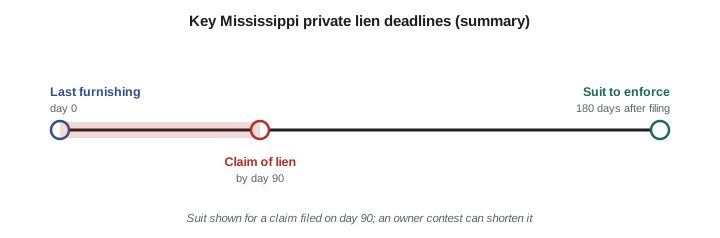
To create the lien, the claimant files a claim of lien with the chancery clerk of the county where the property is located. As the law firm summary describes Miss. Code 85-7-405, the claim must be filed within 90 days after the last day the claimant furnished labor or materials. The claim identifies the claimant, the owner, the property and the amount due, and it is sworn. It must describe the property accurately and claim only what is owed. A claim filed late, on the wrong property or for an inflated amount may fail, and an inflated claim can expose the claimant to liability.
| Step | Rule (summary of Miss. Code 85-7-405 to 85-7-423) | Madison County houses (last furnishing Aug. 21, 2026) |
|---|---|---|
| Pre-lien notice to owner (residential, subcontractor) | Owner has ten days to pay before the claim proceeds | Sent October 14, 2026 |
| Claim of lien filed with the chancery clerk | Within 90 days after last furnishing | Due by November 19, 2026; filed October 30 |
| Suit to enforce | Within 180 days after the claim is filed | By April 28, 2027 |
| If the owner files a notice of contest | Suit within 90 days after the owner's filing | Ninety days from any contest filing |
# Lien calendar for the Madison County houses (illustrative; confirm every date with counsel)
from datetime import date, timedelta

last_furnished = date(2026, 8, 21)
pre_lien_sent = date(2026, 10, 14)
filed = date(2026, 10, 30)

claim_due = last_furnished + timedelta(days=90)
earliest_after_notice = pre_lien_sent + timedelta(days=10)
suit_due = filed + timedelta(days=180)
print("Claim of lien due by:", claim_due)
print("Ten days after pre-lien notice:", earliest_after_notice)
print("Filed on time:", earliest_after_notice <= filed <= claim_due)
print("Suit to enforce due by:", suit_due)Claim of lien due by: 2026-11-19 Ten days after pre-lien notice: 2026-10-24 Filed on time: True Suit to enforce due by: 2027-04-28
Enforcing the lien
A claim of lien is security, not payment. If the claim is not resolved, the claimant must file suit to enforce the lien. As the law firm summary describes Miss. Code 85-7-423, suit must be filed within 180 days after the claim of lien is filed, or the lien expires. For Pearl River Current's October 30 filings, that date is April 28, 2027. Many liens are resolved before suit, when an owner who wants to sell or refinance pays the claim or bonds it off, but the claimant should calendar the suit deadline as if it will be needed.
The owner can force the pace. The owner may file a notice of contest of lien, and then the claimant must file suit within 90 days after the owner's filing or the lien expires. A notice of contest can therefore shorten the claimant's time considerably. Renee checks the chancery clerk's records for each lien every two weeks so that a contest filing does not go unnoticed.
What counts as the last furnishing
Every private lien deadline runs from the last day the claimant furnished labor or materials under its contract. That date is not always obvious. A return trip to replace a faulty fixture under warranty, or to finish a trivial punch-list item, may not extend the date if the contract work was really complete. The safest practice is to calculate from the last day of substantial contract work and to treat any later date with suspicion. Good daily job logs and delivery tickets make the date easy to prove.
Public projects and payment bonds
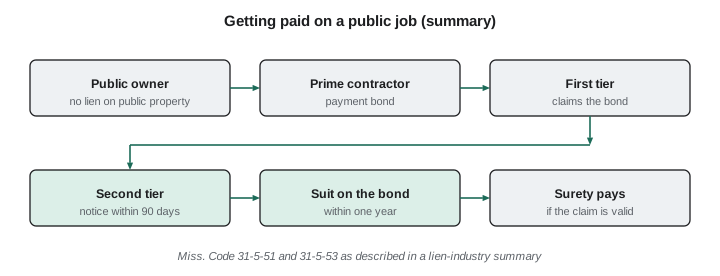
On public buildings and public works, the subcontractor's protection is the prime contractor's payment bond under Miss. Code 31-5-51, described in lesson 8. As a lien-industry summary describes the statute, the bond protects first-tier subcontractors and suppliers of the contractor, second-tier subcontractors and suppliers of those subcontractors, and laborers. A second-tier claimant must give written notice to the contractor within 90 days after its last labor or materials, by personal delivery or certified mail. Under Miss. Code 31-5-53, suit on the bond must be filed within one year after the claimant's last labor or materials.
Lien waivers and releases
Owners and general contractors often ask for lien waivers in exchange for payments. A conditional waiver gives up lien rights only when the payment is actually received; an unconditional waiver gives them up at once. Signing an unconditional waiver before the money clears can leave a contractor with neither the payment nor the lien. Pearl River Current signs conditional waivers for progress payments and unconditional waivers only after funds are in its account. When a lien is paid, the claimant should file a release with the chancery clerk so the owner's title is clear.
Worked problem
Working a commercial calendar
Pearl River Current is a first-tier electrical subcontractor on a private office building in Flowood. Its last day of contract work is February 9, 2027, and it is not paid. When must it file its claim of lien, and does it need a pre-lien notice?
Show solution
- The project is commercial and the company is a first-tier subcontractor, so no pre-lien notice to the owner is required.
- The claim of lien must be filed within 90 days after last furnishing.
- Ninety days after February 9, 2027 is May 10, 2027.
- Suit must follow within 180 days after filing, or within 90 days after any owner contest.
Answer: No pre-lien notice; file the claim of lien by May 10, 2027.
Common mistakes
MistakeRelying on the old stop notice statute.
InsteadIt was struck down in 2013 and repealed in 2014; use the current lien law.
MistakeCounting deadlines from the last invoice.
InsteadDeadlines run from the last day labor or materials were furnished.
MistakeFiling a residential subcontractor claim without a pre-lien notice.
InsteadSend the pre-lien notice early enough for the owner's ten days to run before filing.
MistakeFiling a claim and then waiting.
InsteadSue within 180 days after filing, or within 90 days of an owner's contest.
Summary and key terms
- Clear contracts, written change orders and prompt invoicing prevent most payment problems.
- The stop notice statute was held unconstitutional in 2013; the 2014 law gave subcontractors and suppliers lien rights on private work.
- A claim of lien is filed with the chancery clerk within 90 days after last furnishing.
- Residential subcontractors give the owner a pre-lien notice with ten days to pay; commercial sub-subcontractors notify the general contractor within 30 days of starting.
- Suit to enforce is due within 180 days after filing; on public work, claim the payment bond instead.
- Claim of lien
- The sworn claim filed with the chancery clerk to create the lien.
- Pre-lien notice
- Written warning to a residential owner that a subcontractor is unpaid, with ten days to pay.
- Owner's notice of contest
- An owner's filing that shortens the claimant's time to sue to 90 days.
- Stop notice
- The former remedy under Miss. Code 85-7-181, struck down in 2013.
- Little Miller Act
- Miss. Code 31-5-51, requiring payment bonds on public work.
Practice problems
Work each problem on paper first, then reveal the answer to check.
Where is a Mississippi claim of lien filed?
Show answer
With the chancery clerk of the county where the property is located.
Within how many days after last furnishing must the claim be filed?
Show answer
90 days.
Within how many days after filing must suit be brought?
Show answer
180 days, or 90 days after an owner's notice of contest.
Lesson quiz · 5 questions
Score 60% or more to complete this lesson.
Create a free account to save your progress, take quizzes and earn a certificate.