
MELU-224 · Lesson 5 of 12 · 19 min
The NEC as adopted in Mississippi and local amendments
▶ Video coming soon A video version of this lesson is on the way.
In September 2026 Pearl River Current had electrical work under way in four places within twenty miles of its Brandon shop: a house in Brandon, a restaurant remodel in Pearl, a church addition in unincorporated Rankin County and a beach house in Gulfport for a returning customer. Tasha Odom asked Renee Galloway a question she thought would have one answer: which edition of the National Electrical Code applies to our work? Renee pulled out her jurisdiction sheets and answered: it depends on which side of the city line you are standing on. The four jobs did not all fall under the same edition, and one of them had no local electrical inspection at all.
This lesson explains how the NEC becomes enforceable in Mississippi, why the answer is local, what the Mississippi Building Code Act of 2014 did and did not do, what kinds of local amendments a contractor meets, and how to find the edition and amendments for any job. It also explains why the edition on the exam can differ from the edition on the job site. It does not reproduce any code text.
The NEC is a model code
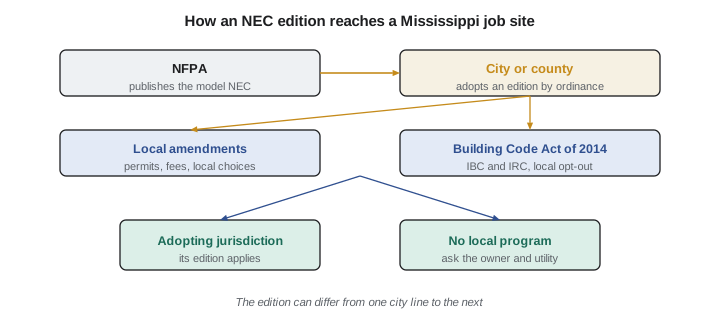
The National Electrical Code, published as NFPA 70 by the National Fire Protection Association, is a model code. It has no legal force by itself. It becomes law when a government with authority to regulate construction adopts it, usually by ordinance or regulation. The adopting government can adopt the code as published, adopt it with amendments, adopt only parts of it or adopt an older edition. A new edition appears every three years, and governments adopt editions on their own schedules.
Many states adopt the NEC at the state level and enforce it statewide, sometimes with state amendments. Mississippi has not done that for private construction. No state agency adopts the NEC for all private electrical work in Mississippi in the way Kentucky and Louisiana do. The licensing guides and code summaries reviewed for this course describe electrical code adoption in Mississippi as a local matter. That is why this lesson's title speaks of local amendments rather than state amendments.
The Mississippi Building Code Act of 2014
After Hurricane Katrina, the state moved toward wider building code adoption, first in the coastal counties and then statewide. The Mississippi Building Code Act, signed in 2014, directed counties and municipalities to adopt one of the three most recent editions of the International Building Code and International Residential Code. It also gave local governing bodies a period to opt out, and many did. A code-adoption summary for electrical professionals describes the coastal counties as required to adopt and enforce the state building code, and enforcement elsewhere as voluntary.
The act concerns the International codes. Those codes refer to the NEC for electrical work, so a jurisdiction that adopts the IBC and IRC brings the NEC into play through those references, but many local governments also adopt the NEC directly by name, with their own choice of edition. The practical effect is the same as in the rest of this lesson: the edition and any amendments are found in the local ordinance. A contractor should not assume that a jurisdiction has adopted the International codes, or that one that has adopted them enforces the electrical provisions in the same way as its neighbor.
What a local adoption looks like
A typical local adoption is a short ordinance. It names the code by title and edition, states that it is adopted as the electrical code of the city or county, lists any amendments, and adds administrative provisions on permits, fees, inspections, licensing and penalties. The amendments are often administrative rather than technical, but some are technical. Common kinds of local amendments in many jurisdictions include:
- an administrative chapter that replaces the NEC's own general provisions with the jurisdiction's permit, fee and inspection procedures;
- rules on who may pull a permit, such as a locally licensed electrician or a registered contractor;
- a delayed effective date, or a decision to keep an older edition until inspectors are trained on the new one;
- choices on particular technical requirements, where the jurisdiction keeps, removes or modifies a provision of the edition it adopted;
- requirements specific to local conditions, such as flood zones, wind exposure or utility service rules.
Because this course does not reproduce code text, it does not list particular sections that any jurisdiction has amended. The way to find them is to read the ordinance itself, which most cities publish through their code of ordinances online or make available at the building department.
Finding the edition for a job
Renee's jurisdiction sheets follow a simple process. First, find out who has authority over the site. A street address in a city's mailing area is not always inside the city limits, so she checks the property on the county's parcel map. Second, contact the building department for that city or county and ask for the adopted edition, the date it took effect and any amendments. Third, check whether the permit was issued under an earlier edition, because work is usually inspected under the code in effect when the permit was issued. Fourth, write it down.
For the four September jobs, the answers came out differently. Brandon and Pearl each had a building department with an adopted edition, though not the same one. Gulfport, in a coastal county, had its own building department and adopted codes. The church addition in unincorporated Rankin County was another matter: Renee had to confirm with the county what, if anything, it required for electrical work in that area. Where no local program reviews the work, the contractor still has to do it to a recognized standard, and the owner, the insurer, the lender or the electric utility may each ask for evidence of that before power is connected.
| Job | Who has authority | What Renee recorded |
|---|---|---|
| House, Brandon | City building department | Adopted edition, permit office and inspection line |
| Restaurant remodel, Pearl | City building department | A different adopted edition, and any local registration |
| Church addition, unincorporated county | County, if it runs a program | What the county requires; utility and owner requirements |
| Beach house, Gulfport | City building department, coastal county | Adopted edition and local flood and wind rules |
Where no local program exists
Some rural areas of Mississippi have no local electrical inspection. That does not mean anything goes. A contractor still owes the customer competent work, the contract may require compliance with a named edition of the NEC, the owner's insurer or lender may require it, and the electric utility may have its own requirements before it energizes a new service. A contractor who wires to a recognized edition protects the customer and itself, because in a dispute or after a fire, the question will be whether the work met the accepted standard.
Pearl River Current's practice where no program exists is to write the edition into the contract. For the church addition, the contract said the work would follow the edition adopted by the nearest city with a program, and Tasha kept photographs of the rough-in before the walls were closed.
Reading an adopting ordinance
An adopting ordinance is short, but it rewards a careful read. Start with the title and edition: the ordinance should name the code exactly, such as the National Electrical Code, a given year's edition, as published by the NFPA. Then find the effective date and any transition rule for permits applied for before that date. Next, read the list of amendments. Each amendment usually names the article or section it changes and says whether it is deleted, replaced or added to. Finally, read the administrative sections, which say who may obtain a permit, what the fees are, how inspections are requested and what penalties apply.
Tasha keeps a copy of the adopting ordinance for each city Pearl River Current works in, saved as a file with the city's name and the ordinance date. When an inspector cites a requirement she does not recognize, she checks the ordinance first. Twice in 2026 the answer was a local amendment she had missed, and once it was an inspector applying a newer edition than the city had adopted. In that case she asked the building official, politely and in writing, which edition governed the permit, and the correction was withdrawn.
A contractor who disagrees with an inspector's reading has a route: the building official, then any board of appeals the ordinance sets up. Most disagreements end at the first conversation, especially when the contractor brings the ordinance and the code section and asks a clear question. Arguing on the site rarely helps. Asking for the requirement in writing usually does.
Public and state work
Work for the state, for public universities or for other public owners can bring its own code requirements, set by the owning agency, the project specifications or the design professional. Public bid documents usually name the codes and editions that apply. When they do, the contract governs, and the contractor should read the specifications before pricing the job. When the specifications and the local ordinance differ, the contractor should ask the design professional in writing which governs.
The exam edition and the job edition
Because adoption is local, the edition on the trade exam may not be the edition the candidate uses at work. The exam is written to the edition the PSI bulletin names, as lesson 4 explains. The candidate should study that edition for the exam and the adopted editions for the work. Tasha kept two books on her desk all autumn, one tabbed for the exam and one for the field, and she labeled their spines so she would not grab the wrong one.
When a jurisdiction adopts a new edition
When a city moves to a new edition, it usually sets an effective date and decides how to treat permits issued before that date. A contractor with a job in progress should ask which edition applies to its permit. A contractor bidding work that will be permitted after the change should price the new edition's requirements. And a contractor whose contract was signed before the change should check whether the contract allows a change order for code changes adopted after signing. That clause appears in Pearl River Current's standard contract, and lesson 9 returns to it.
Worked problem
Finding the code for a new job
A customer asks Pearl River Current to add a detached garage with a subpanel at a house with a Brandon mailing address. What should the office do before pricing the job?
Show solution
- Check the parcel map to confirm whether the property is inside Brandon's city limits or in the county.
- Contact the building department with authority and ask for the adopted NEC edition and any amendments.
- Ask whether the garage needs its own permit and who may pull it.
- Record the answers on the jurisdiction sheet with the date and the name of the person who answered.
- Price the work to the adopted edition and its amendments.
Answer: Confirm the jurisdiction from the parcel map, then get the adopted edition and amendments from that building department.
# A jurisdiction sheet as data (illustrative entries, not real adoptions)
sheets = {
    "Brandon": {"program": True, "edition": "edition A", "local_license": True},
    "Pearl": {"program": True, "edition": "edition B", "local_license": True},
    "Rankin County, unincorporated": {"program": None, "edition": None, "local_license": None},
    "Gulfport": {"program": True, "edition": "edition A", "local_license": True},
}
for place, s in sheets.items():
    if s["program"] is None:
        print(f"{place}: call the county; record what it requires")
    else:
print(f"{place}: {s['edition']}; local license needed: {s['local_license']}")Brandon: edition A; local license needed: True Pearl: edition B; local license needed: True Rankin County, unincorporated: call the county; record what it requires Gulfport: edition A; local license needed: True
The point of the sheet is the flag. An entry with no answer is a phone call to make before the bid goes out, not a guess to make after the permit is refused.
Common mistakes
MistakeAssuming one NEC edition applies across Mississippi.
InsteadAdoption is local; check the edition for each jurisdiction.
MistakeUsing the mailing address to decide jurisdiction.
InsteadCheck the parcel map; the property may be outside the city limits.
MistakeTreating a site with no local inspection as having no standard.
InsteadWork to a recognized edition and write it into the contract.
MistakeStudying the field edition for the exam.
InsteadThe exam uses the edition named in the PSI bulletin.
Summary and key terms
- The NEC is a model code that becomes law when a government adopts it.
- Mississippi has no statewide adoption of the NEC for private work; cities and counties adopt editions locally.
- The 2014 Building Code Act concerns the IBC and IRC, allowed local opt-out, and is described as mandatory in coastal counties.
- Local ordinances name the edition and add amendments, often on permits, fees and licensing.
- Find the jurisdiction from the parcel map, then confirm the edition and amendments with the building department.
- Model code
- A code written by a private body that has force only when a government adopts it.
- Adopting ordinance
- The local law that makes a code edition enforceable, with any amendments.
- Local amendment
- A change a city or county makes to the edition it adopts.
- Authority having jurisdiction
- The office that enforces the code for a particular site.
- Opt-out
- A local decision under the 2014 act not to adopt the state building code.
Practice problems
Work each problem on paper first, then reveal the answer to check.
Who adopts the NEC for private work in most of Mississippi?
Show answer
The city or county with authority over the site.
What did the 2014 Building Code Act address?
Show answer
Local adoption of the International Building and Residential Codes, with an opt-out.
Which edition does the trade exam use?
Show answer
The edition named in the current PSI bulletin.
Lesson quiz · 5 questions
Score 60% or more to complete this lesson.
Create a free account to save your progress, take quizzes and earn a certificate.