
MELU-224 · Lesson 1 of 12 · 20 min
How electrical licensing works in Mississippi
▶ Video coming soon A video version of this lesson is on the way.
Lonnie Hartfield started Pearl River Current Electric in Brandon, in Rankin County, in 1998 with one truck and a residential license from the Mississippi State Board of Contractors. For most of those years the company wired houses, remodels and service upgrades in Rankin and Madison counties. In the summer of 2026 a general contractor asked Pearl River Current to bid the electrical work on a 310,000 dollar clinic fit-out in Flowood. Lonnie wanted the job, but he knew the residential license would not cover it. He called in Tasha Odom, his lead project manager for nine years, and asked her to become the company's qualifying party for a commercial license with the Electrical classification. “You know the work,” he told her. “Now you need to know the rules, and pass two exams.”
This course follows Tasha through that process, from the first application in August 2026 to the trade exam she has booked for December. Along the way it covers how Mississippi regulates electrical work, what the board requires of a licensed contractor, how local codes and permits work, how Mississippi lien law protects an unpaid contractor, and the safety and workers' compensation duties that come with having employees. This first lesson lays out the system, because Mississippi does it differently from many of its neighbors.
Two kinds of license: the business and the person
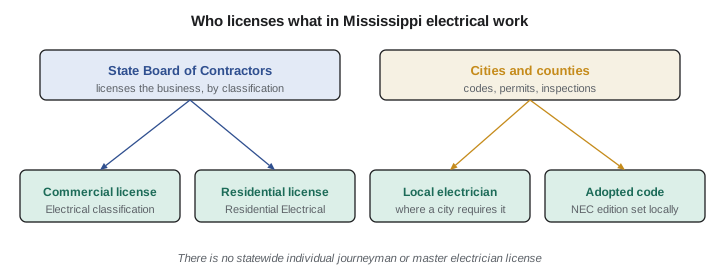
In most states an electrician thinks first about a personal license: apprentice, journeyman and master, each earned with hours of experience and an exam, and each valid across the state. Mississippi does not work that way. According to the licensing guides reviewed for this course, Mississippi has no statewide individual license for journeymen or master electricians. The state licenses contracting businesses instead, through the Mississippi State Board of Contractors, often shortened to MSBOC. The license belongs to the business, and it lists the classifications of work the business may contract for, such as Electrical on the commercial side or Residential Electrical on the residential side.
Individual electricians are not ignored. Many Mississippi cities and some counties run their own licensing for the people who do the work, often with an exam, and require a permit for each job. Those local licenses are set by local ordinance, so the requirements, the exam and the fee differ from one city to the next, and a license from one city does not automatically count in another. A contractor who works in several cities may need to register in each of them, or employ people who hold the local licenses each city asks for.
So a Mississippi electrical contractor deals with two layers. The state board decides whether the business may contract for the work at all, and the city or county decides who may pull a permit, which code edition applies and whether the work passes inspection. Lesson 5 covers the code question and lesson 6 covers permits and inspections. This lesson and the next three concentrate on the state license.
The State Board of Contractors
The board licenses commercial contractors under Title 31, chapter 3 of the Mississippi Code, and residential builders and remodelers under Title 73, chapter 59. It also licenses roofers. The board's website, msboc.us, carries the application, the list of classifications, the testing information, the fee schedule and the laws and rules. Older documents and some public bid forms refer to a commercial license as a certificate of responsibility, the term used in the board's rules for the commercial application. When Tasha first read the rules she found both terms used for the same thing.
The board does not inspect wiring or adopt the electrical code. Its job is to decide who may contract for construction work in the state and to discipline those who break the licensing law. In practice that means the board checks that a business is properly organized, that it has the financial strength and insurance the rules require, and that the person who qualifies the business has passed the exams for each classification. Lesson 2 covers those requirements in detail.
When a state license is needed
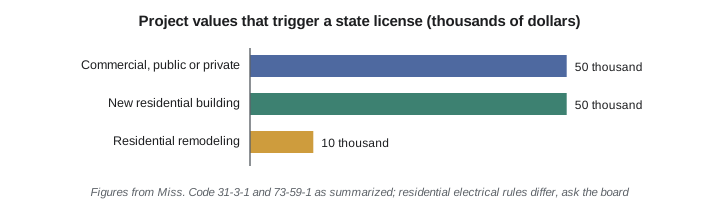
The commercial license is required by value. As the 2020 text of Miss. Code 31-3-1 reads, the commercial licensing chapter does not apply to a contract or undertaking under 50,000 dollars. Put the other way, a business that contracts for commercial, industrial or public work valued at 50,000 dollars or more needs a commercial license with the right classification. The rule reaches subcontractors as well as general contractors, so an electrical subcontractor with a 310,000 dollar subcontract on the Flowood clinic needs the Electrical classification itself. It cannot shelter under the general contractor's license.
The same section lists exclusions. Residential projects of up to 50 families and no more than three stories fall outside the commercial chapter, because the residential law covers them. So does certain small new commercial construction, of under 7,500 square feet and two stories or fewer, when it is done by a business licensed under the residential law. Owners who improve a building that is not for sale, lease or public use are also outside it. These exclusions are narrow, and Lonnie's rule for the office is simple: if a commercial job is close to 50,000 dollars, assume a commercial license is needed and ask the board if there is any doubt.
The residential law works the same way with different figures. As Miss. Code 73-59-1 defines the terms, a residential builder undertakes a home of up to three stories for a total cost over 50,000 dollars, and a remodeler undertakes improvements to an existing home for a total cost over 10,000 dollars. The board also offers trade classifications for residential work, including Residential Electrical, which it marks as requiring a test. The guides reviewed for this course do not agree on whether a residential electrical contractor needs that license below the remodeler figure, so a contractor should ask the board how the rule applies to its own work rather than rely on a guide.
| Kind of work | State license involved | Value that triggers it (summary) |
|---|---|---|
| Commercial, industrial or public electrical work | Commercial license, Electrical classification | 50,000 dollars or more |
| Low voltage, alarm or communication systems | Commercial license, a specialty classification | 50,000 dollars or more |
| New homes up to three stories | Residential builder license | Over 50,000 dollars |
| Improvements to an existing home | Residential remodeler license | Over 10,000 dollars |
| Residential electrical work | Residential Electrical classification | Ask the board how its rule applies |
Classifications
A state license is not a blank check. It lists the classifications the business has qualified for, and the business may contract only for work in those classifications. The board's list puts Electrical among the major commercial classifications and notes that the trade exam or a NASCLA accredited exam is accepted for it. Under Electrical the board lists specialty classifications, among them alarm systems, access systems and security equipment; communication systems and low voltage electrical; instrumentation; telecommunications; traffic control; transmission and distribution lines; turbine generator maintenance and repair; underground cable installation; and installation of automated meter reading equipment. Some specialties require a test and some do not.
On the residential side the board lists Residential Electrical, limited to residential electrical work, and Residential Solar, which requires the holder to also have the classification needed to make the electrical or mechanical connections. Several other classifications touch electrical work. Conveyor systems, for example, include electrical work only for the safety disconnect, and fueling systems include low voltage work. When Tasha studied the list, she saw why the classification matters: a business licensed only for communication systems could not contract for a 480 volt service, even if its people knew how to install one.
Exams for the business, not a ladder of hours
Because the license belongs to the business, the exams are taken by the person who qualifies the business, called the qualifying party. Every applicant takes the Mississippi Law and Business Management exam, and most classifications add a trade exam. The board contracts with PSI Services to run both. Lesson 4 describes the formats. Unlike a state master electrician license, the board's requirements as published do not set a number of hours of experience for the qualifying party. Experience shows up instead in the trade exam, which assumes a working knowledge of the code, and in the local electrician licenses that many cities require of the people on the tools.
This difference catches people moving from other states. A master electrician from Kentucky or Texas who moves to Gulfport finds that his personal license gives him no state standing in Mississippi. He can work under a licensed contractor, subject to the city's own rules, or he can form a business, become its qualifying party and pass the board's exams. Lesson 2 describes the reciprocity arrangements the board has with some neighboring states.
Codes and inspections are local
The electrical code is also a local matter. Mississippi has not adopted the National Electrical Code for private work across the whole state. The Mississippi Building Code Act of 2014 directs counties and cities to adopt recent editions of the International Building Code and International Residential Code, which refer to the NEC, but it allowed local governments to opt out, and code summaries describe enforcement outside the coastal counties as voluntary. In practice each city or county that runs a building department adopts an edition of the NEC, sometimes with local amendments, and inspects to it. Lesson 5 covers how to find the edition for a job.
The result is that a contractor working across a metro area may face different code editions and permit rules on the same day. Pearl River Current has jobs in Brandon, Flowood, Pearl, Madison and unincorporated Rankin County, and Renee Galloway, its office manager, keeps a one-page sheet for each jurisdiction with the adopted edition, the permit office, the inspection request line and any local license the city requires.
Worked problem
Which license does the clinic job need?
Pearl River Current holds a residential license with the Residential Electrical classification. A general contractor offers it a 310,000 dollar electrical subcontract for a medical clinic fit-out in Flowood. What does the company need from the state before it signs?
Show solution
- The work is commercial, not residential, so the residential license does not cover it.
- The subcontract is 310,000 dollars, well over the 50,000 dollar commercial figure.
- The commercial rule applies to subcontractors, so the general contractor's license does not cover Pearl River Current.
- The company needs a commercial license listing the Electrical classification, qualified by a person who has passed the law and trade exams.
- Flowood's own permit and any local license rules still apply on top of the state license.
Answer: A commercial license with the Electrical classification, plus whatever Flowood requires locally.
Why the exam cares about this
The Law and Business Management exam tests the contractor's grasp of Mississippi law as well as general business practice. Questions on when a license is needed, what a classification allows and who the board regulates are a natural fit for it. The trade exam, in turn, assumes the candidate can find answers in the code edition the exam uses, whatever edition a given city has adopted. Tasha's first study note was a two-column page: on the left, what the state decides; on the right, what the city decides. She kept adding to it all autumn.
Penalties for contracting without a license
The licensing law gives the board power to act against unlicensed contracting and against licensees who break the rules, including fines and action against a license. The details are in the statute and the board's rules, and they change from time to time, so this course does not list amounts. The practical risks go beyond fines. A business that contracts without the license it needs may have trouble enforcing its contract or a lien, may lose the chance to bid public work and may find that a general contractor or owner will not pay. Owners and general contractors on larger jobs ask for the license number before they sign, and public bid forms ask for it on the bid.
A further risk falls on the people who hire an unlicensed contractor. A general contractor who uses an unlicensed electrical subcontractor on a commercial job exposes its own project to delay and dispute. That is one reason the Flowood general contractor asked Pearl River Current for its commercial license number before it would send the subcontract for signature.
Where this course gets its facts
The figures in this course come from the board's own pages, the statutes as published, the 2023 PSI candidate bulletin for the Mississippi contractor exams, and summaries written by Mississippi construction lawyers and industry publishers. Where a source is secondary, the lesson says so, and where sources disagree or a point could not be verified, the lesson words it generally. Before you rely on any figure, check it against the board's current page, the current statute or the current bulletin. Board staff answer questions by phone and email, and they would rather answer a question early than deny an application later.
Tasha's approach was to treat every number as provisional until she had seen it on an official page. That habit is worth adopting. It protects you on the exam, where a question may turn on a figure that changed recently, and it protects your company on the job, where a wrong assumption about a license or a deadline can cost far more than the time it takes to check.
Common mistakes
MistakeAssuming a journeyman or master license from another state lets you contract in Mississippi.
InsteadMississippi licenses the contracting business through the board; a personal license from another state gives no state standing.
MistakeTreating a residential license as enough for any job under one roof.
InsteadCommercial work of 50,000 dollars or more needs a commercial license with the right classification.
MistakeAssuming the general contractor's license covers its subcontractors.
InsteadThe commercial rule applies at every tier, so an electrical subcontractor needs its own license.
MistakeAssuming the NEC edition is the same statewide.
InsteadCode adoption is local; find the edition for each jurisdiction.
Summary and key terms
- The Mississippi State Board of Contractors licenses contracting businesses, not individual electricians.
- Commercial work of 50,000 dollars or more needs a commercial license with the right classification, at every tier.
- Residential builders need a license above 50,000 dollars and remodelers above 10,000 dollars; residential trade classifications have their own rules.
- Electrical is a major commercial classification with a set of specialties; Residential Electrical is a residential classification.
- Cities and counties adopt codes, issue permits, inspect and may license individual electricians.
- MSBOC
- The Mississippi State Board of Contractors, which licenses commercial and residential contractors.
- Classification
- A category of work listed on a license, such as Electrical or Residential Electrical.
- Qualifying party
- The person who passes the exams that qualify a business for a classification.
- Certificate of responsibility
- An older name for the commercial license, still found in rules and bid forms.
- Local license
- A license a city or county requires of individual electricians or contractors working there.
Practice problems
Work each problem on paper first, then reveal the answer to check.
Who licenses electrical contracting businesses in Mississippi?
Show answer
The Mississippi State Board of Contractors.
At what contract value does the commercial license requirement begin?
Show answer
50,000 dollars.
Does Mississippi issue a statewide master electrician license?
Show answer
No; individual electrician licensing is local where it exists.
Lesson quiz · 5 questions
Score 60% or more to complete this lesson.
Create a free account to save your progress, take quizzes and earn a certificate.