
MELU-224 · Lesson 7 of 12 · 18 min
Duties and responsibilities of the Electrical Contractor License holder
▶ Video coming soon A video version of this lesson is on the way.
When the commercial license issues early in 2027, Tasha Odom's name will sit on it as the qualifying party for the Electrical classification, and Pearl River Current's name will sit on it as the licensee. In October 2026, while she was still studying, Lonnie Hartfield asked her to write down what that would mean in practice. Her list ran to two pages. At the top she wrote: “The license is the company's. The exams were mine. Keeping it clean is everybody's job, but I'm the one the board will call.”
This lesson covers the duties that come with holding a Mississippi contractor license with the Electrical classification: the business's duties to the board, to customers and to the public, the role of the qualifying party, what to do when a qualifying party leaves, how to use the license number on bids and contracts, keeping the license information current, supervising the work, and what the board can do when a licensee breaks the rules. The rules referred to are those in the licensing statute and the board's rules, summarized here in general terms.
The licensee is the business
The license is issued to the business, so the business carries the duties. It must contract only for work within its classifications and above whose value it is licensed, keep its insurance in force, keep its information with the board current, renew on time and follow the licensing law and the board's rules. It must also follow every other law that applies to contractors, including the local permit rules, tax law, employment law and safety law. A violation by an employee acting for the business can lead to action against the business's license.
The business is responsible for the work it contracts for, even when its own subcontractor performs it. If Pearl River Current subcontracts the fire alarm scope on a job to a specialty firm, the specialty firm needs its own license for that classification if the value requires it, and Pearl River Current remains responsible to the general contractor for the whole electrical scope under its subcontract.
The qualifying party
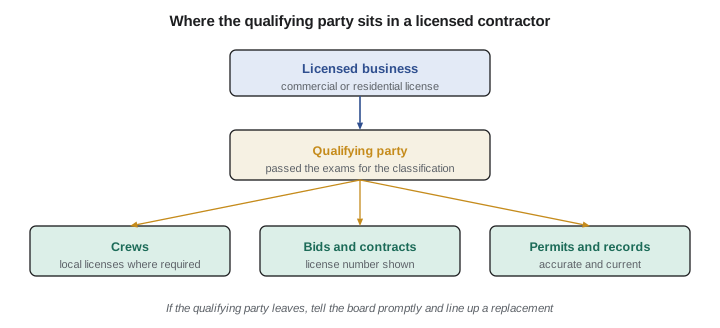
The qualifying party is the person whose exams qualify the business for a classification. Lesson 2 described the exams. The board's rules treat the qualifying party as the link between the business and the knowledge the license represents. In practice the qualifying party is expected to be genuinely involved in the business's work in that classification, not a name lent for a fee. Licensing boards in many states take a dim view of a qualifier who has no real role in the company, and a contractor should assume the Mississippi board does too.
Tasha's role will cover estimating, project management and quality control on commercial electrical work. She will review every commercial bid before it goes out, visit each commercial job at least weekly and sign off on the closeout documents. She will also be the person who answers the board's questions about the Electrical classification.
When a qualifying party leaves
If the qualifying party for a classification leaves the business, the classification loses its basis. The business should tell the board promptly and ask what the rules require, including how long it has to name and qualify a replacement and whether it may continue work in progress in the meantime. The details are set by the board's rules, and the sources reviewed for this course did not give a specific period, so a contractor should get the current answer from the board rather than rely on another state's rule.
The practical lesson is to plan ahead. A business that depends on one qualifying party for its main classification is exposed if that person leaves, retires or becomes ill. Pearl River Current's plan is for Lonnie to remain the qualifying party on the residential license and for Tasha to qualify the commercial Electrical classification, with a senior estimator, Darnell Pruitt, to begin studying for the law exam in 2027 as a backup. A second qualifying party costs study time and exam fees, but it protects the license.
Using the license number
Owners, general contractors and public agencies ask for the license number before they sign. Public bid procedures in Mississippi commonly require the bidder's license or certificate of responsibility number to appear on the bid, often on the outside of the sealed bid envelope, and a bid without it may be rejected unopened. Bid instructions say exactly where the number must appear, and estimators should read them for every bid.
The license number should also appear on the company's contracts and proposals, and it is good practice to show it in advertising, on trucks and on the website. Customers use it to check the license on the board's public search. A business should never let another business use its license number, and should never use a number to bid work outside its classifications.
Keeping information current
The board relies on the information in its file. A licensee should tell the board about changes such as a new address, a new legal name, a change in ownership or officers, a change of qualifying party, a lapse or change in insurance, and any change in entity type. Some changes, such as converting a sole proprietorship to an LLC, may need a new license because the license belongs to the entity. The board's site and staff explain which changes need a form and which need a new application.
Insurance is the item most often missed. A general liability policy renews each year, and the board needs a current certificate naming it. Renee sends the new certificate to the board the week the policy renews. She also checks that workers' compensation remains in force, because a lapse can bring both a board problem and a much larger problem if a worker is injured.
| Change | What the business should do (general guidance) |
|---|---|
| New office address | Update the board's record and the license fact sheet |
| Qualifying party leaves | Tell the board promptly and ask about the replacement period and work in progress |
| Insurance renews or changes | Send a current certificate naming the board |
| New owner, partner or officer | Ask the board which form or filing is needed |
| Change of entity | Ask whether a new license is required for the new entity |
| New classification wanted | Apply, pay the fee and pass any required exam |
Duties to customers
A licensed contractor owes its customers honest dealing and competent work. That means a written contract that describes the work and the price, permits obtained before work starts, work done to the adopted code and the contract, inspections passed, changes documented in writing, and warranties honored. It also means not abandoning a job, not taking deposits for work the company does not intend to perform, and paying the company's own subcontractors and suppliers, so that the customer's property is not exposed to liens. Lesson 9 explains how Mississippi lien law makes unpaid subcontractors the customer's problem.
Complaints to the board often start with a customer who paid for work that was abandoned, defective or not permitted. The board can investigate and act against the license. A contractor that handles customer complaints quickly and fairly rarely sees one reach the board.
Supervising the work
The business is responsible for the people who do its work. Where a city requires local electrician licenses, the business must make sure that its crews hold them and that unlicensed workers work only as the local rules allow. On commercial jobs Tasha's plan is that each crew lead holds the local license the city requires, that each apprentice works with a licensed electrician, and that she reviews the work at the stages that matter most: before rough-in inspection, before the service is energized and before the final.
Supervision also means safety. Lesson 10 covers the OSHA rules and workers' compensation. The qualifying party may not be the safety manager, but a contractor's license and its safety record are closely linked, because a serious accident brings scrutiny from every direction.
Discipline
The licensing statute gives the board authority to investigate complaints and to discipline licensees. The grounds in contractor licensing laws generally include contracting outside the license's classifications or limits, fraud or misrepresentation in obtaining a license, abandoning a contract, failing to pay for materials or labor, lending the license to another, and violating the board's rules. The penalties can include fines, conditions on the license, suspension and revocation, and the board can also act against people who contract without a license. Because the amounts and procedures change, this course does not list them. The board's rules set out the process, including notice and a hearing.
A licensee who receives a complaint or a letter from the board should answer promptly and accurately, keep copies, and talk to a lawyer if the matter is serious. Ignoring a board letter usually makes a small matter large.
Worked problem
Is this bid within the license?
Pearl River Current, once licensed for Electrical, is invited to bid a 140,000 dollar public school project that includes 95,000 dollars of power and lighting work and 45,000 dollars of fire alarm work. What should the estimator check before bidding?
Show solution
- The whole bid is over 50,000 dollars, so a commercial license is needed.
- Power and lighting fall within the Electrical classification.
- Ask the board, or read the classification list, to confirm whether the fire alarm work falls within Electrical or needs the alarm systems specialty.
- If a specialty is needed, either add it or carry a licensed fire alarm subcontractor.
- Put the license number where the bid instructions require, such as on the bid envelope.
Answer: Confirm that the fire alarm scope is covered, use a licensed specialty subcontractor if it is not, and show the license number as the bid instructions require.
# A pre-bid license check (illustrative)
license = {"number": "MS-EXAMPLE-0000", "classes": {"Electrical"}, "commercial": True}

def check_bid(value, scopes):
    issues = []
    if value >= 50_000 and not license["commercial"]:
        issues.append("needs a commercial license")
    for scope, needs in scopes.items():
        if needs not in license["classes"]:
            issues.append(f"{scope}: confirm classification '{needs}' or use a licensed sub")
    return issues or ["within the license"]

for line in check_bid(140_000, {"power and lighting": "Electrical", "fire alarm": "Alarm Systems"}):
print(line)fire alarm: confirm classification 'Alarm Systems' or use a licensed sub
The check flagged the fire alarm scope, which is the point: the estimator does not guess, he asks. On the school job, the bid documents required a separately licensed fire alarm contractor, and Pearl River Current carried one.
Records the license holder should keep
A licensed contractor keeps records that show how it met its duties: contracts and change orders, permits and inspection results, insurance certificates sent to the board, workers' compensation certificates from subcontractors, payroll and safety training records, and correspondence with the board. These records answer a complaint quickly, support a lien or a claim, and make each renewal routine. Pearl River Current keeps them by job and by year, and keeps license records separately, so that the history of the license can be shown in one folder.
The qualifying party should know where these records are and should review them from time to time, even if the office keeps them. Tasha's plan is a quarterly review with Renee of open permits, expiring certificates and any board correspondence, so that nothing waits until a renewal or a complaint brings it to light.
A short annual self-check helps. Once a year, compare the license fact sheet with the board's public record, confirm that every bid template shows the right number, and confirm that every crew lead's local licenses are current. It takes an hour and prevents most of the problems this lesson describes.
Common mistakes
MistakeLending the company's license number to another contractor.
InsteadNever let another business use your license; it can cost you the license.
MistakeBidding a scope outside the license's classifications.
InsteadConfirm each scope's classification and carry licensed subcontractors where needed.
MistakeLetting insurance lapse between renewals.
InsteadSend a current certificate naming the board each time a policy renews.
MistakeTreating the qualifying party as a name on paper.
InsteadThe qualifying party should be genuinely involved in the classification's work.
Summary and key terms
- The licensee is the business, which must work within its classifications and follow the board's rules.
- The qualifying party's exams qualify the business; he or she should be genuinely involved in the work.
- If the qualifying party leaves, tell the board promptly and ask about the replacement period.
- Show the license number as bid instructions require, often on the bid envelope for public work.
- Keep the board's file current, supervise crews and answer complaints promptly.
- Licensee
- The business named on the license.
- Qualifying party
- The person whose exams qualify the business for a classification.
- Bid envelope
- The sealed envelope for a public bid, which often must show the license number.
- Complaint
- A report to the board about a licensee's conduct.
- Revocation
- The board's withdrawal of a license.
Practice problems
Work each problem on paper first, then reveal the answer to check.
Who holds a Mississippi contractor license?
Show answer
The business, not the individual.
What should a business do if its qualifying party leaves?
Show answer
Tell the board promptly and ask about the replacement period.
Where must the license number go on many public bids?
Show answer
Where the bid instructions say, often on the outside of the bid envelope.
Lesson quiz · 5 questions
Score 60% or more to complete this lesson.
Create a free account to save your progress, take quizzes and earn a certificate.