
MELU-224 · Lesson 4 of 12 · 19 min
The exam format and the references allowed
▶ Video coming soon A video version of this lesson is on the way.
On the morning of October 6, 2026, Tasha Odom carried one book into a PSI test center in the Jackson area: the Mississippi edition of the NASCLA contractors guide, tabbed with colored flags and marked in pencil. She had a silent calculator in her bag and two forms of identification in her wallet. Two hours later she walked out with a pass on the Law and Business Management exam. For the electrical trade exam in December she will carry a heavier load, a code book with permanent tabs, and she has already timed herself on two practice sets. “The first exam taught me where the time goes,” she said. “On an open-book test, it goes into looking things up.”
This lesson describes the two exams a qualifying party takes for the Electrical classification: the Mississippi Law and Business Management exam and the electrical trade exam. It covers what the PSI candidate bulletin says about format, passing score and references, what licensing sources say about the trade exam, the NASCLA accredited exam that the board accepts, and a pacing plan for an open-book exam.
The Law and Business Management exam
Every applicant, commercial or residential, takes the Mississippi Law and Business Management exam. The 2023 PSI bulletin describes it as 50 questions in two hours, with a passing score of 70. It is open book. The reference is the NASCLA Contractors Guide to Business, Law and Project Management, Mississippi edition. The bulletin said that the 5th or 6th edition could be used, and that from October 1, 2023 only the 6th edition would be referenced. A candidate should confirm the current edition in the bulletin in force when booking.
The guide covers the topics a contractor runs into in business: licensing law, business organization, estimating and bidding, contracts, project management, risk and insurance, safety, labor law, payroll taxes, financial management, accounting, and liens. The Mississippi edition adds the state's own licensing, lien, tax and employment rules. The exam questions follow the guide closely, so a candidate who knows its layout can find most answers in a minute or two.
A silent, non-printing, non-programmable calculator is allowed. Many law exam questions involve arithmetic: a payroll tax calculation, a markup, a depreciation figure, a break-even point or a lien deadline. Practice with the calculator you will bring, so that you are not learning its keys during the exam.
The electrical trade exam
The board's classification list marks Electrical as requiring a test and says the trade exam or a NASCLA accredited exam is accepted. The trade exam is open book and is written to a particular edition of the National Electrical Code, plus any other references the bulletin lists. The excerpt of the 2023 bulletin reviewed for this course did not include the outline for the Electrical classification itself, so this course does not state its question count, time or edition as fact. An electrical licensing publisher's summary of Mississippi lists a master electrician exam of 80 questions in three hours, written to the 2020 NEC. A candidate should take the exact figures from the current bulletin.
For the two electrical specialty exams that the 2023 bulletin did describe, the figures give a sense of the format. The Alarm Systems and Equipment exam had 60 questions in two hours, and the Communication Systems exam had 50 questions in two hours, each with a passing score of 70 and each open book. Their references included an edition of the NEC and specialty texts on fire alarm and low voltage systems, telecommunications wiring and federal telecommunications rules. Every exam described in the bulletin used a passing score of 70.
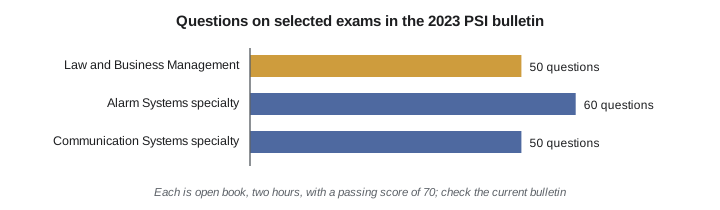
| Exam | Questions and time | Passing score | Main reference |
|---|---|---|---|
| Law and Business Management | 50 questions, 2 hours | 70 | NASCLA guide, Mississippi edition |
| Electrical trade (commercial) | Check the current bulletin | Check the bulletin | The NEC edition named in the bulletin |
| Alarm Systems and Equipment | 60 questions, 2 hours | 70 | NEC edition listed, fire alarm references |
| Communication Systems | 50 questions, 2 hours | 70 | NEC edition listed, telecom references |
| NASCLA accredited electrical exam | Set by NASCLA | Set by NASCLA | NASCLA's own reference list |
The NASCLA accredited exam
NASCLA, the National Association of State Contractors Licensing Agencies, offers accredited exams that several member states accept in place of their own trade exams. The board's classification list says the NASCLA accredited exam is accepted for the Electrical classification. A contractor who works in several states that accept the NASCLA exam may find it useful to take that exam once rather than each state's trade exam. The NASCLA exam has its own format and references, set by NASCLA, and does not replace the Mississippi Law and Business Management exam.
Tasha chose the Mississippi trade exam because Pearl River Current works only in Mississippi. If the company later bids work in Alabama or Louisiana, the NASCLA route is worth a look, and lesson 2 describes the reciprocity arrangements that may waive a trade exam in either direction.
Which code edition is on the exam
Code adoption in Mississippi is local, as lesson 5 explains, so the edition on the exam may not match the edition a given city enforces. The exam is written to the edition the bulletin names, and that is the edition a candidate should bring and study. The 2023 bulletin's specialty exams named the 2014 NEC, which shows how far an exam edition can lag the current code. The publisher's summary that named 2020 for the master electrician exam also noted that the state's building code references a later edition. The candidate's job on exam day is simple: answer from the book the exam names, not from the code the candidate uses at work.
Tasha found this harder than it sounds. At work she uses the edition Flowood and Brandon have adopted, and some section numbers have moved between editions. She bought the edition the bulletin named, tabbed it fresh and did her practice questions only from it.
What open book really means
An open-book exam is not an easy exam. The questions are written on the assumption that the candidate can find the answer, so they test whether the candidate knows where to look and can do it quickly. A candidate who has to read the index for every question will run out of time. The bulletin sets out what may and may not be brought into the test room and whether books may be tabbed, highlighted or written in. Candidates should read those rules carefully, because a book that does not meet them can be refused at check-in.
The usual advice is to use permanent tabs on the main articles and tables, to highlight sparingly, and to know the index well. Tasha's NASCLA guide had tabs for each chapter and smaller flags for the Mississippi lien and licensing sections, the payroll tax tables and the formulas for markup and margin.
Pacing an open-book exam
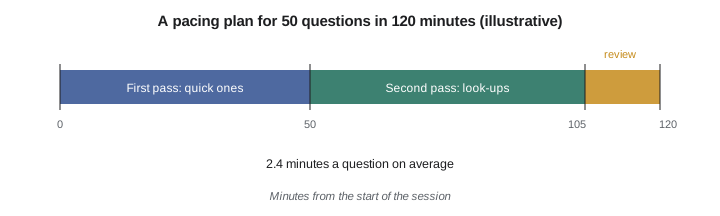
Fifty questions in 120 minutes works out to 2.4 minutes a question. That sounds generous until a lookup takes four minutes. A good plan has two passes. On the first pass, answer every question you can answer quickly from memory or with one lookup, and flag the rest. On the second pass, work the flagged questions, starting with those you think you can find fastest. Keep the last ten to fifteen minutes for review and for making sure every question has an answer, because an unanswered question scores the same as a wrong one.
# Pacing checkpoints for an open-book exam (illustrative)
def plan(questions, minutes, review=15):
    working = minutes - review
    per_q = minutes / questions
    marks = [(q, round(q * working / questions)) for q in (10, 25, 40, questions)]
    return per_q, marks

per_q, marks = plan(50, 120)
print(f"Average minutes per question: {per_q:.1f}")
for q, m in marks:
print(f"By question {q:>2}: about {m} minutes in")Average minutes per question: 2.4 By question 10: about 21 minutes in By question 25: about 52 minutes in By question 40: about 84 minutes in By question 50: about 105 minutes in
Tasha wrote her checkpoints on the scratch paper PSI gave her as soon as the exam started: question 10 at about 21 minutes, question 25 at 52, question 40 at 84. At question 25 she was eight minutes ahead, which told her she could spend longer on the arithmetic questions she had flagged. She will use the same method for the trade exam once she has its figures from the bulletin.
Question styles
Both exams use multiple-choice questions with a single best answer. Law exam questions often describe a situation, such as an employee who is injured or a lien claim filed late, and ask what rule applies. Trade exam questions often ask for a value from a table, a calculation such as a box fill or a conductor ampacity adjustment, or the rule for a particular installation. Read the whole question before you start looking anything up, because a detail at the end, such as a voltage, a location or an occupancy type, often decides which section applies.
Some answer choices are traps for people who skip details. A question about a wet location, a dwelling or a specific voltage may have one answer choice that would be right for a dry location, a commercial building or another voltage. If two answers look right, read the question again for the detail that separates them.
Studying the NASCLA guide
The law exam's reference is long, and candidates who read it cover to cover often run out of study time. A better approach is to learn its structure first. Read the table of contents and the index, then skim each chapter for its headings, tables and formulas. Then work practice questions and look up each answer in the guide, noting the page. After a few dozen questions, patterns appear: certain chapters, such as those on payroll, lien law, contracts and financial management, produce many questions, and certain tables come up again and again. Those are the places to tab.
The Mississippi chapters deserve extra time because they are the part a candidate is least likely to know from experience in another state. Tasha read the Mississippi licensing and lien sections twice and wrote a one-page summary of each in her own words. Her summary of the lien section later became the starting point for the company's lien calendar, which lesson 9 describes.
Arithmetic questions reward a little drill. Markup and margin are the classic trap: a 25 dollar markup on a 100 dollar cost gives a 125 dollar price, but the margin on that price is 25 divided by 125, or one fifth, not one quarter. Payroll questions need the current tax tables in the guide. Depreciation questions usually use the straight-line method. A candidate who can do each of these in under two minutes has time for the harder lookups.
At the test center
The bulletin sets the rules for check-in: arrive early, bring the identification it lists, and leave phones, bags and notes in the space provided. PSI staff check reference books against the bulletin's rules before the exam starts. The exam is taken on a computer, with an on-screen timer and a way to flag questions for review. A candidate who has never taken a computer-based exam may find it helpful to try the tutorial at the start, which does not count against the exam time if the bulletin says so. Lesson 12 covers test day in more detail.
Scores and retakes
PSI gives the candidate a score report at the end of the session. A candidate who passes needs to do nothing more with that exam, and the score goes to the board. A candidate who fails receives a report that usually shows performance by content area, which is the best guide to what to study before the retake. Retakes inside the six-month window are unlimited, as lesson 3 explains, but each attempt costs a fee and a day, so it is worth preparing to pass the first time.
Worked problem
Building a pacing plan from the bulletin
Suppose the current bulletin lists the electrical trade exam at 80 questions in 180 minutes. How long should a candidate allow per question, and where should the first-pass checkpoint fall if the plan keeps 20 minutes for review?
Show solution
- Average time is 180 divided by 80, or 2.25 minutes a question.
- Working time after review is 180 minus 20, or 160 minutes.
- At an even pace, question 40 should be reached at 40 times 160 divided by 80, or 80 minutes.
- If the candidate is well behind at that point, it is time to answer quickly and flag more.
Answer: About 2.25 minutes a question, with question 40 reached at about 80 minutes.
Common mistakes
MistakeBringing the code edition used at work instead of the one the bulletin names.
InsteadStudy and bring the edition listed in the current bulletin.
MistakeTreating an open-book exam as easy.
InsteadPractice lookups until you can find most answers in a minute or two.
MistakeLeaving questions blank at the end.
InsteadAnswer every question; a blank scores the same as a wrong answer.
MistakeBringing a book with notes or tabs the bulletin does not allow.
InsteadRead the bulletin's rules on what may be brought and how books may be marked.
Summary and key terms
- The Law and Business Management exam has 50 questions in two hours, open book, with a passing score of 70.
- Its reference is the NASCLA guide, Mississippi edition; the 2023 bulletin named the 6th edition.
- The electrical trade exam is open book and written to the NEC edition the bulletin names; take its format from the current bulletin.
- The board accepts a NASCLA accredited exam for the Electrical classification.
- A two-pass plan with checkpoints keeps an open-book exam on pace.
- PSI
- The company that schedules and administers the Mississippi contractor exams.
- NASCLA guide
- The business, law and project management reference for the law exam.
- NASCLA accredited exam
- A multistate trade exam accepted by the board for the Electrical classification.
- Open book
- An exam on which the listed references may be used.
- Checkpoint
- A point in an exam where the candidate checks progress against time.
Practice problems
Work each problem on paper first, then reveal the answer to check.
How many questions are on the Law and Business Management exam?
Show answer
50, in two hours.
What passing score did the 2023 bulletin set for the exams it described?
Show answer
70.
Which code edition should a candidate bring to the trade exam?
Show answer
The edition named in the current bulletin.
Lesson quiz · 5 questions
Score 60% or more to complete this lesson.
Create a free account to save your progress, take quizzes and earn a certificate.