
MELU-224 · Lesson 6 of 12 · 18 min
Permits, inspections and the inspection authority
▶ Video coming soon A video version of this lesson is on the way.
The restaurant remodel in Pearl was the first job of the autumn to fail an inspection. On September 29, 2026 the city's electrical inspector walked the rough-in with Marcus Bell, Pearl River Current's lead on the job, and wrote three corrections: a missing bonding jumper at a metal box, a cable not secured within the distance the adopted code requires, and a panel schedule that had not been filled in. Marcus fixed all three the next morning and called for a reinspection, which passed on October 2. Tasha Odom used the job in her study notes, not because the corrections were unusual, but because each one was a question she might meet on the trade exam.
This lesson covers how electrical permits and inspections work in Mississippi: who the inspection authority is, how to find it, who may pull a permit, what the state license number has to do with a local permit, the usual inspection stages, how to handle corrections and what happens at the end of the job. Because inspection is local, the details vary, and the lesson describes the common pattern rather than any one city's rules.
Who the inspection authority is
The inspection authority is the office that enforces the adopted code on a particular site. In Mississippi that is usually a city building department, or a county building department for areas outside city limits where the county runs a program. Lesson 5 explained that code adoption is local. Inspection follows the same lines: the city or county that adopted the code issues the permit and inspects the work.
The state board does not inspect wiring. Its role in permitting is indirect. A business that needs a state license for a job must hold it, and building officials often ask for the license number on the permit application for work above the state thresholds. The board's site has a section for building officials and public works officials, which reflects the role local officials play in checking that contractors are licensed.
Where no local program covers a site, there is no local inspection to call. As lesson 5 explained, the contractor still works to a recognized standard, and the electric utility, the owner's insurer or the lender may ask for evidence of compliance before power is connected or a loan closes. Some utilities ask for an inspection by a qualified third party or a signed statement from the contractor. The contractor should ask the utility early what it needs.
Finding the authority for a site
Pearl River Current's office follows the same three steps for every new job. First, check the parcel on the county's map to see whether it lies inside a city's limits. Second, find the building department for that city, or the county's department if the parcel is outside city limits. Third, call or check the department's site for its permit requirements. The mailing address is not reliable, because many addresses with a city's name lie outside its limits.
The answer can change during a job. Cities annex land from time to time, and an annexation can move a parcel from the county's authority to the city's. When a job is long, or close to a city line, Renee checks again before the final inspection.
Who may pull a permit
Local ordinances say who may obtain an electrical permit. A common pattern is that a permit for electrical work must be obtained by a person or business licensed or registered with the city, and that the applicant must show any state license the job requires. Some cities require a locally licensed master electrician or electrical contractor to sign the permit. Some allow a homeowner to obtain a permit for work on the home he or she lives in, under conditions. These rules differ from city to city, which is why Renee's sheets record them.
In one city where the company works, Tasha holds a local electrician license she earned years before she became Pearl River Current's qualifying party, and that number goes on the company's permits there. In another city the company registered as a contractor and listed its state license number. Lesson 1 noted that local licenses do not automatically transfer between cities, so a contractor that works in a new city should expect to register there before it pulls its first permit.
The permit application
A permit application usually asks for the job address and parcel, the owner, the contractor and its state and local license numbers, a description of the work, the service size and voltage, the number of circuits or fixtures, the value of the work and the fee. Larger commercial jobs may need plans or a load calculation. The fee is set by the city's fee schedule, often by the value of the work or the number of items. The permit must be issued before work starts, except where the ordinance allows emergency repairs to begin first with a permit obtained promptly afterward.
The permit belongs to the job. It should be posted on site where the inspector can see it, and the job address and scope on the permit should match the work. If the scope grows, for example from a remodel to a service upgrade, the contractor should amend the permit before doing the added work.
Inspection stages
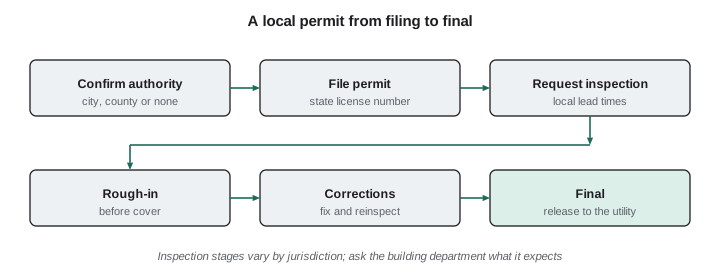
Most electrical jobs have at least two inspections. The rough-in inspection takes place after boxes, raceways and cables are installed and before walls and ceilings are closed. The final inspection takes place when devices, fixtures and equipment are installed and the system is ready to energize. Some jobs add an underground or slab inspection before trenches are backfilled or concrete is poured, a service inspection before the utility connects, or separate inspections for a generator, a solar installation or a fire alarm system. The department will say which inspections it requires for the scope on the permit.
| Stage | When to call | What the inspector usually looks at |
|---|---|---|
| Underground or slab | Before backfill or concrete | Raceway, depth, bonding, conductors where visible |
| Rough-in | Before walls and ceilings are covered | Boxes, cables, raceways, supports, bonding, box fill |
| Service | Before the utility energizes the service | Service equipment, grounding electrode system, clearances |
| Final | When the work is complete | Devices, fixtures, panel schedules, labels, protection, function |
Requesting an inspection
Departments take inspection requests by phone, online portal or email, and each sets its own lead time. A busy department may need a day or two of notice. Pearl River Current's leads call for inspections the afternoon before they expect to be ready, not the morning they finish, and they confirm the permit number and the inspection type when they call. An inspector who arrives to find the work not ready may charge a reinspection fee and will certainly remember it.
The lead should meet the inspector on site when possible. Being there lets the lead answer questions, show work that is hard to see and understand any correction before the inspector leaves. Marcus met the inspector in Pearl, which is why he could fix all three corrections the next morning.
Corrections and reinspection
A correction notice lists the items the inspector found that do not meet the adopted code. Each item should name the requirement, and the contractor should ask for the code section if it is not given. The contractor fixes each item and calls for a reinspection. If the contractor disagrees with a correction, it should first ask the inspector to explain, then raise it with the building official if needed. Lesson 5 described the route through the building official and any board of appeals.
Corrections are information. Tasha keeps a log of every correction the company receives, sorted by type. Over a year the log shows patterns, such as a crew that keeps missing box fill or a supplier whose fittings do not suit a particular box. The log feeds into the company's training, and it was the source for a third of the trade exam practice topics Tasha chose.
Final inspection and release
When the final inspection passes, the department records it and, for a new or upgraded service, notifies the electric utility or gives the contractor a release that the utility needs before it connects. The utility's own requirements, such as meter base location and service entrance details, also have to be met. A building may also need a certificate of occupancy from the building department, which usually depends on the electrical final among other inspections.
On the Flowood clinic, the general contractor's schedule depended on the electrical final for the certificate of occupancy. Tasha built the inspection dates into Pearl River Current's schedule for that job before the subcontract was signed, so that the general contractor could see when each inspection was expected.
Records
Keep a permit file for every job: the permit, the approved plans if any, every inspection record and correction notice, photographs of the rough-in before cover, and the final approval. These records answer questions years later, for example when an owner sells the building, when an insurer investigates a claim or when a later contractor finds something unexpected behind a wall.
Worked problem
Planning inspections for a service upgrade
A homeowner in Brandon hires Pearl River Current to replace a 100 ampere service with a 200 ampere service and add four circuits in a new laundry room. Which inspections should the lead expect, and what should he do before calling for the first one?
Show solution
- Confirm from the parcel map that the house is inside Brandon's limits.
- Obtain a permit for the service change and the new circuits, listing the company's licenses.
- Expect a rough-in inspection for the new circuits before the laundry walls are closed.
- Expect a service inspection or final before the utility reconnects the new service.
- Call the afternoon before the work is ready and meet the inspector on site.
Answer: A rough-in inspection for the new circuits and a service or final inspection before the utility reconnects.
# Tracking corrections by type across jobs (illustrative)
from collections import Counter

corrections = [
    ("Pearl remodel", "bonding"), ("Pearl remodel", "securing"), ("Pearl remodel", "labeling"),
    ("Brandon house", "box fill"), ("Madison house", "labeling"), ("Flowood office", "box fill"),
    ("Pearl remodel 2", "labeling"),
]
by_type = Counter(kind for _, kind in corrections)
for kind, n in by_type.most_common():
    print(f"{kind:10} {n}")
print("Most common:", by_type.most_common(1)[0][0])labeling 3 box fill 2 bonding 1 securing 1 Most common: labeling
Labeling came out on top in Tasha's log, which surprised the crews until they looked at the notices. Most were panel schedules left blank or incomplete. The fix was a habit, not a skill: fill in the schedule as circuits are landed, not at the end of the job.
Working with inspectors
Inspectors in most Mississippi building departments cover a lot of ground, and some handle building, plumbing and mechanical work as well as electrical. A contractor that makes their job easy earns patience when it needs it. That means work that is ready when called, a permit posted where it can be found, panel schedules filled in, labels in place, and a lead who can show what is behind a cover without being asked twice. It also means accepting a correction gracefully, fixing it promptly and calling back only when it is fixed.
Relationships matter in small departments. An inspector who has seen a contractor's work pass cleanly for years will often help the contractor plan a difficult installation, for example by explaining in advance how the department reads a requirement. Tasha encourages crew leads to ask such questions before rough-in rather than after, and to write down the answer with the inspector's name and the date.
When a job crosses a boundary, such as a site that straddles a city line or a service fed from one jurisdiction for a building in another, the contractor should ask both departments early how they will handle it. Most such questions have a simple answer, but only if they are asked before the work is done.
Common mistakes
MistakeStarting work before the permit is issued.
InsteadObtain the permit first, except where the ordinance allows emergency repairs.
MistakeCalling for an inspection the moment work is finished.
InsteadCall ahead with the department's lead time and be ready when the inspector comes.
MistakeArguing with an inspector on site.
InsteadAsk for the requirement and the code section, then go to the building official if needed.
MistakeClosing walls before the rough-in passes.
InsteadWait for approval of the rough-in inspection before covering.
Summary and key terms
- The inspection authority is usually the city, or the county outside city limits, that adopted the code.
- Find it from the parcel map, not the mailing address.
- Local ordinances say who may pull a permit; state license numbers often go on the application.
- Common stages are underground, rough-in, service and final, set by the department for the scope.
- Corrections are fixed and reinspected; the final releases the service to the utility.
- Permit
- Local authorization to do electrical work at a particular site.
- Rough-in inspection
- An inspection before walls and ceilings are covered.
- Correction notice
- An inspector's list of items that do not meet the adopted code.
- Reinspection
- A follow-up inspection after corrections are made.
- Release
- Word to the utility that the service may be connected.
Practice problems
Work each problem on paper first, then reveal the answer to check.
Who usually inspects electrical work in a Mississippi city?
Show answer
The city's building department.
When is the rough-in inspection called?
Show answer
Before walls and ceilings are covered.
What should a contractor do if it disagrees with a correction?
Show answer
Ask for the requirement, then raise it with the building official.
Lesson quiz · 5 questions
Score 60% or more to complete this lesson.
Create a free account to save your progress, take quizzes and earn a certificate.