
MELU-224 · Lesson 2 of 12 · 19 min
Eligibility for the Electrical Contractor License
▶ Video coming soon A video version of this lesson is on the way.
In the first week of August 2026, Tasha Odom sat down with Lonnie Hartfield and Renee Galloway at the long table in Pearl River Current's office in Brandon. On the table were the company's articles of organization, last year's financial statements, the liability insurance certificate, the workers' compensation policy and a printout of the board's commercial application. “Before we pay a fee,” Renee said, “let's make sure we qualify.” They went down the list one item at a time, and two items needed work: the company's financial statement had been compiled, not reviewed, and the insurance certificate named the wrong certificate holder.
This lesson covers who can hold a Mississippi commercial license with the Electrical classification and what the board asks of the business and of its qualifying party. It also covers the residential license for comparison, the specialty classifications under Electrical, and reciprocity with neighboring states. The board's requirements apply to the business as a whole, so eligibility is as much about the company's paperwork as about the candidate's knowledge.
Who holds the license
The license is issued to the business that will sign contracts. That can be a sole proprietor, a partnership, a corporation, a limited liability company or a limited liability partnership. The board's license page says corporations, LLCs and LLPs must show they are in good standing with the Mississippi Secretary of State. A business organized in another state registers with the Secretary of State to do business in Mississippi before it applies. The license is issued in the exact legal name of the entity, and contracts, bids and permits should use that same name.
Pearl River Current Electric, LLC was organized in Mississippi in 2004, when Lonnie converted his sole proprietorship. Its annual reports were current, so Renee printed a certificate of good standing from the Secretary of State's website. She also checked that the company's sales tax number was active, because the board asks commercial applicants for a Mississippi sales tax or use tax number.
The qualifying party
Each license needs at least one qualifying party, the person whose exam results qualify the business for its classifications. The board's page says each qualifying party takes the exams. For a commercial license with the Electrical classification, the qualifying party passes the Mississippi Law and Business Management exam and the electrical trade exam, or a NASCLA accredited exam that the board accepts for the classification. A business may use different qualifying parties for different classifications, for example one for Electrical and another for a low voltage specialty.
The qualifying party is usually an owner, an officer or a senior employee. The board's published pages reviewed for this course do not set a minimum number of years of experience for the qualifying party, and they do not require a personal electrician license. The trade exam assumes the candidate can work through code questions quickly, though, so in practice the qualifying party is someone with years of field and estimating experience. Tasha had fourteen years in the trade, nine of them at Pearl River Current running jobs, and she had passed a city electrician exam years earlier.
Because the license depends on the qualifying party, the company should think about what happens if that person leaves. Lesson 7 covers the qualifying party's duties and what to do when one departs. For now, note that Lonnie asked Tasha to qualify the company partly because she planned to stay, and partly because he was ready to step back from estimating.
Financial strength
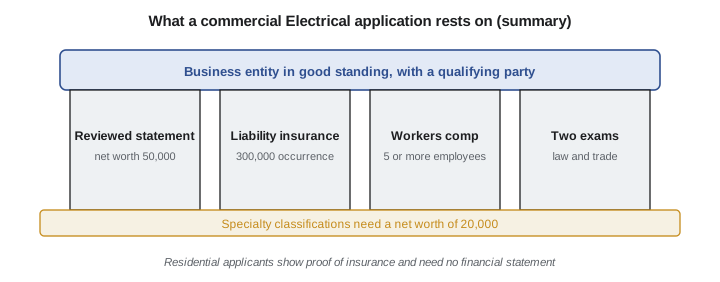
Commercial applicants show financial strength with a financial statement. The board's license page says a reviewed statement prepared by a certified public accountant is required, and that net worth must be 50,000 dollars or more for a major classification, such as Electrical, or 20,000 dollars or more for a specialty classification. A reviewed statement is a step above a compiled statement: the accountant performs analytical procedures and inquiries and gives limited assurance, though less than an audit. A compiled statement, which simply presents management's figures in a standard format, does not meet the requirement.
That was the first item that needed work for Pearl River Current. Its outside accountant had prepared compiled statements for years, which suited the bank. Renee asked the accountant for a reviewed statement for the year that ended December 31, 2025. It took three weeks and cost more than a compilation, but it showed a net worth well above 50,000 dollars, mostly in equipment, receivables and retained earnings.
Net worth here means total assets minus total liabilities, as the reviewed statement presents them. A young company with little equity may struggle to reach the figure, and owners sometimes add capital or convert loans to equity before the statement date. Those decisions should be made with the accountant, because the board reads the statement as presented.
Insurance
The board requires proof of general liability insurance, with the board listed on the certificate. The license page states that commercial applicants must show coverage of at least 300,000 dollars per occurrence or 600,000 dollars aggregate. Residential applicants must show proof of coverage, but the page says no minimum amount is required for them.
Pearl River Current carried 1,000,000 dollars per occurrence, far above the minimum, because general contractors on larger jobs require it. The problem was the certificate: it listed a bank as certificate holder and did not name the board. Renee asked the agent for a new certificate naming the board, and she added a reminder to her calendar to send a fresh certificate to the board each time the policy renews.
Workers' compensation is the other insurance item. The board's page says workers' compensation coverage is required for applicants with five or more employees, which matches the coverage threshold in the state workers' compensation law. Pearl River Current had twenty-two employees and a policy in force. Lesson 10 covers workers' compensation in more detail.
| Requirement | Commercial license | Residential license |
|---|---|---|
| Application fee | 400 dollars | 50 dollars |
| Financial statement | Reviewed by a CPA | Not required |
| Net worth | 50,000 dollars major, 20,000 specialty | No figure |
| General liability insurance | At least 300,000 per occurrence or 600,000 aggregate | Proof of coverage, no minimum |
| Workers' compensation | With five or more employees | With five or more employees |
| Law and Business Management exam | Required | Required |
| Trade exam | Required for Electrical | Required for Residential Electrical |
The exams as an eligibility item
The exams are a requirement for the license, not a separate credential. The Law and Business Management exam is required of every applicant, commercial or residential. The board's classification list marks Electrical as requiring a test and states that the trade exam or a NASCLA accredited exam is accepted. Residential Electrical also requires a test. Some commercial specialty classifications under Electrical, such as alarm systems or communication systems, have their own trade exams, while others do not require a test.
A qualifying party who passed the Law and Business Management exam for an earlier license may be able to rely on that result for a new one. Tasha had never taken it, because Lonnie had qualified the residential license himself years before. She would take both exams. Lesson 3 covers how the board grants eligibility to test and how long a candidate then has to pass.
Reciprocity
Some candidates can skip the trade exam. Licensing guides describe reciprocity agreements under which a business licensed in Alabama, Arkansas, Louisiana, South Carolina or Tennessee, in an equivalent classification, may have the trade exam waived. One guide says the out-of-state license must have been held for three consecutive years. The same guides agree that the Mississippi Law and Business Management exam is never waived, because it tests Mississippi law. These arrangements are set by agreement between boards and can change, so a candidate should confirm the current terms with the board before relying on them.
Reciprocity did not help Pearl River Current, which had no out-of-state license. It did matter to a competitor Tasha knew, a Mobile, Alabama contractor who wanted to bid work in Gulfport and Biloxi. Its qualifying party took only the Mississippi law exam, after the board confirmed that its Alabama license qualified.
Choosing classifications
Applying for a classification costs money and, often, an exam. A business should apply for the classifications it will actually use. Pearl River Current applied only for Electrical on the commercial side. Tasha considered adding the communication systems specialty, because the clinic job included data cabling, but the general contractor had a separate low voltage subcontractor for that scope. Lonnie decided they could add the specialty later if the work came.
The board's guides list a fee for each additional classification on a commercial license. A company that does fire alarm and security work alongside power wiring may find that one major classification and one or two specialties fit its business. The specialty exams for alarm systems and communication systems use their own references, which lesson 4 describes.
Worked problem
Does the company meet the financial test?
Pearl River Current's reviewed statement shows total assets of 1,240,000 dollars and total liabilities of 715,000 dollars. Does it meet the net worth requirement for the Electrical classification, and would it also meet the requirement for a specialty classification?
Show solution
- Net worth is total assets minus total liabilities: 1,240,000 minus 715,000 equals 525,000 dollars.
- The Electrical classification is a major classification, which needs 50,000 dollars or more.
- 525,000 dollars exceeds 50,000 dollars, so the test is met.
- A specialty classification needs 20,000 dollars or more, which is also met.
Answer: Yes. Net worth is 525,000 dollars, above both the 50,000 and 20,000 dollar figures.
# Checking an application against the commercial list (illustrative)
company = {
    "good_standing": True,
    "statement_type": "reviewed",
    "net_worth": 1_240_000 - 715_000,
    "gl_per_occurrence": 1_000_000,
    "board_on_certificate": False,
    "employees": 22,
    "workers_comp": True,
    "tax_number": True,
}
checks = [
    ("Entity in good standing", company["good_standing"]),
    ("Reviewed CPA statement", company["statement_type"] == "reviewed"),
    ("Net worth at least 50,000 (major)", company["net_worth"] >= 50_000),
    ("Liability at least 300,000 per occurrence", company["gl_per_occurrence"] >= 300_000),
    ("Board named on certificate", company["board_on_certificate"]),
    ("Workers comp if 5 or more employees", company["employees"] < 5 or company["workers_comp"]),
    ("Sales or use tax number", company["tax_number"]),
]
for name, ok in checks:
    print(("ok   " if ok else "FIX  ") + name)
print("Net worth:", f"{company['net_worth']:,}", "dollars")ok Entity in good standing ok Reviewed CPA statement ok Net worth at least 50,000 (major) ok Liability at least 300,000 per occurrence FIX Board named on certificate ok Workers comp if 5 or more employees ok Sales or use tax number Net worth: 525,000 dollars
The check flagged the certificate, the same item Renee had found by hand. A checklist like this is useful for a company that applies for several classifications or renews several licenses, because the same items come up every time.
Residential Electrical for comparison
Pearl River Current kept its residential license, because most of its work was still in homes. The residential license has lighter requirements: a 50 dollar application fee, proof of insurance with no minimum, no financial statement, the Law and Business Management exam and, for Residential Electrical, a trade exam. The residential license also carries a continuing education requirement for residential builders and remodelers, which lesson 11 covers. A company that holds both licenses keeps both current, and each has its own renewal.
Who does what on the application
Eligibility is a team effort inside a contractor. At Pearl River Current, Lonnie as the owner signed the application and answered questions about the company's ownership and history. Renee as office manager gathered the entity, tax and insurance documents and dealt with the accountant and the agent. Tasha as qualifying party filled in her own section, prepared for the exams and read the classification list closely so the company asked for the right one. The accountant prepared the reviewed statement, and the insurance agent issued the certificate. Each person had a short list, and Renee kept the master list.
This division matters because the board's questions, when they come, go to the person who signed. A business that knows who owns each item answers faster. It also matters at renewal and when the company adds a classification, because the same people will be asked for the same documents again.
Small companies often have one person doing all of it, usually the owner. That works, but it helps to write the list down anyway. An owner who files a commercial application once every few years will not remember which kind of financial statement the board wanted or what the certificate holder line had to say. A one-page list saved with the application file solves that.
Eligibility problems that cannot be fixed quickly
Most eligibility gaps can be closed in a few weeks: a new certificate, a reviewed statement, a good-standing certificate. Two cannot. A business whose net worth is well below the figure for the classification it wants needs time, capital or both, and should talk with its accountant before applying. And a business without a qualifying party who is ready to pass the trade exam needs study time measured in months, not days. Lesson 12 sets out a study plan. Knowing early which kind of gap you face saves an application fee and a lost testing window.
Common mistakes
MistakeSending a compiled financial statement with a commercial application.
InsteadThe board requires a statement reviewed by a CPA.
MistakeUsing a liability certificate that names someone else as holder.
InsteadName the board on the certificate the agent issues.
MistakeAssuming reciprocity also waives the law exam.
InsteadThe Mississippi Law and Business Management exam is required of every applicant.
MistakeApplying for every classification the company might someday use.
InsteadApply for the classifications the business will actually contract for; add others later.
Summary and key terms
- The license is issued to the business, which must be in good standing with the Secretary of State.
- A qualifying party passes the law exam and the trade exam for each classification.
- Commercial applicants submit a CPA-reviewed statement showing net worth of 50,000 dollars for a major classification or 20,000 for a specialty.
- Commercial liability insurance must be at least 300,000 dollars per occurrence or 600,000 aggregate, with the board on the certificate.
- Reciprocity with some neighboring states may waive the trade exam, never the law exam.
- Reviewed statement
- A financial statement on which a CPA gives limited assurance after inquiry and analysis.
- Net worth
- Total assets minus total liabilities.
- Major classification
- A broad classification, such as Electrical, with a 50,000 dollar net worth requirement.
- Specialty classification
- A narrower classification, such as communication systems, with a 20,000 dollar requirement.
- Reciprocity
- An agreement under which another state's license may waive a Mississippi trade exam.
Practice problems
Work each problem on paper first, then reveal the answer to check.
What kind of financial statement does a commercial application need?
Show answer
A statement reviewed by a certified public accountant.
What net worth does a major classification need?
Show answer
50,000 dollars or more.
Which exam is never waived by reciprocity?
Show answer
The Mississippi Law and Business Management exam.
Lesson quiz · 5 questions
Score 60% or more to complete this lesson.
Create a free account to save your progress, take quizzes and earn a certificate.