
MELU-224 · Lesson 10 of 12 · 18 min
Workplace safety law and OSHA for electrical contractors
▶ Video coming soon A video version of this lesson is on the way.
On a hot afternoon in July 2026, a second-year apprentice at Pearl River Current reached into an energized panel at a Pearl restaurant to tighten a neutral, against the lead's instruction. The screwdriver slipped, and the arc flash burned his forearm and singed his eyebrows. He was treated at the emergency room and released the same evening. Nobody was admitted to the hospital, and he was back at work, on light duty, in a week. Lonnie Hartfield called the whole company together the next morning. “We were lucky,” he said. “The rules exist because other people weren't.” The incident became the opening example in the company's safety training, and in Tasha Odom's study notes for the law exam.
This lesson covers the safety and injury law that applies to a Mississippi electrical contractor: federal OSHA's jurisdiction in Mississippi, the construction and general industry standards that matter most for electrical work, NFPA 70E as the consensus standard for electrical safe work practices, OSHA's injury reporting and recordkeeping rules, and the Mississippi workers' compensation law. It does not reproduce any standard; it describes what each one covers and how a contractor uses it.
Who enforces safety law in Mississippi
Mississippi does not operate an OSHA-approved state plan for private employers, so private-sector workplaces in Mississippi fall under federal OSHA, the Occupational Safety and Health Administration of the United States Department of Labor. Federal OSHA inspects Mississippi job sites, investigates accidents and complaints, and issues citations and penalties under the federal Occupational Safety and Health Act. A contractor working in Mississippi follows the federal standards directly, without a state overlay, which is different from neighboring states that run their own plans.
OSHA inspections on construction sites usually follow an accident, a complaint, a referral or a targeted program. An inspector may arrive without notice. The contractor should have a plan for the visit: who meets the inspector, who calls the office, where the safety program and training records are kept, and how the company responds to requests for documents or interviews.
The standards that matter most
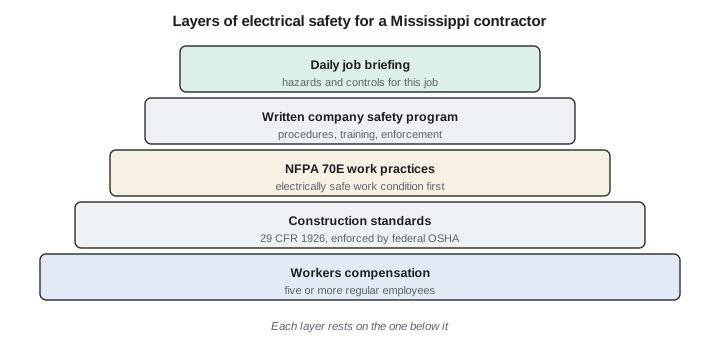
Construction work is governed by OSHA's construction standards in 29 CFR Part 1926. Subpart K covers electrical safety on construction sites, including ground-fault protection for temporary power, assured equipment grounding conductor programs where used, lockout and tagging of circuits, and safe use of electrical equipment. Other subparts cover fall protection, ladders, scaffolds, excavations, personal protective equipment, hazard communication and training. Maintenance and repair work in existing facilities can fall under the general industry standards in 29 CFR Part 1910, including Subpart S on electrical safety and the lockout and tagout standard for the control of hazardous energy.
The line between construction and general industry is not always clear. Installing a new circuit in a building under construction is construction. Repairing a motor controller in a working factory is usually maintenance under general industry. A contractor that does both kinds of work should train its people on both sets of rules and decide, job by job, which applies.
NFPA 70E
NFPA 70E, the Standard for Electrical Safety in the Workplace, is a consensus standard published by the National Fire Protection Association. OSHA does not adopt it word for word, but OSHA treats it as the recognized industry practice for protecting workers from electrical hazards, and citations under OSHA's general duty clause and its electrical standards often point to it. Its core idea is that work on energized equipment should be avoided, and that the first choice is to create an electrically safe work condition: disconnect, lock and tag, test for absence of voltage, and ground where needed.
When energized work cannot be avoided, NFPA 70E sets out a process: justify the energized work, assess the shock and arc flash risks, select the work practices and personal protective equipment, prepare an energized work permit where required, and make sure only qualified persons do the work. Pearl River Current's apprentice was not qualified for energized work and had been told not to touch the panel. The company's training after the incident focused on that point: the safest way to tighten a neutral is to turn the panel off first.
The company safety program
OSHA's construction standards require employers to have programs and training for specific hazards, and every serious contractor has a written safety program that ties them together. A good program covers management commitment, hazard identification, training, personal protective equipment, lockout and tagout, energized work, fall protection, ladders and lifts, excavation, hazard communication, first aid and emergency response, incident reporting and investigation, and discipline. It also names a competent person for the hazards the standards require one for.
The program only works if it reaches the job site. Pearl River Current's leads hold a short briefing at the start of each day, covering the day's tasks, the hazards and the controls. After the July incident the company added a rule that every briefing must name who is qualified for any energized work planned that day, and a second rule that no apprentice opens a live panel cover, for any reason.
Reporting injuries to OSHA
OSHA's reporting rule requires employers to report a work-related fatality to OSHA within 8 hours, and a work-related in-patient hospitalization, amputation or loss of an eye within 24 hours. Reports can be made by phone or online. The clock starts when the employer learns of the event. A treat-and-release emergency room visit, like the apprentice's, is not an in-patient hospitalization and does not by itself trigger the 24-hour report, though it may be recordable.
Employers with more than ten employees in most industries, including construction, must keep OSHA's injury and illness records: a log of recordable injuries and illnesses, an incident report for each, and an annual summary posted in the workplace from February through April. Some larger establishments must also submit data to OSHA electronically. The apprentice's burn required medical treatment beyond first aid and restricted work, so it was recordable on Pearl River Current's log.
| Event | Report to OSHA | Other steps |
|---|---|---|
| Work-related fatality | Within 8 hours | Notify the insurer; preserve the scene |
| In-patient hospitalization | Within 24 hours | Notify the insurer; investigate |
| Amputation or loss of an eye | Within 24 hours | Notify the insurer; investigate |
| Treat-and-release injury needing medical treatment | No immediate report; record if recordable | Notify the insurer; record on the log |
Workers' compensation in Mississippi
Mississippi's workers' compensation law, in Title 71, chapter 3 of the Mississippi Code, requires coverage for employers with five or more workers regularly employed in the same business. As Miss. Code 71-3-5 reads, some employers are excluded, such as charitable and religious nonprofit organizations and employers of domestic servants and farm labor, and certain owners, including sole proprietors, partners and some shareholders, may waive coverage for themselves in writing and are then not counted. The law is administered by the Mississippi Workers' Compensation Commission. An employer covered by the law buys insurance or qualifies to self-insure.
Workers' compensation is generally the exclusive remedy of an injured employee against the employer. The employee receives medical care and wage benefits without proving fault, and in return generally cannot sue the employer for the injury. That trade is the reason the law exists, and it protects the contractor as much as the worker, but only if the contractor carries the coverage. An uninsured employer that is required to have coverage loses that protection and faces penalties.
A contractor should also understand that coverage can reach down the chain. Under the workers' compensation laws of many states, a contractor can become responsible for the injured employee of an uninsured subcontractor, and a Mississippi contractor should ask its insurer or lawyer how the Mississippi law treats that situation. The practical rule is to collect a current certificate of workers' compensation insurance from every subcontractor before it starts and to check it at each renewal. Pearl River Current's office will not issue a subcontract until the certificate is on file.
After an injury
When an employee is hurt, the first step is care: first aid, then medical treatment. Next, the lead calls the office, and the office decides within the hour whether OSHA must be called and when. The office reports the injury to the workers' compensation insurer promptly, as the policy requires, and the insurer handles the filings with the Commission. The company investigates what happened, not to blame someone but to stop it happening again, and records the injury on the OSHA log if it is recordable.
After the July incident, Pearl River Current did all of this the same day. The apprentice received treatment and returned to light duty. The insurer was notified the next morning. The investigation found two causes: an apprentice who did not understand the danger, and a lead who had left the panel cover off and the panel energized while he went to the truck. Both causes went into the training.
Worked problem
Which reports are needed?
A journeyman at Pearl River Current falls from a ladder at the Flowood clinic and is admitted to the hospital overnight with a broken leg. The office learns of it at 3 p.m. on a Tuesday. What reports are needed, and by when?
Show solution
- An in-patient hospitalization must be reported to OSHA within 24 hours.
- The office learned at 3 p.m. Tuesday, so the OSHA report is due by 3 p.m. Wednesday.
- The workers' compensation insurer should be notified promptly, as the policy requires.
- The injury is recordable and goes on the OSHA log.
- The company should investigate the fall and correct its cause.
Answer: Report to OSHA by 3 p.m. Wednesday, notify the insurer promptly and record the injury.
# Reporting deadlines from the time the employer learns of an event (illustrative)
from datetime import datetime, timedelta

rules = {"fatality": 8, "hospitalization": 24, "amputation": 24, "eye loss": 24}

def deadline(event, learned):
    hours = rules.get(event)
    return None if hours is None else learned + timedelta(hours=hours)

learned = datetime(2027, 3, 16, 15, 0)
for e in ("hospitalization", "fatality", "treat and release"):
    d = deadline(e, learned)
print(f"{e:18} {'no OSHA report; record if recordable' if d is None else d}")hospitalization 2027-03-17 15:00:00 fatality 2027-03-16 23:00:00 treat and release no OSHA report; record if recordable
The point of a tool like this is not the arithmetic, which is simple, but the habit of writing the deadline down the moment the office hears of an injury.
Training that sticks
OSHA's standards require training for many hazards, and NFPA 70E requires that workers be trained for the electrical tasks they perform. Training that sticks is short, specific and repeated. Pearl River Current's approach is a monthly safety meeting on one topic, a daily briefing on the day's hazards, and a field check by the lead or the qualifying party at least once a week. New hires and apprentices receive a first-week orientation that covers lockout and tagout, ladders, temporary power and the company's rule against energized work without authorization.
Training records matter too. An OSHA inspector who asks how a worker was trained expects a document that shows the date, the topic, the trainer and the worker's signature. A company that trains well but does not record it may have trouble showing that it did.
Return to work
A good return-to-work program brings an injured employee back to suitable light duty as soon as the doctor allows. It keeps the employee connected to the crew, reduces the cost of the claim and often speeds recovery. Pearl River Current's light-duty tasks include material takeoffs, organizing the warehouse, preparing panel schedules and riding along as a second set of eyes on safety walks. The apprentice injured in July spent his week of light duty preparing the panel schedules for the Flowood clinic, which the crews later said were the best they had seen.
Common mistakes
MistakeAssuming a Mississippi state safety agency enforces construction safety.
InsteadFederal OSHA covers private employers in Mississippi.
MistakeWorking energized because it is faster.
InsteadCreate an electrically safe work condition first, as NFPA 70E directs.
MistakeWaiting until the next day to decide whether OSHA must be called.
InsteadDecide within the hour; hospitalizations are due within 24 hours, fatalities within 8.
MistakeHiring subcontractors without checking workers' compensation.
InsteadCollect a current certificate before they start.
Summary and key terms
- Federal OSHA enforces workplace safety for private employers in Mississippi.
- 29 CFR 1926 Subpart K covers construction electrical safety; 1910 Subpart S covers general industry.
- NFPA 70E is the recognized practice for electrical safe work; establish an electrically safe work condition first.
- Report fatalities within 8 hours and in-patient hospitalizations, amputations and eye losses within 24 hours.
- Mississippi requires workers' compensation for employers with five or more regular employees.
- OSHA
- The federal Occupational Safety and Health Administration.
- Electrically safe work condition
- Equipment disconnected, locked, tagged, tested and grounded as needed.
- Qualified person
- A worker trained and able to recognize and avoid electrical hazards on the work assigned.
- Recordable injury
- A work-related injury that must be entered on the OSHA log.
- Exclusive remedy
- The rule that workers' compensation generally replaces an employee's suit against the employer.
Practice problems
Work each problem on paper first, then reveal the answer to check.
Which agency enforces safety for private employers in Mississippi?
Show answer
Federal OSHA.
Within how many hours must a work-related fatality be reported to OSHA?
Show answer
8 hours.
How many regular employees bring a Mississippi employer under the workers' compensation law?
Show answer
Five or more.
Lesson quiz · 5 questions
Score 60% or more to complete this lesson.
Create a free account to save your progress, take quizzes and earn a certificate.