
MELU-224 · Lesson 12 of 12 · 18 min
Practice exam review and test-day strategy
▶ Video coming soon A video version of this lesson is on the way.
On November 9, 2026, four weeks before her trade exam, Tasha Odom took a full-length timed practice exam at the kitchen table after her children were asleep. She scored 74. She was pleased for a minute and then opened her miss log. Of the questions she missed, more than half were in two areas: motor calculations and grounding and bonding. Four of the misses were questions she knew the answer to but had misread. She wrote the plan for the next four weeks on one page: two evenings a week on motors, two on grounding and bonding, one full practice exam each weekend, and a rule to underline the last line of every question before she answered it.
This final lesson brings the course together. It covers building a study plan for the two exams, using practice questions and a miss log, a one-page Mississippi review sheet for the law exam, preparing the reference books, the days before the exam, test day at a PSI center, and what to do after the score report. The plan here is an example; the right one depends on the candidate's starting point and the time available.
Two exams, two kinds of study
The Law and Business Management exam and the electrical trade exam call for different preparation. The law exam rewards knowing the layout of one reference book, the NASCLA guide's Mississippi edition, and being quick with business arithmetic. The trade exam rewards fast navigation of the code book named in the bulletin and fluency with electrical calculations. Many candidates schedule the law exam first, as Tasha did, because it needs less study time and a pass builds confidence. Others study for both together and book them on consecutive days. Either works, as long as both are passed within the six-month window that lesson 3 described.
A study plan
A study plan sets hours by week and topic. Tasha's plan runs ten weeks, from September 29 to her December 8 exam. She had begun reading the NASCLA guide as soon as she became eligible, so the first two weeks finished her law exam preparation, and she took the law exam on October 6, early in week two. Weeks three and four went to learning the layout of the code book and placing tabs. Weeks five to seven go to the trade exam content: services and feeders, branch circuits, grounding and bonding, wiring methods, motors, special occupancies and calculations. Weeks eight and nine are timed practice, and week ten, the week before the exam, is review and rest.
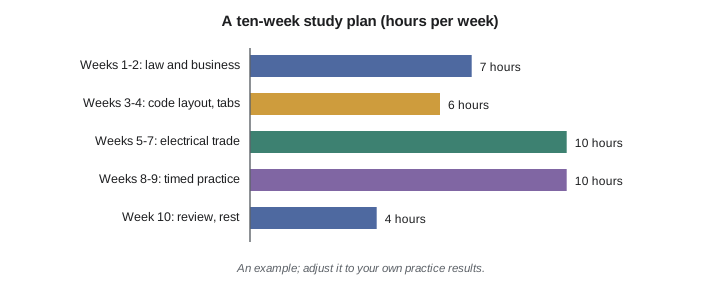
The plan has already changed twice. After the law exam Tasha started trade study a few days early, and after her November 9 practice exam she rebalanced the remaining weeks toward motors and grounding. A plan that never changes is a plan that is not being checked against results.
Practice questions and the miss log
Practice questions are the core of preparation for an open-book exam, because they train the skill the exam tests: finding the answer quickly. Work them under time pressure, look up every answer you are not sure of even if you got it right, and note the page or section where the answer is. A miss log records each wrong answer with the topic, the reason for the miss and the reference. The reasons usually fall into a few groups: did not know where to look, looked in the wrong place, misread the question, made an arithmetic error, or ran out of time. Each group has a different fix.
| Reason for the miss | What it means | The fix |
|---|---|---|
| Did not know where to look | Weak index or tab knowledge | Drill the index; add tabs for the topic |
| Looked in the wrong place | Similar sections confused | Note the difference on a review sheet |
| Misread the question | A key detail skipped | Underline the last line and the conditions |
| Arithmetic error | Calculator or method slip | Repeat the calculation type until automatic |
| Ran out of time | Pacing too slow | Use checkpoints and a two-pass method |
# Summarizing a miss log by topic and cause (illustrative entries)
from collections import Counter

misses = [
    ("motors", "wrong place"), ("motors", "arithmetic"), ("grounding", "did not know"),
    ("grounding", "wrong place"), ("services", "misread"), ("motors", "did not know"),
    ("grounding", "misread"), ("box fill", "arithmetic"), ("motors", "misread"), ("grounding", "misread"),
]
print("By topic:", Counter(t for t, _ in misses).most_common())
print("By cause:", Counter(c for _, c in misses).most_common())
score = 74
print(f"Practice score {score}; margin over 70: {score - 70}")By topic: [('motors', 4), ('grounding', 4), ('services', 1), ('box fill', 1)]
By cause: [('misread', 4), ('wrong place', 2), ('arithmetic', 2), ('did not know', 2)]
Practice score 74; margin over 70: 4The summary showed what Tasha saw on paper: motors and grounding led the topics, and misreading was the most common cause. A margin of four points over 70 is too thin to rely on, so the next four weeks aim at the two weak topics and at reading discipline.
A Mississippi review sheet for the law exam
The law exam's Mississippi questions are the ones candidates from other states most often miss, because they cannot be answered from experience elsewhere. A one-page review sheet of Mississippi facts, written in the candidate's own words, is worth the evening it takes. Tasha's sheet listed the figures this course has covered:
- commercial license at 50,000 dollars or more, at every tier; residential builder over 50,000 and remodeler over 10,000;
- commercial fee 400 dollars and residential 50; complete the application within 180 days; six months from eligibility to pass;
- reviewed CPA statement; net worth 50,000 for a major classification and 20,000 for a specialty;
- general liability of 300,000 per occurrence or 600,000 aggregate for commercial applicants, with the board on the certificate;
- workers' compensation at five or more regular employees;
- claim of lien within 90 days of last furnishing, filed with the chancery clerk; suit within 180 days of filing, or 90 days after an owner's contest;
- residential subcontractor pre-lien notice giving the owner ten days; commercial sub-subcontractor notice to the general contractor within 30 days of starting;
- public work payment bonds under Miss. Code 31-5-51; second-tier notice within 90 days; suit within one year;
- residential builder and remodeler education of two hours a year.
The sheet is a study aid, not a reference to bring into the exam unless the bulletin allows it, and most bulletins do not allow loose notes. Its value is in writing it.
Preparing the reference books
Read the bulletin's rules on what may be brought and how books may be marked before you mark anything. Within those rules, permanent tabs on major chapters or articles and on the tables you use most will save minutes on every exam. Highlight sparingly; a book in which everything is highlighted has no highlights. Make sure the books are the editions the bulletin names. Tasha bought a fresh copy of the code edition the bulletin listed and tabbed it from scratch, rather than adding tabs to her field copy of a different edition.
The days before the exam
The last week is for review and rest, not new material. Work one more timed practice set early in the week, review the miss log, and stop serious study the evening before. Confirm the appointment, the test center's address and the arrival time. Pack the reference books, the calculator with fresh batteries and the identification the bulletin requires the night before, and check the weather and the drive. Tasha plans a dry run to the test center on the Saturday before her December 8 exam, so that the drive on the day holds no surprises.
Test day
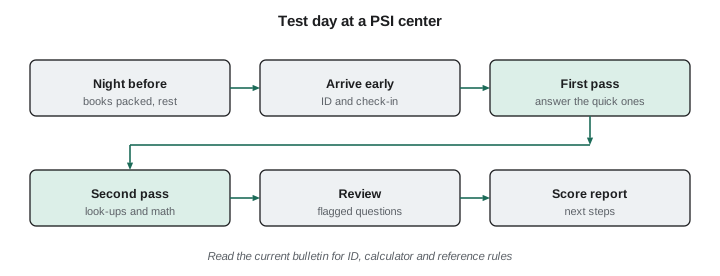
Arrive early, as the bulletin directs. Check-in includes identification, a check of the reference books against the bulletin's rules and storage of personal items. Before the exam starts, take the tutorial if one is offered, and when the timer starts, write the pacing checkpoints on the scratch material provided, as lesson 4 described. Then work the two-pass plan: answer the quick questions first and flag the rest, then work the flagged questions, then review. Answer every question, because a blank scores the same as a wrong answer.
Read each question to the end before looking anything up. Underline, mentally or on scratch paper, the conditions that decide the answer: the voltage, the occupancy, the location, whether the question asks for a minimum or a maximum, and whether it asks which choice is not permitted. When two answers look right, read the question again for the detail that separates them. Do not change an answer on review unless you have found a specific reason; first instincts on a question you looked up are usually right.
Manage energy as well as time. A two- or three-hour open-book exam is tiring. If your concentration slips, take a few deep breaths, look away from the screen for a moment and continue. Do not let a hard question take five minutes of a pace that allows two; flag it and move on.
After the score report
PSI gives a score report at the end of the session. A pass goes to the board, and the application moves toward approval, as lesson 3 explained. A fail comes with a breakdown by content area, which is the most useful study guide you will ever get. Rebook promptly inside the six-month window, study the weak areas and take the exam again. Many good contractors passed on a second attempt.
When the license issues, the work in lessons 7 and 11 begins: keeping the license current, keeping the file accurate and keeping the people who do the work safe and qualified. Tasha's December exam is the last step of this course's story, and the first step of her work as Pearl River Current's qualifying party.
Worked problem
Rebalancing a plan from practice results
Four weeks before her exam, Tasha's practice score is 74. Her miss log shows ten misses: four in motors, four in grounding, one in services and one in box fill, and four of the ten were misreadings. How should she spend the next four weeks?
Show solution
- Motors and grounding account for eight of ten misses, so they get most of the content hours.
- Misreading caused four misses across topics, so reading discipline is a daily habit, not a topic.
- One full timed practice exam each weekend checks progress and pacing.
- The last week is review and rest, with no new material.
- If weekend scores do not rise, rebook the exam while at least two days remain to avoid losing the fee.
Answer: Spend most content hours on motors and grounding, practice careful reading daily, test weekly, and rest the last week.
Studying with others
Many candidates study alone, but a study partner helps. Two candidates who quiz each other on lookups, compare miss logs and time each other on practice sets often both improve faster than either would alone. Tasha studied the law exam with Darnell Pruitt, the estimator who plans to qualify as a backup in 2027, and they met at the office one evening a week. A prep course or an online group can serve the same purpose. Whatever the format, the core of the work is the same: timed practice, honest review of misses and repeated lookups until they are fast.
Keeping calm under time pressure
Nerves cost points. The best cure is familiarity: by test day, a candidate who has taken several full timed practice exams under realistic conditions knows what the clock feels like at question 25 and what it feels like to flag and move on. Simulate the day as closely as possible: the same start time, the same books, the same calculator and no phone. Tasha took her practice exams on weekend mornings at the same hour as her booked appointment, so that her body was used to working hard at that time.
Common mistakes
MistakeStarting with page one of the reference and reading forward.
InsteadTake a practice exam first and study where it shows gaps.
MistakeCounting a right answer you guessed as known.
InsteadLook up every uncertain answer, right or wrong.
MistakeCramming new material the night before.
InsteadUse the last week for review and the last evening for rest.
MistakeSpending five minutes on one hard question.
InsteadFlag it, move on and come back on the second pass.
Summary and key terms
- Take a timed practice exam first and use the results to set the plan.
- Keep a miss log by topic and cause; each cause has its own fix.
- Write a one-page Mississippi review sheet for the law exam.
- Prepare the editions the bulletin names, marked only as the bulletin allows.
- On test day, arrive early, set checkpoints, work two passes and answer every question.
- Miss log
- A record of practice misses by topic, cause and reference.
- Review sheet
- A one-page summary of facts to memorize, written in your own words.
- Two-pass method
- Answering quick questions first, then returning to flagged ones.
- Checkpoint
- A planned point to compare progress with time.
- Score report
- PSI's report of the result, with a breakdown by content area on a fail.
Practice problems
Work each problem on paper first, then reveal the answer to check.
What should a candidate do before starting serious study?
Show answer
Take a timed practice exam to find the gaps.
How should a candidate handle a hard question on the first pass?
Show answer
Flag it and move on.
What should the last week before the exam be used for?
Show answer
Review and rest, not new material.
Lesson quiz · 5 questions
Score 60% or more to complete this lesson.
Create a free account to save your progress, take quizzes and earn a certificate.