
MELU-224 · Lesson 8 of 12 · 18 min
Contractor licensing, insurance and bonding
▶ Video coming soon A video version of this lesson is on the way.
In late October 2026, the Flowood general contractor sent Pearl River Current its draft subcontract for the clinic. Renee Galloway read the insurance and bonding exhibit twice. It asked for general liability of 1,000,000 dollars per occurrence and 2,000,000 aggregate, the general contractor named as additional insured, workers' compensation with a waiver of subrogation, commercial auto coverage, and a performance and payment bond for the full subcontract amount of 310,000 dollars. “The board wants 300,000,” she told Lonnie. “The contract wants a lot more, and a bond besides.” Lonnie nodded. The state's license requirements are a floor. The contracts set the real numbers.
This lesson brings together the money side of a Mississippi contractor license: the fees, the financial statement and net worth, the board's insurance requirement, workers' compensation, the tax number, and bonds. Bonds are where Mississippi differs from many states, because the board's license page does not list a license bond. Bonds come instead from public contract statutes and from the contracts themselves.
Fees
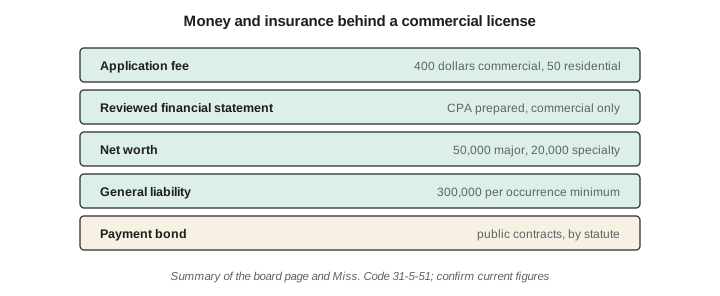
The board's license page sets the commercial application fee at 400 dollars and the residential application fee at 50 dollars, and says the fees are not refundable. Licensing guides add a fee for each additional commercial classification and list annual renewal fees, with a higher figure for commercial than for residential renewals. PSI charges its own exam fees, which were 120 dollars a portion in the 2023 bulletin. Cities that issue local licenses and permits charge their own fees. A company planning its first commercial license should budget for the board fee, two exam fees, the accountant's fee for a reviewed statement and the study materials, which together can come to a few thousand dollars.
The financial statement and net worth
Lesson 2 described the requirement: a commercial applicant submits a financial statement reviewed by a certified public accountant, showing a net worth of 50,000 dollars or more for a major classification such as Electrical, or 20,000 dollars or more for a specialty classification. The residential license does not require a financial statement. The statement is the board's check that the business can carry the cost of the work it contracts for, at least to a minimum level.
Net worth also matters well beyond the board. Sureties use the same kind of statement, and usually more, to decide how much bonding capacity to give a contractor. Banks use it to set credit lines. A contractor that keeps clean books, with a reviewed statement every year, finds the board requirement easy and the surety conversation easier.
General liability insurance
The board requires proof of general liability insurance, with the board listed on the certificate. Its license page sets the commercial minimum at 300,000 dollars per occurrence or 600,000 dollars aggregate. Residential applicants show proof of coverage with no minimum amount. General liability covers claims by third parties for bodily injury and property damage arising from the contractor's operations and completed work, such as a fire caused by a faulty connection after the job is finished.
The board's minimum is low compared with what customers ask for. Most general contractors and many owners require 1,000,000 dollars per occurrence and 2,000,000 aggregate, with themselves as additional insureds, and some require an umbrella policy above that. Public owners set their own requirements in the bid documents. Pearl River Current carries 1,000,000 and 2,000,000 with a 2,000,000 umbrella, which meets nearly every contract it sees.
Workers' compensation
The board's license page says workers' compensation coverage is required for applicants with five or more employees. That matches Miss. Code 71-3-5, which applies the workers' compensation law to employers with five or more workers regularly employed in the same business. Lesson 10 covers the law in more detail. Contracts often require workers' compensation regardless of the number of employees, and most general contractors require it of every subcontractor, so a small electrical contractor with three employees may still need a policy to get work.
Contracts also commonly ask for a waiver of subrogation in favor of the general contractor and owner. That endorsement prevents the workers' compensation insurer from suing them to recover what it pays on a claim. It usually costs a small additional premium and must be added by the insurer, not just written on the certificate.
Other insurance contracts ask for
Beyond general liability and workers' compensation, contracts commonly ask for commercial auto liability, an umbrella or excess policy, and sometimes contractor's pollution liability or professional liability where the contractor does design work, such as design-build electrical systems. A builder's risk policy covering the work under construction is usually bought by the owner or general contractor, but the subcontract should say who carries it. Equipment and tools are covered by an inland marine or contractor's equipment policy, which the contractor buys for its own protection.
| Coverage | Board requirement | Typical contract requirement |
|---|---|---|
| General liability | 300,000 per occurrence or 600,000 aggregate, commercial | 1,000,000 and 2,000,000, additional insured |
| Workers' compensation | Five or more employees | Required of every subcontractor, waiver of subrogation |
| Commercial auto | Not listed | Often 1,000,000 combined single limit |
| Umbrella or excess | Not listed | Often required on larger jobs |
| Performance and payment bonds | Not listed for the license | Public contracts by statute; private by contract |
Bonds: where they come from in Mississippi
Many states require contractors to post a license bond with the licensing board. The Mississippi board's license page lists the application, the financial statement, insurance, workers' compensation and the exams, and does not list a license bond. Bonds in Mississippi electrical contracting come instead from two other sources: the public contract statutes, and the terms of private contracts.
A surety bond is a three-party promise. The surety, usually an insurance company, guarantees to the obligee, such as the owner or general contractor, that the principal, the contractor, will perform. A performance bond guarantees that the contractor will complete the work under the contract. A payment bond guarantees that the contractor will pay its subcontractors, suppliers and laborers. A bid bond guarantees that a low bidder will sign the contract and provide the required bonds. Unlike insurance, a bond does not protect the contractor: if the surety pays, it will look to the contractor, and usually its owners under an indemnity agreement, to repay it.
Public contracts
On public buildings and public works, Mississippi law requires the prime contractor to furnish bonds. Miss. Code 31-5-51 is the state's payment bond statute, sometimes called the Little Miller Act after the federal Miller Act. As a lien-industry summary describes it, when a contract is under 25,000 dollars the public owner may choose to pay a lump sum at completion instead, and no payment bond is required in that case. The payment bond protects subcontractors and suppliers of the contractor, their subcontractors and suppliers, and laborers on the project. Lesson 9 covers the notice and suit deadlines for claims on the bond.
Because a contractor cannot place a lien on public property, the payment bond is the unpaid subcontractor's main protection on public work. An electrical subcontractor bidding a public job should ask for a copy of the prime contractor's payment bond at the start, so it knows the surety's name and the bond's terms if it ever needs to claim.
Private contracts
On private work, bonds are a matter of contract. An owner or lender may require the general contractor to furnish bonds, and the general contractor may in turn require major subcontractors, such as the electrical subcontractor, to furnish their own. The Flowood clinic's general contractor required a subcontract performance and payment bond of 310,000 dollars. Pearl River Current's surety approved it within a week, based on the company's reviewed statement and its work history, and the premium was priced into the bid.
A contractor that wants to grow into larger work should build its surety relationship before it needs a bond. Sureties look at the contractor's financial statements, work in progress, backlog, experience, management and character. A first bond is easier to obtain for a modest job than for the largest job the company has ever bid.
Worked problem
Pricing the bond into the bid
The surety quotes Pearl River Current a bond premium of 18 dollars per thousand dollars of contract value for the clinic subcontract of 310,000 dollars. What is the premium, and how should it appear in the bid?
Show solution
- Divide the contract value by 1,000: 310,000 divided by 1,000 is 310.
- Multiply by the rate: 310 times 18 equals 5,580 dollars.
- Include the premium as a cost in the bid, like any other job cost.
- If the contract value changes by change order, expect the premium to be adjusted.
Answer: The premium is 5,580 dollars, carried as a job cost in the bid.
# Bond premium on a tiered rate (illustrative rates, not a real surety quote)
tiers = [(100_000, 25), (400_000, 15), (None, 10)]   # (upper limit, dollars per thousand)

def premium(value):
    total, lower = 0, 0
    for upper, rate in tiers:
        top = value if upper is None else min(value, upper)
        if top > lower:
            total += (top - lower) / 1000 * rate
        if upper is None or value <= upper:
            break
        lower = upper
    return total

for v in (90_000, 310_000, 750_000):
print(f"{v:>9,} contract: premium {premium(v):,.0f} dollars")90,000 contract: premium 2,250 dollars 310,000 contract: premium 5,650 dollars 750,000 contract: premium 10,500 dollars
Real surety rates depend on the contractor's credit and the job, and many sureties price on a sliding scale like the one in the code. A contractor should get a quote for each bonded job rather than use a rule of thumb.
The tax number
The board asks commercial applicants for a Mississippi sales tax or use tax number. Contractors in Mississippi deal with contractor's tax on certain larger contracts and with sales and use tax on materials, and the rules depend on the contract and the contractor's role. The Mississippi Department of Revenue explains the rules, and the NASCLA guide's Mississippi chapter covers them for the law exam. A contractor bidding its first large commercial job should ask its accountant how the contract will be taxed before it prices the work.
Reading an insurance exhibit
A subcontract's insurance exhibit is a short list with long consequences. Read each line for the type of coverage, the limits, who must be named as additional insured, whether coverage must be primary and noncontributory, whether a waiver of subrogation is required, how long completed operations coverage must continue after the job, and how much notice of cancellation is required. Then compare each line with the policies the company actually holds. Renee sends the exhibit to the agent with a simple question: can we meet every line, and if not, what would it cost to do so?
On the clinic job the agent found one gap. The exhibit required completed operations coverage to continue for three years after the job, and the company's policy form needed an endorsement to show it. The agent added it for a small premium, and Renee noted the requirement on the job's closeout checklist so the certificates would be renewed for the full period.
When a policy is canceled
If an insurer cancels or does not renew a policy, the contractor must replace it before the old one ends, or it will be working uninsured and out of line with the board's requirement and its contracts. Most contracts require the contractor to give notice of cancellation to the general contractor or owner, and many certificates promise notice from the insurer as well. A contractor whose policy is canceled should call its agent the same day, obtain replacement coverage, send new certificates to the board and to every customer that holds one, and keep proof of continuous coverage. A gap of even a few days can leave an accident uninsured.
Common mistakes
MistakeAssuming the board's 300,000 dollar minimum will satisfy a general contractor.
InsteadRead each contract's insurance exhibit; most require far more.
MistakeTreating a surety bond as insurance for the contractor.
InsteadA surety that pays will seek repayment from the contractor and its indemnitors.
MistakeWaiting until bid day to ask for a first bond.
InsteadBuild the surety relationship before you need it.
MistakeWriting a waiver of subrogation on a certificate without the endorsement.
InsteadAsk the insurer to add the endorsement to the policy.
Summary and key terms
- Commercial applications cost 400 dollars and residential 50, not refundable, plus exam fees.
- Commercial applicants need a CPA-reviewed statement and net worth of 50,000 dollars for a major classification.
- The board's general liability minimum for commercial applicants is 300,000 per occurrence or 600,000 aggregate.
- Workers' compensation is required with five or more employees; contracts often require it regardless.
- The board's license page lists no license bond; bonds come from Miss. Code 31-5-51 on public work and from contracts on private work.
- Surety bond
- A surety's guarantee to an obligee that the contractor will perform or pay.
- Performance bond
- A bond guaranteeing completion of the contract work.
- Payment bond
- A bond guaranteeing payment of subcontractors, suppliers and laborers.
- Additional insured
- A party added to a contractor's liability policy for claims arising from its work.
- Waiver of subrogation
- An endorsement that stops the insurer from suing a named party to recover its payments.
Practice problems
Work each problem on paper first, then reveal the answer to check.
What general liability minimum does the board set for commercial applicants?
Show answer
300,000 dollars per occurrence or 600,000 dollars aggregate.
Which Mississippi statute requires payment bonds on public work?
Show answer
Miss. Code 31-5-51.
Does the board's license page list a license bond?
Show answer
No; bonds come from public contract law and private contracts.
Lesson quiz · 5 questions
Score 60% or more to complete this lesson.
Create a free account to save your progress, take quizzes and earn a certificate.