
MELU-224 · Lesson 11 of 12 · 18 min
Renewal and continuing education
▶ Video coming soon A video version of this lesson is on the way.
Renee Galloway keeps a wall calendar in the Brandon office with nothing on it but expiry dates. In November 2026 it showed the residential license renewal, the general liability policy renewal, the workers' compensation policy renewal, three local electrician license renewals for crew leads, the city contractor registrations in Pearl and Flowood, and, in pencil, the date the new commercial license is expected to issue. “Getting a license is hard once,” she told Tasha Odom. “Keeping it is easy every year, as long as somebody looks at this wall.”
This lesson covers how Mississippi contractor licenses are renewed, the documents that go with a renewal, the continuing education rule for residential licensees, what happens if a license lapses, inactive status, and the local licenses and registrations that have their own renewal cycles. The board's rules and fees change, so the lesson describes the pattern and points to where the current details are found.
The renewal cycle
Board licenses are renewed on a fixed cycle, and the expiry date is printed on the license and shown on the board's public search. Licensing guides describe commercial licenses as renewed each year, with a renewal fee, and list a separate, lower renewal fee for residential licenses. The board sends renewal notices, but a contractor should not rely on receiving one: the duty to renew is the licensee's. Renewals are filed through the board's online system.
A renewal is not just a fee. The board uses it to confirm that the license's file is current: the business is in good standing, the qualifying party is still in place, insurance is in force with the board on the certificate, and workers' compensation is in place where required. For commercial licenses, the board may also ask for updated financial information. The renewal form lists what is needed in a given year, and it should be read every year rather than filled in from memory.
Continuing education for residential licensees
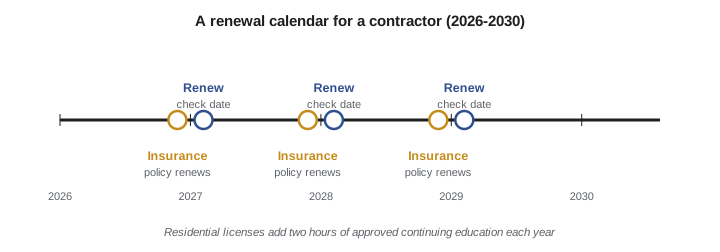
The board's rules set a continuing education requirement for residential licensees. As 30 Miss. Code R. 803-1.4 reads, it applies to holders of residential builder and remodeler licenses issued on or after July 1, 2015, including each qualifying party on those licenses. The requirement is two credit hours each year, from a provider or instructor approved by the board, with a credit hour equal to 50 minutes of instruction. Proof of the hours goes with each renewal, and a licensee who cannot show compliance cannot renew. Extra hours do not carry over to the next year, and courses taken before the person was licensed do not count.
The rule leaves the choice of courses to the licensee, except when the board orders particular education after a disciplinary hearing. Approved courses are listed on the board's website. Providers offer two-hour courses for residential trade licensees, including electrical topics, but whether the rule applies to a particular residential trade classification such as Residential Electrical, and in what way, is a question to confirm with the board, because the rule's text speaks of residential builder and remodeler licenses.
The rule also allows the board to defer or waive the requirement during a state of emergency declared by the governor or for good cause shown. Board members and members of standing committees can meet the requirement through their service. A licensee who is inactive is exempt while inactive, but must complete the hours before returning to active status.
| Point | Rule as summarized from 30 Miss. Code R. 803-1.4 |
|---|---|
| Who | Residential builder and remodeler licensees licensed on or after July 1, 2015, and their qualifying parties |
| How much | Two credit hours each year; one credit hour is 50 minutes |
| From whom | Board-approved providers or instructors |
| Proof | Submitted with each renewal; no renewal without it |
| Carryover | None; extra hours do not count toward the next year |
| Inactive licensees | Exempt while inactive; complete hours before reactivating |
Commercial licenses and education
The sources reviewed for this course do not describe a board continuing education requirement for commercial licenses comparable to the residential rule. A commercial licensee should still read each year's renewal form for any new requirement. Whatever the rule, the code changes every three years, and each city adopts new editions on its own schedule, so a qualifying party who does not study will fall behind. Pearl River Current budgets for each lead to take a code update course whenever a city it works in adopts a new edition, and Tasha plans to take one each year.
Local licenses and registrations
Local electrician licenses and contractor registrations have their own renewal dates, fees and, in some cities, their own continuing education rules. These are set by local ordinance, so each has to be tracked separately. A crew lead whose city license lapses may not be able to pull permits or work as the lead in that city until it is renewed, which can stop a job. Renee's wall calendar lists each crew lead's local licenses by city, and she asks for proof of any required education a month before each renewal.
Local permits do not renew in the same way, but they expire. Many ordinances say a permit lapses if work does not start within a set time or stops for a set time. A long job, or one that stalls, should be checked against the permit's terms so that the final inspection is not refused on an expired permit.
Late renewal and lapse
A license that is not renewed by its expiry date lapses. The board's rules say what late renewal is allowed, what late fees apply and when a lapsed license can no longer be renewed and must be applied for again. Those details change, so this course does not state them. The practical consequences of a lapse are the same whatever the rule: a business with a lapsed license may not contract for work that needs it, may have bids rejected, and may find general contractors and owners withholding payment until the license is restored.
A lapse can also cascade. If the commercial license lapses during a job, the general contractor may treat it as a default under the subcontract. If the residential license lapses, permits may be refused in cities that check state licenses. And if the license must be applied for again, the qualifying party may need to retest. The cost of a missed renewal is out of all proportion to the effort of a timely one.
Inactive status
A licensee that stops contracting for a time, for example because the owner is ill or the business is winding down, may be able to place the license in inactive status under the board's rules rather than let it lapse. Inactive status keeps the license on record without allowing the business to contract under it, and the residential education rule exempts inactive licensees while they are inactive. Returning to active status requires meeting the current requirements, including any education owed. The board's staff can explain the current procedure.
Renewing insurance alongside the license
Insurance renewals and license renewals are separate, but they are linked. The board needs a current certificate of general liability insurance naming the board, and a renewal may be held up if the certificate on file has expired. Renee's practice is to ask the agent for the board's certificate on the day each policy renews and to send it to the board that week, whether or not a license renewal is due. She keeps a copy of each certificate with the date it was sent.
Worked problem
Building next year's renewal list
Pearl River Current will hold a residential license with the Residential Electrical classification and, from early 2027, a commercial license with the Electrical classification. List the items Renee should check before each license renewal.
Show solution
- Both licenses: business in good standing with the Secretary of State.
- Both licenses: qualifying party still with the company.
- Both licenses: general liability certificate current and naming the board.
- Both licenses: workers' compensation in force, since the company has more than five employees.
- Residential license: proof of any continuing education the board requires for the license.
- Commercial license: any financial information the renewal form asks for.
Answer: Good standing, qualifying party, current insurance certificate, workers' compensation, and the items each renewal form requires, such as education or financial information.
# Building a reminder list from expiry dates (illustrative dates)
from datetime import date, timedelta

items = {
    "Residential license": date(2027, 3, 31),
    "General liability policy": date(2027, 1, 15),
    "Workers comp policy": date(2027, 1, 15),
    "Crew lead city license (lead A)": date(2026, 12, 31),
}
today = date(2026, 11, 10)
for name, expires in sorted(items.items(), key=lambda kv: kv[1]):
    first, second = expires - timedelta(days=60), expires - timedelta(days=14)
    status = "act now" if today >= first else "upcoming"
print(f"{name:32} expires {expires} 60-day {first} 14-day {second} {status}")Crew lead city license (lead A) expires 2026-12-31 60-day 2026-11-01 14-day 2026-12-17 act now General liability policy expires 2027-01-15 60-day 2026-11-16 14-day 2027-01-01 upcoming Workers comp policy expires 2027-01-15 60-day 2026-11-16 14-day 2027-01-01 upcoming Residential license expires 2027-03-31 60-day 2027-01-30 14-day 2027-03-17 upcoming
Run on November 10, 2026, the list shows the crew lead's city license already inside its sixty-day window, with the policy renewals close behind. That is the purpose of the list: to make the next action obvious.
Who owns the calendar
Renewals fail when everyone assumes someone else is watching. In a small company, one person should own the renewal calendar and one other person should check it each month. At Pearl River Current, Renee owns it and Tasha checks it at the first-of-the-month meeting. The calendar lists every board license, every local license and registration, every insurance policy, every surety relationship and every education deadline, with the person responsible for each.
The calendar should also hold the less obvious dates: the Secretary of State's annual report for the LLC, which keeps the company in good standing; the accountant's deadline for the reviewed statement, if the board or a surety will want a current one; and the expiry of each subcontractor's workers' compensation certificate on open jobs. Each of these can hold up a renewal or a payment if it is missed.
Changes at renewal time
Renewal is a natural time to review the license itself. Does it still list the right classifications? Is a classification no longer used and costing a fee? Is there work the company is turning down that a new classification would allow? Is the qualifying party for each classification still the right person, and is there a backup? A short conversation with the owner each year about these questions keeps the license matched to the business.
For Pearl River Current, the 2027 renewal will be the first with both licenses. Lonnie and Tasha have already agreed to look then at the communication systems specialty, because two of their commercial customers have asked whether the company can take on structured cabling. If the answer is yes, the application, the fee and any exam will go on the calendar like everything else.
Education that pays off
Required hours are a minimum. The most useful education for a qualifying party tracks the work: a code update course when a city adopts a new edition, a session on lien and contract changes when the law moves, an arc flash refresher for leads each year, and short courses on estimating or project management for those moving into those roles. Pearl River Current keeps an education log for each employee, with the course, the date, the hours and the provider, and uses it both to prove required hours and to plan the next year's training budget.
Common mistakes
MistakeWaiting for the board's renewal notice before acting.
InsteadThe duty to renew is the licensee's; track the expiry date yourself.
MistakeFilling in the renewal form from memory.
InsteadRead the current form every year for new requirements.
MistakeTaking extra education hours this year to cover next year.
InsteadResidential hours do not carry over.
MistakeForgetting local licenses and registrations.
InsteadTrack each city's license and registration renewal separately.
Summary and key terms
- Board licenses renew on a fixed cycle; the licensee must track the expiry date.
- A renewal confirms good standing, the qualifying party, insurance and workers' compensation.
- Residential builder and remodeler licensees licensed on or after July 1, 2015 need two approved hours each year.
- Local licenses, registrations and permits have their own cycles and rules.
- A lapse can stop work and may require a new application; inactive status may be available instead.
- Renewal
- The periodic filing that keeps a license active.
- Credit hour
- Fifty minutes of approved instruction under the residential rule.
- Lapse
- The end of a license's validity after it is not renewed.
- Inactive status
- A license kept on record without the right to contract under it.
- Approved provider
- An education provider approved by the board.
Practice problems
Work each problem on paper first, then reveal the answer to check.
How many hours of continuing education does the residential rule require each year?
Show answer
Two credit hours.
How long is one credit hour under the rule?
Show answer
50 minutes of instruction.
Can extra hours carry over to the next year?
Show answer
No.
Lesson quiz · 5 questions
Score 60% or more to complete this lesson.
Create a free account to save your progress, take quizzes and earn a certificate.