
MELU-222 · Lesson 9 of 12 · 19 min
Contracts and mechanics' liens in Michigan
▶ Video coming soon A video version of this lesson is on the way.
The Riverside Family Clinic job went well on site and badly in the office. Cedar River was a subcontractor to Lakeshore Builders, the general contractor, and by October the clinic was open, the electrical work had passed final inspection, and 46,500 dollars of Cedar River's contract was still unpaid. Lakeshore blamed the owner, the owner said it had paid Lakeshore, and Diane asked Jamal and Nina to sit down with the company's construction lawyer. The lawyer's first questions were about paperwork Cedar River had filed months earlier: had it served a notice of furnishing on time, had it kept sworn statements and waivers straight, and when exactly had it last furnished labor or materials?
Most states call the remedy a mechanics' lien. Michigan's statute is the Construction Lien Act, 1980 Public Act 497, and it calls the remedy a construction lien. This lesson explains how construction contracts and liens work in Michigan: the notice of commencement, the notice of furnishing, sworn statements, lien waivers, the claim of lien, the deadline to foreclose, protections for homeowners and the payment bond alternative on public jobs. Deadlines are summarized from the act and from study materials citing it; real lien questions are time-sensitive and belong with a lawyer.
Contracts first
A lien protects a contract right; it does not replace a good contract. Before work starts, the contract should identify the parties, the scope, the price and how changes are priced, the payment schedule and any retainage, the insurance and bonding requirements, the schedule, and how disputes are handled. Subcontracts often pass down the general contractor's obligations to the owner and may include pay-when-paid language, which the lawyer told Jamal to read carefully, because courts treat these clauses differently depending on the wording.
Change orders deserve special care. Most payment disputes start with work done on a verbal promise. Jamal's rule became simple: no extra work without a signed change order or, at least, a written directive from someone with authority to give it, with the price or a method for pricing it. A sworn statement and a lien can only protect amounts the contractor can prove it is owed.
The notice of commencement
On most private projects the owner records a notice of commencement with the county register of deeds before work starts and posts a copy at the site. The notice identifies the property, the owner, the general contractor and a designee who receives notices for the owner. Under the act, a subcontractor, supplier or laborer can request a copy by certified mail, and the owner, lessee or general contractor must provide a copy and a blank notice of furnishing form within 10 days. If they fail to, the time to serve a notice of furnishing is extended until 20 days after the notice is provided, and the owner can be liable for actual damages.
The notice of furnishing
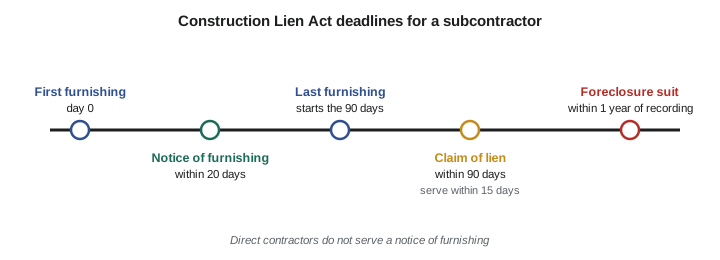
Section 109 of the act, MCL 570.1109, requires lien claimants who do not have a direct contract with the owner to serve a notice of furnishing on the designee named in the notice of commencement and on the general contractor. Subcontractors and suppliers must serve it within 20 days after furnishing the first labor or material. Laborers owed wages have 30 days after the wages were due. A contractor who contracts directly with the owner does not need to serve one. The notice follows a statutory form and can be served by personal delivery or, for subcontractors and suppliers, by certified mail, with service complete on mailing.
A late notice is not always fatal. Under the act, a late notice still supports a lien for labor and materials furnished after it is served. For earlier work, the late notice matters only to the extent the owner paid the general contractor relying on a sworn statement or a lien waiver. That rule is why subcontractors serve the notice early on every job, even jobs with customers they trust: it costs a stamp and protects the whole contract.
Sworn statements
Section 110 of the act deals with sworn statements: notarized statements that list each subcontractor, supplier and laborer on the job with its contract price, amount paid, amount due and balance. Owners and lenders rely on them to know who must be paid before they release money. Under the act, a contractor generally cannot demand payment or enforce a lien without providing a proper sworn statement when required, and knowingly giving a false sworn statement with intent to defraud is a felony. Nina prepared Cedar River's sworn statements from the purchase order log, so that every supplier and sub-subcontractor appeared with accurate balances.
Lien waivers
Section 115 of the act provides statutory waiver forms in four types: partial conditional, partial unconditional, full conditional and full unconditional. A conditional waiver takes effect only when the payment it describes actually clears; an unconditional waiver is effective when signed. Signing an unconditional waiver before a check clears can permanently give up lien rights if the check bounces. Cedar River's policy was to sign conditional waivers with each pay application and unconditional waivers only after funds were in the bank.
| Document | Who provides it | Timing or effect (summary) |
|---|---|---|
| Owner notice of commencement | Owner, recorded and posted | Before work starts; copy within 10 days of a proper request |
| Subcontractor notice of furnishing | Subcontractors, suppliers and laborers without a direct owner contract | Within 20 days of first furnishing (laborers: 30 days after wages due) |
| Sworn statement | Contractors and subcontractors | Lists everyone to be paid; required to demand payment or enforce a lien |
| Partial or full conditional waiver | Lien claimant | Effective only when the stated payment clears |
| Partial or full unconditional waiver | Lien claimant | Effective when signed |
| Claim of lien | Lien claimant | Recorded within 90 days after the last furnishing; served within 15 days after recording |
The claim of lien
Section 111 of the act requires a claim of lien to be recorded with the register of deeds within 90 days after the lien claimant's last furnishing of labor or material. Study materials stress that warranty work, punch-list callbacks and remedial repairs generally do not extend the deadline, so a claimant should not count on a small return visit to restart the clock. Within 15 days after recording, the claimant serves a copy on the owner or designee and files proof of service. A lien is not a judgment; to collect, the claimant must foreclose, and under section 117 a foreclosure action must be filed within one year after the claim of lien is recorded, or the lien expires.
# Construction Lien Act deadlines for the Riverside Family Clinic (study aid; dates for practice only)
from datetime import date, timedelta

first_furnish = date(2026, 3, 3)
last_furnish = date(2026, 9, 18)
recorded = date(2026, 11, 20)

print("Furnishing notice due by:", first_furnish + timedelta(days=20))
print("Claim of lien must be recorded by:", last_furnish + timedelta(days=90))
print("Serve recorded claim by:", recorded + timedelta(days=15))
print("Foreclosure suit must be filed by:", recorded.replace(year=recorded.year + 1))Furnishing notice due by: 2026-03-23 Claim of lien must be recorded by: 2026-12-17 Serve recorded claim by: 2026-12-05 Foreclosure suit must be filed by: 2027-11-20
The calculator shows the dates the lawyer checked first. Cedar River had mailed its notice of furnishing by certified mail on March 12, well within 20 days of first furnishing on March 3. Its last substantial furnishing was September 18, so it had until December 17 to record. The lawyer recorded the claim on November 20, served it within 15 days, and calendared November 20 of the next year as the last day to file suit.
Homeowners and residential jobs
The act gives special protection to owners of residential structures who have paid their contractor. An owner or lessee who has paid the contractor for the improvement can defend against a subcontractor's or supplier's lien, including by filing an affidavit with proof of payment, so the homeowner does not pay twice. Michigan once had a Homeowner Construction Lien Recovery Fund that paid unpaid subcontractors in some residential cases, but the legislature eliminated that fund in 2010 after it became insolvent. Today an unpaid subcontractor on a fully paid residential job usually has to pursue the contractor who did not pay.
For Cedar River, the practical lesson was to know who it was working for. On residential jobs where Cedar River contracted directly with the homeowner, it was the contractor in privity, did not need a notice of furnishing, and relied on its contract and payment schedule. On residential jobs as a subcontractor to a builder, it served notices of furnishing promptly and watched the builder's payment habits closely.
Public jobs and payment bonds
Public property generally cannot be subjected to construction liens. On public projects such as schools and municipal buildings, Michigan law requires the prime contractor to provide payment and performance bonds above a threshold, and unpaid subcontractors and suppliers claim against the payment bond instead of recording a lien. Bond claims have their own notice requirements and deadlines, which can be shorter than lien deadlines, so a subcontractor on a public job reads the bond and the statute at the start of the job.
Worked problem
Saving lien rights after a late notice
On a warehouse job, Cedar River first furnished material on May 1 but did not serve its notice of furnishing until June 20, after the owner had already paid the general contractor for April and May based on the general contractor's sworn statements. Cedar River's last furnishing was August 30, and it is owed 22,000 dollars, of which 9,000 dollars is for work done before June 20. What can it claim?
Show solution
- The notice was due May 21, so it was late.
- A late notice supports a lien for work furnished after it was served, so the 13,000 dollars of work after June 20 is protected.
- For the 9,000 dollars of earlier work, the late notice matters only to the extent the owner paid relying on sworn statements or waivers.
- Because the owner paid for April and May relying on sworn statements, the earlier 9,000 dollars is likely at risk.
- The claim of lien must be recorded by November 28, within 90 days of August 30.
Answer: Likely the 13,000 dollars for work after the late notice, recorded by November 28; the earlier 9,000 dollars is at risk and is a question for the lawyer.
A lien calendar for every job
Lien rights are lost to missed dates far more often than to legal arguments. Nina kept a lien calendar for every job where Cedar River was not the direct contractor: the date of first furnishing, the notice of furnishing deadline 20 days later, the date of last furnishing as each phase ended, and the 90-day claim of lien deadline after that. When the clinic payments slowed, the calendar showed exactly how much time remained, so the company could talk to the general contractor first and still record a lien in time if talks failed.
Common mistakes
MistakeSkipping the notice of furnishing for a trusted customer.
InsteadServe it within 20 days of first furnishing on every job where you lack a direct owner contract.
MistakeSigning an unconditional waiver before the check clears.
InsteadUse conditional waivers until funds are in the bank.
MistakeCounting a warranty callback as the last furnishing.
InsteadWarranty and punch-list work generally does not extend the 90-day lien deadline.
MistakeRecording a lien and then waiting.
InsteadA foreclosure action must be filed within one year after recording or the lien expires.
Summary and key terms
- Michigan's Construction Lien Act, 1980 PA 497, calls the remedy a construction lien.
- Owners record and post a notice of commencement; on request, a copy and a blank notice of furnishing must be provided within 10 days.
- Subcontractors and suppliers serve a notice of furnishing within 20 days of first furnishing; direct contractors are exempt.
- Sworn statements list everyone to be paid, and the act provides four statutory waiver forms, conditional and unconditional.
- A claim of lien is recorded within 90 days after last furnishing, served within 15 days, and foreclosed within one year after recording; public jobs use payment bonds.
- Construction lien
- A claim against real property for unpaid labor or materials under the Construction Lien Act.
- Commencement notice
- The owner's recorded and posted notice identifying the project and its designee.
- Furnishing notice
- A subcontractor's or supplier's notice that it is providing labor or materials.
- Sworn statement
- A notarized list of everyone on the job and what each is owed.
- Conditional waiver
- A lien waiver that takes effect only when the stated payment clears.
Practice problems
Work each problem on paper first, then reveal the answer to check.
Within how many days after first furnishing must a subcontractor serve a notice of furnishing?
Show answer
20 days.
A supplier's last delivery was June 5. By what date must its claim of lien be recorded?
Show answer
By September 3, 90 days after June 5.
What happens if no foreclosure action is filed within a year after recording?
Show answer
The lien expires.
Why are liens uncommon on public school jobs?
Show answer
Public property generally cannot be liened; payment bonds protect subcontractors instead.
Lesson quiz · 5 questions
Score 60% or more to complete this lesson.
Create a free account to save your progress, take quizzes and earn a certificate.