
MELU-222 · Lesson 11 of 12 · 18 min
Renewal and continuing education
▶ Video coming soon A video version of this lesson is on the way.
In December, Nina's calendar lit up with renewal reminders: Jamal's new master license, Marcus's journeyman license, four apprentice registrations, the company's electrical contractor license, the workers' compensation policy and two vehicle registrations. Most were routine. Jamal's was not, because the next time Michigan adopted a new electrical code, his renewal would depend on finishing a board-approved code update course within a year of the change. Diane had seen good electricians lose their licenses over a missed course, and she wanted Jamal to understand the system before the next code cycle arrived.
This lesson explains how Michigan electrical licenses are renewed, how the code update requirement works, how courses are approved and reported, what happens when a license lapses, and how a company keeps all of its licenses and registrations current. Renewal dates, fees and course hours are summarized from the statute, the bureau and widely used sources, and some of those details have changed in recent years. Check the bureau's current renewal information each year rather than relying on last year's habit.
Renewal cycles
Michigan licenses are renewed on fixed cycles. The bureau says apprentices must renew their registration every year. Widely used licensing summaries describe journeyman and master electrician licenses as renewing annually, with licenses expiring at the end of the year and renewal accepted into the following year before the license becomes void, and describe electrical contractor licenses as renewing on a longer, multi-year cycle. The exact dates, grace periods and fees are set by the bureau and its rules and can change, so the safest habit is to renew as soon as the renewal window opens and to confirm the deadline on the bureau's site.
Renewal is not automatic. The licensee must submit the renewal, pay the fee and meet any education requirement that applies to that cycle. Fees are modest compared with the cost of a lapse: one commonly cited fee schedule lists 50 dollars for a master renewal and 40 dollars for a journeyman renewal, figures to verify before paying.
| License | Cycle (summary; confirm with the bureau) | Education at renewal |
|---|---|---|
| Apprentice registration | Every year | None |
| Electrical journeyman | Annual, per common summaries | Code update course after a state code change |
| Master electrician | Annual, per common summaries | Code update course after a state code change |
| Electrical contractor | Multi-year cycle, per common summaries | Depends on the qualifying master staying current |
The code update requirement
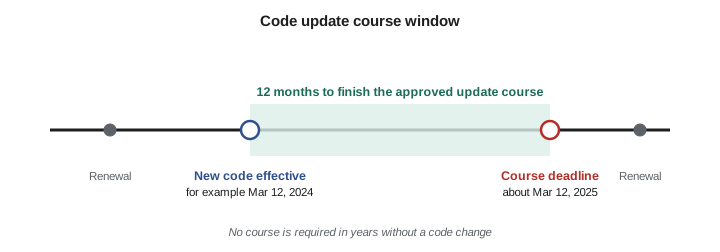
Michigan does not require a fixed number of education hours every year. Instead, Act 407 ties education to code changes. Section 713 says that to renew, a master electrician must complete a board-approved course on any update or change in the state construction code within 12 months after the change, and that the requirement applies only during or after years when the code is updated or changed. The journeyman section has a parallel rule. In years with no new code, there is no course to take; in a year after a new code, the course is mandatory.
Common sources describe the update course for masters and journeymen as 15 hours, with a shorter course for sign specialists. The bureau's announcement of the 2023 Michigan Electrical Code said that continuing education courses must be submitted for approval, and that licensees would use CE Broker, available from January 26, 2024, while code officials used a separate bureau application. The 2023 code took effect on March 12, 2024, and the bureau adjusted the renewal deadline for licensees to account for that adoption date. When the next code is adopted, expect a similar announcement with the course requirement and the deadline.
Approved courses and reporting
Only courses approved for Michigan count. Providers include trade schools, unions, contractor associations, community colleges and online training companies. Before paying for a course, check that it is approved for the license type and the current code change, and that the provider will report completion through the system the bureau uses. Keep the completion certificate with the license records. Taking a general NEC course from another state, or a course approved for a different license type, may not satisfy the Michigan requirement.
Jamal planned to take the next update course early in its window, at a weekend class run by a contractor association, rather than online at the last minute. He had found the 2023 changes easier to learn in a room with other electricians arguing about real installations, and an early course meant he would be working to the new code correctly from the start, not just renewing his license.
When a license lapses
A license that is not renewed on time stops being valid, and working on an expired license is working without a license. Depending on how long the license has been expired and the bureau's rules, the licensee may be able to renew late with a fee, or may have to reapply and meet current requirements, which for a master could mean taking the exam again. For a company, a lapsed master license is worse than inconvenient: the contractor license no longer has a qualifying master, and permits and payments can stop.
# Code update course window (study aid)
from datetime import date, timedelta

def course_deadline(adopted):
    # Act 407 requires completion within 12 months after the code change
    try:
        return adopted.replace(year=adopted.year + 1)
    except ValueError:
        return adopted + timedelta(days=365)

adopted = date(2024, 3, 12)
deadline = course_deadline(adopted)
print("New code effective:", adopted)
print("Finish approved update course by about:", deadline)
for taken in (date(2024, 9, 14), date(2025, 2, 28), date(2025, 4, 2)):
    ok = taken <= deadline
print(taken, "on time" if ok else "LATE - renewal at risk")New code effective: 2024-03-12 Finish approved update course by about: 2025-03-12 2024-09-14 on time 2025-02-28 on time 2025-04-02 LATE - renewal at risk
The calculator applies the 12-month rule to the 2023 adoption: courses finished in September 2024 or February 2025 are on time, and one finished in April 2025 is late. The bureau's adjusted deadline for that adoption was close to the end of the 12 months, so electricians who waited until the last few weeks had little room for a sick day or a canceled class.
A company-wide renewal system
A contractor with eighteen employees has dozens of renewals a year, and each one can stop work if it is missed. Nina's system had three parts. First, a single spreadsheet listed every license, registration, policy and permit-related credential with its number and expiration date. Second, the spreadsheet fed calendar reminders 90, 60 and 30 days before each deadline. Third, every renewal confirmation and course certificate was scanned into the same folder. Jamal reviewed the list monthly as part of the crew check from Lesson 7.
The system also tracked code changes. When the bureau announced a new code, Nina added a line for each journeyman and master showing the course deadline, and Jamal scheduled a group class so the whole crew learned the changes together. That turned a compliance task into training that improved the company's work.
Worked problem
Planning around a code adoption
Suppose Michigan files a new electrical code that takes effect on April 15 of next year. Cedar River has one master (Jamal), three journeymen and five apprentices. What should Jamal and Nina do?
Show solution
- The apprentices renew their registrations annually but do not need the code update course.
- Jamal and the three journeymen must complete an approved update course within 12 months, by about April 15 of the following year.
- Nina adds the course deadline to each person's line in the renewal spreadsheet with reminders.
- Jamal books a group class early in the window so the crews learn the new code before using it on permits issued after April 15.
- Certificates are stored with the license records, and completion is reported through the bureau's system.
Answer: Schedule an approved group course for the master and journeymen early in the 12-month window, track it in the renewal system, and keep the certificates.
Learning the new code, not just the course
The update course is a minimum. A master needs to understand how the new code will change the company's work, its prices and its inspections. When the 2023 Michigan Electrical Code took effect, Jamal and Diane listed the changes that mattered most to Cedar River's jobs, such as the outdoor emergency disconnect for dwellings, the surge protection rules and changes to ground-fault protection, and updated the company's estimating templates and material lists. They also told the office staff, because quotes written in February for permits pulled in April would fall under the new code.
Jamal also watched for interpretations. After a new code is adopted, inspectors, the bureau and trade groups often discuss how particular sections will be enforced, and early jobs can reveal differences between jurisdictions. Keeping a short list of those points, and sharing it with foremen, kept the company's work consistent with what inspectors expected.
Returning after time away
Some electricians leave the trade for a while, to work in another field, serve in the military or care for family. Before letting a license lapse, find out what the bureau requires to restore it and how long a license can be expired before reapplication or a new exam is required. Those rules can change, so ask the bureau directly and keep its answer in writing. An electrician who plans to return is usually better off renewing on time and completing the update courses, even while away, than starting over.
Records an auditor or customer may ask for
Renewal records do more than satisfy the state. Customers, general contractors and insurers may ask for proof that the master and journeymen are licensed and current. Public owners may check licenses before awarding a contract. The bureau may ask for proof of a completed course. Cedar River kept a simple set of records for each person: license number and expiration, renewal confirmations, update course certificates with dates and course numbers, and apprentice registration history. Nina could answer most requests in minutes, and that speed was part of how the company won and kept good customers.
Nina also set a rule that no one should wait for the last month of a renewal window. Each license holder received a reminder at 90 days with the renewal link, the fee and a note about whether an update course was due. At 60 days she checked who had not renewed and asked why. At 30 days Jamal called anyone still outstanding. In three years under this system no license at Cedar River lapsed, and the only renewal problem came from a lost email that the 60-day check caught.
For the company license, the stakes are higher still. A contractor license that lapses can stop permits on every open job, and a general contractor who learns that a subcontractor is unlicensed may withhold payment or terminate the subcontract. Nina therefore treated the contractor license renewal like a project, starting months before the deadline and confirming that the qualifying master's license was current before filing.
Common mistakes
MistakeWaiting for a reminder from the state.
InsteadRenewal is the licensee's responsibility; track your own dates.
MistakeTaking any NEC course to meet the requirement.
InsteadOnly courses approved for Michigan and the current code change count.
MistakeFinishing the update course in the last week of the window.
InsteadTake it early; a missed class can put the renewal at risk.
MistakeIgnoring the company impact of a lapsed master license.
InsteadA lapsed master leaves the contractor license without a qualifying master.
Summary and key terms
- Apprentices renew every year; journeyman and master licenses renew on short cycles, and contractor licenses on a longer cycle; confirm current dates and fees.
- Michigan ties education to code changes: masters and journeymen complete a board-approved update course within 12 months after a new code.
- Common sources describe the master and journeyman update course as 15 hours; licensees report completion through the bureau's system.
- An expired license is no license; late renewal or reapplication depends on the bureau's rules and how long it has lapsed.
- A company-wide tracking system with reminders and stored certificates prevents costly lapses.
- Renewal
- Submitting the application, fee and any required education to keep a license valid.
- Code update course
- A board-approved course on changes in the state construction code.
- CE Broker
- The system Michigan licensees use for continuing education, per the bureau's 2024 announcement.
- Lapse
- The status of a license that was not renewed on time.
- Renewal window
- The period when a license can be renewed before it expires or becomes void.
Practice problems
Work each problem on paper first, then reveal the answer to check.
Does a Michigan master electrician need education hours every year?
Show answer
No. The code update course is required within 12 months after the state code changes.
The state code changes on May 1. By about when must a journeyman finish the update course?
Show answer
By about May 1 of the following year.
What happens to Cedar River's contractor license if Jamal's master license lapses?
Show answer
The company loses its qualifying master and must restore or replace it before contracting for electrical work.
How should a contractor confirm a course will count?
Show answer
Check that it is approved for Michigan, the license type and the current code change, and that completion will be reported.
Lesson quiz · 5 questions
Score 60% or more to complete this lesson.
Create a free account to save your progress, take quizzes and earn a certificate.