
MELU-222 · Lesson 10 of 12 · 19 min
Workplace safety law and OSHA for electrical contractors
▶ Video coming soon A video version of this lesson is on the way.
On a windy afternoon in June, a Cedar River crew was setting a light pole at a warehouse in DeWitt when the foreman noticed that the boom truck's planned swing path passed under the utility's overhead distribution line. He stopped the lift, called Jamal and moved the setup thirty feet. Nobody was hurt, but that evening Jamal wrote up the near miss and asked the crew to walk him through the job hazard analysis they had done that morning. It had not mentioned the overhead line at all. As the company's new master of record, Jamal now owned the safety program as well as the code compliance program, and the near miss showed him where to start.
This lesson explains who enforces workplace safety for Michigan electrical contractors, the main MIOSHA standards that apply to electrical construction work, injury reporting and record keeping, incident rates, and how a master electrician builds a practical safety program. Michigan runs its own state plan, so the rules and the agency differ in some respects from federal OSHA. Rule numbers and details are summarized; check MIOSHA's current standards and publications before relying on them.
MIOSHA, not federal OSHA
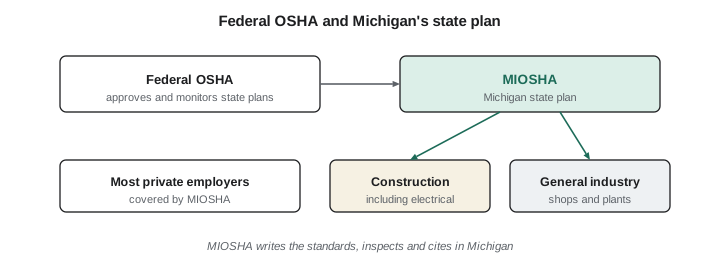
Federal law lets a state run its own occupational safety and health program if the state plan is at least as effective as federal OSHA. Michigan does, through the Michigan Occupational Safety and Health Act and the agency known as MIOSHA, part of the state's Department of Labor and Economic Opportunity. For most private employers in Michigan, including electrical contractors, MIOSHA, not federal OSHA, writes and enforces the safety standards, conducts inspections and issues citations. The catalog title of this lesson says OSHA because that is the term most electricians use, but in Michigan the agency to know is MIOSHA.
MIOSHA's standards are organized into numbered parts. Construction safety standards cover construction work, and general industry standards cover other workplaces, including shop and maintenance work. Many MIOSHA standards closely follow federal ones, but MIOSHA also has its own rules and wording. MIOSHA's construction standards include a part on electrical installations, and the agency publishes fact sheets, including one on power line clearances. A master electrician should know where these documents are and read the parts that match the company's work.
Electrical hazards on construction sites
The hazards are familiar to every electrician: contact with energized parts, arc flash, contact with overhead power lines, falls from ladders and lifts, struck-by and caught-between injuries, and trench and excavation hazards when running underground feeders. MIOSHA's construction standards address electrical installations, ground-fault protection for temporary power, lockout and energy control, ladders, scaffolds, aerial work platforms and excavations. NFPA 70E, the consensus standard for electrical safety in the workplace, is widely used to set up the electrically safe work practices that the standards require, such as establishing an electrically safe work condition before work begins.
Overhead lines deserve special attention because they kill electrical and non-electrical workers alike. Cranes, boom trucks, aerial lifts, ladders and long materials can contact lines without anyone touching the conductor directly. MIOSHA's rules and its power line clearances fact sheet set minimum approach distances and require precautions such as planning the setup, using a dedicated observer and coordinating with the utility to de-energize or cover lines. The DeWitt near miss happened because the crew planned the pole location but not the lift's swing path.
| Hazard | Typical controls on a Cedar River job |
|---|---|
| Energized parts | Establish an electrically safe work condition; lockout and verification before work |
| Arc flash | Labels, approach boundaries, energized work only with justification and proper protective equipment |
| Overhead lines | Plan setups and swing paths, keep required clearances, use an observer, call the utility |
| Temporary power | Ground-fault protection and inspected cords |
| Falls | Inspected ladders, guardrails or fall protection on lifts and roofs |
| Trenches | Locate utilities first; slope, bench or shore excavations as the standards require |
Reporting and record keeping
Employers must report serious workplace injuries to MIOSHA promptly. The reporting windows follow the same pattern as the federal rule: a fatality must be reported within hours, and an in-patient hospitalization, amputation or loss of an eye within a slightly longer period. Check MIOSHA's current reporting rule for the exact time limits and how to report, and post the information where foremen can find it. Most employers must also keep a log of recordable injuries and illnesses, an annual summary that is posted for employees, and an incident report for each case, unless they qualify for an exemption based on size or industry.
Records serve two purposes. They meet the legal requirement, and they show patterns. When Jamal reviewed three years of Cedar River's logs, he found that most recordable injuries were cuts and strains from material handling, not electrical shocks. That told him the next round of training should cover lifting, cut-resistant gloves and organizing material on site, alongside the electrical topics everyone expected.
Incident rates
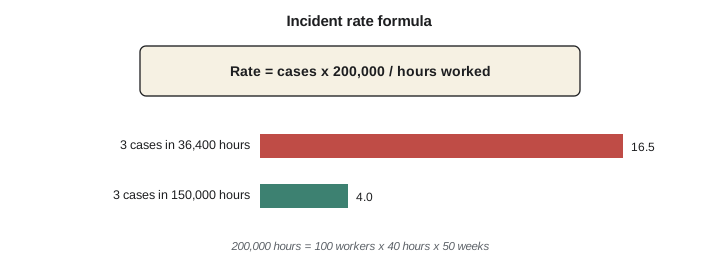
Owners, general contractors and insurers compare contractors using incident rates. The total recordable incident rate converts a company's recordable cases into a rate per 100 full-time workers, using 200,000 hours as the base, because 100 workers working 40 hours a week for 50 weeks equals 200,000 hours. The formula is the number of recordable cases multiplied by 200,000, divided by the total hours worked by all employees. A similar formula using only cases with days away, restricted duty or job transfer gives the DART rate. These rates, along with the experience modification rate from Lesson 8, often appear on prequalification forms.
# Incident rates for Cedar River (study aid; illustrative figures)
hours = 36400          # total hours worked by all employees in the year
recordable = 3         # recordable cases
dart_cases = 1         # cases with days away, restricted work or transfer

trir = recordable * 200000 / hours
dart = dart_cases * 200000 / hours
print(f"TRIR: {trir:.1f} per 100 full-time workers")
print(f"DART: {dart:.1f} per 100 full-time workers")
print("Hours behind each recordable case:", round(hours / recordable))TRIR: 16.5 per 100 full-time workers DART: 5.5 per 100 full-time workers Hours behind each recordable case: 12133
With three recordable cases in 36,400 hours, Cedar River's rate is about 16.5 per 100 full-time workers, a high figure for a company its size, driven mainly by the cuts and strains Jamal found. Small companies see large swings from a single case, which is why customers often look at several years of rates rather than one.
Building a safety program that works
MIOSHA expects employers to have written programs for specific hazards, such as lockout, hazard communication and, where needed, respiratory protection and excavations, and to train employees. A program that works goes further than binders. It starts each job with a short hazard analysis that the crew actually discusses, gives foremen authority to stop work, investigates near misses as seriously as injuries, and tracks corrective actions until they are done. It also makes sure new hires and apprentices get training before they face a hazard, not after.
After the DeWitt near miss, Jamal added two lines to the job hazard analysis form: "Overhead lines within reach of lifts, booms or materials?" and "Swing path checked?" He also made the near miss the topic of the next crew meeting, with the foreman who stopped the lift telling the story. Stories from coworkers stick in a way that rule numbers never do.
Inspections and citations
MIOSHA conducts inspections after complaints, serious injuries and referrals, and through programs that target high-hazard industries such as construction. An inspector may visit a jobsite without notice. A master electrician or foreman should know the company's procedure: greet the inspector politely, call the office, accompany the inspector, take the same photos and notes, and correct obvious hazards immediately. Citations can carry penalties and must be abated by a deadline, and employers can contest them through MIOSHA's process. Safety citations do not directly affect an electrical license, but the same incident can involve both MIOSHA and code enforcement.
Worked problem
Rewriting a job hazard analysis
The original job hazard analysis for the DeWitt pole job listed digging the base, setting the pole, terminating conductors and testing. What should the revised analysis include?
Show solution
- Locate underground utilities before digging the base.
- Identify the overhead line, measure the distance and plan the truck setup and boom swing to stay outside the required clearance.
- Assign a dedicated observer during lifting and agree on a stop signal.
- Call the utility if the work cannot keep the required distance, to discuss de-energizing or covering the line.
- Before terminating conductors, establish an electrically safe work condition and verify absence of voltage.
Answer: Add utility locates, overhead line clearance planning with an observer and utility coordination, and an electrically safe work condition before terminations.
Training apprentices and new hires
New workers are hurt at higher rates than experienced ones, often in their first weeks. Jamal made sure every new hire and apprentice received orientation before starting on a jobsite: the company's safety rules, how to report hazards and injuries, the lockout procedure, ladder and lift use, and who to call when something feels wrong. Apprentices were paired with a journeyman who knew that part of the job was teaching safe habits. Jamal also checked that training was documented, because MIOSHA inspectors often ask for training records, and a program that cannot show who was trained, on what and when may be treated as no program at all.
Training is repeated, not done once. Short toolbox talks at the start of the week kept topics fresh, and Jamal chose the topics from the injury log, recent near misses and the work coming up, such as trenching before an underground job or aerial lift rules before a warehouse lighting retrofit.
Shared jobsites
On a construction site, several employers share the same space and hazards. A hazard created by one trade can injure another trade's workers, and safety agencies may look at which employer created the hazard, which exposed its workers, which was in a position to correct it and which controlled the site. For an electrical subcontractor, that means protecting its own workers from hazards created by others, such as open floor edges or unguarded trenches, and making sure its own work does not create hazards for others, such as energized temporary wiring or open panel covers. When Jamal's foremen saw a hazard created by another trade, they reported it to the general contractor in writing and kept their own crews away until it was fixed.
Jamal also asked the foremen to keep a short record of each toolbox talk: the date, the topic, who attended and any hazards the crew raised. Those sheets served three purposes. They proved training to an inspector or customer, they showed which crews had missed a topic, and the hazards crews raised became the agenda for the next safety meeting. When a crew member said a ladder had a cracked rail, the foreman tagged it out that day and the office ordered a replacement, and the next talk covered how to inspect ladders before use. Small, steady records like these show that a safety program is real and working.
Common mistakes
MistakeAssuming federal OSHA enforces safety on Michigan private jobsites.
InsteadMichigan runs a state plan; MIOSHA writes and enforces the standards for most private employers.
MistakePlanning the pole location but not the lift's swing path.
InsteadCheck every setup and swing path against overhead line clearances.
MistakeRecording injuries but never reviewing the log.
InsteadUse the log to find patterns and target training.
MistakeTreating a near miss as good luck.
InsteadInvestigate near misses like injuries and fix the cause.
Summary and key terms
- Michigan runs its own state plan; MIOSHA writes and enforces safety standards for most private employers, including electrical contractors.
- MIOSHA has construction standards, including a part on electrical installations, and publishes a power line clearances fact sheet.
- Serious injuries must be reported promptly within the time limits in MIOSHA's reporting rule, and most employers keep injury logs and post an annual summary.
- Incident rates scale cases to 100 full-time workers using 200,000 hours, and customers use them to screen contractors.
- A working safety program includes job hazard analysis, stop-work authority, near-miss investigation and training before exposure.
- MIOSHA
- The Michigan Occupational Safety and Health Administration, which runs Michigan's state safety plan.
- State plan
- A state-run safety program approved as at least as effective as federal OSHA.
- TRIR
- Total recordable incident rate, cases times 200,000 divided by hours worked.
- Job hazard analysis
- A short written review of a task's hazards and controls before work starts.
- Electrically safe work condition
- A state in which equipment has been de-energized, locked out and verified before work.
Practice problems
Work each problem on paper first, then reveal the answer to check.
Which agency enforces workplace safety for a private electrical contractor in Lansing?
Show answer
MIOSHA, under Michigan's state plan.
Calculate the TRIR for 2 recordable cases in 80,000 hours.
Show answer
2 × 200,000 ÷ 80,000 = 5.0.
Why did the DeWitt near miss happen?
Show answer
The crew planned the pole location but did not check the boom truck's swing path against the overhead line.
What should a foreman do when a MIOSHA inspector arrives?
Show answer
Greet the inspector, call the office, accompany the inspector, take the same notes and photos, and fix obvious hazards right away.
Lesson quiz · 5 questions
Score 60% or more to complete this lesson.
Create a free account to save your progress, take quizzes and earn a certificate.