
MELU-222 · Lesson 4 of 12 · 18 min
The exam format and the references allowed
▶ Video coming soon A video version of this lesson is on the way.
The night Jamal was approved, he downloaded the PSI candidate information bulletin for Michigan Bureau of Construction Codes examinations and read the master electrician section with a highlighter. By the end he had three pages of notes: how many questions, how much time, what score passes, which books he could bring, how those books had to be marked, and what subjects the questions covered. "Half of passing this exam is knowing the rules of the exam," Diane told him. "The other half is knowing your code book well enough to find things fast."
This lesson covers the format of the Michigan master electrician exam, the reference rules, the content outline and how to turn those facts into a pacing plan and a book that works for you under time pressure. The figures come from the bulletin that took effect on August 20, 2026. PSI and the bureau revise bulletins, sometimes changing question counts, code editions or reference lists, so always study from the current version and reread it the week before the exam.
Questions, time and passing score
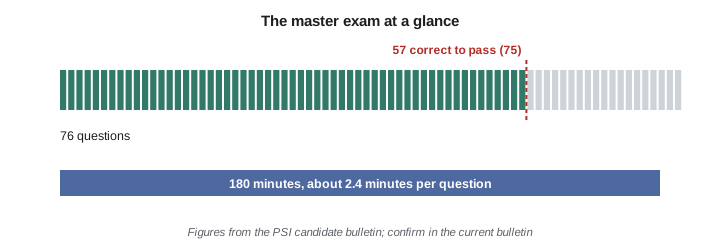
According to the August 2026 bulletin, the master electrician exam has 76 questions with a time limit of 180 minutes, and the passing score is 75 out of every 100 points. The bureau's licensing page confirms the 75 passing standard for the journeyman, master, fire alarm specialty technician and sign specialist exams. On a 76-question exam, 75 in 100 means 57 correct answers. A candidate can miss 19 questions and still pass, but not 20.
Three hours for 76 questions is a little under two and a half minutes per question. That sounds generous until you remember that many questions require finding a rule in the code book, reading an exception, or working a calculation such as a load, a conductor adjustment or a box fill. Some questions take thirty seconds; others take five minutes. The time budget only works if the quick questions stay quick.
| Item | Master electrician exam (August 2026 bulletin) |
|---|---|
| Number of questions | 76 |
| Time limit | 180 minutes |
| Passing score | 75 in 100 (57 of 76 correct) |
| Delivery | Computer-based at a PSI test center |
| Book rules | Open book, approved references only |
| Code edition the questions use | 2023 NEC as adopted by the Michigan Electrical Code |
The approved references
The exam is open book, but only certain books are allowed, and they must be in the right condition. The bulletin lists the National Electrical Code; 2016 PA 407, the Skilled Trades Regulation Act; 1972 PA 230, the Stille-DeRossett-Hale Single State Construction Code Act; and the Michigan Electrical Code Rules, Part 8. The NEC Handbook, which contains commentary and illustrations, is not allowed. Candidates may use another NEC edition if they bring it, but the bulletin says the questions are based on the 2023 edition, so an older book can lead to wrong answers where the code changed.
The bulletin is strict about markings. The NEC may have factory markings or highlights and factory tabs only. Printed copies of the statutes and rules downloaded from the bureau's website must be bound, with three staples on the left edge, each as a separate document, and must not contain any highlighting, writing or tabs. All reference material must appear exactly as published, and candidates may not bring loose or attached papers. A straight edge without calculations printed on it is allowed. PSI staff inspect books at check-in, and a book that fails inspection stays outside the room.
| Reference | Allowed? | Condition |
|---|---|---|
| National Electrical Code (2023 edition recommended) | Yes | Factory markings, highlights and tabs only |
| NEC Handbook | No | Not permitted |
| 2016 PA 407 printout | Yes | Bound, three staples on the left edge, no marks or tabs |
| 1972 PA 230 printout | Yes | Bound, three staples on the left edge, no marks or tabs |
| Michigan Electrical Code Rules, Part 8 printout | Yes | Bound, three staples on the left edge, no marks or tabs |
| Loose notes or added pages | No | Not permitted |
| Straight edge | Yes | No calculations printed on it |
Preparing your books
Because handwritten tabs are not allowed, the fastest legal way to make the NEC easy to navigate is to buy it with factory tabs and to practice with that exact copy until the layout is automatic. Jamal used the same tabbed NEC at home, at work and in practice exams for two months so that his hands knew where Article 220, Article 250, Article 310 and Chapter 9 were without his eyes having to search. He printed the three Michigan documents from the bureau's website early, stapled them as the bulletin requires, and read them several times, because the statute and rule questions come from documents most electricians never open on a job.
Candidates who want to annotate while studying use a second copy of the code or a notebook, and keep the exam copy clean. That habit also prevents a painful surprise at check-in, when a candidate realizes that a few sticky notes or a highlighted definition have made the whole book unusable.
What the exam covers
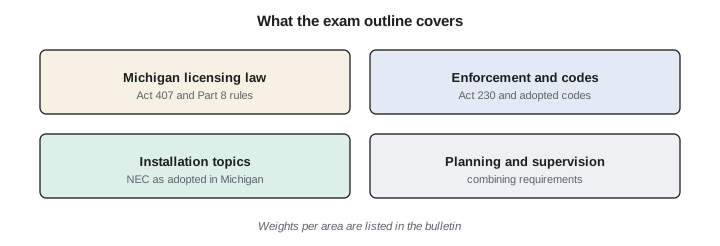
The bulletin's content outline has four broad parts. The first covers the Skilled Trades Regulation Act, its rules, and the Part 8 electrical code rules. The second covers the Stille-DeRossett-Hale Act, the codes adopted under sections 4 and 8a of that act, and related theory. The third is the long list of electrical installation topics: grounding and bonding, overcurrent protection, wiring methods, boxes and cabinets, services, feeders, motors and motor controls, special occupancies, load calculations, lighting, appliances, box and raceway fill, power-limited circuits, general trade knowledge and electrical theory. The fourth covers the additional knowledge needed to plan and supervise electrical installations, which is what separates a master exam from a journeyman exam.
The bulletin does not assign a share of questions to each topic, so candidates cannot skip a topic on the theory that it carries few points. In practice, the core courses in this program cover the installation topics, and this course covers the Michigan law and administration topics. A candidate who has never read Act 407 or the Part 8 rules is giving away questions that are easy once you know where to look.
A pacing plan
With 180 minutes for 76 questions, a common approach is a two-pass method. On the first pass, answer every question you can answer quickly, mark the slow ones and move on. Reserve about 30 minutes at the end for the marked questions and a final review. That leaves 150 minutes for the first pass, just under two minutes per question, with the knowledge that quick questions will bank time for slow ones. Checkpoints help: by 60 minutes you want to be about a third of the way through, and by 120 minutes about two thirds.
# Pacing checkpoints for the Michigan master exam (study aid)
questions, minutes, review = 76, 180, 30
first_pass = minutes - review
per_q = first_pass / questions
need = -(-questions * 75 // 100)  # 75 in 100, rounded up
print(f"First-pass budget: {first_pass} min, {per_q:.2f} min per question")
print("Correct answers needed to pass:", need, "of", questions)
print("Questions you can miss:", questions - need)
for m in (45, 90, 135, 150):
print(f"By minute {m:3}: about {round(m / per_q)} questions done")First-pass budget: 150 min, 1.97 min per question Correct answers needed to pass: 57 of 76 Questions you can miss: 19 By minute 45: about 23 questions done By minute 90: about 46 questions done By minute 135: about 68 questions done By minute 150: about 76 questions done
The calculator confirms the numbers in the bulletin and turns them into a plan: about 1.97 minutes per question on the first pass, 57 correct answers to pass, and checkpoints at 45, 90, 135 and 150 minutes. If the test center provides scratch material (check the bulletin), write the four checkpoint numbers on it at the start of the exam; Jamal did, and glanced at them each time he finished a block of questions.
Worked problem
Reading a pass line correctly
On a practice exam with 76 questions, Jamal answered 52 correctly on his first try and 59 on his third. What score did each attempt represent, and did each pass?
Show solution
- Score = correct ÷ 76 × 100.
- 52 ÷ 76 × 100 is about 68.4, below 75.
- 59 ÷ 76 × 100 is about 77.6, above 75.
- The passing count is 57, so 52 fails and 59 passes.
- His improvement came mostly from faster lookups, which left time for the calculation questions.
Answer: About 68 on the first try (fail) and about 78 on the third (pass).
Calculations and calculators
Many master exam questions involve arithmetic: load calculations, voltage drop, conductor ampacity adjustment, conduit and box fill, motor circuits and transformer sizing. The bulletin explains what calculators, if any, are permitted and what the test center provides. Because these rules can change, Jamal checked the current bulletin and practiced with the kind of calculator it allowed, so that he did not discover on exam day that his usual model was not permitted. He also practiced writing each calculation as a short list of steps, which made it easy to check his work on the second pass.
Questions that test the law
Law questions often look simple and turn on a single word. A question might ask how long a master must hold a journeyman license, who may hold an electrical contractor license, which act creates the single state construction code, or when a local unit's enforcement responsibilities begin. These answers sit in the bound statute and rule printouts. The best preparation is to read those documents twice, then answer practice questions with the documents open and note where each answer was found, so that on exam day you go straight to the right page.
Navigation drills
Because the exam is open book, speed in the code book is a skill of its own. Jamal practiced with short navigation drills: Marcus called out a topic, such as the grounding electrode conductor for a service, box fill, or the ampacity of a conductor at a given temperature rating, and Jamal timed how long it took to find the governing section and table. At first some lookups took three or four minutes. After two weeks of drills he could find most of them in under a minute, because he had learned the structure of the code: the article numbers for each subject, the index terms that work, and which tables he used often enough to tab.
The same drill works with the bound Michigan documents. Because they cannot be tabbed or marked, the only way to find a section quickly is to know how each document is organized. Read the table of contents of Act 407, Act 230 and the Part 8 rules several times, and practice finding the licensing sections, the enforcement and permit sections, and the rule that adopts the NEC with amendments.
When the question and the code seem to disagree
Sometimes a candidate finds a code section that seems to give a different answer from every option offered. Usually the question has a detail that changes which section applies: a dwelling rather than a commercial building, a feeder rather than a service, or a Michigan amendment rather than the base NEC. Reread the question, check the scope of the section you found, and check whether Part 8 amends it. If two answers still seem possible, choose the one that best fits the exact words of the question and mark it for review.
Common mistakes
MistakeBringing a code book with your own tabs or notes.
InsteadOnly factory markings and tabs are allowed; keep a separate study copy for notes.
MistakeBringing the NEC Handbook.
InsteadThe Handbook is not allowed.
MistakeStudying from an older NEC edition.
InsteadQuestions are based on the 2023 edition; another edition can give wrong answers where the code changed.
MistakeSkipping the law documents.
InsteadThe outline includes Act 407, Act 230 and the Part 8 rules; those questions are quick points if you know the documents.
Summary and key terms
- The August 2026 bulletin lists 76 questions, 180 minutes and a passing score of 75, which is 57 correct answers.
- Approved references are the NEC, 2016 PA 407, 1972 PA 230 and the Part 8 rules; the NEC Handbook is not allowed.
- The NEC may carry only factory markings and tabs; printed statutes and rules must be bound with three staples and have no marks or tabs.
- The outline covers Michigan law and administration, the state code act, installation topics and planning and supervision.
- A two-pass plan with about 30 minutes of review and time checkpoints keeps slow questions from eating the clock.
- Open book
- An exam that allows approved reference books in the room.
- Factory tabs
- Tabs applied by the publisher, the only tabs allowed in the exam NEC.
- Two-pass method
- Answering quick questions first, marking slow ones and returning to them later.
- Content outline
- The bulletin's list of subjects the exam covers.
- Passing count
- The number of correct answers needed to reach the passing score.
Practice problems
Work each problem on paper first, then reveal the answer to check.
How many correct answers are needed to pass a 76-question exam at 75 in 100?
Show answer
57.
May you bring the NEC Handbook?
Show answer
No.
How must printouts of Act 407, Act 230 and the Part 8 rules be prepared?
Show answer
Bound as separate documents with three staples on the left edge, with no highlighting, markings or tabs.
Which NEC edition are the questions based on?
Show answer
The 2023 edition, as adopted in Michigan.
Lesson quiz · 5 questions
Score 60% or more to complete this lesson.
Create a free account to save your progress, take quizzes and earn a certificate.