
MELU-222 · Lesson 5 of 12 · 18 min
The NEC as adopted in Michigan and state amendments
▶ Video coming soon A video version of this lesson is on the way.
Cedar River's first job of the spring was a panel upgrade and electric vehicle charger for a family in Okemos. The homeowners had bought a house with a 100-ampere service and wanted a 200-ampere service, a charger in the garage and room for a heat pump later. Jamal ran the job as practice for the master exam, and the job kept raising the same question: which code applies here, and where does Michigan's version differ from the NEC on his shelf? The answer turned on two things: the Michigan Electrical Code in effect on the date the permit was issued, and a short list of Michigan amendments that affect everyday work.
This lesson explains how Michigan adopts the NEC, which edition is in force, how the edition that applies to a job is decided, and the Michigan amendments a master electrician is expected to know. It does not reproduce any code text. NEC sections are cited by number and described in plain words; read the actual requirements in your own copy of the 2023 NEC and the Part 8 rules from the Bureau of Construction Codes.
How the NEC becomes Michigan law
The NEC is a model code published by the National Fire Protection Association. It has no legal force in Michigan until the state adopts it. Under the Stille-DeRossett-Hale Single State Construction Code Act, the Bureau of Construction Codes adopts the electrical code by administrative rule. The rules, called Part 8, incorporate a specific NEC edition by reference and then add, delete or change particular sections. The result is the Michigan Electrical Code. A Michigan electrician must know both the NEC and the Part 8 changes, because the inspector enforces the combination.
Because Michigan has a single state construction code, local units cannot write their own electrical amendments. A city building department in Ann Arbor and a county office in the Upper Peninsula enforce the same Michigan Electrical Code. This is different from states where large cities adopt their own codes, and it simplifies life for a contractor that works in many places.
The edition in force
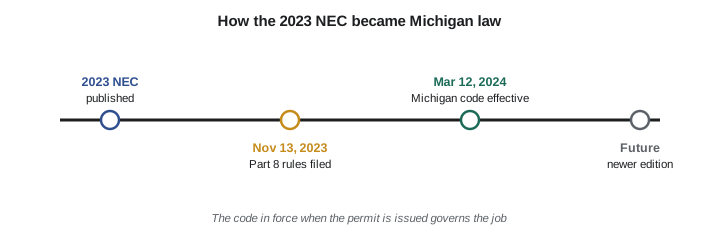
Michigan's current electrical code is the 2023 Michigan Electrical Code, based on the 2023 NEC. According to the state's notice summarized by the International Code Council's technical agency, the new Part 8 rules were filed with the Secretary of State on November 13, 2023, and took effect on March 12, 2024. Before that date the rules could be used for training but were not enforceable. The base document is the 2023 NEC in its second printing, with Michigan's amendments, deletions and additions.
The NFPA publishes a new NEC every three years, and a 2026 edition exists. Michigan adopts new editions on its own schedule, often a year or more after publication. As of late 2026, check the bureau's code page to see whether a newer Michigan Electrical Code has been filed and when it takes effect. The master exam bulletin says which edition the questions use, and in the August 2026 bulletin that edition is 2023.
Which edition governs a job
When the code changes, jobs that are already underway do not switch overnight. The usual rule, which inspectors and study guides apply, is that the code in effect when the permit was issued governs the work under that permit. A permit issued on March 1, 2024 would be inspected under the previous Michigan code even if the final inspection happened in August 2024; a permit issued on April 1, 2024 falls under the 2023 Michigan Electrical Code. Contractors who bid a job before an adoption date and pull the permit after it should price the new requirements.
For the Okemos job, Jamal pulled the permit in March 2026, so the 2023 Michigan Electrical Code applied without question. On larger jobs that span an adoption date, he learned to write the code edition and permit date on the job's cover sheet so the crew and the inspector were working from the same book.
Michigan amendments every master should know
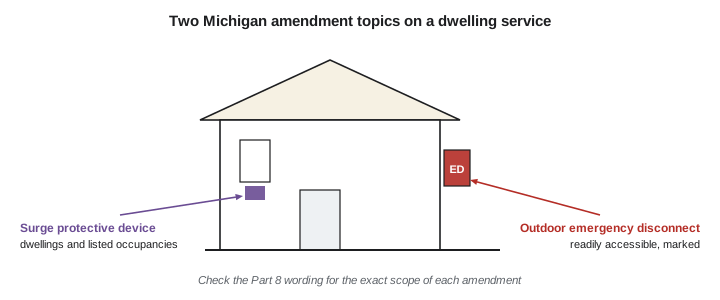
The Part 8 rules change many sections, from administrative chapters to detailed installation rules. Two changes in the 2023 rules stand out because they affect ordinary residential and multifamily work. First, for one- and two-family dwellings, the rules require the emergency disconnect to be readily accessible outdoors, on or within sight of the dwelling, and to be marked so that it is identified as both the emergency disconnect and the service disconnect. Second, the rules address surge protection for feeders and services under NEC sections 215.18, 225.42 and 230.67, limiting where it is required to certain occupancies such as dwelling units, dormitories, hotel and motel guest rooms, and patient sleeping rooms in some nursing and limited-care facilities.
Those two items show the pattern of Michigan amendments: they take an NEC requirement and adjust its scope or details for Michigan. To know exactly what a rule requires, read the Part 8 text alongside the NEC section it modifies. A candidate who memorizes only the NEC can miss a question that turns on the Michigan version, and a contractor who works only from the NEC can fail an inspection.
| Topic | NEC 2023 section | What Michigan's Part 8 rules do (summary) |
|---|---|---|
| Emergency disconnect, one- and two-family dwellings | 230.85 | Require it readily accessible outdoors, on or within sight of the dwelling, and marked as emergency and service disconnect |
| Surge protection on services and feeders | 230.67, 215.18, 225.42 | Limit the requirement to listed occupancies such as dwelling units, dormitories, guest rooms and certain patient sleeping rooms |
| Administrative chapter | Article 80 | Exclude several Article 80 sections because Michigan's own act and rules handle administration |
Administration stays with Michigan law
The NEC includes an optional administrative article, Article 80, that a jurisdiction can adopt to set up permits, inspections and an electrical board. Michigan does not need most of it, because Act 230 and Act 407 already handle those subjects. Study guides summarizing the Part 8 rules note that the rules exclude a list of Article 80 sections. The practical effect is that questions about permits, appeals, enforcing agencies and licenses are answered from Michigan's acts and rules, not from Article 80.
Using the amendments on the job
On the Okemos panel upgrade, the outdoor emergency disconnect requirement shaped the design. Jamal used a meter-main combination outdoors that served as the service disconnect, labeled it as both the emergency and service disconnect as the rules describe, and fed the indoor panel as a feeder panel. He added a surge protective device as the Michigan rules require for a dwelling service and noted the device and its location on the permit drawing. The inspector, Gary Lindqvist, checked the label, the location and the surge protection first, because those were the items he saw done wrong most often.
# Which Michigan Electrical Code edition applies? (study aid using the permit-date rule)
from datetime import date

editions = [
    (date(2024, 3, 12), "2023 Michigan Electrical Code (2023 NEC)"),
]
previous = "previous Michigan Electrical Code"

def edition_for(permit_issued):
    current = previous
    for start, name in editions:
        if permit_issued >= start:
            current = name
    return current

for p in (date(2024, 3, 1), date(2024, 4, 1), date(2026, 3, 9)):
print(p, "->", edition_for(p))2024-03-01 -> previous Michigan Electrical Code 2024-04-01 -> 2023 Michigan Electrical Code (2023 NEC) 2026-03-09 -> 2023 Michigan Electrical Code (2023 NEC)
The output repeats the rule in a way that is easy to remember: a permit issued before March 12, 2024 stays with the previous code, and one issued on or after that date uses the 2023 code. When Michigan adopts a newer edition, the same logic applies with a new date added to the list.
Worked problem
Spotting a Michigan-specific question
A practice question asks: "For a new single-family dwelling in Michigan, where must the emergency disconnect be located?" Jamal's study partner answers from memory of the NEC. Why should Jamal check Part 8 before answering?
Show solution
- The question says Michigan, so the Michigan Electrical Code applies.
- The NEC section on emergency disconnects for dwellings is one that Part 8 modifies.
- Michigan's rules require the disconnect to be readily accessible outdoors, on or within sight of the dwelling, with specific marking.
- An answer that matches the NEC but not Part 8 could be marked wrong.
- The bound Part 8 printout is an approved reference, so the answer can be confirmed in the exam room.
Answer: Check the Part 8 rule, because Michigan modifies the NEC requirement; answer with the Michigan version.
Questions and interpretations
When a contractor and an inspector disagree about what a rule means, the first step is a calm conversation with the code book open. The bureau's Electrical Division answers code questions and publishes some interpretations, and Act 230 provides an appeal route through construction boards of appeals, which Lesson 6 covers. The 2023 rules announcement listed an email address for the bureau's electrical unit for questions. A master who knows how to ask a precise question, citing the section and describing the installation, usually gets a faster and clearer answer than one who calls and asks whether something is allowed.
Reading an amendment correctly
An amendment changes the code only as far as its words go. Michigan's surge protection amendment is a good example. The 2023 NEC sections on surge protection for services, feeders and outside feeders apply broadly, while the Michigan version, as summarized by the code officials' association, limits them to dwelling units, dormitory units, guest rooms and guest suites of hotels and motels, and certain patient sleeping rooms. A master who remembers only the base NEC might require surge protection on a small commercial service that Michigan does not require it for, which costs the customer money; a master who remembers only that Michigan limited the rule might skip it on an apartment building where it is still required.
The same care applies to the emergency disconnect. The Michigan amendment applies to one- and two-family dwellings and calls for a readily accessible outdoor location on or within sight of the dwelling, with marking that identifies the device as the emergency disconnect and the service disconnect. When reading any amendment, note the occupancy it covers, the equipment it covers, and exactly what it adds, deletes or replaces.
Explaining amendments to customers
Customers rarely know the code, but they do notice the cost. On the Okemos panel upgrade, the homeowner asked why the quote included an outdoor disconnect and a surge protective device when a neighbor's older upgrade had neither. Jamal explained that the 2023 Michigan Electrical Code applies to permits issued on or after March 12, 2024, that it requires both items on this kind of job, and that the inspector would look for them. He showed the customer where the disconnect would go and how firefighters would use it. A short, plain explanation turned a price question into a reason to trust the company.
Common mistakes
MistakeWorking only from the NEC in Michigan.
InsteadMichigan enforces the NEC as amended by the Part 8 rules; check Part 8 for every topic it changes.
MistakeAssuming the new code applies the day it is published.
InsteadA new edition applies only after Michigan adopts it, and then by permit-issue date.
MistakeExpecting a city to have its own electrical amendments.
InsteadMichigan has a single state code; local units enforce it but do not amend it.
MistakeUsing Article 80 to answer permit questions.
InsteadMichigan's acts and rules govern administration; several Article 80 sections are excluded.
Summary and key terms
- The Michigan Electrical Code is the NEC as adopted and amended by the Part 8 rules under the single state construction code act.
- The 2023 Michigan Electrical Code, based on the 2023 NEC, was filed November 13, 2023 and took effect March 12, 2024.
- The code in effect when a permit is issued generally governs the work under that permit.
- Notable 2023 amendments cover the outdoor emergency disconnect for one- and two-family dwellings and the occupancies where surge protection is required.
- Administrative questions are answered from Michigan's acts and rules, not from the NEC's Article 80.
- Part 8 rules
- The administrative rules that adopt and amend the NEC as the Michigan Electrical Code.
- Michigan Electrical Code
- The NEC edition adopted by Michigan together with Michigan's amendments.
- Adoption date
- The date a new code edition becomes enforceable in Michigan.
- Permit-date rule
- The practice of applying the code edition in effect when the permit was issued.
- Amendment
- A Michigan change, addition or deletion to an NEC section.
Practice problems
Work each problem on paper first, then reveal the answer to check.
When did the 2023 Michigan Electrical Code take effect?
Show answer
March 12, 2024.
A permit was issued on March 5, 2024 and the final inspection was in June 2024. Which code applies?
Show answer
The previous Michigan Electrical Code, because the permit was issued before March 12, 2024.
Can the City of Lansing adopt its own electrical amendments?
Show answer
No. Michigan has a single state construction code; local units enforce it but do not amend it.
Which three NEC sections are tied to Michigan's surge protection amendment?
Show answer
Sections 215.18, 225.42 and 230.67.
Lesson quiz · 5 questions
Score 60% or more to complete this lesson.
Create a free account to save your progress, take quizzes and earn a certificate.