
MELU-222 · Lesson 6 of 12 · 19 min
Permits, inspections and the inspection authority
▶ Video coming soon A video version of this lesson is on the way.
In April Cedar River won a job building an electrical service and lighting for a new farm shop on a property in a small township in Ionia County, forty minutes west of Lansing. On the same week it started a fit-out for the Riverside Family Clinic in Lansing. Both jobs needed electrical permits, but Jamal discovered that the two permits came from different offices, followed different procedures and would be inspected by different people. The code was identical. What differed was the enforcing agency, and finding the right one was the first task on every new job.
This lesson explains who enforces the Michigan Electrical Code, how to find the enforcing agency for an address, what a permit requires, how inspections work, what happens when work fails, how appeals work and what limits apply to homeowner permits. The framework comes from the Stille-DeRossett-Hale Single State Construction Code Act, 1972 PA 230. Details such as fees, forms and scheduling vary from one agency to another, so check with the agency for each job.
Enforcing agencies
Act 230 creates one state construction code but lets local governments decide who enforces it. Section 8a of the act, often cited as MCL 125.1508a, governs administration and enforcement. A city, village or township may take on responsibility for administering and enforcing the code within its boundaries, including the electrical code. If it does not, a county may take on that responsibility for the areas that have not assumed it. Where neither a local unit nor the county has taken it on, the state Bureau of Construction Codes is the enforcing agency and issues permits and performs inspections itself.
The result is a map with three kinds of territory. Lansing, like most large cities, runs its own building department with electrical inspectors. Many townships rely on the county. A few rural areas rely on the state. A local unit can also choose to enforce some parts of the code, such as building and plumbing, and leave electrical enforcement to another agency, so the agency for electrical work is not always the same office that issues the building permit. The bureau publishes a list of enforcing agencies, and contractors keep their own notes as they work in new areas.
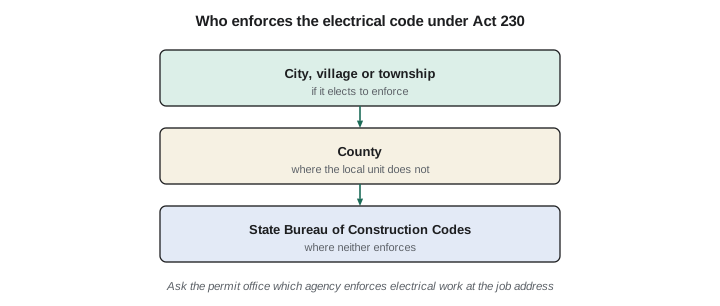
| Situation | Enforcing agency for electrical work |
|---|---|
| City or township that has assumed electrical enforcement | The local building department |
| Local unit that has not assumed it, in a county that enforces | The county building department |
| Neither the local unit nor the county enforces | The state Bureau of Construction Codes |
| Local unit enforces building but not electrical | Whoever enforces electrical work there, which may be the county or the state |
Permits
Electrical work requires a permit from the enforcing agency with jurisdiction, apart from the narrow exemptions described in the rules. Permits are issued to licensed electrical contractors, and in limited cases to homeowners for their own homes. The permit application identifies the property, the owner, the contractor and its license number, and describes the work, often with the service size, number of circuits, fixtures and equipment so that the agency can calculate the fee from its schedule. Commercial jobs may need plans for review before the permit is issued, especially for larger services or special occupancies.
The permit is more than a receipt. It records the code edition that governs the work, as Lesson 5 explained, it triggers inspections, and it tells the utility that the installation will be inspected before it is energized. Working without a permit risks stop-work orders, double fees, removal of finished work for inspection and complaints against the contractor's license. Jamal told his crews a simple rule: no permit card, no work.
Inspections
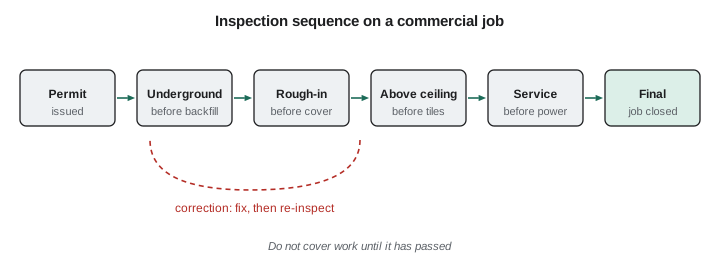
Electrical inspections usually happen in stages. A typical job has a rough-in inspection after wiring is installed and before it is covered by insulation, drywall or concrete, and a final inspection when the work is complete. Larger jobs add inspections for underground work before backfill, above-ceiling work before tiles go in, and services before the utility connects. The contractor requests each inspection through the agency's process and must have the work ready and accessible. Utility connection follows inspection approval.
Inspectors are certified under Michigan's registration system for building officials and inspectors, and electrical inspectors generally have trade experience themselves. Their job is to apply the Michigan Electrical Code, not to design the installation. Jamal found that Gary Lindqvist in Lansing was quick and fair when the work was ready and the permit card was posted, and slow and strict when he arrived to find the work half finished or covered. A good relationship with inspectors starts with calling for inspections only when the work is truly ready.
Corrections, stop-work orders and penalties
When an inspection fails, the inspector issues a correction notice listing the problems and the code sections involved. The contractor corrects the work and requests a re-inspection, which may carry a fee. An enforcing agency can also issue a stop-work order when work proceeds without a permit or in a dangerous way, and serious or repeated violations can lead to penalties and to complaints under Act 407 against the contractor's or electrician's license. Licensing consequences are handled separately from the code enforcement process, but both can follow from the same bad job.
Appeals
Act 230 provides an appeal route when a contractor or owner disagrees with an enforcing agency's decision. Each enforcing agency has a construction board of appeals, and decisions of a local board can be appealed further to a state-level body. Appeals are for genuine disagreements about what the code requires or about the agency's decision, not for avoiding code requirements. Most disagreements are settled earlier, by talking to the inspector, asking the inspector's supervisor or asking the bureau's Electrical Division for an interpretation.
Homeowner permits
Michigan allows a homeowner, in limited circumstances, to obtain a permit and do electrical work on the homeowner's own residence, but the details depend on the rules and on the enforcing agency's process. Homeowners usually must own and live in the single-family dwelling, do the work themselves, and pass the same inspections as a contractor. A homeowner permit cannot be used to cover work by an unlicensed person who is paid to do it. Cedar River sometimes received calls from homeowners who had started a project under a homeowner permit and wanted help finishing it; Diane's rule was to treat it as a new job under a contractor permit, with the existing work opened and checked.
# Inspection planning for a small commercial fit-out (study aid)
stages = [
    ("Underground in slab", "before concrete", 1),
    ("Rough-in walls", "before insulation and drywall", 2),
    ("Above ceiling", "before ceiling tiles", 1),
    ("Service and panel", "before utility release", 1),
    ("Final", "all devices and labels in place", 1),
]
reinspect_fee = 75  # illustrative figure; each agency sets its own fees
visits = 0
for name, when, n in stages:
    visits += n
    print(f"{name:20} {when:34} visits: {n}")
print("Planned visits:", visits)
print("Cost of two failed inspections at the illustrative re-inspection fee:", 2 * reinspect_fee, "dollars")Underground in slab before concrete visits: 1 Rough-in walls before insulation and drywall visits: 2 Above ceiling before ceiling tiles visits: 1 Service and panel before utility release visits: 1 Final all devices and labels in place visits: 1 Planned visits: 6 Cost of two failed inspections at the illustrative re-inspection fee: 150 dollars
The calculator is simple, but the habit behind it is useful: list every inspection when the job starts, tie each one to the trade that will cover the work, and know what a failed inspection costs in fees and in delays to other trades. A re-inspection fee is usually small compared with the cost of a drywall crew standing idle.
Worked problem
Finding the agency for the farm shop
The farm shop is in a township that enforces its own building code but has not taken on electrical enforcement. Ionia County does not enforce electrical work in that township. Who issues Cedar River's electrical permit, and what should Jamal confirm before work starts?
Show solution
- The township enforces building work, so the building permit comes from the township.
- The township has not assumed electrical enforcement, and the county does not enforce it there.
- Under Act 230, the state Bureau of Construction Codes is the enforcing agency for electrical work.
- Jamal applies to the bureau for the electrical permit and schedules inspections with the bureau's inspector.
- He confirms the arrangement with the township and the bureau's list, because enforcement arrangements can change.
Answer: The state Bureau of Construction Codes issues the electrical permit and inspects; Jamal confirms using the bureau's list of enforcing agencies.
Records on the job
Every permit card, correction notice, re-inspection result and final approval belongs in the job file. Commercial owners and general contractors often ask for proof of final electrical approval before they release retainage or final payment, which ties this lesson to the lien and payment topics in Lesson 9. Cedar River kept a scanned copy of each permit and inspection record in the job folder and a paper copy in the job box on site, so a foreman could show the inspector the history of the job without calling the office.
Working with inspectors
Gary Lindqvist had inspected Cedar River's work in Lansing for years, and Diane had taught her foremen to treat him as a partner rather than an obstacle. The habits were simple. Call for inspections only when the work is truly ready. Have the permit card and approved plans on site. Meet the inspector, walk the job together and answer questions directly. When a correction is written, ask what the inspector wants to see when it is fixed, and fix it promptly. When there is a real disagreement about what the code requires, discuss it politely, cite the section, and if necessary use the appeal process rather than arguing on site.
Inspectors talk to each other, and a company's reputation travels. A contractor known for calling inspections early, leaving covers off energized equipment or arguing every correction gets more scrutiny. A contractor known for ready work and quick corrections often finds that inspections go faster, which saves money on every job.
Scheduling inspections into the job plan
Inspections are part of the schedule, not an interruption to it. Before the clinic job began, Jamal listed each inspection the work would need, from underground conduit to above-ceiling and final, and placed each one on the general contractor's schedule with a day of slack. He coordinated with the drywall and ceiling trades so that no wall or ceiling was closed before the electrical rough-in passed. A failed inspection costs more than the re-inspection fee, which some jurisdictions set at an amount such as 75 dollars; it can delay other trades and push back the owner's move-in date. Planning inspections carefully is one of the most valuable things a master does on a commercial job.
Jamal also kept a short record of each inspection result on the job file: the date, the inspector, the result and any corrections. Over a year the record showed which kinds of work drew corrections most often, which told him where to focus training.
Common mistakes
MistakeAssuming the building department always issues the electrical permit.
InsteadThe electrical enforcing agency may be the local unit, the county or the state; check for each address.
MistakeCovering work before the rough-in inspection.
InsteadCovered work may have to be opened; call for inspection before insulation, drywall or concrete.
MistakeLetting a homeowner permit cover a paid helper's work.
InsteadHomeowner permits are for owners doing their own work in limited circumstances, not for paid unlicensed workers.
MistakeArguing on site instead of using the proper channels.
InsteadTalk it through, ask for an interpretation, and use the construction board of appeals for genuine disputes.
Summary and key terms
- Under Act 230, a local unit, a county or the state Bureau of Construction Codes enforces the code for each address.
- Electrical work needs a permit from the enforcing agency; permits go to licensed contractors and, in limited cases, homeowners.
- Inspections usually include rough-in and final stages, with more stages on larger jobs, and utility connection follows approval.
- Failed work is corrected and re-inspected; stop-work orders and license complaints are possible for serious problems.
- Construction boards of appeals hear disputes about enforcing agency decisions.
- Enforcing agency
- The local, county or state office that administers the code for an address.
- Section 8a
- The part of Act 230 that governs administration and enforcement.
- Rough-in inspection
- The inspection of wiring before it is concealed.
- Correction notice
- An inspector's list of items that must be fixed before approval.
- Construction board of appeals
- The board that hears appeals of an enforcing agency's decisions.
Practice problems
Work each problem on paper first, then reveal the answer to check.
Who issues electrical permits where neither the local unit nor the county enforces the code?
Show answer
The state Bureau of Construction Codes.
Why should a contractor never cover wiring before rough-in approval?
Show answer
The inspector must see the work; covered work may have to be opened, delaying the job and other trades.
Can a homeowner use a homeowner permit to hire an unlicensed electrician?
Show answer
No. Homeowner permits are for owners doing their own work in limited circumstances.
Where does a contractor appeal a disputed enforcing agency decision?
Show answer
To the agency's construction board of appeals, with further appeal to a state-level body.
Lesson quiz · 5 questions
Score 60% or more to complete this lesson.
Create a free account to save your progress, take quizzes and earn a certificate.