
MELU-222 · Lesson 2 of 12 · 19 min
Eligibility for the Master Electrician License
▶ Video coming soon A video version of this lesson is on the way.
Before Jamal could book an exam, he had to show the state that he qualified to sit for it. Nina Patel, Cedar River's office manager, had kept every payroll record since Jamal's first day as an apprentice in 2015, and she printed a year-by-year summary of his hours. Diane signed as the master electrician who had supervised him. Together they worked through the requirements in Article 7 of the Skilled Trades Regulation Act and the bureau's licensing page, line by line, because a missing signature or an unverifiable stretch of hours is the most common reason an application comes back.
This lesson covers what the law requires to become a master electrician in Michigan, how the journeyman requirements feed into it, how experience is counted and documented, what happens after failed attempts, and how the master license connects to the contractor license. The figures come from the statute and the bureau's published requirements as of late 2026; check the current application form before you apply, because the bureau updates its forms and checklists.
The master electrician requirements
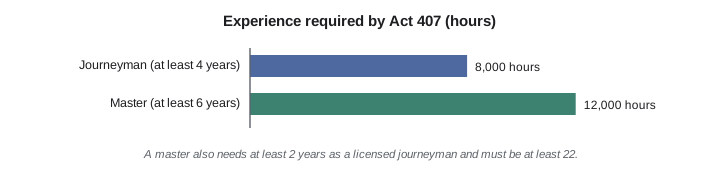
Section 713 of Act 407 sets out the requirements for a master electrician license. The applicant must be at least 22 years old, must meet the general requirements in Article 2 of the act, and must have at least 12,000 hours of experience accumulated over a period of at least six years. The experience has to relate to electrical construction, building maintenance, or electrical wiring or equipment, and it must have been obtained under the supervision of a master electrician. In addition, the applicant must have held an electrical journeyman license for at least two years. The bureau's licensing page adds that the applicant needs at least 4,000 hours as a journeyman.
Each of these requirements is separate, and an applicant must meet all of them at the same time. Hours alone are not enough: someone who works long overtime for four years and logs 12,000 hours still has to wait until six years have passed. Time alone is not enough either: someone with six years of part-time work and only 8,000 hours has to keep working. And the journeyman requirement means a person cannot jump from apprentice to master, no matter how many hours they have.
| Requirement | Master electrician | Electrical journeyman |
|---|---|---|
| Minimum age | 22 | 20 |
| Total experience | 12,000 hours over at least 6 years | 8,000 hours over at least 4 years |
| Who supervised | A master electrician | A licensed individual, directly supervising |
| License held first | Journeyman for at least 2 years (and 4,000 hours as a journeyman, per the bureau) | Apprentice registration |
| Exam | Yes, through PSI | Yes, through PSI |
The journeyman step
Because the master license requires two years as a journeyman, the journeyman requirements are part of every master candidate's history. Section 715 requires a journeyman applicant to be at least 20 years old and to have at least 8,000 hours of experience over at least four years under the direct supervision of a licensed individual. The act also allows a route for recently discharged veterans, with an affidavit from a supervisor describing their experience, and allows the department to give partial credit toward the hours. Most journeymen in Michigan come up through a registered apprenticeship, either a union program or an open-shop program, which combines on-the-job hours with classroom instruction.
Registered apprentices must renew their apprentice registration every year, according to the bureau. Hours worked without a current registration can be hard to count later, so apprentices who let their registration lapse sometimes discover a gap when they apply for the journeyman exam. Cedar River's office tracked each apprentice's renewal date on the same calendar as vehicle registrations and insurance renewals.
What counts as experience
Experience must be in electrical construction, building maintenance, or electrical wiring or equipment, and it must be supervised. The supervision requirement is the one that trips people up. Hours worked for an unlicensed handyman, hours spent doing electrical work as a sole proprietor without a contractor license, or hours under a supervisor who did not hold the right license may not count. The safest experience is work done as a registered apprentice or licensed journeyman for a licensed electrical contractor, under a master electrician who can sign for it.
Experience from outside Michigan can count if it can be documented and verified, even though Michigan does not recognize out-of-state licenses. A candidate who worked in Ohio for three years should collect letters from that employer, union hall records or payroll records that show the hours and the type of work, and expect the bureau to ask questions if the paperwork is thin. Military electrical experience may also count, especially through the veteran route described in section 715.
Documenting hours
The application asks for the employers, dates and hours that make up the experience, with signatures from the supervising licensees. Nina built Jamal's summary from payroll, not from memory, because payroll records show actual hours worked and can be produced if the bureau asks. She separated the years before and after his journeyman license so the reviewer could see the 4,000 journeyman hours at a glance, and she added a short description of the work each year: residential service work, then commercial fit-outs, then crew leadership on school renovations.
# Master electrician eligibility check (study aid based on Act 407 section 713 and the bureau's page)
from datetime import date

def years_between(a, b):
    return (b - a).days / 365.25

def master_ready(birth, first_hour, total_hours, journeyman_since, journeyman_hours, today):
    checks = {
        "age 22 or older": years_between(birth, today) >= 22,
        "12,000 hours total": total_hours >= 12000,
        "6 years since first counted hour": years_between(first_hour, today) >= 6,
        "journeyman license 2 years": years_between(journeyman_since, today) >= 2,
        "4,000 journeyman hours": journeyman_hours >= 4000,
    }
    return checks

jamal = master_ready(date(1995, 5, 14), date(2015, 6, 1), 14050, date(2023, 3, 10), 5850, date(2026, 2, 16))
marcus = master_ready(date(1990, 9, 2), date(2016, 4, 4), 13200, date(2025, 10, 6), 640, date(2026, 2, 16))
for name, res in (("Jamal", jamal), ("Marcus", marcus)):
    print(name, "eligible" if all(res.values()) else "not yet")
    for k, v in res.items():
print(" ", "ok " if v else "MISS", k)Jamal eligible
ok age 22 or older
ok 12,000 hours total
ok 6 years since first counted hour
ok journeyman license 2 years
ok 4,000 journeyman hours
Marcus not yet
ok age 22 or older
ok 12,000 hours total
ok 6 years since first counted hour
MISS journeyman license 2 years
MISS 4,000 journeyman hoursThe calculator shows why each requirement has to be checked on its own. Jamal meets every line. Marcus Hill, another Cedar River journeyman, has more than enough total hours and years in the trade, but he only received his journeyman license in October 2025. He cannot apply for the master exam until October 2027, and he also needs to build up 4,000 hours as a journeyman by then.
Failed attempts and waiting periods
Act 407 limits repeated attempts. Under section 713, an applicant who fails the master exam twice within a two-year period cannot sit again until at least one year after the second failure, and must then show proof of completing a board-approved course on the Michigan electrical code, electrical fundamentals or electrical theory. The journeyman section has a parallel rule. The PSI bulletin adds a practical limit: master and journeyman candidates are allowed two examination attempts within one year of approval, after which they must reapply with the state. Lesson 3 covers how approval and scheduling work.
Marcus knew this rule from experience. He failed the journeyman exam twice in 2023, waited a year, took a code course at a community college, and passed in 2025. He told Jamal that the year of waiting cost him more in wages than the course cost in tuition, and that he wished he had studied properly before the first attempt instead of after the second.
One master, one contractor
Section 713 also says that a master electrician license cannot be used to satisfy the eligibility requirement for more than one electrical contractor license. The bureau's page puts it simply: a master electrician can only associate with one electrical contractor at a time. For Jamal, that meant he could not keep a side business of his own under his new master license while also serving as Cedar River's master. For Diane, it meant that when Jamal became the company's master of record, her own master license would be free to qualify a different company, if she ever wanted to.
Worked problem
Finding the earliest exam date
Ethan Brooks started his registered apprenticeship at Cedar River on August 15, 2024, at age 19. Assume he works 2,000 counted hours a year, passes the journeyman exam as soon as he qualifies, and receives his journeyman license exactly four years after starting. When is the earliest he could qualify to apply for the master exam?
Show solution
- Journeyman: 8,000 hours over at least 4 years; at 2,000 hours a year both are met on August 15, 2028, and he is over 20.
- Master: he needs 2 years as a licensed journeyman, so not before August 15, 2030.
- By then he has 6 years in the trade and about 12,000 hours, meeting the 6-year and 12,000-hour rules.
- He has 2 years at 2,000 hours as a journeyman, which is 4,000 journeyman hours.
- He will be 25, over the minimum age of 22.
Answer: About August 15, 2030, when all five requirements are met together.
Other license routes
Candidates sometimes ask whether an engineering degree or a related license can replace the experience requirements. Act 407 and its rules allow some substitutions and partial credit in specific situations, such as the veteran route for journeymen, but the master license is built on supervised field experience. Anyone hoping to count education, engineering work or out-of-state experience should read the current application instructions and, if needed, call the Licensing Division before filing, rather than filing and hoping.
Planning the path from apprentice to master
Marcus used Jamal's application as a template for his own plan. He became a licensed journeyman in October 2025, so the two years of licensed journeyman time in section 713 would run until October 2027 at the earliest. He counted his documented hours, about 10,400 at the end of 2025, and estimated that steady full-time work would carry him past 12,000 hours well before the two years were up. The binding limit in his case was the journeyman time, not the hours. Knowing that, he planned to start serious study in the spring of 2027, apply as soon as the two years were complete, and test that fall.
Every candidate has a binding limit like that, and it is worth finding early. For some it is age, for others the six-year span, the total hours or the licensed journeyman time. Candidates who switched trades, worked part time or took time away from the trade often find that the span of years and the documented hours do not line up the way they expected. Laying out each requirement on a calendar, with the date it will be met, shows which one controls and when the application can go in.
Common documentation problems
Applications slow down when the documentation does not match the requirement. Typical problems include hours from an employer that has closed, letters that list total hours without dates, experience gained while unlicensed or unregistered, and hours from out of state that the bureau must evaluate. The fix is to collect verification as you go, not years later: ask each employer for a signed letter when you leave, keep pay records, and keep a copy of your apprentice registration history. When a past employer cannot be reached, ask the bureau what alternative proof it accepts before filing.
Common mistakes
MistakeCounting hours worked for an unlicensed employer.
InsteadExperience must be supervised by an appropriately licensed person; unlicensed work may not count.
MistakeAssuming 12,000 hours in four years qualifies.
InsteadThe hours must be spread over at least six years, and you must have held a journeyman license for two years.
MistakeLetting an apprentice registration lapse.
InsteadApprentices renew every year; hours without a current registration can be hard to count.
MistakePlanning to qualify two companies with one master license.
InsteadA master can be associated with only one electrical contractor at a time.
Summary and key terms
- A master electrician applicant must be at least 22, with 12,000 hours over at least six years under a master electrician's supervision.
- The applicant must also have held a journeyman license for at least two years, and the bureau lists 4,000 hours as a journeyman.
- Journeyman applicants need to be at least 20, with 8,000 hours over at least four years under direct supervision.
- Two failures within two years trigger a one-year wait and a required board-approved course; PSI allows two attempts within one year of approval.
- One master license can qualify only one electrical contractor.
- Section 713
- The part of Act 407 that sets master electrician requirements.
- Section 715
- The part of Act 407 that sets journeyman requirements.
- Supervised experience
- Work done under a licensed electrician who can verify the hours and the type of work.
- Master of record
- Informal name for the master electrician whose license qualifies an electrical contractor.
- Board-approved course
- A course approved by the Electrical Administrative Board, required before retesting after repeated failures.
Practice problems
Work each problem on paper first, then reveal the answer to check.
What is the minimum age for a Michigan master electrician license?
Show answer
22.
A journeyman licensed on June 1, 2025 has 14,000 total hours over 9 years. When can he first meet the journeyman-time requirement for the master exam?
Show answer
June 1, 2027, after holding the journeyman license for two years, assuming he also has 4,000 journeyman hours by then.
Why does Nina build the hours summary from payroll?
Show answer
Payroll shows actual hours worked and can be produced if the bureau asks for proof.
What must a candidate who failed the master exam twice in two years do before testing again?
Show answer
Wait at least one year after the second failure and complete a board-approved course on the Michigan electrical code, electrical fundamentals or electrical theory.
Lesson quiz · 5 questions
Score 60% or more to complete this lesson.
Create a free account to save your progress, take quizzes and earn a certificate.