
MELU-222 · Lesson 3 of 12 · 19 min
Applying, approval and booking the exam
▶ Video coming soon A video version of this lesson is on the way.
Jamal filed his master electrician exam application on the first of March. Nina had read the instructions twice and built a checklist: the application form completed and signed, the experience section filled in employer by employer with dates and hours, Diane's signature as the supervising master, proof of his journeyman license, and the application fee. Three weeks later an email arrived from the Bureau of Construction Codes saying he was approved to test and explaining how to schedule with PSI. The approval letter was the starting gun: Jamal now had a limited window to schedule, pay the testing company and pass.
This lesson walks through the steps from application to license in Michigan: what goes into the application, how approval works, how scheduling and fees work with PSI, what happens on and after exam day, and how the license is issued. The figures come from the bureau's licensing page and the PSI candidate information bulletin for Michigan Bureau of Construction Codes exams that took effect on August 20, 2026. Fees, forms and procedures change, so confirm each step with the current bulletin and application instructions.
The application to the state
The first step is always with the state, not with the testing company. The candidate submits an exam application to the Bureau of Construction Codes, which reviews eligibility under Act 407: age, hours, years, supervision and, for the master exam, time as a licensed journeyman. The bureau publishes the application form and its fee on its website. The application asks for identifying information, a history of the candidate's electrical experience with supervisor verification, and answers to background questions about prior discipline or convictions that the general provisions of the act make relevant.
An application that is incomplete or unsupported comes back for more information, which can add weeks. The most common problems are missing supervisor signatures, hours that do not add up across employers, experience under someone who was not licensed, and dates that make the six-year or two-year windows fall short. Jamal's application went through quickly because Nina had matched every date to payroll and every supervisor to a license number, and because Jamal had waited until he clearly met every requirement instead of applying a few weeks early.
Approval and the testing window
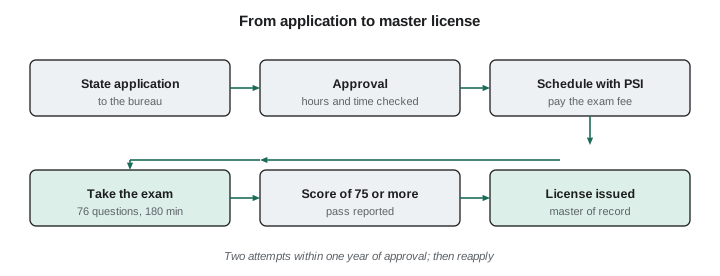
When the bureau approves an application, it notifies the candidate and passes the approval to PSI, the company that administers Michigan's electrical exams. The candidate then schedules directly with PSI and pays PSI's exam fee directly to PSI, not to the state. The bureau's page says exactly that: after approval, schedule with PSI and pay PSI. The PSI bulletin limits master and journeyman candidates to two examination attempts within one year. A candidate who does not pass within those limits must reapply with the state to become eligible again.
This window matters for planning. A candidate who gets approved in March, puts off scheduling until late summer, fails in September and fails again in February has used both attempts. If those two failures fall within two years, section 713's longer waiting period and course requirement apply as well. Diane's advice to Jamal was to schedule his first attempt about eight weeks after approval, long enough to study and short enough to keep the material fresh, and to treat the second attempt as insurance rather than a plan.
PSI fees and rules
According to the bulletin, the examination fee is 100 dollars per attempt. The fee is not refundable or transferable, and it is valid for one year from the date of payment. A candidate forfeits the fee by failing to cancel at least two days before the appointment, by not showing up, by arriving after the start time, or by not bringing proper identification. Two forfeited appointments cost as much as two exams and can also use up the testing window, so candidates treat the appointment like a court date.
| Item | What the bulletin says (summary) |
|---|---|
| Exam fee | 100 dollars per attempt, paid to PSI |
| Refunds and transfers | Not refundable or transferable |
| How long the fee is good | One year from the date of payment |
| Cancellation | At least two days before the appointment to avoid losing the fee |
| Late or no ID | Arriving after the start time or without proper identification forfeits the fee |
| Attempts | Two attempts within one year for master and journeyman candidates |
Scheduling
PSI offers appointments at test centers around the state, and the bulletin describes how to schedule online or by phone and what identification is required. Jamal chose a weekday morning at the Lansing-area center, because he concentrated best early and did not want to drive to Detroit or Grand Rapids on exam day. He booked the appointment as soon as he received his approval and blocked off the day before as a light review day. He also confirmed that the name on his identification matched the name on his application exactly; a mismatch is a simple way to lose an appointment.
Candidates who need accommodations for a disability arrange them through the process described in the bulletin before scheduling, because accommodations usually require documentation and advance notice. Candidates who change their minds about a date reschedule early, inside the cancellation window, so they do not lose the fee.
Exam day
On exam day the candidate brings the required identification and the approved reference books, checks in, has the books inspected and takes the exam on a computer. The bulletin describes the rules for references in detail, and Lesson 4 covers them. PSI reports results after the exam; the bulletin explains how. A candidate who passes moves on to licensing. A candidate who fails receives information about weak areas, which is worth studying carefully before a second attempt, and still has the bulletin's attempt limits and the statute's waiting rules to think about.
# Planning attempts inside the testing window (study aid)
from datetime import date, timedelta

approved = date(2026, 3, 23)
window_end = approved + timedelta(days=365)
first = approved + timedelta(weeks=8)
second = first + timedelta(weeks=6)
print("Approved:", approved)
print("Window closes about:", window_end)
print("First attempt:", first)
print("Backup attempt if needed:", second)
print("Days left in window after backup:", (window_end - second).days)

fee = 100
for forfeits in range(3):
print(forfeits, "forfeited appointments cost", fee * forfeits, "dollars and use part of the window")Approved: 2026-03-23 Window closes about: 2027-03-23 First attempt: 2026-05-18 Backup attempt if needed: 2026-06-29 Days left in window after backup: 267 0 forfeited appointments cost 0 dollars and use part of the window 1 forfeited appointments cost 100 dollars and use part of the window 2 forfeited appointments cost 200 dollars and use part of the window
The plan shows the logic Diane described: an attempt eight weeks after approval, a backup about six weeks later if needed, and still most of the year left. The second part of the output is the cost of carelessness: each forfeited appointment costs a full exam fee and buys nothing.
From passing to license
Passing the exam does not by itself make someone a master electrician. The bureau issues the license after confirming the passing result and any remaining requirements, and the license must then be kept current through renewal, which Lesson 11 covers. Jamal received notice that his master license had been issued about three weeks after he passed in May. On the same day, Diane and Nina filed the paperwork to update Cedar River's electrical contractor license so that Jamal, not Diane, was listed as the full-time master electrician responsible for the company's code compliance.
The order of those steps matters. A company cannot list a master who is not yet licensed, and a master cannot be listed on two contractor licenses at once. If Jamal had been the master of record for a side business, he would have had to end that association before Cedar River could list him. Lesson 8 covers the contractor license changes in more detail.
Worked problem
Rescuing a late start
Marcus's friend Keisha was approved to take the master exam on January 10. She scheduled her first attempt for November 20, failed, and wants to retest. What should she do?
Show solution
- The PSI bulletin allows two attempts within one year of approval.
- Her window runs to about January 10 of the next year, so she has less than eight weeks.
- She should look at her score report, focus on her weakest areas and book the earliest date that leaves real study time.
- If she cannot pass before the window closes, she must reapply with the state.
- If both failures fall within two years, section 713's one-year wait and required course would apply after the second failure.
Answer: Book the second attempt quickly inside the window, study the weak areas, and understand that a second failure triggers reapplication and the statutory waiting rules.
Keeping records
Keep copies of everything: the application, the approval notice, PSI confirmations, receipts, score reports and the license notice. If a question comes up later about when you were licensed, whether a fee was paid or which attempt counted, the records answer it in minutes. Nina kept a folder for each license in the company, with a scanned copy in the office's shared drive, because renewals, permit applications and customer prequalification forms all ask for license numbers and dates.
Common reasons applications are delayed
Most delays come from incomplete applications. A missing signature, an experience letter without dates, an unpaid fee or a name that does not match the identification on file can send an application back. The bureau then waits for the missing item, and the clock on the candidate's plans keeps running. Before Jamal submitted, Nina compared each page against the bureau's current instructions, checked that every letter showed dates and hours, and made sure the name on the application matched his driver's license exactly, because the same name must match at the PSI test center.
Other delays are outside the candidate's control, such as heavy application volume after a code change or a change in the exam vendor's process. The practical response is to build slack into the plan: apply as soon as you are eligible, watch for messages from the bureau and PSI, and answer any request for more information quickly. Keep the confirmation number and the date of every submission so a follow-up call can go straight to the right file.
Planning the calendar around the exam
Jamal chose an exam date that left eight weeks of study after approval and avoided the company's busiest season. He also checked that his approval would not expire before a possible second attempt, since the bulletin allows two attempts within one year of approval and the exam fee is valid for one year. If he failed in May, he would still have time to study and retest before the window closed. He blocked out the day of the exam and the day before as time off, so a late job would not cut into his last review or his sleep.
Once the exam was booked, Nina added three dates to the company calendar: the exam itself, the latest date to reschedule without losing the fee, and the approval expiration date. Those three dates, more than any study guide, kept the process on track.
Common mistakes
MistakeScheduling with PSI before the state approves you.
InsteadThe state approves eligibility first; only then do you schedule and pay PSI.
MistakeWaiting months to book the first attempt.
InsteadAttempts are limited within one year of approval; book early enough to leave room for a backup attempt.
MistakeArriving late or with the wrong ID.
InsteadBoth forfeit the fee; check the bulletin's identification rules and arrive early.
MistakeAssuming a passing score is the license.
InsteadThe bureau issues the license; the contractor license must then be updated to list the new master.
Summary and key terms
- Candidates apply to the Bureau of Construction Codes, which reviews eligibility before anything else happens.
- After approval, candidates schedule with PSI and pay the 100-dollar exam fee directly to PSI.
- The fee is not refundable or transferable, is valid for a year, and is lost on a late cancellation, no-show, late arrival or missing ID.
- Master and journeyman candidates get two attempts within one year of approval before they must reapply.
- The state issues the license after a passing result, and the contractor license must be updated to name the new master.
- Approval
- The bureau's decision that a candidate meets the requirements to sit for the exam.
- PSI
- The testing company that schedules and administers Michigan's electrical exams.
- Candidate information bulletin
- PSI's document describing scheduling, fees, rules, references and content for the exams.
- Forfeit
- To lose a paid exam fee by missing or mishandling an appointment.
- Testing window
- The period after approval during which a candidate may use the allowed attempts.
Practice problems
Work each problem on paper first, then reveal the answer to check.
Who receives the exam fee, the state or PSI?
Show answer
PSI. Candidates pay the exam fee directly to PSI after approval.
How far ahead must a candidate cancel to avoid losing the fee?
Show answer
At least two days before the appointment, according to the bulletin.
A candidate fails twice within the year after approval. What now?
Show answer
Reapply with the state; if the failures fall within two years, also wait a year after the second failure and complete a board-approved course.
What must Cedar River update after Jamal's master license is issued?
Show answer
Its electrical contractor license, so that Jamal is listed as the full-time master responsible for code compliance.
Lesson quiz · 5 questions
Score 60% or more to complete this lesson.
Create a free account to save your progress, take quizzes and earn a certificate.